

Theo Bowden
At a glance:
- Digital identity adoption is accelerating globally, but national schemes, digital wallets and private-sector identity solutions create an increasingly diverse landscape.
- The next challenge is not simply accepting digital credentials, but determining whether they can be trusted and are fit for purpose.
- Interoperability, trust frameworks and a flexible strategy will be critical to scaling and addressing risk.
Digital identity adoption is accelerating, but simply being able to accept a digital credential is not enough. Organisations also need to understand whether that credential can be trusted and whether it provides the right level of assurance for the intended use.
In our previous article, we explored the European Digital Identity (EUDI) framework and what it means for businesses. While EUDI represents a significant milestone, it is only one part of a broader transformation in digital identity. As digital identity schemes and reusable credentials become more widely available, the challenge is increasingly one of navigating a growing and more diverse identity ecosystem.
Digital identity: a fragmented landscape
Digital identity is becoming an important component of national digital infrastructure. Public- and private-sector organisations around the world are investing heavily in digital identity programmes, giving individuals new ways to prove who they are online.
However, digital identity is not developing through a single global framework. The World Bank’s 2025 ID4D Global Dataset reports that 89 countries have their own government-recognised digital identity credential capable of supporting remote authentication (Figure 1). The examples below show how varied these initiatives are:
- The European Union is implementing the European Digital Identity (EUDI) Wallet framework. Separately, the Anti-Money Laundering Regulation (AMLR) sets out new requirements for customer due diligence and identity verification.
- Uptake of electronic ID (eID) is particularly high in the Nordics, with 90–98% of the population using eIDs in 2023–2024.
- India has established one of the world’s largest digital identity infrastructures through Aadhaar and DigiLocker.
- Digital identity ecosystems are increasingly extending across public- and private-sector services, as demonstrated by Singapore’s Singpass.
Figure 1: Do nations have a digital ID system for citizens and businesses?
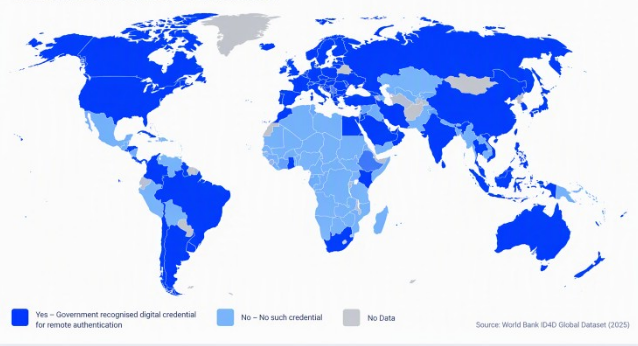
Source: World Bank 2025 ID4D Global Dataset. Based on 2024 data, 89 countries offer at least one government-recognised digital identity credential enabling remote authentication for online services and transactions. Please see the end for important legal disclosures.
For consumers, a growing number of digital identity schemes brings greater choice and convenience. People can use identity solutions that are already trusted and widely adopted in their market, rather than relying on a single global approach.
For organisations, however, the picture is more complex. Each new scheme can mean additional integrations, vendor relationships, compliance checks and technical requirements. Supporting every scheme individually is neither practical nor scalable.
More importantly, being able to receive a digital credential does not, by itself, mean an organisation should rely on it.
Accepting vs trusting an identity
Many discussions about digital identity focus on technical connectivity: can an organisation receive and process a particular digital credential? Connectivity is important, but it overlooks a more fundamental challenge.
Digital identity schemes can differ in how an individual is initially verified, how credentials are issued, how users authenticate and what level of assurance the resulting credential provides. Organisations therefore need to understand the trust framework behind the credential, not simply whether their technology can accept it.
That means answering questions such as:
- Is the credential genuine, valid and issued by a recognised source?
- How was the individual originally verified?
- Can the organisation establish that the credential is being presented by its legitimate holder?
- Does the credential meet the requirements of the intended use case?
The question, therefore, is no longer simply whether an organisation can accept a digital identity, but whether it can trust that identity for a particular purpose. Trust is not a binary judgement, but one shaped by the level of assurance provided and the requirements of the use case. As the digital identity landscape expands, organisations need a consistent way to make these assessments across different schemes and customer journeys.
Interoperability: building for a multi-ecosystem future
As digital identity adoption grows, consumers will increasingly expect to use trusted digital credentials across organisations and borders. At the same time, the future of digital identity is unlikely to be defined by a single wallet, provider or national scheme. Organisations therefore need to navigate multiple identity ecosystems without adding unnecessary complexity, while retaining confidence in the identities they accept.
Interoperability will be central to addressing this challenge. As identity ecosystems expand, organisations will need to recognise and assess credentials from different schemes, issuers and providers, alongside other forms of identity verification. This creates greater flexibility to determine the appropriate approach based on the customer, use case, risk profile and regulatory requirements.
The challenge, then, is not simply one of connectivity, but of establishing trust consistently across different identity ecosystems. Interoperability can provide the foundations for credentials and identity services to work across organisational, technological and geographic boundaries, while allowing different levels of assurance to be applied where appropriate.
As the digital identity landscape continues to evolve, the organisations best positioned for success will not necessarily be those connected to the most schemes. They will be those able to navigate different identity ecosystems and establish the appropriate level of trust for each customer journey.


Legal Disclaimer
Republication or redistribution of LSE Group content is prohibited without our prior written consent.
The content of this publication is for informational purposes only and has no legal effect, does not form part of any contract, does not, and does not seek to constitute advice of any nature and no reliance should be placed upon statements contained herein. Whilst reasonable efforts have been taken to ensure that the contents of this publication are accurate and reliable, LSE Group does not guarantee that this document is free from errors or omissions; therefore, you may not rely upon the content of this document under any circumstances and you should seek your own independent legal, investment, tax and other advice. Neither We nor our affiliates shall be liable for any errors, inaccuracies or delays in the publication or any other content, or for any actions taken by you in reliance thereon.
Copyright © 2026 London Stock Exchange Group. All rights reserved.
The content of this publication is provided by London Stock Exchange Group plc, its applicable group undertakings and/or its affiliates or licensors (the “LSE Group” or “We”) exclusively.
Neither We nor our affiliates guarantee the accuracy of or endorse the views or opinions given by any third party content provider, advertiser, sponsor or other user. We may link to, reference, or promote websites, applications and/or services from third parties. You agree that We are not responsible for, and do not control such non-LSE Group websites, applications or services.
The content of this publication is for informational purposes only. All information and data contained in this publication is obtained by LSE Group from sources believed by it to be accurate and reliable. Because of the possibility of human and mechanical error as well as other factors, however, such information and data are provided "as is" without warranty of any kind. You understand and agree that this publication does not, and does not seek to, constitute advice of any nature. You may not rely upon the content of this document under any circumstances and should seek your own independent legal, tax or investment advice or opinion regarding the suitability, value or profitability of any particular security, portfolio or investment strategy. Neither We nor our affiliates shall be liable for any errors, inaccuracies or delays in the publication or any other content, or for any actions taken by you in reliance thereon. You expressly agree that your use of the publication and its content is at your sole risk.
To the fullest extent permitted by applicable law, LSE Group, expressly disclaims any representation or warranties, express or implied, including, without limitation, any representations or warranties of performance, merchantability, fitness for a particular purpose, accuracy, completeness, reliability and non-infringement. LSE Group, its subsidiaries, its affiliates and their respective shareholders, directors, officers employees, agents, advertisers, content providers and licensors (collectively referred to as the “LSE Group Parties”) disclaim all responsibility for any loss, liability or damage of any kind resulting from or related to access, use or the unavailability of the publication (or any part of it); and none of the LSE Group Parties will be liable (jointly or severally) to you for any direct, indirect, consequential, special, incidental, punitive or exemplary damages, howsoever arising, even if any member of the LSE Group Parties are advised in advance of the possibility of such damages or could have foreseen any such damages arising or resulting from the use of, or inability to use, the information contained in the publication. For the avoidance of doubt, the LSE Group Parties shall have no liability for any losses, claims, demands, actions, proceedings, damages, costs or expenses arising out of, or in any way connected with, the information contained in this document.
LSE Group is the owner of various intellectual property rights ("IPR”), including but not limited to, numerous trademarks that are used to identify, advertise, and promote LSE Group products, services and activities. Nothing contained herein should be construed as granting any licence or right to use any of the trademarks or any other LSE Group IPR for any purpose whatsoever without the written permission or applicable licence terms.