

Indrani De, CFA, PRM

David McNay, CFA
Key takeaways:
- The spread between French OATs and German Bunds has gapped higher, driven by concerns over the French fiscal position; investors are contending with political uncertainty and a large maturity wall, that requires refinancing at higher rates.
- Currently, this appears more like an idiosyncratic issue than the start of a fresh Eurozone Debt Crisis. However, contagion risks can become self-fulfilling as sovereigns are forced to refinance at higher rates, increasing fiscal pressure.
- European bond investors also have German Bunds, and with bund yields having risen YTD the bunds maybe attractive enough to lure investors concerned about peripheral Europe.
- The ECB’s reaction function will be telling. Mechanistically, there is a bond buying program that exists, but technically France is disqualified due to its fiscal deficit. An indication that the ECB may conduct bond purchases could calm bond investors.
OATs are toasted, but not yet burned
French OAT yields have risen dramatically – which unfortunately isn’t a comment about an abundance of breakfast cereal. Year-to-date, OAT-Bund [note1] spreads, the yield difference between the French and German bonds, has more than doubled since the start of June, gapping from c 60 basis-points c. 130 basis-points (bps), the highest since the European Debt Crisis.
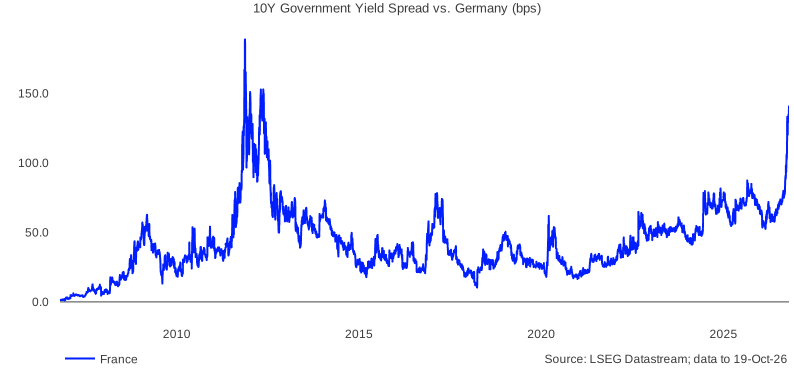
Figure 1: Spread between the 10 year French OATs vs. the German Bunds, which have gapped higher in the last few weeks. At circa. 130bps the current spread is the highest since the European Debt Crisis which started in 2010
| Date | Spread (bps) | Country | Benchmark |
| Nov 2006 | 0.0 | France | Germany |
| Dec 2006 | 0.0 | France | Germany |
| Jan 2007 | 0.0 | France | Germany |
| Feb 2007 | 0.0 | France | Germany |
| Mar 2007 | 0.0 | France | Germany |
| Apr 2007 | 0.0 | France | Germany |
| May 2007 | 0.0 | France | Germany |
| Jun 2007 | 0.0 | France | Germany |
| Jul 2007 | 0.0 | France | Germany |
| Aug 2007 | 1.5 | France | Germany |
| Sep 2007 | 1.5 | France | Germany |
| Oct 2007 | 2.8 | France | Germany |
| Nov 2007 | 1.3 | France | Germany |
| Dec 2007 | 2.9 | France | Germany |
| Jan 2008 | 0.0 | France | Germany |
| Feb 2008 | 1.1 | France | Germany |
| Mar 2008 | 4.1 | France | Germany |
| Apr 2008 | 8.1 | France | Germany |
| May 2008 | 6.2 | France | Germany |
| Jun 2008 | 6.5 | France | Germany |
| Jul 2008 | 10.3 | France | Germany |
| Aug 2008 | 11.6 | France | Germany |
| Sep 2008 | 12.1 | France | Germany |
| Oct 2008 | 21.1 | France | Germany |
| Nov 2008 | 24.9 | France | Germany |
| Dec 2008 | 28.0 | France | Germany |
| Jan 2009 | 35.0 | France | Germany |
| Feb 2009 | 43.2 | France | Germany |
| Mar 2009 | 43.7 | France | Germany |
| Apr 2009 | 46.5 | France | Germany |
| May 2009 | 34.4 | France | Germany |
| Jun 2009 | 30.9 | France | Germany |
| Jul 2009 | 28.1 | France | Germany |
| Aug 2009 | 19.3 | France | Germany |
| Sep 2009 | 16.5 | France | Germany |
| Oct 2009 | 22.3 | France | Germany |
| Nov 2009 | 22.6 | France | Germany |
| Dec 2009 | 21.6 | France | Germany |
| Jan 2010 | 16.2 | France | Germany |
| Feb 2010 | 16.1 | France | Germany |
| Mar 2010 | 17.4 | France | Germany |
| Apr 2010 | 24.3 | France | Germany |
| May 2010 | 29.1 | France | Germany |
| Jun 2010 | 30.6 | France | Germany |
| Jul 2010 | 36.5 | France | Germany |
| Aug 2010 | 22.9 | France | Germany |
| Sep 2010 | 27.1 | France | Germany |
| Oct 2010 | 28.2 | France | Germany |
| Nov 2010 | 31.0 | France | Germany |
| Dec 2010 | 40.1 | France | Germany |
| Jan 2011 | 35.9 | France | Germany |
| Feb 2011 | 29.6 | France | Germany |
| Mar 2011 | 30.1 | France | Germany |
| Apr 2011 | 27.2 | France | Germany |
| May 2011 | 29.4 | France | Germany |
| Jun 2011 | 32.4 | France | Germany |
| Jul 2011 | 40.1 | France | Germany |
| Aug 2011 | 55.9 | France | Germany |
| Sep 2011 | 61.2 | France | Germany |
| Oct 2011 | 75.0 | France | Germany |
| Nov 2011 | 125.7 | France | Germany |
| Dec 2011 | 133.2 | France | Germany |
| Jan 2012 | 122.1 | France | Germany |
| Feb 2012 | 107.9 | France | Germany |
| Mar 2012 | 94.3 | France | Germany |
| Apr 2012 | 105.4 | France | Germany |
| May 2012 | 135.0 | France | Germany |
| Jun 2012 | 122.5 | France | Germany |
| Jul 2012 | 101.9 | France | Germany |
| Aug 2012 | 76.9 | France | Germany |
| Sep 2012 | 65.3 | France | Germany |
| Oct 2012 | 59.0 | France | Germany |
| Nov 2012 | 57.8 | France | Germany |
| Dec 2012 | 62.0 | France | Germany |
| Jan 2013 | 56.5 | France | Germany |
| Feb 2013 | 55.9 | France | Germany |
| Mar 2013 | 59.6 | France | Germany |
| Apr 2013 | 56.2 | France | Germany |
| May 2013 | 41.8 | France | Germany |
| Jun 2013 | 42.9 | France | Germany |
| Jul 2013 | 54.3 | France | Germany |
| Aug 2013 | 53.7 | France | Germany |
| Sep 2013 | 50.6 | France | Germany |
| Oct 2013 | 46.6 | France | Germany |
| Nov 2013 | 42.1 | France | Germany |
| Dec 2013 | 48.0 | France | Germany |
| Jan 2014 | 57.1 | France | Germany |
| Feb 2014 | 58.7 | France | Germany |
| Mar 2014 | 50.3 | France | Germany |
| Apr 2014 | 45.2 | France | Germany |
| May 2014 | 40.0 | France | Germany |
| Jun 2014 | 33.0 | France | Germany |
| Jul 2014 | 37.1 | France | Germany |
| Aug 2014 | 32.9 | France | Germany |
| Sep 2014 | 30.3 | France | Germany |
| Oct 2014 | 35.6 | France | Germany |
| Nov 2014 | 34.1 | France | Germany |
| Dec 2014 | 22.3 | France | Germany |
| Jan 2015 | 19.7 | France | Germany |
| Feb 2015 | 17.9 | France | Germany |
| Mar 2015 | 14.6 | France | Germany |
| Apr 2015 | 18.4 | France | Germany |
| May 2015 | 20.6 | France | Germany |
| Jun 2015 | 28.5 | France | Germany |
| Jul 2015 | 34.1 | France | Germany |
| Aug 2015 | 26.2 | France | Germany |
| Sep 2015 | 27.6 | France | Germany |
| Oct 2015 | 23.4 | France | Germany |
| Nov 2015 | 24.4 | France | Germany |
| Dec 2015 | 25.2 | France | Germany |
| Jan 2016 | 30.9 | France | Germany |
| Feb 2016 | 29.8 | France | Germany |
| Mar 2016 | 24.0 | France | Germany |
| Apr 2016 | 19.3 | France | Germany |
| May 2016 | 25.0 | France | Germany |
| Jun 2016 | 31.2 | France | Germany |
| Jul 2016 | 27.9 | France | Germany |
| Aug 2016 | 18.3 | France | Germany |
| Sep 2016 | 15.9 | France | Germany |
| Oct 2016 | 17.7 | France | Germany |
| Nov 2016 | 30.7 | France | Germany |
| Dec 2016 | 42.3 | France | Germany |
| Jan 2017 | 45.0 | France | Germany |
| Feb 2017 | 59.7 | France | Germany |
| Mar 2017 | 59.7 | France | Germany |
| Apr 2017 | 54.7 | France | Germany |
| May 2017 | 40.0 | France | Germany |
| Jun 2017 | 32.6 | France | Germany |
| Jul 2017 | 27.4 | France | Germany |
| Aug 2017 | 27.9 | France | Germany |
| Sep 2017 | 26.8 | France | Germany |
| Oct 2017 | 20.3 | France | Germany |
| Nov 2017 | 16.0 | France | Germany |
| Dec 2017 | 12.9 | France | Germany |
| Jan 2018 | 15.0 | France | Germany |
| Feb 2018 | 12.5 | France | Germany |
| Mar 2018 | 7.5 | France | Germany |
| Apr 2018 | 11.3 | France | Germany |
| May 2018 | 21.8 | France | Germany |
| Jun 2018 | 24.9 | France | Germany |
| Jul 2018 | 22.8 | France | Germany |
| Aug 2018 | 19.8 | France | Germany |
| Sep 2018 | 20.3 | France | Germany |
| Oct 2018 | 24.1 | France | Germany |
| Nov 2018 | 29.1 | France | Germany |
| Dec 2018 | 36.0 | France | Germany |
| Jan 2019 | 40.9 | France | Germany |
| Feb 2019 | 36.5 | France | Germany |
| Mar 2019 | 28.1 | France | Germany |
| Apr 2019 | 24.1 | France | Germany |
| May 2019 | 28.5 | France | Germany |
| Jun 2019 | 29.1 | France | Germany |
| Jul 2019 | 21.9 | France | Germany |
| Aug 2019 | 21.2 | France | Germany |
| Sep 2019 | 21.5 | France | Germany |
| Oct 2019 | 20.6 | France | Germany |
| Nov 2019 | 20.0 | France | Germany |
| Dec 2019 | 18.8 | France | Germany |
| Jan 2020 | 18.5 | France | Germany |
| Feb 2020 | 16.0 | France | Germany |
| Mar 2020 | 36.5 | France | Germany |
| Apr 2020 | 38.5 | France | Germany |
| May 2020 | 39.4 | France | Germany |
| Jun 2020 | 27.6 | France | Germany |
| Jul 2020 | 22.9 | France | Germany |
| Aug 2020 | 21.5 | France | Germany |
| Sep 2020 | 16.5 | France | Germany |
| Oct 2020 | 15.4 | France | Germany |
| Nov 2020 | 13.1 | France | Germany |
| Dec 2020 | 11.6 | France | Germany |
| Jan 2021 | 12.6 | France | Germany |
| Feb 2021 | 14.3 | France | Germany |
| Mar 2021 | 14.4 | France | Germany |
| Apr 2021 | 16.4 | France | Germany |
| May 2021 | 24.1 | France | Germany |
| Jun 2021 | 24.3 | France | Germany |
| Jul 2021 | 24.7 | France | Germany |
| Aug 2021 | 24.6 | France | Germany |
| Sep 2021 | 21.2 | France | Germany |
| Oct 2021 | 21.0 | France | Germany |
| Nov 2021 | 21.8 | France | Germany |
| Dec 2021 | 22.4 | France | Germany |
| Jan 2022 | 23.2 | France | Germany |
| Feb 2022 | 30.4 | France | Germany |
| Mar 2022 | 30.7 | France | Germany |
| Apr 2022 | 33.0 | France | Germany |
| May 2022 | 29.1 | France | Germany |
| Jun 2022 | 34.3 | France | Germany |
| Jul 2022 | 34.6 | France | Germany |
| Aug 2022 | 43.2 | France | Germany |
| Sep 2022 | 51.2 | France | Germany |
| Oct 2022 | 49.6 | France | Germany |
| Nov 2022 | 41.9 | France | Germany |
| Dec 2022 | 42.6 | France | Germany |
| Jan 2023 | 41.5 | France | Germany |
| Feb 2023 | 43.5 | France | Germany |
| Mar 2023 | 45.3 | France | Germany |
| Apr 2023 | 44.7 | France | Germany |
| May 2023 | 45.9 | France | Germany |
| Jun 2023 | 42.6 | France | Germany |
| Jul 2023 | 44.7 | France | Germany |
| Aug 2023 | 44.9 | France | Germany |
| Sep 2023 | 48.8 | France | Germany |
| Oct 2023 | 50.5 | France | Germany |
| Nov 2023 | 45.9 | France | Germany |
| Dec 2023 | 40.1 | France | Germany |
| Jan 2024 | 38.2 | France | Germany |
| Feb 2024 | 37.9 | France | Germany |
| Mar 2024 | 42.2 | France | Germany |
| Apr 2024 | 44.1 | France | Germany |
| May 2024 | 42.4 | France | Germany |
| Jun 2024 | 59.2 | France | Germany |
| Jul 2024 | 64.0 | France | Germany |
| Aug 2024 | 64.2 | France | Germany |
| Sep 2024 | 65.9 | France | Germany |
| Oct 2024 | 59.7 | France | Germany |
| Nov 2024 | 66.0 | France | Germany |
| Dec 2024 | 67.1 | France | Germany |
| Jan 2025 | 64.7 | France | Germany |
| Feb 2025 | 55.6 | France | Germany |
| Mar 2025 | 52.6 | France | Germany |
| Apr 2025 | 58.2 | France | Germany |
| May 2025 | 60.9 | France | Germany |
| Jun 2025 | 63.8 | France | Germany |
| Jul 2025 | 65.3 | France | Germany |
| Aug 2025 | 71.8 | France | Germany |
| Sep 2025 | 73.8 | France | Germany |
| Oct 2025 | 69.9 | France | Germany |
| Nov 2025 | 65.3 | France | Germany |
| Dec 2025 | 59.6 | France | Germany |
| Jan 2026 | 52.6 | France | Germany |
| Feb 2026 | 51.2 | France | Germany |
| Mar 2026 | 59.3 | France | Germany |
| Apr 2026 | 53.6 | France | Germany |
| May 2026 | 54.7 | France | Germany |
| Jun 2026 | 59.8 | France | Germany |
| Jul 2026 | 64.9 | France | Germany |
| Aug 2026 | 73.8 | France | Germany |
| Sep 2026 | 104.4 | France | Germany |
| Oct 2026 | 130.0 | France | Germany |
The immediate driver is fiscal arithmetic. Authorities [note2] announced they would miss their fiscal targets for 2026 and a revised plan [note3] projects the public deficit to reach 5.4% of GDP in 2026, before dropping to 5.0% in 2027; official projections expect an increase in debt-to-GDP to 121.7% in 2027. In a vacuum that is an undesirable outcome, but not one that would typically cause a c. 50bps spike in a month.
Several things are happening concurrently:
- France has presidential elections in 2027 which is injecting fiscal uncertainty
- Material refinancing requirements
- Macro forces pushing sovereign real yields higher broadly
- Weak growth, raising concerns about debt sustainability
Uncertainty in the Elysée
To understand the political uncertainty, one needs to know that French Presidential elections can have a maximum of two rounds, where if no candidate achieves an outright majority in the 1st round, the top two candidates have a runoff. In the 2017 and 2022 election Marine Le Pen, the far-right candidate, made it through to the 2nd round[note4] but failed to secure enough centrist votes to defeat the President Macron.
Polling[note5] has Le Pen consistently in the lead in the 1st round, but recently there has been a surge of support for the far-left candidate, Jean-Luc Mélenchon. He now polls in 2nd or 3rd place depending on whom the centrist bloc fields. Mélenchon sparked market concern with a quip[note6] that Banque de France’s should “throw it in the fire”; referring to the banks holdings of OATs; comments he has later clarified.[note7] This has increased the implied probability of an extreme party taking the French presidency – and importantly leads to material policy uncertainty.
Debt Refinancing
Regardless of who wins the Elysée, the market consensus is that fiscal reform will be a difficult task. France hasn’t had a balanced budget since 1974 and the IMF[note8] Real GDP growth estimate is 0.7% for 2026 growing to only 1.1% on their 5-year projection; weak growth reinforces concerns about a sovereign debt trap[note9].
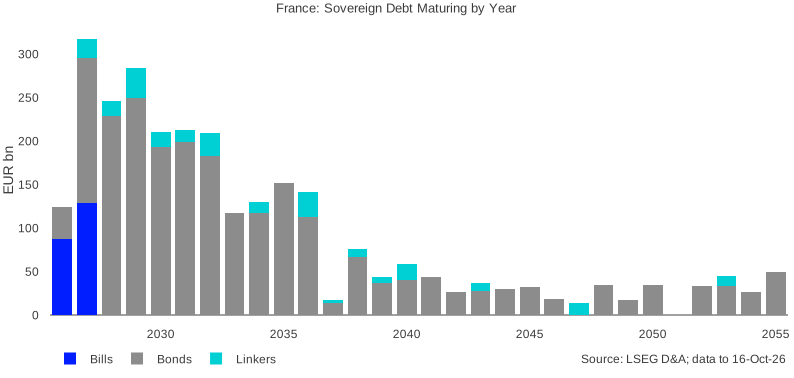
Figure 2: French sovereign debt maturity by year through to 2055. France has a material proportion of it’s total debt which will need to be refinanced over the next few years.
| Maturity year | Bills (EUR bn) | Bonds (EUR bn) | Linkers (EUR bn) | Total (EUR bn) |
| 2026 | 86.0 | 35.5 | 0.0 | 121.5 |
| 2027 | 128.0 | 164.5 | 20.6 | 313.1 |
| 2028 | 0.0 | 227.1 | 16.8 | 243.9 |
| 2029 | 0.0 | 247.7 | 33.6 | 281.3 |
| 2030 | 0.0 | 191.6 | 16.8 | 208.4 |
| 2031 | 0.0 | 197.2 | 13.1 | 210.3 |
| 2032 | 0.0 | 181.3 | 26.2 | 207.5 |
| 2033 | 0.0 | 116.8 | 0.0 | 116.8 |
| 2034 | 0.0 | 115.9 | 12.1 | 128.0 |
| 2035 | 0.0 | 150.5 | 0.0 | 150.5 |
| 2036 | 0.0 | 111.2 | 28.0 | 139.2 |
| 2037 | 0.0 | 13.1 | 1.9 | 15.0 |
| 2038 | 0.0 | 65.4 | 9.3 | 74.7 |
| 2039 | 0.0 | 35.5 | 5.6 | 41.1 |
| 2040 | 0.0 | 39.3 | 17.8 | 57.1 |
| 2041 | 0.0 | 43.0 | 0.0 | 43.0 |
| 2042 | 0.0 | 25.2 | 0.0 | 25.2 |
| 2043 | 0.0 | 27.1 | 7.5 | 34.6 |
| 2044 | 0.0 | 29.0 | 0.0 | 29.0 |
| 2045 | 0.0 | 30.8 | 0.0 | 30.8 |
| 2046 | 0.0 | 17.8 | 0.0 | 17.8 |
| 2047 | 0.0 | 0.0 | 13.1 | 13.1 |
| 2048 | 0.0 | 33.6 | 0.0 | 33.6 |
| 2049 | 0.0 | 16.8 | 0.0 | 16.8 |
| 2050 | 0.0 | 33.6 | 0.0 | 33.6 |
| 2051 | 0.0 | 0.0 | 0.0 | 0.0 |
| 2052 | 0.0 | 32.7 | 0.0 | 32.7 |
| 2053 | 0.0 | 32.7 | 12.1 | 44.8 |
| 2054 | 0.0 | 25.2 | 0.0 | 25.2 |
| 2055 | 0.0 | 48.6 | 0.0 | 48.6 |
There is also the pressing issue of needing to roll over circa. €380 billion [note10] of debt by the end of 2027. Higher yields mean debt must be refinanced at a higher rate – official estimates indicate debt service costs could increase by circa. €10 billion in 2027.
We mustn’t forget that yields as well as spreads having widened, the benchmark German bunds at c. 3.5%, are nearly 100bps higher than they were in March this year which may cause investors to require a greater spread compensation all else equal.
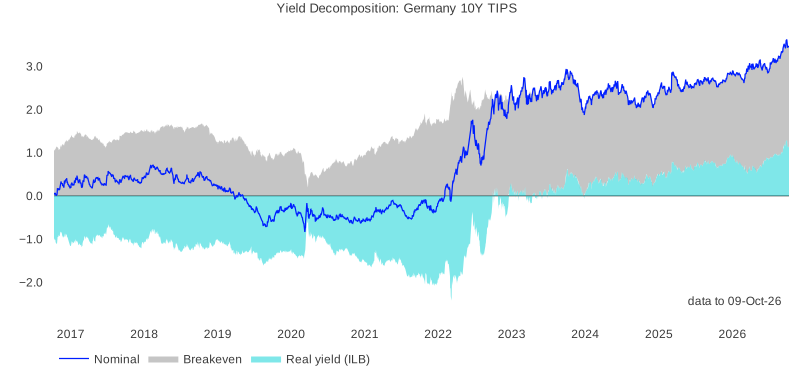
Figure 3: Yield decomposition of the German 10 year Bund, broken into the real-yield and the breakeven, calculated from 10 year inflation linked bonds.
| Date | Nominal 10-year yield (%) | 10-year breakeven inflation (%) | 10-year real yield, ILB (%) | Calculated nominal: breakeven + real (%) | Digitisation difference (percentage points) |
| Jan 2017 | 0.24 | 1.39 | -1.15 | 0.24 | 0.00 |
| Feb 2017 | 0.38 | 1.51 | -1.13 | 0.38 | 0.00 |
| Mar 2017 | 0.34 | 1.51 | -1.17 | 0.34 | 0.00 |
| Apr 2017 | 0.29 | 1.38 | -1.09 | 0.29 | 0.00 |
| May 2017 | 0.38 | 1.44 | -1.06 | 0.38 | 0.00 |
| Jun 2017 | 0.28 | 1.26 | -0.98 | 0.28 | 0.00 |
| Jul 2017 | 0.43 | 1.32 | -0.89 | 0.43 | 0.00 |
| Aug 2017 | 0.42 | 1.38 | -0.96 | 0.42 | 0.00 |
| Sep 2017 | 0.34 | 1.40 | -1.06 | 0.34 | 0.00 |
| Oct 2017 | 0.44 | 1.46 | -1.02 | 0.44 | 0.00 |
| Nov 2017 | 0.39 | 1.54 | -1.15 | 0.39 | 0.00 |
| Dec 2017 | 0.32 | 1.53 | -1.21 | 0.32 | 0.00 |
| Jan 2018 | 0.43 | 1.54 | -1.11 | 0.43 | 0.00 |
| Feb 2018 | 0.64 | 1.64 | -1.00 | 0.64 | 0.00 |
| Mar 2018 | 0.63 | 1.55 | -0.92 | 0.63 | 0.00 |
| Apr 2018 | 0.51 | 1.62 | -1.11 | 0.51 | 0.00 |
| May 2018 | 0.58 | 1.67 | -1.09 | 0.58 | 0.00 |
| Jun 2018 | 0.40 | 1.65 | -1.25 | 0.40 | 0.00 |
| Jul 2018 | 0.30 | 1.60 | -1.30 | 0.30 | 0.00 |
| Aug 2018 | 0.40 | 1.61 | -1.21 | 0.40 | 0.00 |
| Sep 2018 | 0.38 | 1.63 | -1.25 | 0.38 | 0.00 |
| Oct 2018 | 0.51 | 1.72 | -1.21 | 0.51 | 0.00 |
| Nov 2018 | 0.41 | 1.66 | -1.25 | 0.41 | 0.00 |
| Dec 2018 | 0.27 | 1.44 | -1.17 | 0.27 | 0.00 |
| Jan 2019 | 0.23 | 1.29 | -1.06 | 0.23 | 0.00 |
| Feb 2019 | 0.15 | 1.28 | -1.13 | 0.15 | 0.00 |
| Mar 2019 | 0.13 | 1.39 | -1.26 | 0.13 | 0.00 |
| Apr 2019 | -0.02 | 1.34 | -1.36 | -0.02 | 0.00 |
| May 2019 | 0.00 | 1.36 | -1.36 | 0.00 | 0.00 |
| Jun 2019 | -0.20 | 1.10 | -1.30 | -0.20 | 0.00 |
| Jul 2019 | -0.34 | 0.98 | -1.32 | -0.34 | 0.00 |
| Aug 2019 | -0.49 | 1.04 | -1.53 | -0.49 | 0.00 |
| Sep 2019 | -0.64 | 0.93 | -1.57 | -0.64 | 0.00 |
| Oct 2019 | -0.57 | 0.92 | -1.49 | -0.57 | 0.00 |
| Nov 2019 | -0.34 | 1.00 | -1.34 | -0.34 | 0.00 |
| Dec 2019 | -0.32 | 0.98 | -1.30 | -0.32 | 0.00 |
| Jan 2020 | -0.24 | 1.10 | -1.34 | -0.24 | 0.00 |
| Feb 2020 | -0.40 | 1.05 | -1.45 | -0.40 | 0.00 |
| Mar 2020 | -0.66 | 0.79 | -1.45 | -0.66 | 0.00 |
| Apr 2020 | -0.42 | 0.54 | -0.96 | -0.42 | 0.00 |
| May 2020 | -0.53 | 0.55 | -1.08 | -0.53 | 0.00 |
| Jun 2020 | -0.38 | 0.62 | -1.00 | -0.38 | 0.00 |
| Jul 2020 | -0.47 | 0.68 | -1.15 | -0.47 | 0.00 |
| Aug 2020 | -0.54 | 0.84 | -1.38 | -0.54 | 0.00 |
| Sep 2020 | -0.47 | 0.83 | -1.30 | -0.47 | 0.00 |
| Oct 2020 | -0.52 | 0.74 | -1.26 | -0.52 | 0.00 |
| Nov 2020 | -0.58 | 0.82 | -1.40 | -0.58 | 0.00 |
| Dec 2020 | -0.58 | 0.95 | -1.53 | -0.58 | 0.00 |
| Jan 2021 | -0.57 | 0.98 | -1.55 | -0.57 | 0.00 |
| Feb 2021 | -0.53 | 1.11 | -1.64 | -0.53 | 0.00 |
| Mar 2021 | -0.34 | 1.13 | -1.47 | -0.34 | 0.00 |
| Apr 2021 | -0.36 | 1.26 | -1.62 | -0.36 | 0.00 |
| May 2021 | -0.25 | 1.28 | -1.53 | -0.25 | 0.00 |
| Jun 2021 | -0.19 | 1.39 | -1.58 | -0.19 | 0.00 |
| Jul 2021 | -0.25 | 1.37 | -1.62 | -0.25 | 0.00 |
| Aug 2021 | -0.47 | 1.40 | -1.87 | -0.47 | 0.00 |
| Sep 2021 | -0.44 | 1.43 | -1.87 | -0.44 | 0.00 |
| Oct 2021 | -0.23 | 1.66 | -1.89 | -0.23 | 0.00 |
| Nov 2021 | -0.15 | 1.89 | -2.04 | -0.15 | 0.00 |
| Dec 2021 | -0.32 | 1.74 | -2.06 | -0.32 | 0.00 |
| Jan 2022 | -0.23 | 1.83 | -2.06 | -0.23 | 0.00 |
| Feb 2022 | -0.06 | 1.75 | -1.81 | -0.06 | 0.00 |
| Mar 2022 | 0.02 | 2.44 | -2.42 | 0.02 | 0.00 |
| Apr 2022 | 0.58 | 2.60 | -2.02 | 0.58 | 0.00 |
| May 2022 | 0.92 | 2.77 | -1.85 | 0.92 | 0.00 |
| Jun 2022 | 1.24 | 2.58 | -1.34 | 1.24 | 0.00 |
| Jul 2022 | 1.48 | 2.37 | -0.89 | 1.48 | 0.00 |
| Aug 2022 | 0.92 | 2.30 | -1.38 | 0.92 | 0.00 |
| Sep 2022 | 1.38 | 2.64 | -1.26 | 1.38 | 0.00 |
| Oct 2022 | 2.04 | 2.61 | -0.57 | 2.04 | 0.00 |
| Nov 2022 | 2.21 | 2.12 | 0.09 | 2.21 | 0.00 |
| Dec 2022 | 1.89 | 2.40 | -0.51 | 1.89 | 0.00 |
| Jan 2023 | 2.40 | 2.21 | 0.19 | 2.40 | 0.00 |
| Feb 2023 | 2.15 | 2.07 | 0.08 | 2.15 | 0.00 |
| Mar 2023 | 2.59 | 2.51 | 0.08 | 2.59 | 0.00 |
| Apr 2023 | 2.25 | 2.42 | -0.17 | 2.25 | 0.00 |
| May 2023 | 2.36 | 2.44 | -0.08 | 2.36 | 0.00 |
| Jun 2023 | 2.43 | 2.35 | 0.08 | 2.43 | 0.00 |
| Jul 2023 | 2.47 | 2.34 | 0.13 | 2.47 | 0.00 |
| Aug 2023 | 2.45 | 2.34 | 0.11 | 2.45 | 0.00 |
| Sep 2023 | 2.57 | 2.38 | 0.19 | 2.57 | 0.00 |
| Oct 2023 | 2.83 | 2.26 | 0.57 | 2.83 | 0.00 |
| Nov 2023 | 2.77 | 2.26 | 0.51 | 2.77 | 0.00 |
| Dec 2023 | 2.43 | 2.05 | 0.38 | 2.43 | 0.00 |
| Jan 2024 | 2.02 | 1.96 | 0.06 | 2.02 | 0.00 |
| Feb 2024 | 2.25 | 1.97 | 0.28 | 2.25 | 0.00 |
| Mar 2024 | 2.38 | 1.96 | 0.42 | 2.38 | 0.00 |
| Apr 2024 | 2.36 | 2.08 | 0.28 | 2.36 | 0.00 |
| May 2024 | 2.51 | 2.13 | 0.38 | 2.51 | 0.00 |
| Jun 2024 | 2.58 | 2.09 | 0.49 | 2.58 | 0.00 |
| Jul 2024 | 2.47 | 2.00 | 0.47 | 2.47 | 0.00 |
| Aug 2024 | 2.34 | 1.94 | 0.40 | 2.34 | 0.00 |
| Sep 2024 | 2.21 | 1.81 | 0.40 | 2.21 | 0.00 |
| Oct 2024 | 2.11 | 1.77 | 0.34 | 2.11 | 0.00 |
| Nov 2024 | 2.30 | 1.85 | 0.45 | 2.30 | 0.00 |
| Dec 2024 | 2.20 | 1.80 | 0.40 | 2.20 | 0.00 |
| Jan 2025 | 2.36 | 1.87 | 0.49 | 2.36 | 0.00 |
| Feb 2025 | 2.53 | 2.00 | 0.53 | 2.53 | 0.00 |
| Mar 2025 | 2.53 | 1.98 | 0.55 | 2.53 | 0.00 |
| Apr 2025 | 2.69 | 2.01 | 0.68 | 2.69 | 0.00 |
| May 2025 | 2.45 | 1.88 | 0.57 | 2.45 | 0.00 |
| Jun 2025 | 2.57 | 1.91 | 0.66 | 2.57 | 0.00 |
| Jul 2025 | 2.57 | 1.89 | 0.68 | 2.57 | 0.00 |
| Aug 2025 | 2.64 | 1.92 | 0.72 | 2.64 | 0.00 |
| Sep 2025 | 2.70 | 1.91 | 0.79 | 2.70 | 0.00 |
| Oct 2025 | 2.70 | 1.91 | 0.79 | 2.70 | 0.00 |
| Nov 2025 | 2.58 | 1.90 | 0.68 | 2.58 | 0.00 |
| Dec 2025 | 2.70 | 1.91 | 0.79 | 2.70 | 0.00 |
| Jan 2026 | 2.85 | 1.93 | 0.92 | 2.85 | 0.00 |
| Feb 2026 | 2.83 | 2.06 | 0.77 | 2.83 | 0.00 |
| Mar 2026 | 2.72 | 2.04 | 0.68 | 2.72 | 0.00 |
| Apr 2026 | 3.00 | 2.38 | 0.62 | 3.00 | 0.00 |
| May 2026 | 3.02 | 2.38 | 0.64 | 3.02 | 0.00 |
| Jun 2026 | 3.02 | 2.30 | 0.72 | 3.02 | 0.00 |
| Jul 2026 | 2.93 | 2.06 | 0.87 | 2.93 | 0.00 |
| Aug 2026 | 3.13 | 2.19 | 0.94 | 3.13 | 0.00 |
| Sep 2026 | 3.25 | 2.27 | 0.98 | 3.25 | 0.00 |
| Oct 2026 | 3.51 | 2.26 | 1.25 | 3.51 | 0.00 |
Is this a return to the Eurozone Debt Crisis?
Critically, France has not been locked out of the debt markets. The 15 October auction placed €13.25 billion [note11], at an aggregate bid-to-cover ratio of 2.28x. That implies there was plenty of demand for French paper, just at a price.
Peripheral European markets like Italy and Greece have been making good progress in terms of fiscal reform: debt-to-GDP is at 138% and 136% respectively[note12], but the trend has been lower. Bond markets had rewarded their efforts: Italian BTP- and Greek- spreads have declined from c. 245bps and 320bps respectively in 2022 to lows of 58bps and 55bps in January 2026.
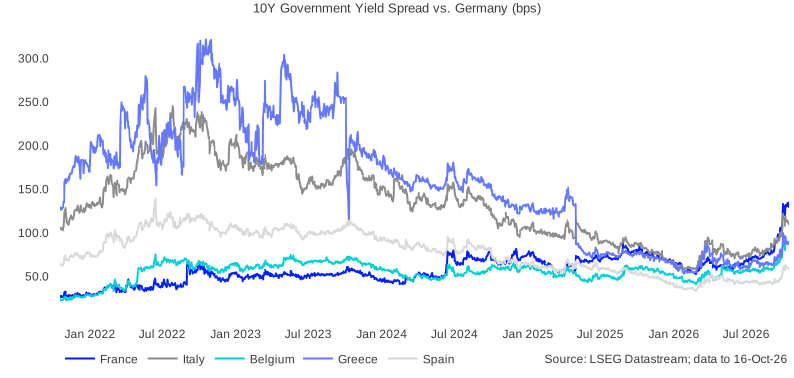
Figure 4: Spread between various European 10-year bonds and German Bunds.
Source: LSEG Datastream; data to 16-Oct-2026. Past performance is not a guide to future returns. Please see the end for important legal disclosures.
| Date | France | Italy | Belgium | Greece | Spain |
| 2021-10-01 | 25 | 100 | 25 | 130 | 65 |
| 2022-07-01 | 40 | 220 | 70 | 200 | 120 |
| 2023-01-01 | 55 | 180 | 55 | 290 | 110 |
| 2024-01-01 | 45 | 140 | 50 | 180 | 85 |
| 2025-01-01 | 75 | 105 | 65 | 130 | 65 |
| 2026-01-01 | 55 | 55 | 45 | 60 | 35 |
| 2026-10-16 | 130 | 115 | 90 | 125 | 60 |
Whilst France was the catalyst, there has been spread widening amongst some of the periphery of Europe. Italian and Greek spreads are notably wider, although both still yield less than OATs.
Currently this looks more like an idiosyncratic French issue than the start of another Eurozone Debt Crisis. That being said, it is important to remain cognisant about how contagion risk can potentially be self-fulfilling and the importance of sentiment. Italy also has ~16% of its outstanding stock to refinance in 2027 and having to refinance at higher rates risks applying stress on fiscal arithmetic.
Concerns are also likely to weigh on the Euro as a currency: in 2010 the trade-weighted Euro fell [note13] c. 8.8% eventually declining c. 14% before the ECB began Outright Monetary Transactions (OMT) in July 2012. YTD trade weighted Euro is down c. 3.4% although that is a confluence of factors, including the effect of inflation and higher energy prices.
This may also adjust the reaction function from the ECB. The bank could make use of the TPI[note14] facility, a conditional bond buying program – although from the Italian experience after 2011 we know they would regularly allow spreads >200bps without intervening. France is also technically ineligible due to an Excessive Deficit Procedure and Christine Lagard[note15] has stated “The primary and first solution lies at home in France. And it has to do with fiscal policies.”. This is a reminder that the ECB remains aware of the lessons learned during the 2010 crisis of the threat to independent monetary policy from fiscal dominance, whereby inflation stability is subordinated to fiscal concerns.
None the less there have been exceptions made in the past, such as Greece, if there is political will. It is also plausible that an indication from the ECB about the potential use of TPI would be enough to calm the bond market.
Conclusions
The rise in OAT spreads reflects largely idiosyncratic fiscal concerns and political uncertainty in France. Bond investors are not locking France out of capital markets but are repricing the risk. Currently, it doesn’t look like the start of a Eurozone crisis but contagion risk can become self-fulfilling if unchecked which is why the reaction function of the ECB will be important to observe.
footnotes
[1] OAT stands for Obligations assimilables du Trésor – common name for French government bonds. | Back to Note 1
[2] In 2024 President Macron called a snap legislative election, which has led to a hung National Assembly. No political bloc is close to a majority. The result is that durable legislation, like fiscal consolidation, is hard to achieve due to a lack of consensus. Frictions have increased as the Presidential Election is scheduled for April 2027. | Back to Note 2
[3] Minutes of the Council of Ministers: October 1, 2026 | Back to Note 3
[4]In the 2017 election Le Pen took 21.3% in the 1st round and 33.9% in the runoff. In 2022 she won 23.2% in the 1st round and 41.5% of the vote in the runoff. Emmanuel Macron marginally beat Le Pen in the 1st round on both occasions with 24.0% in 2017 and 27.9% in 2022, but was better able to capitalise in the 2nd round. | Back to Note 4
[5] The Politico Poll-of-Polls 1st round elections, as of September 29, 2026 puts Mélenchon in either 2nd or 3rd based on a scenario where either Gabriel Attal or Edouard Philippe stands as the centrist candidate. More recently Reuters have reported Le Pen and Mélenchon head for a runoff which uses survey data from October 5th-8th and has Mélenchon 2nd in the 1st round in all of their scenarios. | Back to Note 5
[6] Press conference from June 24, 2026. | Back to Note 6
[7] In a blog from September 08, 2026, Mélenchon expanded to say the debt should be frozen: “[translated with AI] freezing the debt means transforming it into a perpetual debt, that is, without a repayment deadline with a low or zero interest rate. Freezing it is therefore effectively equivalent to cancelling it” | Back to Note 7
[8] IMF World Economic Outlook October 2026 | Back to Note 8
[9] In the medium- to long- term if real debt service costs exceed the real growth rate, the debt-to-GDP ratio continuously rises until there is primary budget surplus. | Back to Note 9
[10] Source LSEG Data and Analytics with FTSE Russell calculations, as of October 12, 2026. | Back to Note 10
[11] Issuance of €12 billion medium term of conventional OATs with maturities between Feb 2031 and November 2033 and €1.25 billion of inflation linked OATs from 2032 to 2040. | Back to Note 11
[12] Source: IMF World Economic Outlook October 2026. Greece’s debt-to-GDP peaked in 2010 at 210% and has fallen rapidly since, Italy’s 2010 peak was 154%. France’s debt-to-GDP has been steadily growing from c. 60% in 1996, 86% in 2010 and is expected to be 118.5% in 2026. | Back to Note 12
[13] Using the ECB Daily nominal effective exchange rate for the Euro during the European Debt Crisis the Euro fell from 120.98 to 110.303 during 2010 and it troughed at 104.077 in 2011 before the ECB engaged in Outright Monetary Transactions (OMT) which drove a sharp rebound. | Back to Note 13
[14] Transmission Protection Instrument (TPI) was added as a complement to Outright Monetary Transactions (OMT) which were a tool created during the Euro Debt Crisis and Mario Draghi’s famous “whatever it takes” moment. The TPI serves a similar purpose which is to ensure monetary policy is transmitted smoothly across the euro area and to avoid disorderly dynamics. | Back to Note 14
[15] Speaking at a CNN event in Bangkok on October 14, 2026 | Back to Note 15

Disclaimer
© [2026] London Stock Exchange Group plc and its applicable group undertakings (“LSEG”). LSEG includes (1) FTSE International Limited (“FTSE”), (2) Frank Russell Company (“Russell”), (3) FTSE Global Debt Capital Markets Inc. “FTSE Canada”, (4) FTSE Fixed Income LLC (“FTSE FI”), (5) FTSE (Beijing) Consulting Limited (“WOFE”), (6) FTSE EU SAS ("FES"). All rights reserved.
FTSE Russell® is a trading name of FTSE, Russell, FTSE Canada, FTSE FI, WOFE, FTSE EU and other LSEG entities providing LSEG Benchmark and Index services. “FTSE®”, “Russell®”, “FTSE Russell®”, “FTSE4Good®”, “ICB®”, “Refinitiv”, “WMR™” “FR™” and all other trademarks and service marks used herein (whether registered or unregistered) are trademarks and/or service marks owned or licensed by the applicable member of LSEG or their respective licensors.
FTSE International Limited is authorised as a Benchmark Administrator and regulated in the United Kingdom (UK) by the Financial Conduct Authority ("FCA") according to the UK Benchmark Regulation, FCA Reference Number 796803. FTSE EU SAS is authorised as Benchmark Administrator and regulated in the European Union (EU) by the Autorité des Marches Financiers (“AMF”) according to the EU Benchmark Regulation.
All information is provided for information purposes only. All information and data contained in this publication is obtained by LSEG, from sources believed by it to be accurate and reliable. Because of the possibility of human and mechanical inaccuracy as well as other factors, however, such information and data is provided "as is" without warranty of any kind. No member of LSEG nor their respective directors, officers, employees, partners or licensors make any claim, prediction, warranty or representation whatsoever, expressly or impliedly, either as to the accuracy, timeliness, completeness, merchantability of any information or LSEG Products, or of results to be obtained from the use of LSEG products, including but not limited to indices, rates, data and analytics, or the fitness or suitability of the LSEG products for any particular purpose to which they might be put. The user of the information assumes the entire risk of any use it may make or permit to be made of the information.
No responsibility or liability can be accepted by any member of LSEG nor their respective directors, officers, employees, partners or licensors for (a) any loss or damage in whole or in part caused by, resulting from, or relating to any inaccuracy (negligent or otherwise) or other circumstance involved in procuring, collecting, compiling, interpreting, analysing, editing, transcribing, transmitting, communicating or delivering any such information or data or from use of this document or links to this document or (b) any direct, indirect, special, consequential or incidental damages whatsoever, even if any member of LSEG is advised in advance of the possibility of such damages, resulting from the use of, or inability to use, such information.
No member of LSEG nor their respective directors, officers, employees, partners or licensors provide investment advice and nothing in this document should be taken as constituting financial or investment advice. No member of LSEG nor their respective directors, officers, employees, partners or licensors make any representation regarding the advisability of investing in any asset or whether such investment creates any legal or compliance risks for the investor. A decision to invest in any such asset should not be made in reliance on any information herein. Indices and rates cannot be invested in directly. Inclusion of an asset in an index or rate is not a recommendation to buy, sell or hold that asset nor confirmation that any particular investor may lawfully buy, sell or hold the asset or an index or rate containing the asset. The general information contained in this publication should not be acted upon without obtaining specific legal, tax, and investment advice from a licensed professional.
Past performance is no guarantee of future results. Charts and graphs are provided for illustrative purposes only. Index and/or rate returns shown may not represent the results of the actual trading of investable assets. Certain returns shown may reflect back-tested performance. All performance presented prior to the index or rate inception date is back-tested performance. Back-tested performance is not actual performance, but is hypothetical. The back-test calculations are based on the same methodology that was in effect when the index or rate was officially launched. However, back-tested data may reflect the application of the index or rate methodology with the benefit of hindsight, and the historic calculations of an index or rate may change from month to month based on revisions to the underlying economic data used in the calculation of the index or rate.
This document may contain forward-looking assessments. These are based upon a number of assumptions concerning future conditions that ultimately may prove to be inaccurate. Such forward-looking assessments are subject to risks and uncertainties and may be affected by various factors that may cause actual results to differ materially. No member of LSEG nor their licensors assume any duty to and do not undertake to update forward-looking assessments.
No part of this information may be reproduced, stored in a retrieval system or transmitted in any form or by any means, electronic, mechanical, photocopying, recording or otherwise, without prior written permission of the applicable member of LSEG. Use and distribution of LSEG data requires a licence from LSEG and/or its licensors.