Name Name
Autocallables can offer attractive income when markets are stable or moderately weaker, but their returns are conditional and their risks can be significant. Coupon payments, early redemption and the return of capital all depend on the performance of an underlying asset or index.
This Q&A explains how coupon, autocall and maturity barriers shape investor outcomes. It also explores the role of volatility, the potential benefits of laddering and how systematic autocallable indices may behave across different market environments.
key takeaways
- Income is conditional
Autocallables may offer relatively high coupons, particularly in stable or moderately declining markets. But coupons are not guaranteed. Payments depend on whether the underlying asset remains above a specified coupon barrier on each observation date.
- Protection has limits
Coupon and maturity barriers can provide a buffer against moderate market declines. They do not remove downside risk. If the underlying asset finishes below the maturity barrier, investors may lose a substantial part of their principal.
- Autocallable indices can diversify entry points
A systematic autocallable index can introduce new exposures at regular intervals. This laddered approach spreads initial reference levels and observation dates, reducing reliance on the market conditions prevailing on a single investment date.
What are autocallables?
Autocallable securities are structured products designed to provide a predefined return profile linked to the performance of an underlying asset or index. Their returns are typically determined by a combination of contingent coupon payments and the repayment of capital, much like a bond.
Unlike conventional fixed-income securities, where coupon payments are generally contractual obligations of the issuer, payments from autocallable securities are dependent on the performance of the underlying reference asset.
What’s the risk-return profile of an autocallable?
Autocallable strategies can exhibit a distinctive risk-return profile. They may provide relatively high levels of income in certain market environments, particularly when markets are range-bound or moderately declining. In general, the market must fall considerably before investors experience capital losses, providing some protection in moderately declining markets. Conversely, in rising markets, there is a higher probability that the product will ‘autocall’, which can limit capital appreciation.
Which parameters determine the payoff profile?
Although individual structures vary, three parameters are particularly important in determining the payoff profile:
| Structural feature | Illustrative level | Purpose |
|---|---|---|
| Coupon barrier | 60% of initial reference level | Determines whether a coupon is payable |
| Autocall barrier | 100% of initial reference level | Determines whether the security redeems early |
| Maturity barrier | 50% of initial reference level | Determines the treatment of principal at maturity |
The parameters above are illustrative and do not represent the terms of any particular security, index or investment product.
Coupon barrier
The coupon barrier determines whether the security pays its contingent coupon on an observation date.
For example, if the coupon barrier is set at 60% of the reference asset's initial level, the coupon would generally be payable when the reference asset is at or above that level on the relevant observation date.
If the reference asset is below the barrier, the coupon may not be paid. Whether missed coupons can subsequently be recovered depends on the specific terms of the structure.
Autocall barrier
The autocall barrier determines whether the security is redeemed before its final maturity.
For example, where the autocall barrier is 100% of the initial reference level, the security will be redeemed by the issuer if the underlying is at or above its initial level on a qualifying observation date.
Subject to the terms of the security, the investor would typically receive the applicable redemption amount together with any coupon due for that observation period.
This feature can shorten the effective duration of the investment, particularly during stable or rising equity markets.
Maturity barrier
The maturity barrier is particularly important where the security has not previously autocalled.
If the reference asset remains above the maturity barrier on the final observation date, the issuer will repay the principal in full, subject to the terms of the instrument and the creditworthiness of the issuer or counterparty.
If the reference asset closes below the maturity barrier, however, the investor may participate in some or all of the decline in the reference asset.
For example, under a structure providing one-for-one downside participation below the barrier, a reference asset finishing 55% below its initial level could result in the repayment of approximately 45% of the original principal.
This illustrates an important feature of autocallable securities: the barrier may provide conditional protection against moderate declines, but it does not eliminate downside risk.
Example autocallable instrument mechanism
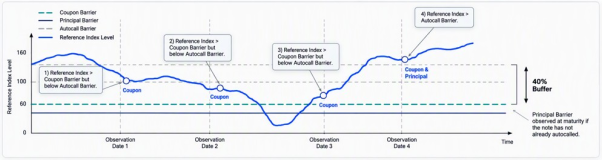
| Observation point | Reference index position | Coupon barrier met? | Autocall barrier met? | Investor outcome |
|---|---|---|---|---|
| Observation Date 1 | Above coupon barrier, below autocall barrier | Yes | No | Coupon paid |
| Observation Date 2 | Above coupon barrier, below autocall barrier | Yes | No | Coupon paid |
| Between Dates 2 and 3 | Falls below coupon barrier | No | No | No observation outcome, index temporarily declines |
| Observation Date 3 | Above coupon barrier, below autocall barrier | Yes | No | Coupon paid |
| Observation Date 4 | Above autocall barrier | Yes | Yes | Coupon paid and principal repaid through early redemption |
| Maturity (if not autocalled) | Compared with principal barrier | Depends on final level | N/A | Determines whether full principal is repaid or loss occurs |
What’s the role of volatility in determining the autocallable payoff?
Volatility is an important component of autocallable pricing. Higher implied volatility can support higher potential coupon levels because the embedded options within the autocallable become more valuable. However, higher volatility may also increase the probability that the underlying asset breaches a coupon or capital barrier.
As a result, a higher headline coupon does not necessarily indicate a more attractive risk-adjusted investment opportunity. Coupon levels should be assessed in conjunction with the underlying volatility, barrier configuration and downside risk.
What’s an index of autocallables?
An autocallable index is a systematic strategy that combines individual autocallable instruments in a hypothetical portfolio, with the aim of mitigating some of the drawbacks of traditional autocallable products.
A single autocallable security typically has one initial reference level and a predefined sequence of observation dates, creating a degree of path dependency. In other words, its payouts depend not only on the starting and ending values of the underlying asset or index, but also on the path taken between them. The investor’s outcome may therefore depend significantly on the market conditions prevailing around the security’s initial fixing date and subsequent observation dates.
A systematic strategy can approach the challenge of path dependency differently by introducing new autocallable exposures periodically. For example, rather than establishing a single position at one point in time, a rules-based strategy could construct a rolling portfolio containing autocallables initiated on different dates and therefore at different reference levels. This type of approach is sometimes described as laddering.
How does FTSE Russell determine the index constituents, rebalancing frequency, coupon and capital barrier levels, and autocall barriers?
FTSE Russell has a flexible platform that can calculate autocallable indices linked to a range of autocallable instruments with different underlying reference assets, barrier levels, observation dates and laddering frequencies.
When determining how to structure the indices, we evaluate the size and frequency of the coupon and the potential for capital loss. Structures with regular, smaller coupons tend to have less market ‘beta’ than those with larger, less frequent coupons; the latter may offer greater potential for capital appreciation. However, the former will generally have a lower coupon barrier, more frequent coupon observations and a higher maturity barrier. Additional features, such as non-call provisions and ‘memory’ coupons, under which missed coupons accrue, may also be incorporated into the index as required.
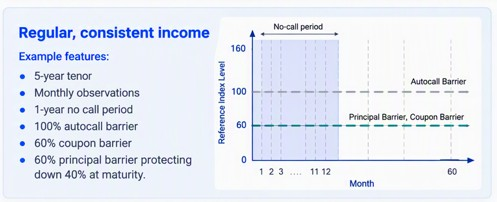
Product Features
| Feature | Description |
|---|---|
| Investment term | 5 years |
| Observation frequency | Monthly |
| No-call period | 1 year |
| Autocall barrier | 100% of initial reference level |
| Coupon barrier | 60% of initial reference level |
| Principal barrier | 60% of initial reference level |
| Capital buffer | 40% downside protection at maturity |
Barrier Structure Summary
| Barrier Type | Level | Purpose |
|---|---|---|
| Autocall barrier | 100% | Determines whether the product redeems early after the no-call period |
| Coupon barrier | 60% | Determines whether coupon payments are made |
| Principal barrier | 60% | Determines principal repayment at maturity |
| Buffer | 40% | Allows the reference index to decline by up to 40% before principal is |
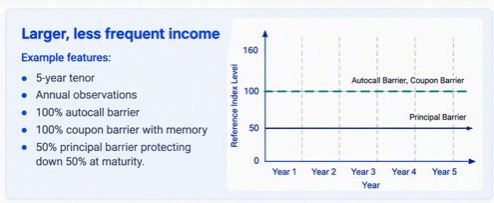
Product Features
| Feature | Description |
|---|---|
| Investment term | 5 years |
| Observation frequency | Annual |
| Autocall barrier | 100% of initial reference level |
| Coupon barrier | 100% of initial reference level |
| Coupon memory | Yes |
| Principal barrier | 50% of initial reference level |
| Capital buffer | 50% downside protection at maturity |
Barrier Structure Summary
| Barrier Type | Level | Purpose |
|---|---|---|
| Autocall barrier | 100% | Determines whether the product redeems early |
| Coupon barrier | 100% | Determines whether annual coupon payments are made |
| Coupon memory | Enabled | Allows missed coupons to be paid later if conditions are subsequently met |
| Principal barrier | 50% | Determines principal repayment at maturity |
| Buffer | 50% | Protects against the first 50% decline in the underlying reference index |
How is an autocallable index likely to perform in different market environments?
The relative performance of autocallable strategies can vary meaningfully across different market regimes.
Range-bound markets
Markets that remain relatively stable may be supportive for autocallable strategies because the reference asset can remain above its coupon barrier without appreciating sufficiently to make any foregone equity upside particularly significant.
Moderately declining markets
Autocallable structures may continue to generate coupons during moderate declines, provided the reference asset remains above the relevant coupon barrier.
This represents one of the key differences (and potential benefits) of autocallables relative to direct equity exposure.
Strongly rising markets
In strongly rising markets, autocallable strategies may generate positive returns but can lag the underlying equity market because participation in the appreciation of the underlying reference asset is typically capped by the coupon and autocall structure.
Significant equity drawdowns
Large and persistent market declines represent the principal adverse scenario for an investor in autocallables. Coupons can cease when barriers are breached, while sufficiently large declines may result in capital losses.
How an autocallable index may perform across market environments

What’s distinctive about FTSE Russell’s approach?
Autocallables contain embedded derivatives and can display non-linear, path-dependent exposures. Understanding these characteristics requires familiarity with both the economics of structured products and conventional index construction.
FTSE Russell’s capabilities are enhanced by the structuring and derivatives trading experience of the Engineered Indices team that designs these indices. This experience can help bridge the gap between the theoretical design of an index and the practical economics of implementing the strategy.
The resulting index design process brings together quantitative research, derivatives structuring and index methodology expertise, allowing autocallables to be considered from a broader portfolio perspective.

Disclaimer
© [2026] London Stock Exchange Group plc and its applicable group undertakings (“LSEG”). LSEG includes (1) FTSE International Limited (“FTSE”), (2) Frank Russell Company (“Russell”), (3) FTSE Global Debt Capital Markets Inc. “FTSE Canada”, (4) FTSE Fixed Income LLC (“FTSE FI”), (5) FTSE (Beijing) Consulting Limited (“WOFE”), (6) FTSE EU SAS ("FES"). All rights reserved.
FTSE Russell® is a trading name of FTSE, Russell, FTSE Canada, FTSE FI, WOFE, FTSE EU and other LSEG entities providing LSEG Benchmark and Index services. “FTSE®”, “Russell®”, “FTSE Russell®”, “FTSE4Good®”, “ICB®”, “Refinitiv”, “WMR™” “FR™” and all other trademarks and service marks used herein (whether registered or unregistered) are trademarks and/or service marks owned or licensed by the applicable member of LSEG or their respective licensors.
FTSE International Limited is authorised as a Benchmark Administrator and regulated in the United Kingdom (UK) by the Financial Conduct Authority ("FCA") according to the UK Benchmark Regulation, FCA Reference Number 796803. FTSE EU SAS is authorised as Benchmark Administrator and regulated in the European Union (EU) by the Autorité des Marches Financiers (“AMF”) according to the EU Benchmark Regulation.
All information is provided for information purposes only. All information and data contained in this publication is obtained by LSEG, from sources believed by it to be accurate and reliable. Because of the possibility of human and mechanical inaccuracy as well as other factors, however, such information and data is provided "as is" without warranty of any kind. No member of LSEG nor their respective directors, officers, employees, partners or licensors make any claim, prediction, warranty or representation whatsoever, expressly or impliedly, either as to the accuracy, timeliness, completeness, merchantability of any information or LSEG Products, or of results to be obtained from the use of LSEG products, including but not limited to indices, rates, data and analytics, or the fitness or suitability of the LSEG products for any particular purpose to which they might be put. The user of the information assumes the entire risk of any use it may make or permit to be made of the information.
No responsibility or liability can be accepted by any member of LSEG nor their respective directors, officers, employees, partners or licensors for (a) any loss or damage in whole or in part caused by, resulting from, or relating to any inaccuracy (negligent or otherwise) or other circumstance involved in procuring, collecting, compiling, interpreting, analysing, editing, transcribing, transmitting, communicating or delivering any such information or data or from use of this document or links to this document or (b) any direct, indirect, special, consequential or incidental damages whatsoever, even if any member of LSEG is advised in advance of the possibility of such damages, resulting from the use of, or inability to use, such information.
No member of LSEG nor their respective directors, officers, employees, partners or licensors provide investment advice and nothing in this document should be taken as constituting financial or investment advice. No member of LSEG nor their respective directors, officers, employees, partners or licensors make any representation regarding the advisability of investing in any asset or whether such investment creates any legal or compliance risks for the investor. A decision to invest in any such asset should not be made in reliance on any information herein. Indices and rates cannot be invested in directly. Inclusion of an asset in an index or rate is not a recommendation to buy, sell or hold that asset nor confirmation that any particular investor may lawfully buy, sell or hold the asset or an index or rate containing the asset. The general information contained in this publication should not be acted upon without obtaining specific legal, tax, and investment advice from a licensed professional.
Past performance is no guarantee of future results. Charts and graphs are provided for illustrative purposes only. Index and/or rate returns shown may not represent the results of the actual trading of investable assets. Certain returns shown may reflect back-tested performance. All performance presented prior to the index or rate inception date is back-tested performance. Back-tested performance is not actual performance, but is hypothetical. The back-test calculations are based on the same methodology that was in effect when the index or rate was officially launched. However, back-tested data may reflect the application of the index or rate methodology with the benefit of hindsight, and the historic calculations of an index or rate may change from month to month based on revisions to the underlying economic data used in the calculation of the index or rate.
This document may contain forward-looking assessments. These are based upon a number of assumptions concerning future conditions that ultimately may prove to be inaccurate. Such forward-looking assessments are subject to risks and uncertainties and may be affected by various factors that may cause actual results to differ materially. No member of LSEG nor their licensors assume any duty to and do not undertake to update forward-looking assessments.
No part of this information may be reproduced, stored in a retrieval system or transmitted in any form or by any means, electronic, mechanical, photocopying, recording or otherwise, without prior written permission of the applicable member of LSEG. Use and distribution of LSEG data requires a licence from LSEG and/or its licensors.