

Mobi Shemfe
Investors commonly track portfolio emissions using absolute and intensity-based metrics. Covering operational (Scope 1 and 2) and, increasingly, value chain (Scope 3) emissions of portfolio companies, these metrics underpin decarbonisation targets and progress reporting. But the key question is delivery: are listed companies actually cutting emissions? And if so, in which markets is that progress happening? Our analysis below draws on LSEG’s Climate MAP dataset (Management, Ambition and Performance), combining company emissions with transition disclosures on governance, targets and delivery.
Uneven progress – with global emissions still rising
From 2016 to 2023, aggregate absolute operational emissions from listed companies have continued to rise, as reductions in developed markets are outweighed by increases elsewhere. Across the FTSE All-World Index (covering 4,000 large- and mid-cap companies and representing about 90% of global equity market capitalisation), median Scope 1 and 2 emissions of developed market firms have fallen by ~1 to 6% per year since 2016 (Figure 1). While emissions are declining in developed markets – driven by Scope 1 and 2 cuts among large-cap companies – emerging markets are still moving in the opposite direction.
Figure 1: Emissions fall in developed markets but grow in emerging markets
Median change in reported Scope 1 and 2 emissions, Developed vs Emerging FTSE All-World Index
Emerging markets are driving the increase in global equity emissions in two ways. First, emissions in emerging markets are still rising, largely due to sector composition. Many firms remain concentrated in energy and resource-intensive industries, reflecting earlier stages of economic development and the industrial structure in these regions. Second, index coverage is expanding. More emerging market companies are now eligible for inclusion in global benchmark indices, as coverage expands and market depth increases. These new constituents, particularly from parts of Asia, typically have higher operational emissions and are earlier in their transition journeys.
As a result, emerging market firms are not only emitting more, but they are also adding more emissions into the investable universe, even as developed market incumbents are reducing theirs. These dynamics reinforce that operational emissions alone do not tell the full story, as many value chain activities and Scope 3 emissions often sit outside the regions where companies are domiciled or listed.
The divergence is clearly visible in intensity metrics
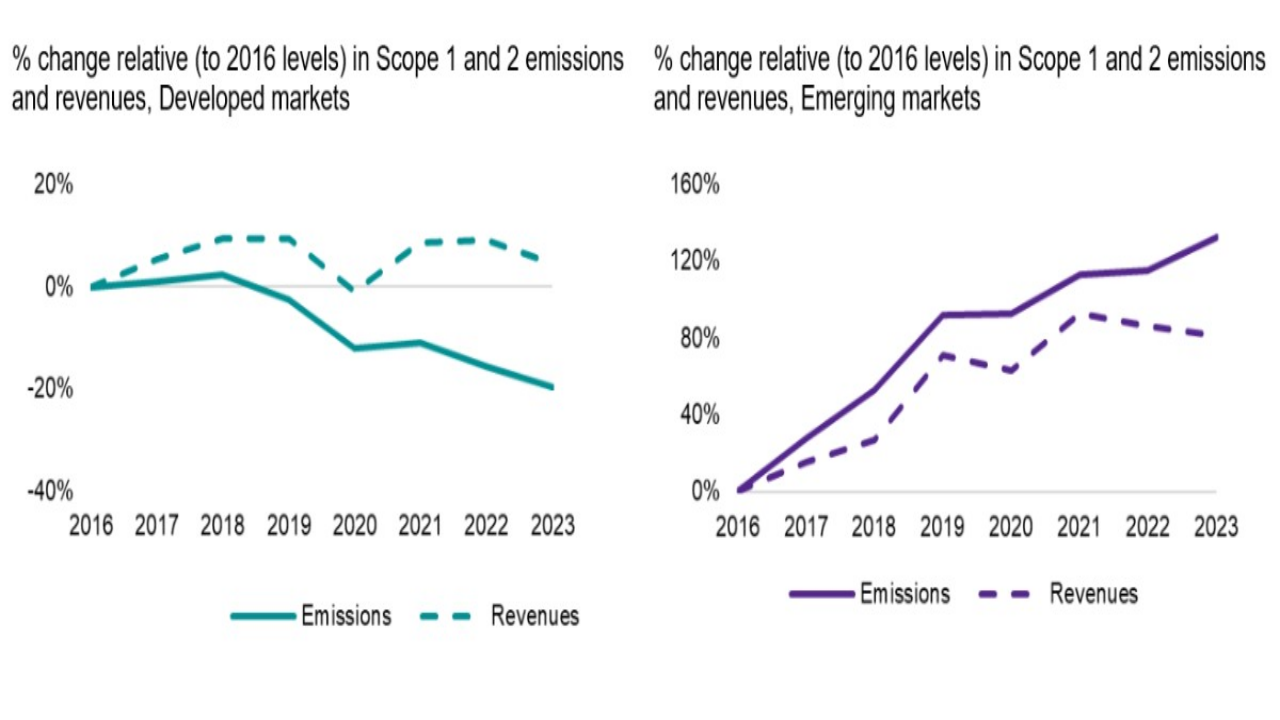
These dynamics are now flowing through to portfolio metrics (Figure 2). Weighted average carbon intensity (WACI), based on emissions normalised against revenues, is around 40% lower in developed markets than it was in 2016, consistent with operational emissions falling by roughly 20% while revenues have grown by around 5% over the same period – an early sign of decoupling (Figure 3).
Figure 2: Developed market WACI falling steadily since 2016, emerging market WACI trending higher
Scope 1 and 2 WACI (2016 =100)
In contrast, emerging markets portfolios have moved in the opposite direction. Their WACI has risen as emissions doubled, and revenues increased by around 71% over the same period, signalling that revenues and emissions remain tightly linked (for a detailed attribution analysis on other factors contributing to WACI trends, see LSEG Decarbonisation in Portfolio Benchmarks Report (2025). Against this backdrop of uneven progress, more companies are setting emissions reduction targets.
Figure 3: Early signs of decoupling in developed markets, emission and revenues track closely in emerging markets
% change relative (to 2016 levels) in Scope 1 and 2 emissions and revenues
Climate targets are rising, but policy will shape outcomes
More listed companies now have emissions reduction targets and are disclosing them. This is particularly true in developed markets where roughly eight out of ten constituents now have formal emissions reduction targets, while adoption in emerging markets has also grown quickly, albeit from a much lower base (Figure 4).
Targets do matter. Firms with climate targets typically deliver more consistent reductions in their operational emissions than those without targets. But the pace of reduction remains modest, and most progress to date has been concentrated in Scope 1 and 2 emissions. Without clearer strategies for reducing value chain emissions, reductions in one region risk being offset elsewhere.
These trends are evolving against a changing policy backdrop. Climate regulations and disclosure requirements are strengthening in some markets and progressing more slowly in others. At the same time, parts of Asia, notably China, is expanding low-carbon investment at pace. These differences will influence the outlook of the markets where emission reductions materialise and how quickly targets translate into delivery across listed portfolios.
Figure 4: Disclosure of climate targets surging across regions at different paces
What it means for investors
Portfolio decarbonisation is happening, but the headline trajectory increasingly depends on regional exposures and portfolio composition, particularly developed vs. emerging market tilts. Three themes stand out:
- Portfolios with higher emerging-market exposure should expect stronger operational emissions headwinds in the near term, given rising emissions among many emerging market constituents.
- Signs of operational decoupling are emerging in developed markets, but this analysis is focused only on Scope 1 and 2 emissions whilst value chain (Scope 3) emissions that sit elsewhere in the world may tell a different story.
- Both investors and companies have, over recent years, increasingly set climate targets. In the next phase, the quality of engagement between investors and companies on climate strategy and targets will be important to connect portfolio emissions to real world outcomes.
For a comprehensive look at the insights behind these trends, download our Decarbonisation in Portfolio Benchmarks 2025 report.
Underpinned by LSEG datasets:


Legal Disclaimer
Republication or redistribution of LSEG content is prohibited without our prior written consent.
The content of this publication is for informational purposes only and has no legal effect, does not form part of any contract, does not, and does not seek to constitute advice of any nature and no reliance should be placed upon statements contained herein. Whilst reasonable efforts have been taken to ensure that the contents of this publication are accurate and reliable, LSEG does not guarantee that this document is free from errors or omissions; therefore, you may not rely upon the content of this document under any circumstances and you should seek your own independent legal, investment, tax and other advice. Neither We nor our affiliates shall be liable for any errors, inaccuracies or delays in the publication or any other content, or for any actions taken by you in reliance thereon.
Copyright © 2025 London Stock Exchange Group. All rights reserved.
The content of this publication is provided by London Stock Exchange Group plc, its applicable group undertakings and/or its affiliates or licensors (the “LSE Group” or “We”) exclusively.
Neither We nor our affiliates guarantee the accuracy of or endorse the views or opinions given by any third party content provider, advertiser, sponsor or other user. We may link to, reference, or promote websites, applications and/or services from third parties. You agree that We are not responsible for, and do not control such non-LSE Group websites, applications or services.
The content of this publication is for informational purposes only. All information and data contained in this publication is obtained by LSE Group from sources believed by it to be accurate and reliable. Because of the possibility of human and mechanical error as well as other factors, however, such information and data are provided "as is" without warranty of any kind. You understand and agree that this publication does not, and does not seek to, constitute advice of any nature. You may not rely upon the content of this document under any circumstances and should seek your own independent legal, tax or investment advice or opinion regarding the suitability, value or profitability of any particular security, portfolio or investment strategy. Neither We nor our affiliates shall be liable for any errors, inaccuracies or delays in the publication or any other content, or for any actions taken by you in reliance thereon. You expressly agree that your use of the publication and its content is at your sole risk.
To the fullest extent permitted by applicable law, LSE Group, expressly disclaims any representation or warranties, express or implied, including, without limitation, any representations or warranties of performance, merchantability, fitness for a particular purpose, accuracy, completeness, reliability and non-infringement. LSE Group, its subsidiaries, its affiliates and their respective shareholders, directors, officers employees, agents, advertisers, content providers and licensors (collectively referred to as the “LSE Group Parties”) disclaim all responsibility for any loss, liability or damage of any kind resulting from or related to access, use or the unavailability of the publication (or any part of it); and none of the LSE Group Parties will be liable (jointly or severally) to you for any direct, indirect, consequential, special, incidental, punitive or exemplary damages, howsoever arising, even if any member of the LSE Group Parties are advised in advance of the possibility of such damages or could have foreseen any such damages arising or resulting from the use of, or inability to use, the information contained in the publication. For the avoidance of doubt, the LSE Group Parties shall have no liability for any losses, claims, demands, actions, proceedings, damages, costs or expenses arising out of, or in any way connected with, the information contained in this document.
LSE Group is the owner of various intellectual property rights ("IPR”), including but not limited to, numerous trademarks that are used to identify, advertise, and promote LSE Group products, services and activities. Nothing contained herein should be construed as granting any licence or right to use any of the trademarks or any other LSE Group IPR for any purpose whatsoever without the written permission or applicable licence terms.