

Felix Fouret

Malgorzata Kee

Jaakko Kooroshy
When facing incomplete and inconsistent data, prioritising the most important Scope 3 sources in each sector has to be the way forward.
Scope 3 emissions – emissions linked to a company’s value chain outside of its operational control and defined in 15 Categories by the GHG Protocol – remain one of the most vexing problems in sustainable finance. Scope 3 emissions typically account for more than 80% of the emissions linked to a company’s products and services, yet reporting on these emissions is often incomplete and inconsistent.
In Scope for improvement: Solving the Scope 3 Conundrum (January 2024), we identified a key source of confusion: a lack of clear guidance on which of the 15 Scope categories companies in different sectors should prioritise in their reporting. As a result, companies often amend the categories they report on and omit key categories. Business travel for example – perhaps the Scope 3 category that is the easiest to report on – is most frequently disclosed by companies but arguably the least material, accounting for less than 1% of Scope 3 emissions[note1].
This leaves investors with volatile, hard-to-compare data, which can limit its usefulness in portfolio analysis and investment decision. The key recommendation of the report was straightforward: encourage companies to focus on consistently reporting the two most emission-intensive Scope 3 categories in their industry. We showed that these categories were relatively easy to identify, and, on average, capture over 80% of a company’s Scope 3 emissions.
Two years later, rules for Scope 3 emissions disclosures remain a focus for standard setters. The GHG Protocol announced in September its strategic partnership with ISO, the independent global standards body. It is currently developing an updated Scope 3 Standard, which is tentatively scheduled for consultation in 2026. New initiatives, such as Carbon Measures, have proposed a more radical overhaul for carbon accounting rules.
To inform these discussions, we update our analysis below and discuss practical workarounds for investors wrestling with noisy and volatile Scope 3 data from companies.
Have disclosure rates improved?
Yes, we are seeing material improvements, albeit from a low base. Overall, 58% of companies in the FTSE All-World Index (which comprises of just over 4,000 of the world’s largest listed companies) now have some form of reporting on their Scope 3 emissions. But omissions of key Scope 3 categories remain a problem. Only one in three (32%) companies report Scope 3 emissions that include the most important (or ‘material’) categories in their sector – up from approximately one in four (26%) in 2021 (see Figure 1). So, while there are clear improvements, there is still a long way to go.
Figure 1: Scope 3 disclosure improved but remains incomplete
Proportion of FTSE All-World constituents disclosing Scope 1, 2 and 3 emissions[note2]
Is reported data becoming less volatile?
Data on the consistency of Scope 3 reporting clearly show that companies still struggling. One third of the disclosing firms (34%) are still changing the Scope categories they report on compared to the previous year, either adding new categories or omitting categories that were previously included in their reporting [note3].
These changes make reported Scope 3 emissions at a company level unusually volatile compared to other metrics. Figure 2 shows that total reported Scope 3 emissions change by more than 50% year-on-year for c.20% of reporting companies. The U-shape of the chart is interesting to note here – a greater emphasis on material Scope 3 reporting initially ‘destabilised’ reported data, as companies began to add emissions intensive categories that they previously omitted in their reporting. With more companies beginning to consistently report on their most material emissions, the data has gradually become more stable since 2020.
Figure 2. Scope 3 data still show high volatility
Share of reported Scope 3 data within YoY variation thresholds
Where do we see most significant improvements?
Compared to our analysis two years ago, improvements in Scope 3 reporting have been particularly notable in sectors that previously lagged their peers (see Figure 3). This includes Health Care (+12 percentage points), Financials (+11 percentage points) and Real Estate (+8 percentage points), while leaders like Telecommunications, Energy, and Consumer Staples have also continued to progress (+9 percentage points).
In terms of Scope 3 reporting categories, a number of particularly important, but often omitted categories have seen the biggest improvements. This includes Investments (or financed emissions) for Financials (Category 15) and Downstream Leased Asset (Category 13) for Real Estate [note4].
Gaps remain however, including for important categories such as Purchased Goods and Services (Category 1) and Use of Sold Products (Category 11), where only 34% and 29% of companies, respectively, cover these categories in sectors where these emissions are among the most important sources of Scope 3 emissions.
Figure 3: There is still significant sectoral variability in disclosure rates
Breakdown of companies with material disclosure of Scope 3 in FTSE All-World Index, by industry
How can materiality filters help investors to deal with the gaps in Scope 3 data?
Faced with persistent data gaps on Scope 3, investors should continue to advocate for companies to prioritise consistent reporting on the two most material categories for their sector. However, improvements in disclosure rates and the quality of disclosures will continue to be gradual.
In the meantime, analysing value chain emissions for companies and portfolios will require investors to be discerning with both disclosed and estimated Scope 3 data. Systematically differentiating between those disclosures that include the most important categories in their sector, and those that omit these in their reporting, can be a straightforward but important step in this direction.
Applying such a ‘materiality filter’ provides investors with a straightforward tool to assess the robustness of a company’s Scope 3 disclosure. It not only can flag companies with material omissions in Scope 3 reporting, but also pinpoint which omitted categories are likely to contain a large share of the company’s value chain emissions.
Materiality filters can also significantly improve the quality of estimated Scope 3 data, by only using disclosures that cover the most material reporting categories to calibrate estimation models. Figure 4 compares estimated data to material disclosed Scope 3 data for two different models – one calibrated using all Scope 3 disclosures and one that applies a materiality filter to the input data. It shows that the materiality filter not only significantly improves accuracy of estimates, but also removes the large underestimation bias caused by calibrating estimates on disclosures that omit material Scope 3 emission categories.
This approach is also reflected in LSEG’s GHG emissions estimation models, where the materiality filter is defined using a step-function approach identifying the one or two most material categories in each sector . It then excludes reported data from companies that omit the most material categories in their reporting from input data used in the estimation model, and replaces reported data that omits material categories with estimates.
Figure 4: Focusing on material Scope 3 increases accuracy of the modelled data
Median, the 25th and 75th percentiles changes of Scope 3 carbon intensities while switching from modelled to material reported data (n=837) [note6]
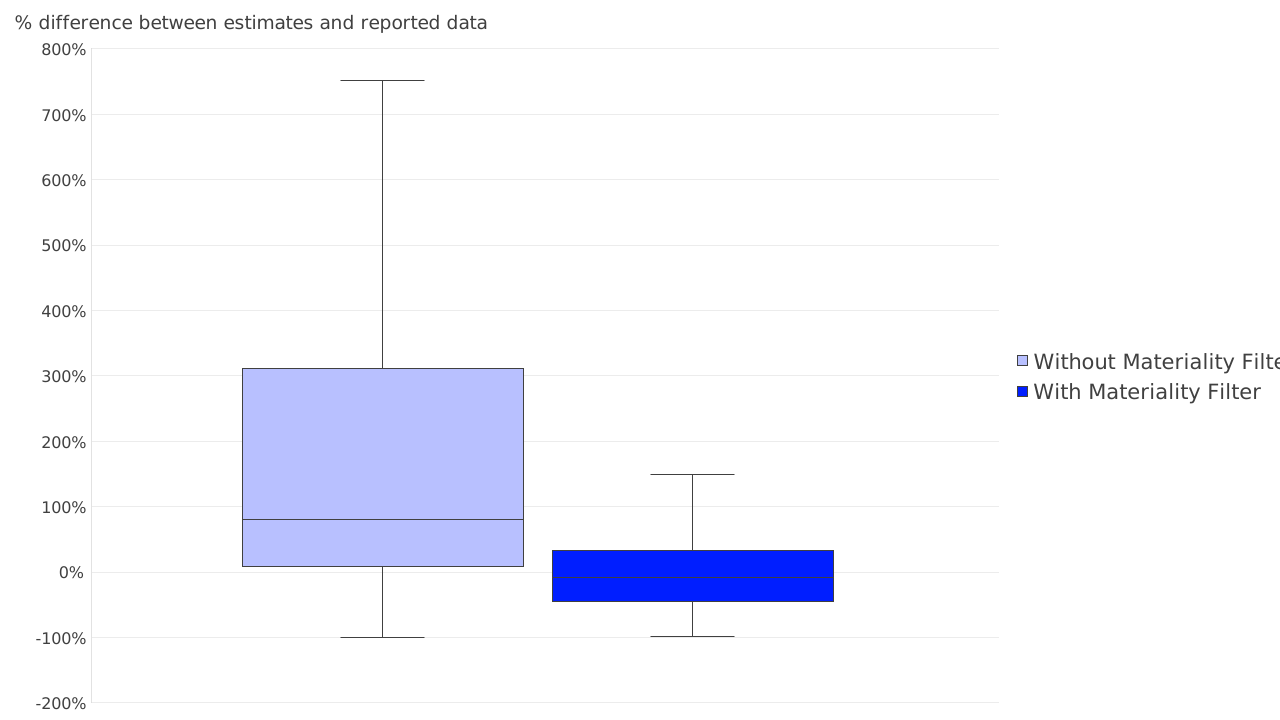
The median difference between estimates and material reported data without a materiality filter is close to +100%, indicating that estimates are typically double the reported values, whereas with the filter applied, the median drops to around -10%, showing near alignment with material disclosed data.
Source: LSEG, November 2025. Past performance is not a guide to future returns. Please see the end for important legal disclosures.
What lies ahead for Scope 3?
In summary, while Scope 3 disclosure rates and quality have improved, significant gaps and volatility remain. Thus, making it difficult for investors to rely on reported data alone. Materiality filters provide a practical interim solution; improving both the reliability of disclosures and the accuracy of estimation models, as reflected in LSEG GHG emissions estimation models. Clearer standards and better guidance for companies, though, will be critical to solving the Scope 3 Conundrum in the long run. More prescriptive guidance around which Scope 3 categories are most relevant for different sectors is critical to foster comparability and consistency across investment universes.

footnotes
[1] See Fouret, F., Olesiewicz, M. & Haalebos, R. (2024). Scope for improvement: Solving the Scope 3 conundrum. LSEG. Available at: https://www.lseg.com/en/ftse-russell/research/solving-scope-3-conundrum – Accessed on 20th November 2025. | Back to Note 1
[2] FY2023 is the latest year with complete Scope 3 coverage across FTSE All World constituents. | Back to Note 2
[3] See Figure 16, Shemfe, M., Meng, A., Jain, M., Fouret, F. (2025 Decarbonisation in portfolio benchmarks: Tracking the portfolio carbon transition. LSEG. Available at: https://www.lseg.com/en/insights/decarbonisation-in-portfolio-benchmarks-2025-tracking-portfolio-carbon-transition – Accessed on 20th November 2025. | Back to Note 3
[4] Between 2021 and 2023, disclosure of Category 15 (Investments) by Financials increased from 18% to 29% and Category 13 (Downstream Leased Assets) in Real Estate increased from 13% to 21%. | Back to Note 4
[5] The sector granularity used to define material categories depends on available sample sizes to ensure reliability, with nearly 70% based on ICB3 and ICB4 classifications (granular subsectors and highly specific industry segments). | Back to Note 5
[6] Sample includes 837 FTSE All-World companies that started reporting at least one material Scope 3 category between 2021 and 2023. | Back to Note 6
Read more about

Disclaimer
© 2025 London Stock Exchange Group plc and its applicable group undertakings (“LSEG”). LSEG includes (1) FTSE International Limited (“FTSE”), (2) Frank Russell Company (“Russell”), (3) FTSE Global Debt Capital Markets Inc. and FTSE Global Debt Capital Markets Limited (together, “FTSE Canada”), (4) FTSE Fixed Income Europe Limited (“FTSE FI Europe”), (5) FTSE Fixed Income LLC (“FTSE FI”), (6) FTSE (Beijing) Consulting Limited (“WOFE”) (7) Refinitiv Benchmark Services (UK) Limited (“RBSL”), (8) Refinitiv Limited (“RL”) and (9) Beyond Ratings S.A.S. (“BR”). All rights reserved.
FTSE Russell® is a trading name of FTSE, Russell, FTSE Canada, FTSE FI, FTSE FI Europe, WOFE, RBSL, RL, and BR. “FTSE®”, “Russell®”, “FTSE Russell®”, “FTSE4Good®”, “ICB®”, “Refinitiv” , “Beyond Ratings®”, “WMR™” , “FR™” and all other trademarks and service marks used herein (whether registered or unregistered) are trademarks and/or service marks owned or licensed by the applicable member of LSEG or their respective licensors and are owned, or used under licence, by FTSE, Russell, FTSE Canada, FTSE FI, FTSE FI Europe, WOFE, RBSL, RL or BR. FTSE International Limited is authorised and regulated by the Financial Conduct Authority as a benchmark administrator. Refinitiv Benchmark Services (UK) Limited is authorised and regulated by the Financial Conduct Authority as a benchmark administrator.
All information is provided for information purposes only. All information and data contained in this publication is obtained by LSEG, from sources believed by it to be accurate and reliable. Because of the possibility of human and mechanical inaccuracy as well as other factors, however, such information and data is provided "as is" without warranty of any kind. No member of LSEG nor their respective directors, officers, employees, partners or licensors make any claim, prediction, warranty or representation whatsoever, expressly or impliedly, either as to the accuracy, timeliness, completeness, merchantability of any information or LSEG Products, or of results to be obtained from the use of LSEG products, including but not limited to indices, rates, data and analytics, or the fitness or suitability of the LSEG products for any particular purpose to which they might be put. The user of the information assumes the entire risk of any use it may make or permit to be made of the information.
No responsibility or liability can be accepted by any member of LSEG nor their respective directors, officers, employees, partners or licensors for (a) any loss or damage in whole or in part caused by, resulting from, or relating to any inaccuracy (negligent or otherwise) or other circumstance involved in procuring, collecting, compiling, interpreting, analysing, editing, transcribing, transmitting, communicating or delivering any such information or data or from use of this document or links to this document or (b) any direct, indirect, special, consequential or incidental damages whatsoever, even if any member of LSEG is advised in advance of the possibility of such damages, resulting from the use of, or inability to use, such information.
No member of LSEG nor their respective directors, officers, employees, partners or licensors provide investment advice and nothing in this document should be taken as constituting financial or investment advice. No member of LSEG nor their respective directors, officers, employees, partners or licensors make any representation regarding the advisability of investing in any asset or whether such investment creates any legal or compliance risks for the investor. A decision to invest in any such asset should not be made in reliance on any information herein. Indices and rates cannot be invested in directly. Inclusion of an asset in an index or rate is not a recommendation to buy, sell or hold that asset nor confirmation that any particular investor may lawfully buy, sell or hold the asset or an index or rate containing the asset. The general information contained in this publication should not be acted upon without obtaining specific legal, tax, and investment advice from a licensed professional.
Past performance is no guarantee of future results. Charts and graphs are provided for illustrative purposes only. Index and/or rate returns shown may not represent the results of the actual trading of investable assets. Certain returns shown may reflect back-tested performance. All performance presented prior to the index or rate inception date is back-tested performance. Back-tested performance is not actual performance, but is hypothetical. The back-test calculations are based on the same methodology that was in effect when the index or rate was officially launched. However, back-tested data may reflect the application of the index or rate methodology with the benefit of hindsight, and the historic calculations of an index or rate may change from month to month based on revisions to the underlying economic data used in the calculation of the index or rate.
This document may contain forward-looking assessments. These are based upon a number of assumptions concerning future conditions that ultimately may prove to be inaccurate. Such forward-looking assessments are subject to risks and uncertainties and may be affected by various factors that may cause actual results to differ materially. No member of LSEG nor their licensors assume any duty to and do not undertake to update forward-looking assessments.
No part of this information may be reproduced, stored in a retrieval system or transmitted in any form or by any means, electronic, mechanical, photocopying, recording or otherwise, without prior written permission of the applicable member of LSEG. Use and distribution of LSEG data requires a licence from LSEG and/or its licensors.