

Ian Mcfarlane
- Finance leaders are increasingly expected to anticipate risk, not simply react to it, making market intelligence a core component of decision-making.
- Funding, credit, FX, commodities, supply chains and geopolitical developments are now interconnected, requiring a more holistic view of risk and opportunity.
- Leading organisations are embedding external market intelligence into treasury, strategy, investor relations and corporate development workflows to improve resilience and capital allocation.
For today’s Office of the CFO, resilience is no longer measured by how quickly the organisation reacts to volatility. It is measured by how confidently finance leaders can anticipate market shifts, quantify financial impact and act before risk becomes margin pressure, funding stress or strategic disadvantage.
The CFO mandate has expanded far beyond reporting, control and stewardship. Funding costs, credit conditions, supply chain resilience, technology investment and geopolitical developments are now deeply connected. A refinancing strategy, for example, may be influenced by interest rate expectations, market liquidity, investor sentiment, supplier health and broader policy trends. This is why market intelligence is moving from data subscription to strategic infrastructure. Like ERP systems, treasury platforms and risk controls, trusted external intelligence is becoming a core operating layer for enterprise decision-making. This layer is helping organisations connect market developments to capital allocation, liquidity planning, risk management and long-term growth.
The new CFO requirement: Transparency beyond execution
Corporate treasury has already seen this shift in FX. Transaction Cost Analysis has moved teams beyond headline rates to expose the true all-in cost of execution: spreads, timing, liquidity provider behaviour and execution quality across market conditions. With modern transaction cost analysis solutions, post-trade workflows and market connectivity, treasurers can benchmark counterparties, evidence best execution, strengthen governance and negotiate banking relationships from a position of fact.
But the same transparency principle now applies across the full CFO agenda. Finance leaders are being asked to illuminate risk across funding markets, private credit, syndicated loans, credit spreads, CDS curves, commodities, supply chains, competitors, shareholders, regulation, ESG and technology disruption.
The boardroom questions are becoming sharper:
- Are peers refinancing, issuing debt, drawing liquidity or delaying investment?
- Which supplier, commodity or counterparty exposures could become issues?
- Which semiconductor and infrastructure developments are reshaping demand and competitive advantage?
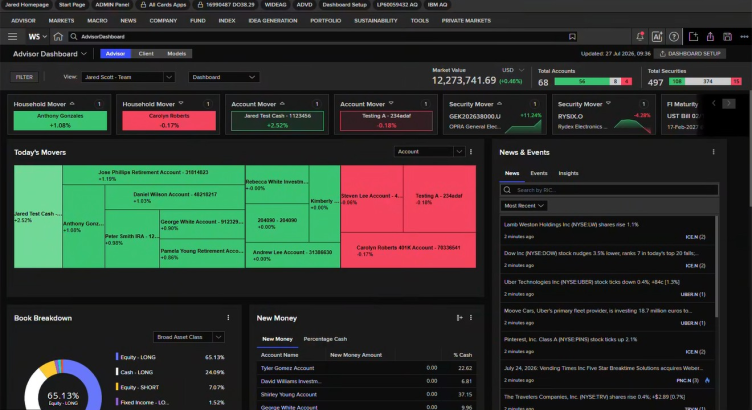
Advisor Dashboard in Workspace blends proprietary client data with LSEG’s deep analytical content
From fragmented data to connected intelligence
Internal reporting cannot answer these questions alone. The challenge is not the absence of data; it is the ability to connect market signals, company fundamentals, credit conditions, loan benchmarks, news, macro indicators, ownership intelligence, supply chain signals and workflow analytics quickly enough to change a decision while it still matters.
Leading corporates are therefore moving from dashboards to decision intelligence. By connecting external market signals with internal business data, firms are creating a more complete picture of opportunity and risk. Through trusted content, analytics and AI-enabled research, they are improving workflows across the finance function.
- Treasury teams gain earlier visibility into funding and liquidity conditions.
- Corporate Development teams can assess valuation dislocations, ownership structures, M&A activity, private-company credit risk, acquisition-funding capacity and competitive activity.
- Strategy teams can track competitive threats, AI disruption, technology-stack shifts, supply chain risks and growth opportunities.
- Investor Relations can understand shareholder behaviour, sentiment, peer performance and investor expectations.
Different teams have different mandates, but they rely on the same foundation of trusted market intelligence connected across markets, sectors and functions. This helps firms move from data to insight.
The operating layer for CFO resilience
Through a connected intelligence ecosystem, finance teams can bring together market, economic, sector and event intelligence with treasury, funding and risk management workflows.
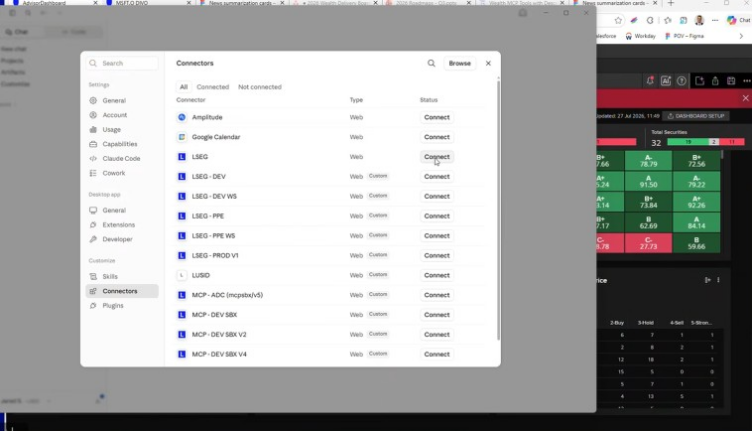
LSEG makes its vast, licensed database of AI-ready financial data and analytics directly accessible to AI applications such as Claude and Copilot through the launch of an MCP connector
By combining external market signals with internal business data, organisations can develop a more complete view of performance, risk and opportunity. This creates a richer context for investor engagement, capital allocation, strategic planning, M&A evaluation and operational resilience. It also helps organisations understand how changes in credit markets, supply chains, commodities, regulation, technology trends and geopolitical developments may influence future outcomes.
Rather than analysing these factors in isolation, leading organisations are increasingly connecting them through a common decision-making framework. The result is a sharper CFO workflow: see the signal, understand the exposure, quantify the impact and act with confidence.
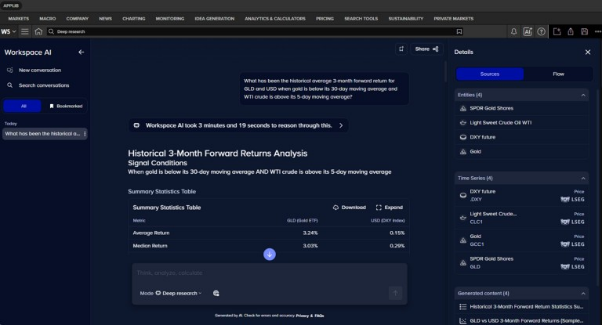
Deep Research in LSEG Workspace enables users to ask complex financial questions in natural language and orchestrates workflows across LSEG’s trusted data to generate actionable research outputs
Where intelligence creates measurable CFO impact
Market intelligence delivers the greatest value when it informs critical business decisions.
- Funding and liquidity: identify refinancing opportunities, compare peer issuance, benchmark syndicated loan and revolver pricing, evaluate private credit alternatives and detect tightening credit conditions.
- Bank relationships: benchmark execution quality, liquidity provision and all-in transaction costs across market conditions.
- Commodity and supply chain exposure: connect price volatility, supplier credit quality, sovereign risk, shipping intelligence, ESG exposure and working-capital implications.
- Growth and M&A: monitor valuation dislocations, ownership shifts, sector momentum, target credit quality and acquisition-financing windows.
- AI-era resilience: separate durable technology shifts from hype by tracking AI infrastructure investment, semiconductor supply chains, policy signals, company fundamentals, news, macro indicators and peer benchmarks.
In every case, the goal is not more information. It is better action: deciding when to refinance, hedge, preserve cash, update guidance, pursue M&A, reprice supplier risk or strengthen the investor narrative.
Resilience belongs to intelligence-led enterprises
As markets become more interconnected and change accelerates, finance leaders face growing pressure to identify the signals that matter and understand their implications for the business.
For the Office of the CFO, market intelligence is a core component of decision-making. The organisations best positioned to succeed will be those that can connect funding conditions, market developments, operational risks and strategic priorities into a clearer view of both opportunity and exposure.
LSEG helps corporates combine trusted data, news, analytics, workflow and AI-enabled research across markets and functions, enhanced through our strategic LLM and cloud partners. We help transform complexity into clarity, and clarity into smarter decisions, stronger resilience and more sustainable growth.

Legal Disclaimer
Republication or redistribution of LSE Group content is prohibited without our prior written consent.
The content of this publication is for informational purposes only and has no legal effect, does not form part of any contract, does not, and does not seek to constitute advice of any nature and no reliance should be placed upon statements contained herein. Whilst reasonable efforts have been taken to ensure that the contents of this publication are accurate and reliable, LSE Group does not guarantee that this document is free from errors or omissions; therefore, you may not rely upon the content of this document under any circumstances and you should seek your own independent legal, investment, tax and other advice. Neither We nor our affiliates shall be liable for any errors, inaccuracies or delays in the publication or any other content, or for any actions taken by you in reliance thereon.
Copyright © 2026 London Stock Exchange Group. All rights reserved.
The content of this publication is provided by London Stock Exchange Group plc, its applicable group undertakings and/or its affiliates or licensors (the “LSE Group” or “We”) exclusively.
Neither We nor our affiliates guarantee the accuracy of or endorse the views or opinions given by any third party content provider, advertiser, sponsor or other user. We may link to, reference, or promote websites, applications and/or services from third parties. You agree that We are not responsible for, and do not control such non-LSE Group websites, applications or services.
The content of this publication is for informational purposes only. All information and data contained in this publication is obtained by LSE Group from sources believed by it to be accurate and reliable. Because of the possibility of human and mechanical error as well as other factors, however, such information and data are provided "as is" without warranty of any kind. You understand and agree that this publication does not, and does not seek to, constitute advice of any nature. You may not rely upon the content of this document under any circumstances and should seek your own independent legal, tax or investment advice or opinion regarding the suitability, value or profitability of any particular security, portfolio or investment strategy. Neither We nor our affiliates shall be liable for any errors, inaccuracies or delays in the publication or any other content, or for any actions taken by you in reliance thereon. You expressly agree that your use of the publication and its content is at your sole risk.
To the fullest extent permitted by applicable law, LSE Group, expressly disclaims any representation or warranties, express or implied, including, without limitation, any representations or warranties of performance, merchantability, fitness for a particular purpose, accuracy, completeness, reliability and non-infringement. LSE Group, its subsidiaries, its affiliates and their respective shareholders, directors, officers employees, agents, advertisers, content providers and licensors (collectively referred to as the “LSE Group Parties”) disclaim all responsibility for any loss, liability or damage of any kind resulting from or related to access, use or the unavailability of the publication (or any part of it); and none of the LSE Group Parties will be liable (jointly or severally) to you for any direct, indirect, consequential, special, incidental, punitive or exemplary damages, howsoever arising, even if any member of the LSE Group Parties are advised in advance of the possibility of such damages or could have foreseen any such damages arising or resulting from the use of, or inability to use, the information contained in the publication. For the avoidance of doubt, the LSE Group Parties shall have no liability for any losses, claims, demands, actions, proceedings, damages, costs or expenses arising out of, or in any way connected with, the information contained in this document.
LSE Group is the owner of various intellectual property rights ("IPR”), including but not limited to, numerous trademarks that are used to identify, advertise, and promote LSE Group products, services and activities. Nothing contained herein should be construed as granting any licence or right to use any of the trademarks or any other LSE Group IPR for any purpose whatsoever without the written permission or applicable licence terms.