Fabian Bulabois
Volatility is not a stranger to the corporate treasurer. In an era where economic cycles seem to accelerate and global shocks reverberate through capital markets with unprecedented speed, the challenge of securing reliable and cost-effective funding - and doing so with a resilient investor base - has never been greater.
- Diversify funding sources: Move beyond traditional bond issuance by cultivating a broad investor base and exploring private credit for flexibility and resilience during market disruptions.
- Harness data for smarter decisions: Use real-time analytics and tools for benchmarking, scenario modelling, and monitoring investor composition to anticipate risks and optimize funding strategies.
- Build a future-ready treasury: Shift from reactive to proactive by challenging advisors with data-driven insights, streamlining processes, and maintaining vigilance against activist investors to protect governance and liquidity.
The role of the treasurer has evolved: they are now critical architects of financial strategy, facing expectations not just to find the lowest borrowing costs, but also to anticipate risks, broaden funding options, and communicate transparently with C-suite and board members about exposures, opportunities, and threats.
The modern funding challenge: more than just issuing bonds
Gone are the days when a single bond issuance, placed with a handful of bank partners and insurance funds, was sufficient. Today’s investors are savvier, regulations are stricter, and market swings can upend even the best-laid funding plans. Corporate treasurers must construct capital structures that weather volatility and adapt to shifting investor appetites. This means more than just timing the market as it’s also about diversification, data-driven decision-making, and proactive engagement with a broad spectrum of stakeholders.
Why robust investor diversification matters
One of the core lessons from recent market disruptions is the importance of cultivating a diverse and well-informed investor base. Relying too heavily on a single investor type, for example, hedge funds, or a small cadre of institutional buyers, can expose an issuer to concentration risk. If those holders pivot, liquidity can dry up, refinancing costs can jump, and the company may face unwelcome scrutiny. A classic case: companies caught flat-footed by activist investors building significant positions due to opaque or overly concentrated ownership structures.
A healthy mix of institutional, including pension funds, mutual funds, insurance companies, and sovereign wealth funds, as well as even retail bondholders, creates a more stable demand profile. It also improves secondary market liquidity and makes it harder for a single party to accumulate enough influence to drive disruptive change. For listed corporates, this is a powerful shield against unwanted activism and a testament to prudent treasury management.
Exploring private credit: optionality and agility in uncertain times
While public bond markets remain the backbone of corporate funding, the rise of private credit offers new avenues for treasurers seeking flexibility and speed. Private debt investment managers can deliver bespoke solutions when public markets are dislocated or when traditional banks hesitate.
Private credit investors are often more willing to negotiate covenants, tailor repayment schedules, and provide funding for complex situations. For treasurers, mixing public or private bond issuance with private credit not only diversifies sources of liquidity, but also introduces competitive tension into funding discussions. This can drive better terms, promote innovation, and ensure that the company always has a “plan B” should market windows abruptly close.
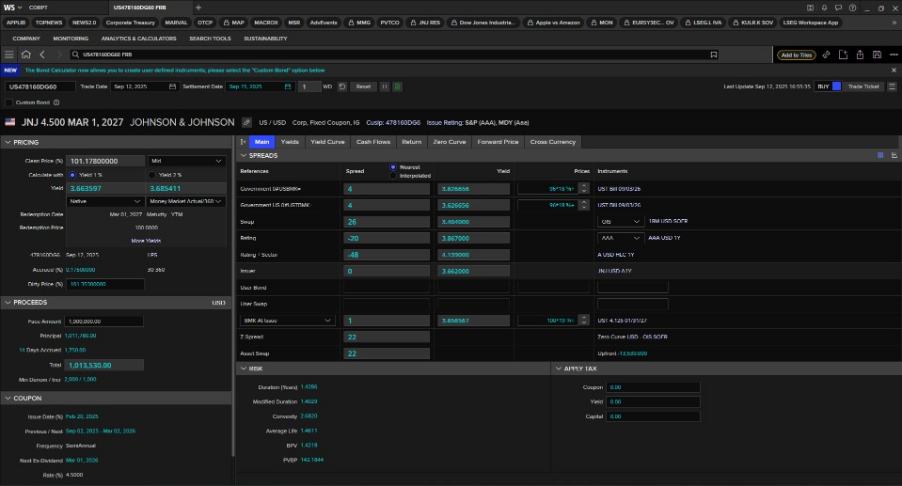
Use bond calculator in LSEG Workspace to do pre- and post-trade analysis on debt issuances.
Harnessing data and analytics for resilience
With an expanding array of funding options comes the need for clarity, speed, and precision in decision-making. The days of relying solely on the advice of syndicate banks are fading. Today, best-in-class treasurers supplement external counsel with their own rigorous analysis, using real-time market data, peer benchmarking, and scenario modelling, for example, leveraging LSEG Workspace to give internal teams a 360-degree view of their funding landscape.
- Benchmark company’s debt against both peers and the broader market, assessing spreads, maturities, and investor composition.
- Track bondholder registers and monitor shifts in the investor base in real-time, highlighting the emergence of activist investors or concentration risks before they become threats.
- Simulate hypothetical funding scenarios—comparing public, private, and hybrid structures—to identify optimal strategies under various market conditions.
- Analyse issuance windows, pricing trends, and demand signals to time the market more effectively.
- Prepare board-ready reporting packs with live data and clear analytics, ensuring leadership is informed and in control.
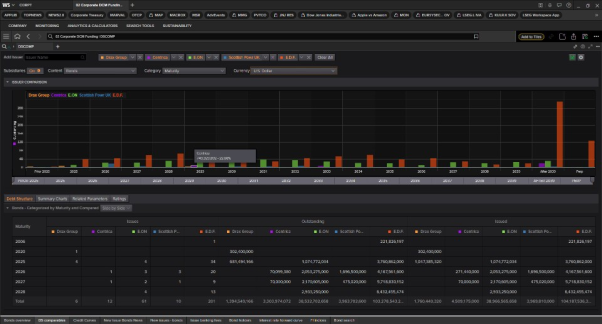
Find debt structure comparables across your industry segments in Workspace with applications like DSCOMP (debt structure comparables) and DS (debt structure), as well as plan cashflows using applications like DRS (debt repayment schedule)
Challenging the advisors: becoming a proactive funding partner
Protecting the board and C-suite: vigilance against activist investors
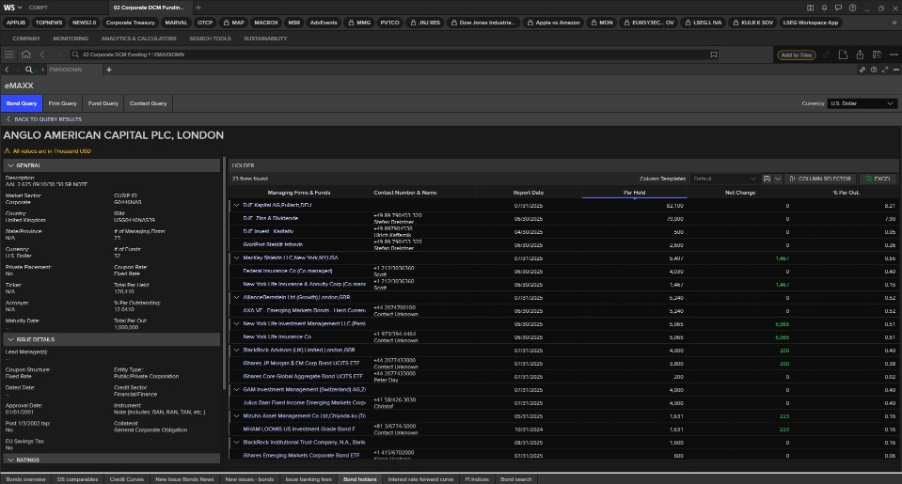
eMaxx provides real-time monitoring of bond holders, as well as other fixed income deals terms and conditions
Building the future-ready treasury function
The role of the corporate treasurer is more complex than ever, but also more strategically important. Success in today’s volatile markets demands a combination of robust investor diversification, smart liquidity management (including access to private credit), and a relentless commitment to data-driven decision-making.
LSEG Workspace stands at the intersection of all these trends, arming treasurers with the insights, tools, and confidence they need to secure optimal funding, challenge their partners, and shield their companies from unseen risks. In the end, the best defence against volatility is preparation. With the right data at your fingertips, corporate treasurers can turn uncertainty into opportunity.

Read more about

Legal Disclaimer
Republication or redistribution of LSEG content is prohibited without our prior written consent.
The content of this publication is for informational purposes only and has no legal effect, does not form part of any contract, does not, and does not seek to constitute advice of any nature and no reliance should be placed upon statements contained herein. Whilst reasonable efforts have been taken to ensure that the contents of this publication are accurate and reliable, LSEG does not guarantee that this document is free from errors or omissions; therefore, you may not rely upon the content of this document under any circumstances and you should seek your own independent legal, investment, tax and other advice. Neither We nor our affiliates shall be liable for any errors, inaccuracies or delays in the publication or any other content, or for any actions taken by you in reliance thereon.
Copyright © 2025 London Stock Exchange Group. All rights reserved.
The content of this publication is provided by London Stock Exchange Group plc, its applicable group undertakings and/or its affiliates or licensors (the “LSE Group” or “We”) exclusively.
Neither We nor our affiliates guarantee the accuracy of or endorse the views or opinions given by any third party content provider, advertiser, sponsor or other user. We may link to, reference, or promote websites, applications and/or services from third parties. You agree that We are not responsible for, and do not control such non-LSE Group websites, applications or services.
The content of this publication is for informational purposes only. All information and data contained in this publication is obtained by LSE Group from sources believed by it to be accurate and reliable. Because of the possibility of human and mechanical error as well as other factors, however, such information and data are provided "as is" without warranty of any kind. You understand and agree that this publication does not, and does not seek to, constitute advice of any nature. You may not rely upon the content of this document under any circumstances and should seek your own independent legal, tax or investment advice or opinion regarding the suitability, value or profitability of any particular security, portfolio or investment strategy. Neither We nor our affiliates shall be liable for any errors, inaccuracies or delays in the publication or any other content, or for any actions taken by you in reliance thereon. You expressly agree that your use of the publication and its content is at your sole risk.
To the fullest extent permitted by applicable law, LSE Group, expressly disclaims any representation or warranties, express or implied, including, without limitation, any representations or warranties of performance, merchantability, fitness for a particular purpose, accuracy, completeness, reliability and non-infringement. LSE Group, its subsidiaries, its affiliates and their respective shareholders, directors, officers employees, agents, advertisers, content providers and licensors (collectively referred to as the “LSE Group Parties”) disclaim all responsibility for any loss, liability or damage of any kind resulting from or related to access, use or the unavailability of the publication (or any part of it); and none of the LSE Group Parties will be liable (jointly or severally) to you for any direct, indirect, consequential, special, incidental, punitive or exemplary damages, howsoever arising, even if any member of the LSE Group Parties are advised in advance of the possibility of such damages or could have foreseen any such damages arising or resulting from the use of, or inability to use, the information contained in the publication. For the avoidance of doubt, the LSE Group Parties shall have no liability for any losses, claims, demands, actions, proceedings, damages, costs or expenses arising out of, or in any way connected with, the information contained in this document.
LSE Group is the owner of various intellectual property rights ("IPR”), including but not limited to, numerous trademarks that are used to identify, advertise, and promote LSE Group products, services and activities. Nothing contained herein should be construed as granting any licence or right to use any of the trademarks or any other LSE Group IPR for any purpose whatsoever without the written permission or applicable licence terms.