

Erwan Jacob
Artificial intelligence (AI) is no longer simply a technology theme. It is increasingly becoming a macroeconomic force that is reshaping global investment, inflation dynamics and capital markets. The scale of capital being committed to AI infrastructure is unprecedented, creating a reinforcing cycle of semiconductor demand, cloud investment and energy consumption.
While this investment boom is contributing to near-term inflationary pressures and periods of market volatility, this insight explores how it is also laying the foundations for longer-term productivity gains that could influence global economic growth.
Key takeaways:
- AI infrastructure investment is becoming a meaningful driver of global capital expenditure
- Rising demand for semiconductors, data centres and electricity is beginning to influence inflation dynamics
- Productivity gains may ultimately offset some of these inflationary pressures over the longer term
- South Korea has emerged as a significant beneficiary due to its role in advanced semiconductor manufacturing
The scale of the investment wave
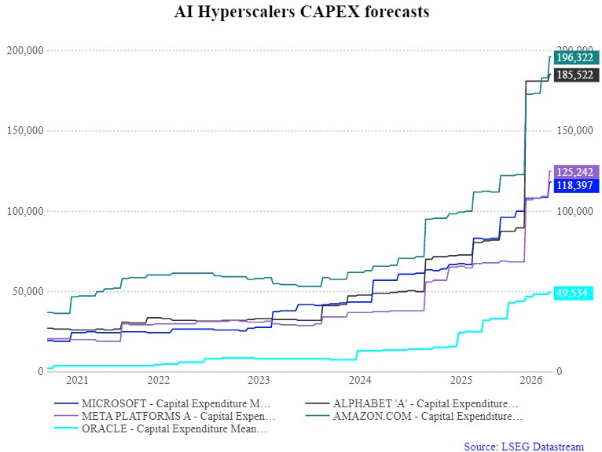
The magnitude of investment illustrates the scale of the opportunity. During 2025, leading AI companies, including Amazon, Anthropic, Google, Meta, Microsoft, OpenAI and Oracle, committed an estimated US$300 billion to AI infrastructure spanning semiconductors, data centres, power infrastructure and specialised labour.
Looking ahead, LSEG data indicates that the five largest US hyperscalers are projected to spend approximately US$720 billion on capital expenditure during 2026, supported by rapidly expanding AI-related revenues. Microsoft reported an annualised AI revenue run rate of US$37 billion, representing 123% year-on-year growth, while Amazon Web Services (AWS) recorded its fastest revenue growth in more than three years as AI-related workloads accelerated.
Source: LSEG Datastream. Past performance is not a guide to future returns. Please see the end for important legal disclosures.
AI's emerging impact on inflation
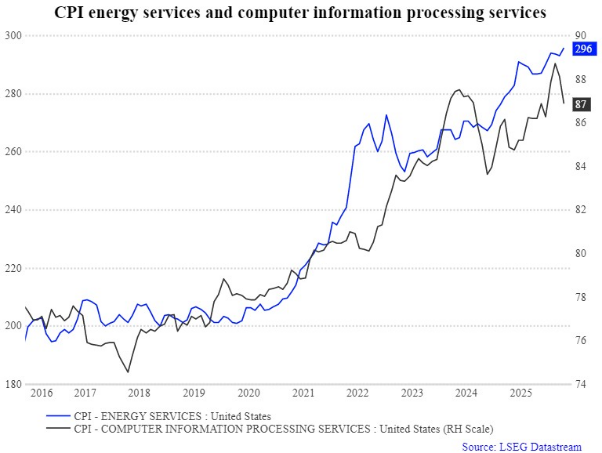
This investment wave is beginning to influence inflation across multiple sectors. Prices for computer software and accessories have risen by almost 14% over the past 12 months, reversing decades of persistent price declines. Wholesale prices for electronic components increased 28% over the same period.
The demand shock is also evident in global trade. US imports of computers more than doubled during the first quarter of 2026 to approximately US$93 billion, while semiconductor imports increased 40% and computer accessory imports rose 37% year on year. Rather than reflecting temporary supply disruption, these trends suggest that AI infrastructure has become an increasingly important source of global demand for advanced technology products.
Energy becomes a critical constraint
Energy is emerging as another key constraint. Following more than a decade of relatively stagnant electricity demand, US electricity production increased 2.5% in 2024, 2.4% in 2025, and 3.0% year-on-year in March 2026, reflecting the rapid expansion of AI data centres.
Source: LSEG Datastream. Past performance is not a guide to future returns. Please see the end for important legal disclosures.
Consumer electricity prices increased 4.6% year-on-year over the same period, highlighting how AI-related investment may be extending inflationary pressures beyond semiconductors into utilities and broader infrastructure. AI therefore represents not only a digital transformation but also a physical investment cycle requiring substantial expansion of electricity generation and transmission capacity.
From inflationary to potentially disinflationary
Despite these inflationary effects, AI also offers the prospect of becoming structurally disinflationary over the longer term. Greater automation, improved supply chain optimisation, enhanced decision-making and productivity improvements could allow economies to generate stronger output growth without proportionate increases in labour or capital costs.
The transition, however, is unlikely to be immediate. Large-scale spending on semiconductors, data centres and energy infrastructure may continue to support upward pressure on selected prices before productivity gains become sufficiently widespread to offset these effects. The relationship between AI-related investment and inflation may therefore be sequential rather than simultaneous: inflationary during the investment phase and potentially disinflationary during broader adoption.
Implications for monetary policy
This dynamic presents a complex challenge for central banks. Policymakers must balance inflation generated by exceptionally strong capital expenditure against the possibility that AI ultimately raises an economy's potential growth rate.
As a result, interest rate decisions are likely to remain sensitive to incoming inflation data, even as policymakers increasingly recognise the structural nature of AI-related investment.
South Korea: A strategic beneficiary
Source: LSEG Datastream. Past performance is not a guide to future returns. Please see the end for important legal disclosures.
Market performance and volatility
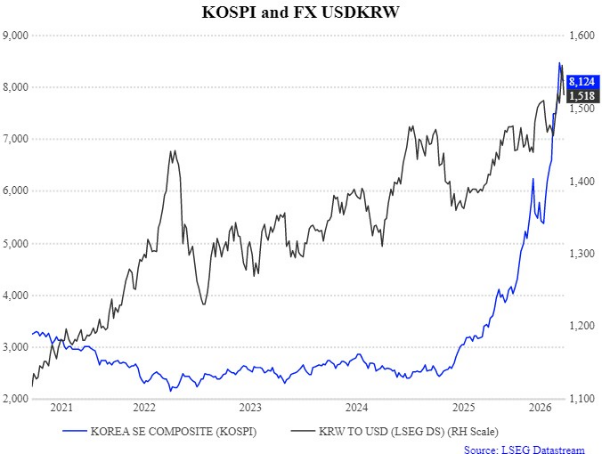
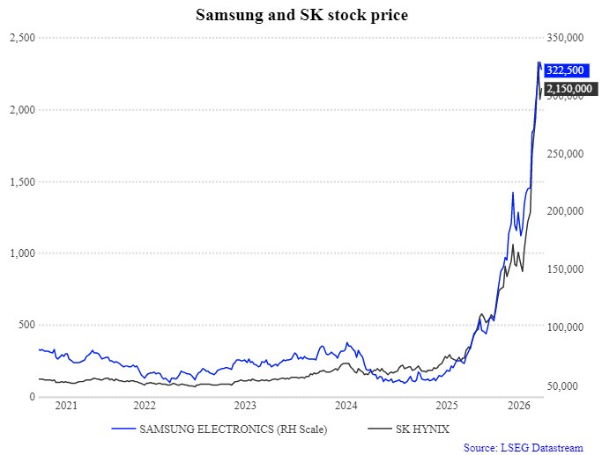
The impact on equity markets has been substantial. Prior to its recent correction, the Korean Composite Stock Price Index (KOSPI) was among the strongest-performing major equity indices globally, supported largely by gains in Samsung Electronics and SK Hynix as AI demand accelerated.
Source: LSEG Datastream. Past performance is not a guide to future returns. Please see the end for important legal disclosures.
At one stage, however, the index experienced a correction of more than 8%, illustrating how concentrated investor positioning in AI-related technology stocks has increased market sensitivity to shifts in global sentiment. Rather than indicating weaker corporate fundamentals, the decline was widely attributed to profit-taking following a strong rally and uncertainty surrounding US monetary policy.
Strong fundamentals continue to support the sector
Industry fundamentals remain robust. Demand from hyperscale cloud providers, AI developers and enterprise customers remains strong and continues to outpace available semiconductor supply, allowing manufacturers of advanced memory products to maintain significant pricing power.
This supply-demand imbalance has become one of the defining features of the current semiconductor cycle and differentiates it from previous technology upcycles that were driven primarily by consumer electronics demand.
Risks within the Korean macro environment
South Korea's macroeconomic backdrop nevertheless highlights some of the risks accompanying the AI investment cycle.
The Bank of Korea has reduced its policy rate to 2.50% in an effort to support domestic demand while remaining cautious about additional easing given persistent inflation risks. The Korean won has weakened towards multi-year lows as higher US interest rates, foreign investor repositioning and periods of stronger US dollar demand have weighed on the currency.
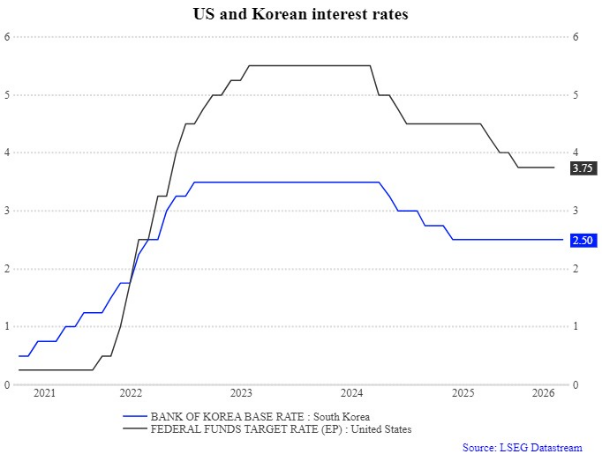
Source: LSEG Datastream. Past performance is not a guide to future returns. Please see the end for important legal disclosures.
Conclusion
Taken together, these developments suggest that AI is evolving into a global capital expenditure supercycle comparable in scale to previous periods of industrial transformation. The investment theme now extends far beyond software, encompassing semiconductor manufacturing, cloud infrastructure, electricity generation, advanced manufacturing and global supply chains.
Although elevated valuations, tighter monetary policy and geopolitical uncertainty are likely to generate periods of volatility, the structural drivers remain intact. Demand for computing power continues to outpace supply, corporate investment plans continue to expand, and countries with strategic positions within the semiconductor ecosystem, particularly South Korea, appear well positioned to benefit from this evolving investment cycle.

Read more about

Legal Disclaimer
Republication or redistribution of LSE Group content is prohibited without our prior written consent.
The content of this publication is for informational purposes only and has no legal effect, does not form part of any contract, does not, and does not seek to constitute advice of any nature and no reliance should be placed upon statements contained herein. Whilst reasonable efforts have been taken to ensure that the contents of this publication are accurate and reliable, LSE Group does not guarantee that this document is free from errors or omissions; therefore, you may not rely upon the content of this document under any circumstances and you should seek your own independent legal, investment, tax and other advice. Neither We nor our affiliates shall be liable for any errors, inaccuracies or delays in the publication or any other content, or for any actions taken by you in reliance thereon.
Copyright © 2026 London Stock Exchange Group. All rights reserved.
The content of this publication is provided by London Stock Exchange Group plc, its applicable group undertakings and/or its affiliates or licensors (the “LSE Group” or “We”) exclusively.
Neither We nor our affiliates guarantee the accuracy of or endorse the views or opinions given by any third party content provider, advertiser, sponsor or other user. We may link to, reference, or promote websites, applications and/or services from third parties. You agree that We are not responsible for, and do not control such non-LSE Group websites, applications or services.
The content of this publication is for informational purposes only. All information and data contained in this publication is obtained by LSE Group from sources believed by it to be accurate and reliable. Because of the possibility of human and mechanical error as well as other factors, however, such information and data are provided "as is" without warranty of any kind. You understand and agree that this publication does not, and does not seek to, constitute advice of any nature. You may not rely upon the content of this document under any circumstances and should seek your own independent legal, tax or investment advice or opinion regarding the suitability, value or profitability of any particular security, portfolio or investment strategy. Neither We nor our affiliates shall be liable for any errors, inaccuracies or delays in the publication or any other content, or for any actions taken by you in reliance thereon. You expressly agree that your use of the publication and its content is at your sole risk.
To the fullest extent permitted by applicable law, LSE Group, expressly disclaims any representation or warranties, express or implied, including, without limitation, any representations or warranties of performance, merchantability, fitness for a particular purpose, accuracy, completeness, reliability and non-infringement. LSE Group, its subsidiaries, its affiliates and their respective shareholders, directors, officers employees, agents, advertisers, content providers and licensors (collectively referred to as the “LSE Group Parties”) disclaim all responsibility for any loss, liability or damage of any kind resulting from or related to access, use or the unavailability of the publication (or any part of it); and none of the LSE Group Parties will be liable (jointly or severally) to you for any direct, indirect, consequential, special, incidental, punitive or exemplary damages, howsoever arising, even if any member of the LSE Group Parties are advised in advance of the possibility of such damages or could have foreseen any such damages arising or resulting from the use of, or inability to use, the information contained in the publication. For the avoidance of doubt, the LSE Group Parties shall have no liability for any losses, claims, demands, actions, proceedings, damages, costs or expenses arising out of, or in any way connected with, the information contained in this document.
LSE Group is the owner of various intellectual property rights ("IPR”), including but not limited to, numerous trademarks that are used to identify, advertise, and promote LSE Group products, services and activities. Nothing contained herein should be construed as granting any licence or right to use any of the trademarks or any other LSE Group IPR for any purpose whatsoever without the written permission or applicable licence terms.