
FTSE Russell Insights

Why Vietnam is joining the FTSE GEIS

LISTEN TO THE PODCAST

  • Paul: [00:00:00] Welcome to Index Ideas from FTSE Russell. I'm Paul Amery, your podcast host. In this podcast we look into how indices are built and why. We explore index ideas that can help you address real-world investment challenges. As a reminder to listeners, you can't invest in an index. So the concepts that we discuss during the podcast are not investment advice. Any reference to potential investment strategies is intended for informational and educational purposes only.

    Paul: [00:00:27] In the last episode of the podcast, we looked at how FTSE Russell indexes the world's equity markets. In this episode, we zoom in and we look at Vietnam, which FTSE is currently reclassifying from a frontier market to an emerging market. To discuss why this is occurring and what it means, I'm joined by Wanming Du, who is director of index policy in the Asia Pacific region for FTSE Russell. Wanming, welcome to Index ideas.

    Wanming: [00:00:53] Thank you. Hi, Paul.

    Paul: [00:00:55] Wanming, what does FTSE Russell's policy team do?

    Wanming: [00:00:58] Our job is really to set, maintain and evolve the rules that govern FTSE Russell indices. And we anchor everything around three key principles: transparency, replicability and investability. In other words, we want people to be able to understand what we do, how our indices are constructed, to be able to replicate them in practice and trust that these are the investable part of the market.

    Paul: [00:01:27] What is your role as a director of index policy in the Asia Pacific region?

    Wanming: [00:01:32] So I lead our policy work across the APAC region. What it means is I spend a lot of time really tracking the market developments, speaking with regulators and clients, making sure our global methodologies are applied in ways that make sense for the local market practice. It's really about bridging the global standards for the regional realities.

    Paul: [00:01:55] And how do you interact with FTSE Russell's policy teams in other parts of the world?

    Wanming: [00:02:00] So I think the best way to describe it is we operate as a one global policy team with regional specialisation. So I work very closely with our colleagues in Europe and the Americas to make sure our methodologies are applied consistently around the world, but also feed in the APAC insights into the global decision-making as well.

    Paul: [00:02:23] What is the FTSE Equity Country classification process and how does the policy team support it?

    Wanming: [00:02:29] So the country classification process is really our framework for determining whether a market is developed, advanced emerging, secondary emerging or frontier. The policy team supports this by doing the underlying analysis, engaging with the market, reviewing accessibility criteria and putting together evidence that leads to the final market reclassification decision.

    Paul: [00:02:55] Let's turn to Vietnam. What decision have we recently taken about Vietnam?

    Wanming: [00:02:59] So we announced that in October 2025, Vietnam will be promoted from frontier to secondary emerging market status, with the change scheduled for September 2026, implementation subject to an interim review in March 2026. This decision reflects the significant progress that Vietnam has made on market accessibility.

    Paul: [00:03:23] Why did we take that decision last autumn and not implement it immediately? Why did we say that we're going to implement it a year later, subject to an interim review this month, in March 2026? Why the delay?

    Wanming: [00:03:36] So we didn't implement Vietnam's inclusion immediately because market reclassification normally requires 6 to 12 months’ notice. So setting the September 2026 is entirely the standard practice. Now, the interim review in March is really focusing on assessing whether an optional global broker model can be in place to help index trackers to replicate the market more efficiently.

    Paul: [00:04:03] Okay, and what does this change, this upcoming change in September 2026 mean in practice? Which important flagship FTSE Russell indices will Vietnam be joining as a result of this classification change?

    Wanming: [00:04:17] Once promoted, Vietnam will become eligible for the FTSE Global Equity Index Series, including the major benchmarks such as the FTSE All-World, FTSE Global All Cap and the FTSE Emerging Market Index.

    Paul: [00:04:30] Right. So these are very widely followed indices around the world by equity investors, either as benchmarks or as the underlying for tracker products like ETFs.

    Wanming: [00:04:40] Yes.

    Paul: [00:04:41] I noticed looking back at our documents that are on the FTSE Russell website that Vietnam had been on the watch list for reclassification from frontier to secondary emerging market for eight years, starting in 2018. That's quite a long time. What did the country need to do during that period to achieve the reclassification, and how did it do it?

    Wanming: [00:05:04] So yeah, you're right. We put Vietnam on the watch list for potential promotion since 2018. Now, in the last two years, I think Vietnam made significant progress towards meeting the requirements. So Vietnam met the last two criteria for secondary emerging market status by introducing the non-prefunding model and then a failed trade management process. Additionally, the account opening process—i.e. as a foreign investor, you need to open an account—that process has been simplified. So that makes a huge difference in terms of the accessibility criteria.

    Paul: [00:05:42] And which regulatory and government bodies did you work with in Vietnam as part of this reclassification process? What kinds of interactions did you have?

    Wanming: [00:05:51] So we worked very closely with the regulator, the State Securities Commission. The stock exchanges and then also the Depository and Clearing House VSDC. We also engage with organisations such as the World Bank and SIFMA. On top of that, we regularly check in with both the onshore and offshore market participants, such as the buy side, the custodians and then also the banks as well.

    Paul: [00:06:17] As part of the FTSE Equity country classification process there's an underlying quality of markets matrix, which shows which levels of market accessibility individual markets have passed. Why is this topic of market infrastructure so important in this quality of markets assessment?

    Wanming: [00:06:37] Because a robust markets infrastructure is fundamental to investors’ confidence. Ultimately, I think [it] is to market's true investability as well. So efficient trading, for example, settlement mechanism, a resilient trading system,  a transparent regulatory framework, and also even just a simple, straightforward account opening process all play a very important role in that. So they directly really influence in terms of how investors manage operational and also counterparty risk. So they determine how easily investors can enter and exit a market. So I would say that even when a market has strong economic fundamentals, without a reliable market infrastructure, it cannot be considered genuinely accessible or investable.

    Paul: [00:07:30] Thank you for explaining that, Wanming. One of the things we do as an index provider and other index providers around the world do the same, is that we adjust companies’ equity share totals for what we call free float. How do we do that in Asian emerging markets and why is this an important topic?

    Wanming: [00:07:47] Yeah. So free float is actually a very important topic when it comes to indexing. So free float is basically the shares  that an investor can actually trade. In the calculation of free float for an index constituent, for example, we take out the government holdings, for example, insider holdings strategic holdings that they typically do not move frequently. So in many Asian emerging markets, for example, also the foreign ownership restriction means that the real investable portion can be much smaller when you take that into account. So I think the free float concept is really important. It matters a lot from an index accuracy and investability as well. It reflects that true investable size of a company and of a market.

    Paul: [00:08:37] And how do we measure that in practice? Does that involve interacting with each individual company on a regular basis or in real time? What's the technology underlying that?

    Wanming: [00:08:47] So we do a periodic check on the free float of the company. We typically do it on a quarterly cadence. Now, of course, when a corporate action or event happens, we review the company floats as well. And the way we do it is we go through, we have a data source coming from O&P , and that's really our kind of foundation of feeding into our free float calculation.

    Paul: [00:09:13] How do we interact with our external advisory committees and what is the role of those committees?

    Wanming: [00:09:21] So the external advisory committee really plays an important role in our governance process. So typically, we have representation from different industries. So from the asset owners, asset managers, they bring in the market insight and then combining the analysis that we do, all these discussions will help shape the recommendations that ultimately go into our formal governance process for decision-making.

    Paul: [00:09:51] But who takes the decisions in the end? Is it FTSE Russell? Do the external committees have a role in decision-making? What's the chain of command there?

    Wanming: [00:10:01] Yeah, I think it's very important to stress that the final decisions are actually taken by FTSE Russell’s Index Governance board. Now they consider feedback from the external committees and also recommendations from the policy team.

    Paul: [00:10:16] And which other markets—we talked about Vietnam during this podcast episode—but which other markets in Asia Pacific are you currently focusing on in your role as policy director? Are there any other ones that are top of mind for you at the moment?

    Wanming: [00:10:29] So beyond Vietnam, I wanted to mention a couple of other markets. So in India, for example, we are monitoring the developments around the introduction of a closing auction and the effort of simplifying the account opening process for foreign investors. In China, we continue to follow the country's ongoing initiative to further opening up its capital market. In South Korea, regulatory developments around short selling are of particular interest. And in Indonesia, following the recent capital markets reform, targeting to improve the data transparency and integrity of the market, we are closely watching how this change may affect our index treatment.

    Paul: [00:11:14] Wanming, thank you very much for taking the time to shine a light on this important, but probably not very well understood area of work at FTSE Russell. It's been a pleasure to have you on the podcast.

    Paul: [00:11:23] And that's it for this episode. If you've enjoyed the conversation, then please follow Index Ideas and give us a positive rating or review on your podcast app of choice. If you'd like to get in touch with Index Ideas, you can do that via the email address fmt@lseg.com. That's fmt@lseg.com. But for now from me, Paul Amery, goodbye.

On April 7 2026, FTSE Russell confirmed it will reclassify Vietnam from Frontier to Secondary Emerging market status within its equity country classification framework. This change will become effective from the market open on Monday 21 September 2026.

Wanming Du, director of index policy in the Asia Pacific region for FTSE Russell, recently joined the Index Ideas podcast to talk about Vietnam’s change of status.

Index effects of Vietnam’s promotion

What does a change from Frontier to Secondary Emerging market status signify in practice? It means that from September, Vietnamese stocks will be eligible for the FTSE Global Equity Index series (FTSE GEIS), which includes major benchmarks such as the FTSE All-World, the FTSE Global All Cap and the FTSE Emerging Market indices.

For example, the FTSE All-World index, which currently includes over 4,250 large- and mid-cap stocks from 48 developed and emerging markets, will be adding its 49th member country.

And the FTSE Emerging index, which currently includes over 2,250 large- and mid-cap stocks from 23 emerging markets, will be adding a 24th member country.

Vietnamese stocks’ inclusion in these and other FTSE GEIS indices will occur in four tranches, beginning in September 2026 and concluding in September 2027. 

This phased approach is designed to help ensure an orderly market transition by managing the anticipated capital inflows. In turn, this will support adequate funding and liquidity throughout the inclusion process.

Market infrastructure and Vietnam’s index inclusion

According to Wanming Du, taking the experience of institutional equity market participants into account when designing and managing indices is one of the key jobs of FTSE Russell’s policy team.

“Our job is really to set, maintain and evolve the rules that govern FTSE Russell indices,” Du said in the podcast.

“We anchor everything around three key principles: transparency, replicability and investability. In other words, we want people to be able to understand what we do, how our indices are constructed, to be able to replicate them in practice and trust that these are the investable part of the market.”

In Vietnam’s case, the inclusion of the country’s stocks in FTSE Russell’s main global equity benchmarks was a relatively long process, with the promotion from Frontier to Secondary Emerging status dependent on recent changes to the equity market’s infrastructure.

“We put Vietnam on the watch list for potential promotion since 2018,” Du explained in the podcast.

“In the last two years, I think Vietnam made significant progress towards meeting the requirements. It met the last two criteria for secondary emerging market status by introducing the Non-Pre-Funding (NPF) model and then a failed trade management process.”

“Additionally, the account opening process—as a foreign investor, you need to open an account—that process has been simplified. So that makes a huge difference in terms of the accessibility criteria.”

FTSE Equity Country Classification Matrix
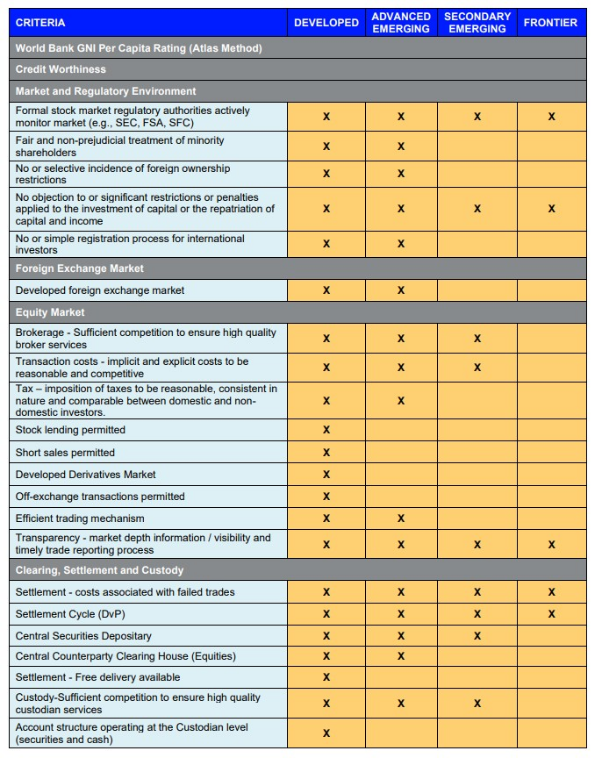
image shows the FTSE Equity Country Classification Matrix

Source: FTSE Russell. Please see the end for important legal disclosures.

According to Du, FTSE Russell had extensive interactions with both governmental and private sector bodies throughout this process.

“We worked very closely with the regulator, the State Securities Commission, the stock exchanges and the Depository and Clearing House (VSDC),” Du said in the podcast

“We also engaged with organisations such as the World Bank and ASIFMA. On top of that, we regularly check in with both the onshore and offshore market participants, such as the buy side, the custodians and then also the banks as well.”

Economic fundamentals and investability

Vietnam’s economic growth rate this millennium has been nothing short of spectacular: the country has witnessed average GDP growth of over 6.3% a year between 2000-2024, according to the World Bank.

But such a performance alone is not enough for index inclusion, Du said in the podcast. 

“A robust market infrastructure is fundamental to investors’ confidence,” she said.

“Ultimately, I think [it] is to a market's true investability as well. An efficient trading and settlement mechanism, a resilient trading system, a transparent regulatory framework, even just a simple, straightforward account opening process all play a very important role in that.”

“They directly influence how investors manage operational and counterparty risk. They determine how easily investors can enter and exit a market. I would say that even when a market has a strong economic fundamentals, without a reliable market infrastructure it cannot be considered genuinely accessible or investable.”

To listen to the Index Ideas podcast featuring Wanming Du, click here.

Read more about

Stay updated

Subscribe to an email recap from:

Disclaimer

© [2026] London Stock Exchange Group plc and its applicable group undertakings (“LSEG”). LSEG includes (1) FTSE International Limited (“FTSE”), (2) Frank Russell Company (“Russell”), (3) FTSE Global Debt Capital Markets Inc. “FTSE Canada”, (4) FTSE Fixed Income LLC (“FTSE FI”), (5) FTSE (Beijing) Consulting Limited (“WOFE”), FTSE EU SAS ("FTSE EU"). All rights reserved.

FTSE Russell® is a trading name of FTSE, Russell, FTSE Canada, FTSE FI, WOFE, FTSE EU and other LSEG entities providing LSEG Benchmark and Index services. “FTSE®”, “Russell®”, “FTSE Russell®”, “FTSE4Good®”, “ICB®”, “Refinitiv, “WMR™”  “FR™” and all other trademarks and service marks used herein (whether registered or unregistered) are trademarks and/or service marks owned or licensed by the applicable member of LSEG or their respective licensors.

FTSE International Limited is authorised as a Benchmark Administrator and regulated in the United Kingdom (UK) by the Financial Conduct Authority ("FCA") according to the UK Benchmark Regulation, FCA Reference Number 796803. FTSE EU SAS is authorised as Benchmark Administrator and regulated in the European Union (EU) by the Autorité des Marches Financiers (“AMF”) according to the EU Benchmark Regulation.

All information is provided for information purposes only. All information and data contained in this publication is obtained by LSEG, from sources believed by it to be accurate and reliable. Because of the possibility of human and mechanical inaccuracy as well as other factors, however, such information and data is provided "as is" without warranty of any kind. No member of LSEG nor their respective directors, officers, employees, partners or licensors make any claim, prediction, warranty or representation whatsoever, expressly or impliedly, either as to the accuracy, timeliness, completeness, merchantability of any information or LSEG Products, or of results to be obtained from the use of LSEG products, including but not limited to indices, rates, data and analytics, or the fitness or suitability of the LSEG products for any particular purpose to which they might be put. The user of the information assumes the entire risk of any use it may make or permit to be made of the information.

No responsibility or liability can be accepted by any member of LSEG nor their respective directors, officers, employees, partners or licensors for (a) any loss or damage in whole or in part caused by, resulting from, or relating to any inaccuracy (negligent or otherwise) or other circumstance involved in procuring, collecting, compiling, interpreting, analysing, editing, transcribing, transmitting, communicating or delivering any such information or data or from use of this document  or links to this document or (b) any direct, indirect, special, consequential or incidental damages whatsoever, even if any member of LSEG is advised in advance of the possibility of such damages, resulting from the use of, or inability to use, such information.

No member of LSEG nor their respective directors, officers, employees, partners or licensors provide investment advice and nothing in this document should be taken as constituting financial or investment advice. No member of LSEG nor their respective directors, officers, employees, partners or licensors make any representation regarding the advisability of investing in any asset or whether such investment creates any legal or compliance risks for the investor. A decision to invest in any such asset should not be made in reliance on any information herein. Indices and rates cannot be invested in directly. Inclusion of an asset in an index or rate is not a recommendation to buy, sell or hold that asset nor confirmation that any particular investor may lawfully buy, sell or hold the asset or an index or rate containing the asset. The general information contained in this publication should not be acted upon without obtaining specific legal, tax, and investment advice from a licensed professional.

Past performance is no guarantee of future results. Charts and graphs are provided for illustrative purposes only. Index and/or rate returns shown may not represent the results of the actual trading of investable assets. Certain returns shown may reflect back-tested performance. All performance presented prior to the index or rate inception date is back-tested performance. Back-tested performance is not actual performance, but is hypothetical. The back-test calculations are based on the same methodology that was in effect when the index or rate was officially launched. However, back-tested data may reflect the application of the index or rate methodology with the benefit of hindsight, and the historic calculations of an index or rate may change from month to month based on revisions to the underlying economic data used in the calculation of the index or rate.

This document may contain forward-looking assessments. These are based upon a number of assumptions concerning future conditions that ultimately may prove to be inaccurate. Such forward-looking assessments are subject to risks and uncertainties and may be affected by various factors that may cause actual results to differ materially. No member of LSEG nor their licensors assume any duty to and do not undertake to update forward-looking assessments.

No part of this information may be reproduced, stored in a retrieval system or transmitted in any form or by any means, electronic, mechanical, photocopying, recording or otherwise, without prior written permission of the applicable member of LSEG. Use and distribution of LSEG data requires a licence from LSEG and/or its licensors.