
Private markets have become an increasingly critical component of institutional portfolios. As total portfolio approaches gain traction, expectations around the timeliness, consistency and comparability of data are also rising—bringing the limitations of traditional private markets benchmarks into sharper focus.
In response, FTSE Russell and StepStone Group have developed the FTSE StepStone Global Private Market Indices, an innovative index series designed to reflect daily fund-level activity.
In this FTSE Russell Insight, we explore how private markets and their benchmarks are evolving and how the FTSE StepStone Global Private Market Indices aim to provide a higher-frequency view of performance.
The evolving investment landscape and benchmarking gap
Private markets have expanded significantly over the past decade, becoming a central part of institutional portfolio construction. A broader range of investors are increasing allocations, drawn by differentiated return streams and the potential for long-term value creation.
The set of stakeholders engaging with private markets is also evolving. Beyond traditional allocation teams, chief information officers and risk managers are taking more active roles. As private assets are incorporated more fully into total portfolio frameworks, expectations around data transparency, comparability and timeliness are rising.
Unlike public markets, where pricing is continuous and standardized, private market data is fragmented and periodic. Fund-level valuations are typically reported quarterly, with a lag of 60 to 120 days as data is collected, reconciled and validated. Methodologies for calculating performance can vary across strategies and managers, making comparisons less straightforward.
Existing benchmarking approaches reflect different priorities around accuracy, coverage and transparency:
- Limited Partner (LP)-sourced datasets draw on investor cash flows and commitments, offering a consistent and closely reconciled view of fund-level performance that relies on representative investor data selection.
- General Partner (GP)-reported datasets provide direct insight into fund activity and strategy detail, though coverage can be selective and less consistently validated across sources.
- Blended datasets combine public filings with voluntary LP and GP submissions, aiming for broader coverage but often facing challenges around consistency and data quality.
- Deal- or asset-level datasets offer granular transaction insight, particularly in credit markets, but may not fully capture fund-level performance experienced by investors.
These approaches can create practical challenges for investors. Evaluating private and public assets within a single portfolio framework can become difficult when the underlying data is not aligned in frequency or methodology. In periods of market volatility, the lag in private market reporting can further complicate risk assessment and decision-making.
Introducing the FTSE StepStone Global Private Market Indices
To address these challenges, FTSE Russell and StepStone Group have partnered to develop a new series of private market indices that reflect daily fund-level activity. The benchmarks are designed to help investors better integrate private markets into multi-asset portfolios, improve transparency and enhance responsiveness in portfolio management.
The FTSE StepStone Global Private Market Indices use StepStone’s institutional-grade dataset of closed-end private equity fund performance, which captures NAV updates, capital calls, distributions and currency movements.
Importantly, the StepStone platform sources data directly from LP returns and GP reporting, covering approximately 5,200 funds accounting for $4.4 trillion NAV. [note1] The data is paired with FTSE Russell’s established index governance framework—including independent advisory committees, published ground rules and monthly restatement protocols—to produce a rules-based index series.
The FTSE StepStone Global Private Market Indices are available in two complementary methodologies, each designed to serve different analytical and portfolio management needs:
- The Daily Cash-Adjusted methodology – Follows private market industry standards by rolling forward reported NAVs using cash flows and foreign exchange movements.
- The Daily Market methodology – Extends the Daily Cash-Adjusted methodology by incorporating estimated mark-to-market valuations derived from relevant public market indices and their historical relationships with private market strategies.
The FTSE StepStone indices are anchored in the fund NAVs reported by GPs, which occur quarterly with a lag . To address this, FTSE has created the Daily Market methodology to provide intra-quarter mark-to-market estimations.
In other words, if an investor were to trade their private market fund position intra-quarter, this variant of the benchmark would provide an estimate of its valuation. The Daily Market index methodology does this by taking the most recent official valuation data and applying a market adjustment factor based on public proxy indices.
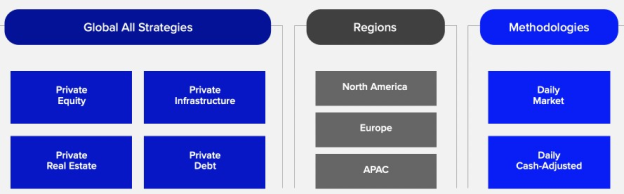
The FTSE StepStone Global Private Market index series covers a broad cross-section of private markets, including private equity, private credit, real estate and infrastructure, across major global regions. It supports segmentation by strategy, geography and vintage, enabling more tailored benchmarking approaches aligned with portfolio exposures and objectives.
Figure 1. Mapping the private markets index universe with FTSE StepStone Global Private Market Indices
Practical applications
The FTSE StepStone Global Private Market Indices are intended to support a range of use cases:
- Portfolio monitoring and allocation – For asset owners and allocators, the indices can provide a more consistent framework for assessing private market exposures alongside public assets. A higher-frequency view may support more informed discussions around allocation, rebalancing and portfolio positioning.
- Benchmarking and reporting – For fund managers, consultants and investor relations teams, the indices offer an additional reference point for performance comparison and communication. By providing a standardised framework, they may help improve consistency in reporting across strategies and time horizons.
- Valuation – For fund managers and investors, these indices provide an additional input for valuation and as a reference for independent valuation ranges and appraisals.
- Risk management – More frequent index updates may help support scenario analysis, stress testing and broader risk oversight, particularly in periods of market volatility.
- Product development and research – A more granular and systematic index framework may support research, strategy development and the design of solutions that integrate private and public assets.
The continued development of private markets benchmarking tools represents an important step toward improving transparency, supporting decision-making and enabling a more coherent view of total portfolio outcomes. By combining high-quality data with complementary methodologies and an established global index framework, the FTSE StepStone Global Private Market Indices aim to provide a more informative view of private market performance.
To learn more about the FTSE StepStone Global Private Market Indices, speak to one of our experts.
Sources
[1] Source: StepStone LLP, data as of April 30, 2026. Number of funds: 5,260; NAV: $4,429,780,245,746 | Back to Note 1

Disclaimer
© [2026] London Stock Exchange Group plc and its applicable group undertakings (“LSEG”). LSEG includes (1) FTSE International Limited (“FTSE”), (2) Frank Russell Company (“Russell”), (3) FTSE Global Debt Capital Markets Inc. “FTSE Canada”, (4) FTSE Fixed Income LLC (“FTSE FI”), (5) FTSE (Beijing) Consulting Limited (“WOFE”), (6) FTSE EU SAS ("FES"). All rights reserved.
FTSE Russell® is a trading name of FTSE, Russell, FTSE Canada, FTSE FI, WOFE, FTSE EU and other LSEG entities providing LSEG Benchmark and Index services. “FTSE®”, “Russell®”, “FTSE Russell®”, “FTSE4Good®”, “ICB®”, “Refinitiv”, “WMR™” “FR™” and all other trademarks and service marks used herein (whether registered or unregistered) are trademarks and/or service marks owned or licensed by the applicable member of LSEG or their respective licensors.
FTSE International Limited is authorised as a Benchmark Administrator and regulated in the United Kingdom (UK) by the Financial Conduct Authority ("FCA") according to the UK Benchmark Regulation, FCA Reference Number 796803. FTSE EU SAS is authorised as Benchmark Administrator and regulated in the European Union (EU) by the Autorité des Marches Financiers (“AMF”) according to the EU Benchmark Regulation.
All information is provided for information purposes only. All information and data contained in this publication is obtained by LSEG, from sources believed by it to be accurate and reliable. Because of the possibility of human and mechanical inaccuracy as well as other factors, however, such information and data is provided "as is" without warranty of any kind. No member of LSEG nor their respective directors, officers, employees, partners or licensors make any claim, prediction, warranty or representation whatsoever, expressly or impliedly, either as to the accuracy, timeliness, completeness, merchantability of any information or LSEG Products, or of results to be obtained from the use of LSEG products, including but not limited to indices, rates, data and analytics, or the fitness or suitability of the LSEG products for any particular purpose to which they might be put. The user of the information assumes the entire risk of any use it may make or permit to be made of the information.
No responsibility or liability can be accepted by any member of LSEG nor their respective directors, officers, employees, partners or licensors for (a) any loss or damage in whole or in part caused by, resulting from, or relating to any inaccuracy (negligent or otherwise) or other circumstance involved in procuring, collecting, compiling, interpreting, analysing, editing, transcribing, transmitting, communicating or delivering any such information or data or from use of this document or links to this document or (b) any direct, indirect, special, consequential or incidental damages whatsoever, even if any member of LSEG is advised in advance of the possibility of such damages, resulting from the use of, or inability to use, such information.
No member of LSEG nor their respective directors, officers, employees, partners or licensors provide investment advice and nothing in this document should be taken as constituting financial or investment advice. No member of LSEG nor their respective directors, officers, employees, partners or licensors make any representation regarding the advisability of investing in any asset or whether such investment creates any legal or compliance risks for the investor. A decision to invest in any such asset should not be made in reliance on any information herein. Indices and rates cannot be invested in directly. Inclusion of an asset in an index or rate is not a recommendation to buy, sell or hold that asset nor confirmation that any particular investor may lawfully buy, sell or hold the asset or an index or rate containing the asset. The general information contained in this publication should not be acted upon without obtaining specific legal, tax, and investment advice from a licensed professional.
Past performance is no guarantee of future results. Charts and graphs are provided for illustrative purposes only. Index and/or rate returns shown may not represent the results of the actual trading of investable assets. Certain returns shown may reflect back-tested performance. All performance presented prior to the index or rate inception date is back-tested performance. Back-tested performance is not actual performance, but is hypothetical. The back-test calculations are based on the same methodology that was in effect when the index or rate was officially launched. However, back-tested data may reflect the application of the index or rate methodology with the benefit of hindsight, and the historic calculations of an index or rate may change from month to month based on revisions to the underlying economic data used in the calculation of the index or rate.
This document may contain forward-looking assessments. These are based upon a number of assumptions concerning future conditions that ultimately may prove to be inaccurate. Such forward-looking assessments are subject to risks and uncertainties and may be affected by various factors that may cause actual results to differ materially. No member of LSEG nor their licensors assume any duty to and do not undertake to update forward-looking assessments.
No part of this information may be reproduced, stored in a retrieval system or transmitted in any form or by any means, electronic, mechanical, photocopying, recording or otherwise, without prior written permission of the applicable member of LSEG. Use and distribution of LSEG data requires a licence from LSEG and/or its licensors.