

Ryuichi Urino
FTSE Russell FICC Product management & research, Senior Director Ryuichi Urino
As index investing continues to expand, currency hedging has become an increasingly important component of portfolio management. For investors with global exposures, currency movements can materially affect returns, making their management a key consideration.
At the same time, currency exposures are continuously evolving due to cash flow and market movements, yet traditional hedging approaches may not always allow for timely and flexible adjustments. Against this backdrop, in this article we explore how greater agility in currency hedging can support more effective portfolio management in index investing.
In practice, currency hedging is not a static exercise. Portfolio exposures evolve constantly as a result of cash flows and portfolio rebalancing. In principle, such changes would call for a continuous reassessment of hedging positions across all currencies and a corresponding rebalancing of FX forward contracts.
However, in multi-currency portfolios, a full restructuring of hedges each time exposures change is often impractical, given transaction costs and the operational complexity associated with the rebalancing of forward contracts. As a result, adjustments are frequently partial or delayed, leaving hedging positions temporarily out of alignment with underlying exposures.
In this context, maintaining a perfectly aligned hedge in line with continuously evolving portfolio exposures is subject to practical constraints. From this perspective, beyond the precision of hedging, the ability to adjust positions in a timely and efficient manner—namely, “agility”—emerges as a key consideration in portfolio management. Accordingly, there is growing interest in more flexible approaches that can complement traditional hedging methods.
Against this backdrop, the Osaka Exchange (OSE) introduced, on 13 April, FX futures referencing the WMR FX benchmark, providing market participants with an additional tool for managing currency exposures. The newly launched OSE contracts cover major currencies, including the US dollar, euro, and the offshore Chinese renminbi (CNH). The contracts are listed on a quarterly cycle (March, June, September and December), with maturities extending up to 15 months, reflecting commonly used tenors in futures contracts.
For investors tracking the FTSE World Government Bond Index (FTSE WGBI), these currencies represent the largest components by market value. In the case of the FTSE WGBI excluding Japan, the US dollar, euro and offshore renminbi together account for approximately 87% of the index by market capitalisation.
FTSE WGBI currency exposures over time
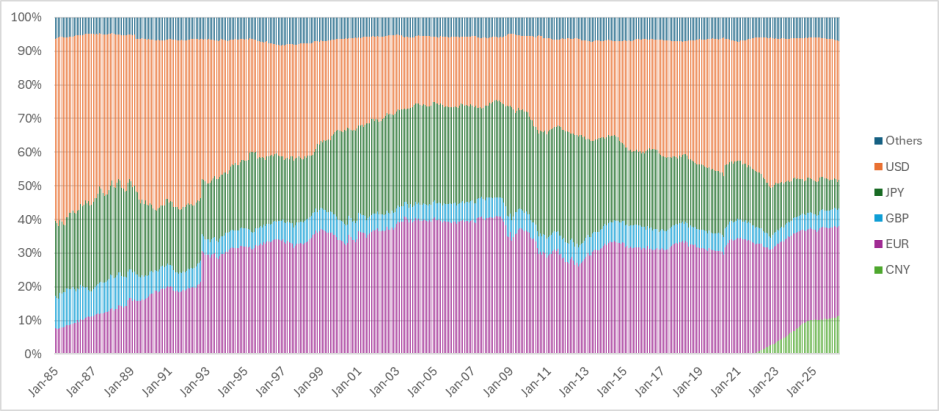
Source: FTSE Russell, data from January 1985-April 2026. Past performance is not a guide to future returns. Please see the end for important legal disclosures.
FTSE WGBI (ex-Japan) currency exposures over time
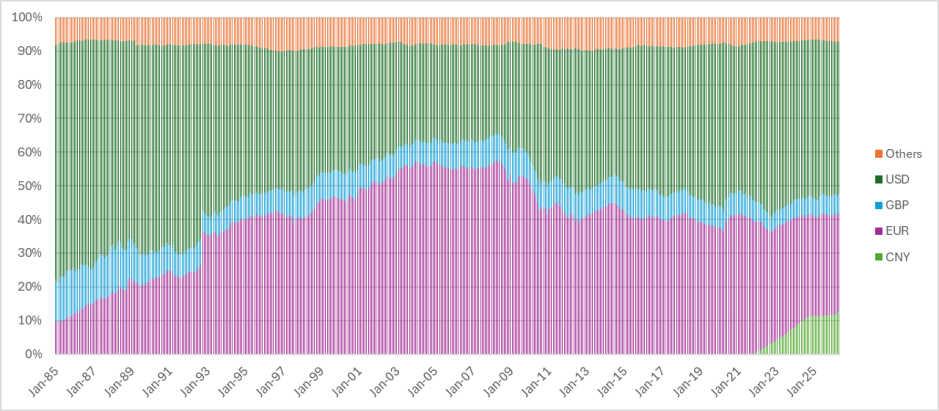
Source: FTSE Russell, data from January 1985-April 2026. Past performance is not a guide to future returns. Please see the end for important legal disclosures.
Moreover, given the relatively high correlation between the US dollar and euro and several other developed market currencies, these exposures may also serve as practical proxies for hedging purposes. As a result, even with a limited set of currencies, such instruments may provide a sufficiently effective and agile solution for managing currency risk in practice.
It is also important to acknowledge certain limitations. The current contracts are limited to a standardised three-month cycle, which may not fully align with all hedging horizons. In addition, the Chinese renminbi exposure is referenced to the offshore market (CNH), which may not perfectly match onshore (CNY) exposures in all cases.
At the same time, these features should be considered in the broader context of their intended use. The standardised structure of listed futures supports transparency in valuation because these contracts are marked to market daily, while their exchange-traded nature enables more timely and flexible adjustments to hedging positions. As such, these instruments may serve as a practical complement to existing hedging approaches, particularly where agility and operational efficiency are key considerations.
Looking ahead, the development of market liquidity will be an important factor to monitor. While open interest was initially concentrated in USD contracts, trading activity in CNH-denominated futures has increased over time, with open interest in USD and CNH reaching comparable levels as at mid-May 2026. By contrast, activity in EUR contracts remains more limited at this stage.
That said, the concentration of liquidity in the most widely used currency at the initial stage is not uncommon in the development of new markets. As market participation broadens, liquidity in other currencies may be expected to deepen over time, enhancing the overall effectiveness of FX futures as part of a broader hedging toolkit.
In summary, as currency exposures in index portfolios continue to evolve, the ability to adjust hedging positions in a timely and efficient manner is becoming increasingly important. While traditional over-the-counter (“OTC”) instruments remain essential for managing longer-term and more customised exposures, listed FX futures offer a complementary approach that may enhance agility in day-to-day portfolio management.
Although the market is still in its early stages of development, particularly in EUR contract, the combination of broad currency coverage, operational flexibility and transparent pricing suggests that such instruments could play an increasingly relevant role in supporting practical and efficient currency hedging for index investors.


Disclaimer
© [2026] London Stock Exchange Group plc and its applicable group undertakings (“LSEG”). LSEG includes (1) FTSE International Limited (“FTSE”), (2) Frank Russell Company (“Russell”), (3) FTSE Global Debt Capital Markets Inc. “FTSE Canada”, (4) FTSE Fixed Income LLC (“FTSE FI”), (5) FTSE (Beijing) Consulting Limited (“WOFE”), (6) FTSE EU SAS ("FES"). All rights reserved.
FTSE Russell® is a trading name of FTSE, Russell, FTSE Canada, FTSE FI, WOFE, FTSE EU and other LSEG entities providing LSEG Benchmark and Index services. “FTSE®”, “Russell®”, “FTSE Russell®”, “FTSE4Good®”, “ICB®”, “Refinitiv”, “WMR™” “FR™” and all other trademarks and service marks used herein (whether registered or unregistered) are trademarks and/or service marks owned or licensed by the applicable member of LSEG or their respective licensors.
FTSE International Limited is authorised as a Benchmark Administrator and regulated in the United Kingdom (UK) by the Financial Conduct Authority ("FCA") according to the UK Benchmark Regulation, FCA Reference Number 796803. FTSE EU SAS is authorised as Benchmark Administrator and regulated in the European Union (EU) by the Autorité des Marches Financiers (“AMF”) according to the EU Benchmark Regulation.
All information is provided for information purposes only. All information and data contained in this publication is obtained by LSEG, from sources believed by it to be accurate and reliable. Because of the possibility of human and mechanical inaccuracy as well as other factors, however, such information and data is provided "as is" without warranty of any kind. No member of LSEG nor their respective directors, officers, employees, partners or licensors make any claim, prediction, warranty or representation whatsoever, expressly or impliedly, either as to the accuracy, timeliness, completeness, merchantability of any information or LSEG Products, or of results to be obtained from the use of LSEG products, including but not limited to indices, rates, data and analytics, or the fitness or suitability of the LSEG products for any particular purpose to which they might be put. The user of the information assumes the entire risk of any use it may make or permit to be made of the information.
No responsibility or liability can be accepted by any member of LSEG nor their respective directors, officers, employees, partners or licensors for (a) any loss or damage in whole or in part caused by, resulting from, or relating to any inaccuracy (negligent or otherwise) or other circumstance involved in procuring, collecting, compiling, interpreting, analysing, editing, transcribing, transmitting, communicating or delivering any such information or data or from use of this document or links to this document or (b) any direct, indirect, special, consequential or incidental damages whatsoever, even if any member of LSEG is advised in advance of the possibility of such damages, resulting from the use of, or inability to use, such information.
No member of LSEG nor their respective directors, officers, employees, partners or licensors provide investment advice and nothing in this document should be taken as constituting financial or investment advice. No member of LSEG nor their respective directors, officers, employees, partners or licensors make any representation regarding the advisability of investing in any asset or whether such investment creates any legal or compliance risks for the investor. A decision to invest in any such asset should not be made in reliance on any information herein. Indices and rates cannot be invested in directly. Inclusion of an asset in an index or rate is not a recommendation to buy, sell or hold that asset nor confirmation that any particular investor may lawfully buy, sell or hold the asset or an index or rate containing the asset. The general information contained in this publication should not be acted upon without obtaining specific legal, tax, and investment advice from a licensed professional.
Past performance is no guarantee of future results. Charts and graphs are provided for illustrative purposes only. Index and/or rate returns shown may not represent the results of the actual trading of investable assets. Certain returns shown may reflect back-tested performance. All performance presented prior to the index or rate inception date is back-tested performance. Back-tested performance is not actual performance, but is hypothetical. The back-test calculations are based on the same methodology that was in effect when the index or rate was officially launched. However, back-tested data may reflect the application of the index or rate methodology with the benefit of hindsight, and the historic calculations of an index or rate may change from month to month based on revisions to the underlying economic data used in the calculation of the index or rate.
This document may contain forward-looking assessments. These are based upon a number of assumptions concerning future conditions that ultimately may prove to be inaccurate. Such forward-looking assessments are subject to risks and uncertainties and may be affected by various factors that may cause actual results to differ materially. No member of LSEG nor their licensors assume any duty to and do not undertake to update forward-looking assessments.
No part of this information may be reproduced, stored in a retrieval system or transmitted in any form or by any means, electronic, mechanical, photocopying, recording or otherwise, without prior written permission of the applicable member of LSEG. Use and distribution of LSEG data requires a licence from LSEG and/or its licensors.