

Adam Gebler
- Private markets are becoming a core allocation
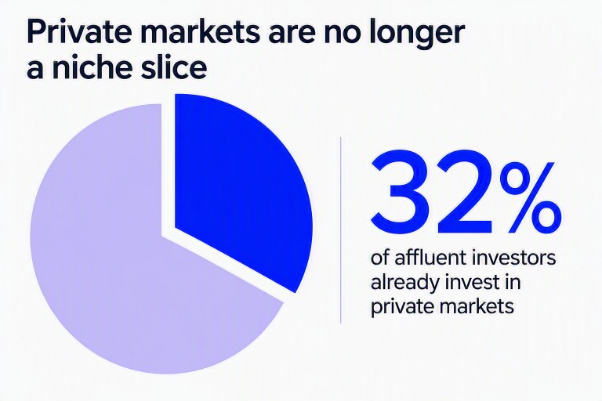
Nearly one-third of affluent investors now hold private market investments, with most allocating at least 10% of their investable assets to the asset class.
- Millennials are leading adoption
Two-thirds of affluent Millennials already invest in private markets, significantly outpacing Gen X and Baby Boomer investors.
- Benchmarks are building investor confidence
Investors increasingly want transparent performance measurement, with most viewing benchmarks as essential for evaluating private market investments.
Private markets have become an increasingly important part of the investment conversation. As access expands and familiarity grows, affluent U.S. investors are not only allocating to the asset class in greater numbers—they're also becoming more thoughtful about how they access it and evaluate its performance.
Key findings from the 2026 FTSE Russell wealth pulse survey illustrate how affluent investors are approaching private markets today, from adoption trends and the role of financial advisors to the growing importance of benchmarks in supporting investment decisions.
Private markets gain ground, especially among Millennials
Private markets continue to gain traction among affluent investors, with adoption extending beyond early movers into the broader wealth management landscape. Nearly one third (32%) of affluent investors now hold private market investments, and for most, participation is relatively recent: 61% began investing in the asset class within the past five years. The majority (74%) have made private markets a meaningful component of their portfolios, allocating 10% or more of their investable assets.
Younger investors are at the forefront of this trend. More than two thirds (67%) of affluent Millennials report investing in private markets, compared with 30% of Gen X investors and just 11% of Baby Boomers. Longer investment horizons and greater willingness to take risk may help explain the generational divide.
The survey also suggests that demand has further room to grow. Among affluent investors who do not currently invest in private markets, nearly 3 in 10 (27%) say they are likely to begin doing so within the next 12 months. Intentions are particularly strong among Millennials, with more than half (56%) expecting to enter the market, compared with roughly one fifth (19%) of Baby Boomers.
Advisor are the gateway to private markets
As investor interest in private markets continues to grow, the survey suggests that financial advisors are the primary gateway to the asset class. More than three quarters (77%) of affluent investors who invest in private markets do so through a financial advisor, with 44% accessing the asset class through wealth managers or private banks.
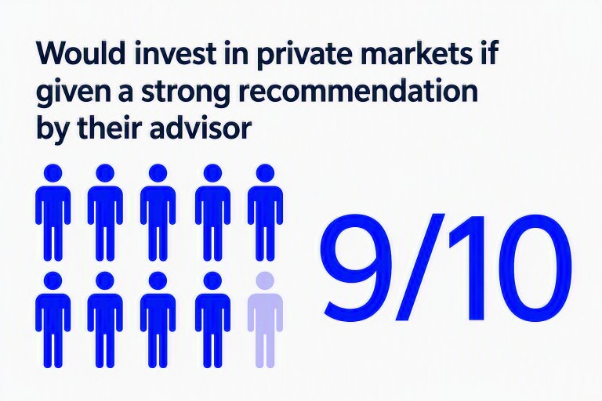
Advisor recommendations carry significant weight. Among investors who have an advisor, 89% say they would invest in private markets following a strong recommendation, compared with 55% who say they would invest regardless.
Despite this, the survey points to a gap between investor interest and advisor engagement. Nearly one third (30%) of advised investors say they would like to discuss private markets but have not yet done so, while only 26% report having had an in-depth conversation about the asset class. These findings suggest that advisors have an opportunity to play an even greater role in helping investors access and understand private markets while strengthening relations with younger clients.
Benchmarks become increasingly important as private markets mature
The survey points to noteworthy demand for tools that help investors evaluate private market performance. With return potential named as the primary motivation for allocating to the asset class, affluent investors are focusing on objective measures of performance and comparability as private markets become a larger part of portfolios.
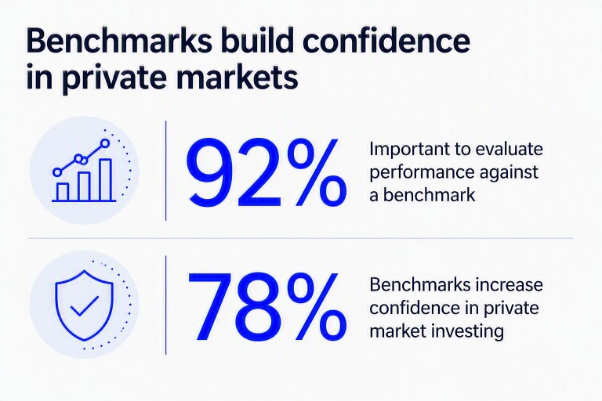
Nearly all respondents (92%) say it is important to evaluate performance against a benchmark, and more than three quarters (78%) believe standardized benchmarks increase their confidence in investing. These findings suggest that benchmarks are becoming an increasingly critical component of the private markets ecosystem, supporting more informed investment evaluation and decision making.
In the evolution of markets, the introduction of standardized indices has often proved a crucial catalyst. They bestow transparency and engender the confidence needed for a market to become a widely accepted part of the investment mainstream. To help meet this need, FTSE Russell and StepStone Group developed the FTSE StepStone Global Private Market Indices, a family of indices designed to provide an innovative and timely view of private market performance. Drawing on data from both limited partners and general partners, the indices are rebalanced daily and track the global private markets universe across all strategies as well as individual asset classes, including private equity, private infrastructure, private real estate and private debt.
A few facts about our research
FTSE Russell conducted an online survey of 600 U.S. retail investors between March 18 and March 30, 2026, in partnership with 8 Acre Perspective, an independent marketing research firm. Respondents were aged 25 and over, with a minimum of $500,000 in investable assets, excluding workplace accounts and real estate. 393 of the 600 respondents had greater than $1 million in assets. Their investments included mutual funds, ETFs and/or individual stocks. All investors taking part were involved in their households’ decision making.
Learn more about our 2026 wealth pulse survey, FTSE Russell index solutions for wealth management and our approach to private market indices.


Disclaimer
© [2026] London Stock Exchange Group plc and its applicable group undertakings (“LSEG”). LSEG includes (1) FTSE International Limited (“FTSE”), (2) Frank Russell Company (“Russell”), (3) FTSE Global Debt Capital Markets Inc. “FTSE Canada”, (4) FTSE Fixed Income LLC (“FTSE FI”), (5) FTSE (Beijing) Consulting Limited (“WOFE”), (6) FTSE EU SAS ("FES"). All rights reserved.
FTSE Russell® is a trading name of FTSE, Russell, FTSE Canada, FTSE FI, WOFE, FTSE EU and other LSEG entities providing LSEG Benchmark and Index services. “FTSE®”, “Russell®”, “FTSE Russell®”, “FTSE4Good®”, “ICB®”, “Refinitiv”, “WMR™” “FR™” and all other trademarks and service marks used herein (whether registered or unregistered) are trademarks and/or service marks owned or licensed by the applicable member of LSEG or their respective licensors.
FTSE International Limited is authorised as a Benchmark Administrator and regulated in the United Kingdom (UK) by the Financial Conduct Authority ("FCA") according to the UK Benchmark Regulation, FCA Reference Number 796803. FTSE EU SAS is authorised as Benchmark Administrator and regulated in the European Union (EU) by the Autorité des Marches Financiers (“AMF”) according to the EU Benchmark Regulation.
All information is provided for information purposes only. All information and data contained in this publication is obtained by LSEG, from sources believed by it to be accurate and reliable. Because of the possibility of human and mechanical inaccuracy as well as other factors, however, such information and data is provided "as is" without warranty of any kind. No member of LSEG nor their respective directors, officers, employees, partners or licensors make any claim, prediction, warranty or representation whatsoever, expressly or impliedly, either as to the accuracy, timeliness, completeness, merchantability of any information or LSEG Products, or of results to be obtained from the use of LSEG products, including but not limited to indices, rates, data and analytics, or the fitness or suitability of the LSEG products for any particular purpose to which they might be put. The user of the information assumes the entire risk of any use it may make or permit to be made of the information.
No responsibility or liability can be accepted by any member of LSEG nor their respective directors, officers, employees, partners or licensors for (a) any loss or damage in whole or in part caused by, resulting from, or relating to any inaccuracy (negligent or otherwise) or other circumstance involved in procuring, collecting, compiling, interpreting, analysing, editing, transcribing, transmitting, communicating or delivering any such information or data or from use of this document or links to this document or (b) any direct, indirect, special, consequential or incidental damages whatsoever, even if any member of LSEG is advised in advance of the possibility of such damages, resulting from the use of, or inability to use, such information.
No member of LSEG nor their respective directors, officers, employees, partners or licensors provide investment advice and nothing in this document should be taken as constituting financial or investment advice. No member of LSEG nor their respective directors, officers, employees, partners or licensors make any representation regarding the advisability of investing in any asset or whether such investment creates any legal or compliance risks for the investor. A decision to invest in any such asset should not be made in reliance on any information herein. Indices and rates cannot be invested in directly. Inclusion of an asset in an index or rate is not a recommendation to buy, sell or hold that asset nor confirmation that any particular investor may lawfully buy, sell or hold the asset or an index or rate containing the asset. The general information contained in this publication should not be acted upon without obtaining specific legal, tax, and investment advice from a licensed professional.
Past performance is no guarantee of future results. Charts and graphs are provided for illustrative purposes only. Index and/or rate returns shown may not represent the results of the actual trading of investable assets. Certain returns shown may reflect back-tested performance. All performance presented prior to the index or rate inception date is back-tested performance. Back-tested performance is not actual performance, but is hypothetical. The back-test calculations are based on the same methodology that was in effect when the index or rate was officially launched. However, back-tested data may reflect the application of the index or rate methodology with the benefit of hindsight, and the historic calculations of an index or rate may change from month to month based on revisions to the underlying economic data used in the calculation of the index or rate.
This document may contain forward-looking assessments. These are based upon a number of assumptions concerning future conditions that ultimately may prove to be inaccurate. Such forward-looking assessments are subject to risks and uncertainties and may be affected by various factors that may cause actual results to differ materially. No member of LSEG nor their licensors assume any duty to and do not undertake to update forward-looking assessments.
No part of this information may be reproduced, stored in a retrieval system or transmitted in any form or by any means, electronic, mechanical, photocopying, recording or otherwise, without prior written permission of the applicable member of LSEG. Use and distribution of LSEG data requires a licence from LSEG and/or its licensors.