

Ryan Miller
- Thematic exposure is now measurable: The methodology moves beyond simple theme identification to quantify and explain a company's level of thematic exposure.
- Evidence replaces assumptions: Revenue data, products, customer activity, transcripts and news are combined to create an auditable exposure assessment.
- Investors can choose their exposure level: Pure, Core and Ecosystem variants allow investors to tailor thematic intensity to different investment objectives.
Why is a company included in a thematic index, and how closely does its business align to that theme? Thematic methodologies have got better at finding relevant companies over time, but these questions have remained. In the FTSE MarketPsych Thematic index series we aim to address them. We move beyond a simple connection to a theme to an auditable, explainable assessment of why a company is connected, how strongly and based on what evidence.
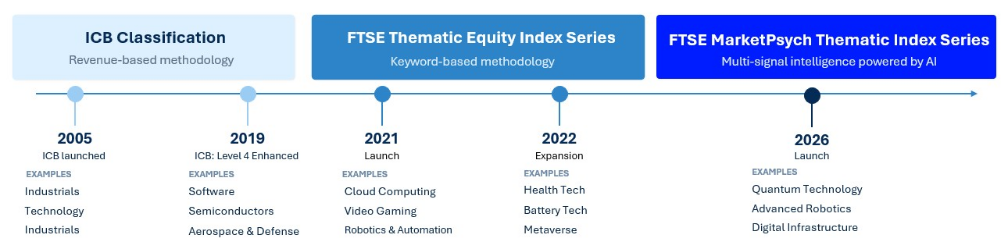
To understand what has changed, it helps to look at how FTSE Russell’s thematic methodologies have evolved, what improvements each stage brought in and where questions have remained.
How our thematic methodologies have evolved
Early approaches to thematic indexing used industry classifications to identify companies associated with a theme. FTSE Russell’s Industry Classification Benchmark (ICB), for example, groups companies by their principal business, using revenue as the primary driver of classification.
This provides a consistent, rules-based view of what a company mainly does, but the classification is one-to-one—one company, one ICB industry, supersector, sector and subsector. While the ICB is widely used across the financial markets, the limitations of this approach are obvious: a company can develop products relevant to several themes while remaining within a single subsector. Any ancillary activities are not reflected in its classification.
IBM’s quantum business illustrates the limitation. IBM is classified in the Computer Services ICB Subsector, but it also operates a dedicated quantum computing business, IBM Quantum. We can drill down further: IBM Quantum System Two is one product within that wider business.
The ICB Computer Services classification does not show how far IBM’s quantum activity has developed or how significant it is within the company. IBM does not disclose quantum revenue separately either, making that exposure difficult to establish from its reported financials alone.
In 2021, we launched our FTSE Thematic index series, using keywords and natural language processing to look beyond standard industry classification systems. This allowed relevant companies to be identified through references to their products and activities. For a company such as IBM, references to Quantum can identify a quantum connection that its principal classification does not describe.
This methodological enhancement widened the search, but a connection alone still does not explain the level of exposure. Different signals can say very different things about where a company sits within a theme. A research collaboration or statement of intent is not the same as a funded multi-year roadmap, a customer deployment or a commercial order. The assessment also needs to distinguish IBM’s dedicated quantum business, which sits within a diversified company, from a company focused entirely on the theme.
The next step is to assess the depth of that participation and explain the result. This means examining the relevant products and services alongside revenue evidence and developments in the business, with a clear record of how they contribute to the assessment.
Figure 1 The Evolution of FTSE Russell’s Thematic Approach: from revenue classification to keyword discovery to explainable thematic
Thematic exposure, measured and explained
The FTSE MarketPsych Thematic Index Series is designed to provide an auditable and evidence-based view of a company’s exposure to a theme. It combines reported revenue with other, forward-looking market signals to produce an explainable FTSE Thematic Exposure Score (the “TES”), reflecting the company’s alignment to that theme. Every TES can be traced back to the underlying evidence, whether that is a revenue figure, product, news event or other signal.
Figure 2 FTSE Thematic Exposure Assessment: Forward-looking, explainable thematic selection
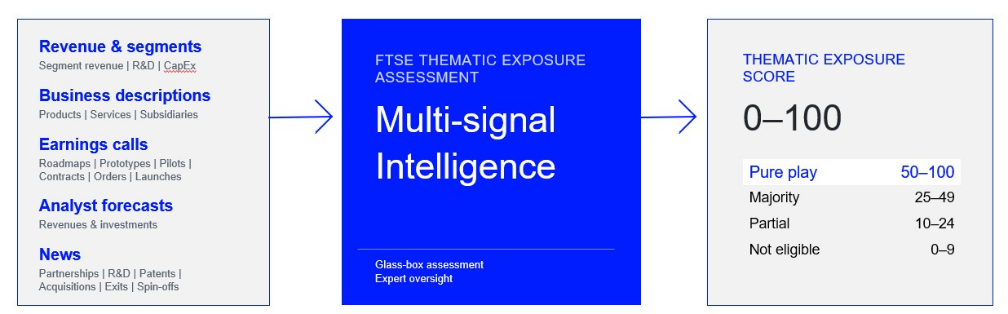
We start by assessing all the companies in FTSE Russell’s flagship global and US equity benchmarks, the FTSE Global All Cap and the Russell 3000. A multi-agent AI framework, co-designed with our partner MarketPsych, allows us to review large volumes of LSEG data efficiently, including Worldscope business descriptions, segmented revenue data and LSEG MarketPsych transcript and news data.
Each company’s theme-eligible products and services are mapped to sub-themes defined in the taxonomy set out iin the index series ground rules. This provides the basis for scoring and keeps each assessment traceable back to the golden source.
For IBM, this means looking across the company’s wider quantum business rather than relying on a single keyword or company description. IBM’s Quantum System Two is one example of an eligible product within that assessment. In total, the research identifies a broader set of quantum products, systems and relationships, while activities non-relevant to the defined sub-themes, such as consulting, IBM Cloud and Red Hat, are kept outside the assessment.
Within the index methodology, the Revenue Pillar looks at evidence of current commercial activity (see Table 1). Its input includes company financials, segment revenue and the products and services mapped to the theme. For example, IBM does not disclose quantum revenue separately and its quantum activity sits within the company’s Software segment. Public disclosures indicate that quantum remains a very small part of the wider business (estimated at under 1% of group revenue on an annual basis). The index methodology therefore recognizes the existing commercial activity without treating IBM’s broader Software segment as quantum exposure.
The Forward-looking Pillar signals how central the theme is to business and how that involvement is developing. News, transcripts and product evidence are classified so that different types of events can be assessed and weighed according to the type of signal.
This matters because not every mention of a theme carries the same weight. Noise and events such as corporate actions can be separated from evidence of substantive business activity, reducing false positives and giving a clearer basis for constituent selection.
Table 1: Inside the IBM Quantum assessment
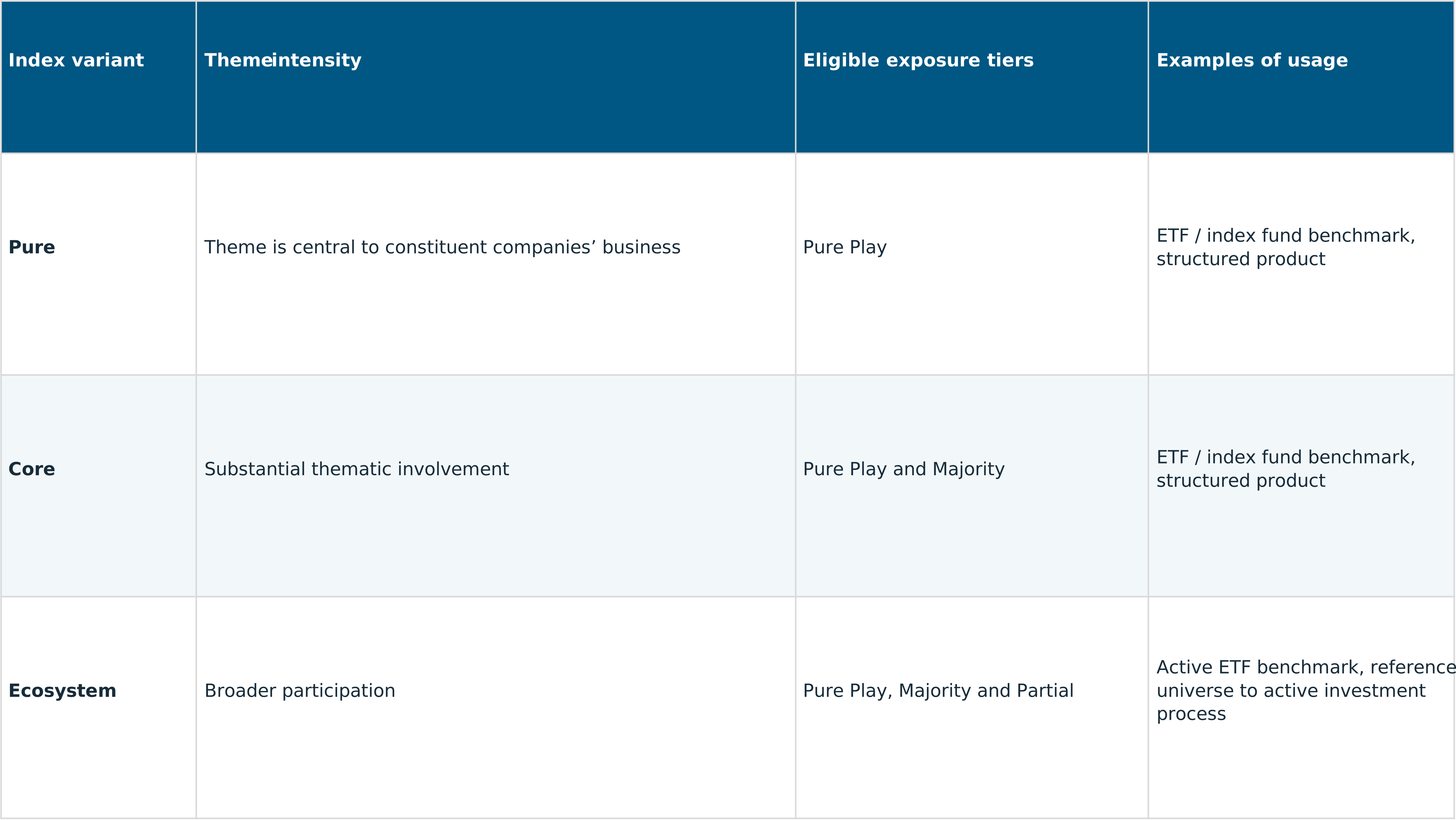
These pillars combine into the FTSE Thematic Exposure Score.The approach is designed to adapt as themes develop, giving investors a new way to access them. The TES determination allows the methodology to evolve as a theme moves from an emerging opportunity to a scaling trend and then a mature investment exposure, so the index can adjust as market dynamics change.
Dark, medium or light roast? Choose your level of thematic exposure
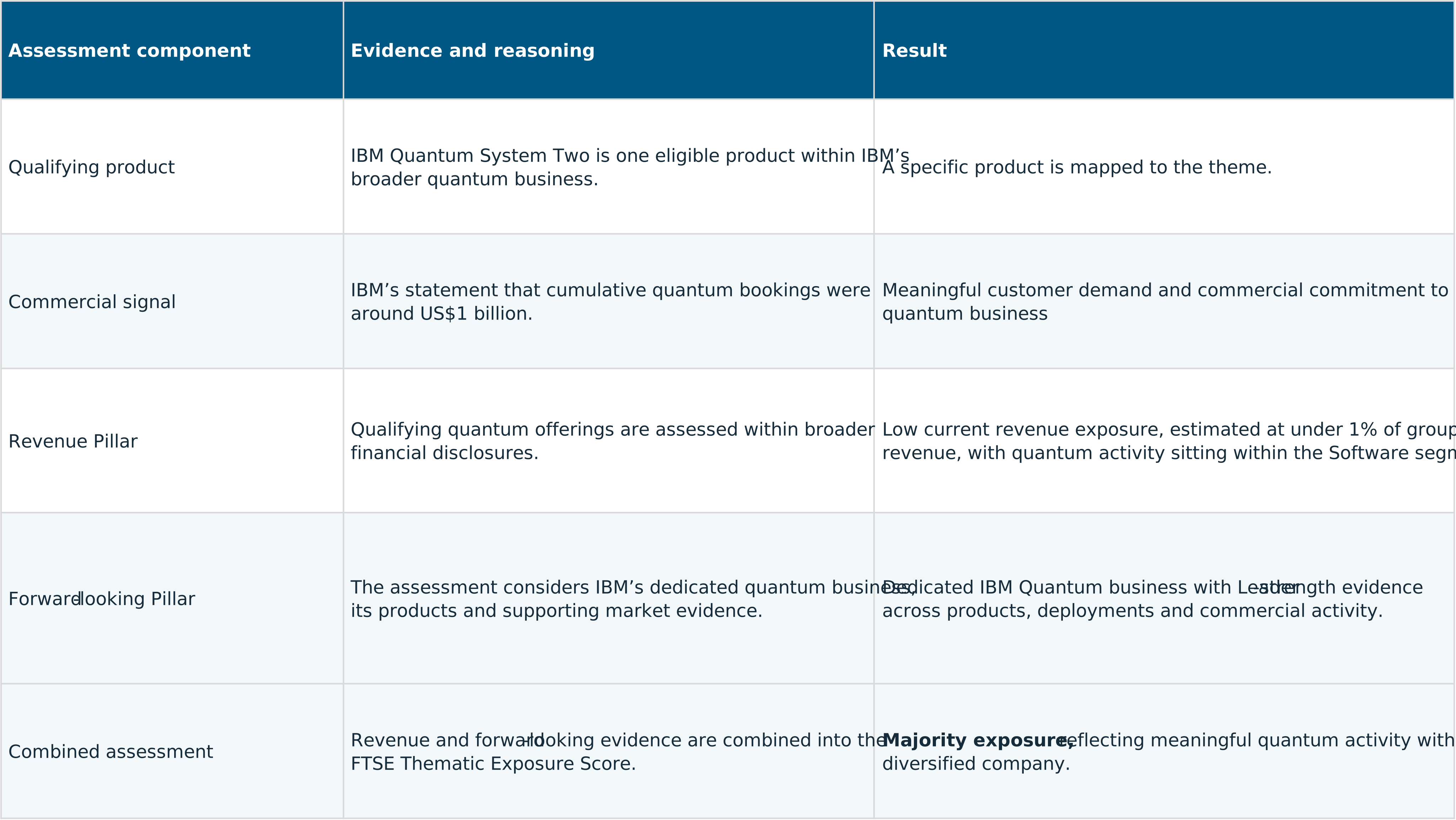
The same exposure assessment can support different levels of thematic concentration and basket sizes. The series therefore offers a range of index variants, allowing investors to choose how narrowly or broadly they want to capture a theme.
One example is the new FTSE Global Quantum Technology Ecosystem Equal Weight Index, part of the FTSE MarketPsych Thematic Index Series. It uses the Ecosystem variant (see Table 2), which includes companies assessed as Pure Play, Majority or Partial. IBM’s Majority assessment makes it eligible for inclusion based on its thematic exposure.
A Pure or a Core variant could instead be used for quantum technology where the objective is a narrower basket focused only on companies assessed as Pure Play and Majority, providing a more concentrated exposure to the theme. The same underlying assessment can therefore support different index outcomes depending on the level of thematic exposure required.
Table 2: From assessed exposure to index choice
The launch of the FTSE MarketPsych Thematic Index Series moves thematic exposure from assertion to evidence, combining broad universe coverage, LSEG’s vast data sources, advanced sentiment and forecast lenses, screened through a multi-agent AI framework to show not only whether a company is connected to a theme, but why, how strongly and based on what evidence. This auditable and evidence-based approach gives investors a clear way to identify the companies shaping long-term structural changes, identifying the development of themes and choosing the level of thematic intensity that fits their objective.


Disclaimer
© [2026] London Stock Exchange Group plc and its applicable group undertakings (“LSEG”). LSEG includes (1) FTSE International Limited (“FTSE”), (2) Frank Russell Company (“Russell”), (3) FTSE Global Debt Capital Markets Inc. “FTSE Canada”, (4) FTSE Fixed Income LLC (“FTSE FI”), (5) FTSE (Beijing) Consulting Limited (“WOFE”), (6) FTSE EU SAS ("FES"). All rights reserved.
FTSE Russell® is a trading name of FTSE, Russell, FTSE Canada, FTSE FI, WOFE, FTSE EU and other LSEG entities providing LSEG Benchmark and Index services. “FTSE®”, “Russell®”, “FTSE Russell®”, “FTSE4Good®”, “ICB®”, “Refinitiv”, “WMR™” “FR™” and all other trademarks and service marks used herein (whether registered or unregistered) are trademarks and/or service marks owned or licensed by the applicable member of LSEG or their respective licensors.
FTSE International Limited is authorised as a Benchmark Administrator and regulated in the United Kingdom (UK) by the Financial Conduct Authority ("FCA") according to the UK Benchmark Regulation, FCA Reference Number 796803. FTSE EU SAS is authorised as Benchmark Administrator and regulated in the European Union (EU) by the Autorité des Marches Financiers (“AMF”) according to the EU Benchmark Regulation.
All information is provided for information purposes only. All information and data contained in this publication is obtained by LSEG, from sources believed by it to be accurate and reliable. Because of the possibility of human and mechanical inaccuracy as well as other factors, however, such information and data is provided "as is" without warranty of any kind. No member of LSEG nor their respective directors, officers, employees, partners or licensors make any claim, prediction, warranty or representation whatsoever, expressly or impliedly, either as to the accuracy, timeliness, completeness, merchantability of any information or LSEG Products, or of results to be obtained from the use of LSEG products, including but not limited to indices, rates, data and analytics, or the fitness or suitability of the LSEG products for any particular purpose to which they might be put. The user of the information assumes the entire risk of any use it may make or permit to be made of the information.
No responsibility or liability can be accepted by any member of LSEG nor their respective directors, officers, employees, partners or licensors for (a) any loss or damage in whole or in part caused by, resulting from, or relating to any inaccuracy (negligent or otherwise) or other circumstance involved in procuring, collecting, compiling, interpreting, analysing, editing, transcribing, transmitting, communicating or delivering any such information or data or from use of this document or links to this document or (b) any direct, indirect, special, consequential or incidental damages whatsoever, even if any member of LSEG is advised in advance of the possibility of such damages, resulting from the use of, or inability to use, such information.
No member of LSEG nor their respective directors, officers, employees, partners or licensors provide investment advice and nothing in this document should be taken as constituting financial or investment advice. No member of LSEG nor their respective directors, officers, employees, partners or licensors make any representation regarding the advisability of investing in any asset or whether such investment creates any legal or compliance risks for the investor. A decision to invest in any such asset should not be made in reliance on any information herein. Indices and rates cannot be invested in directly. Inclusion of an asset in an index or rate is not a recommendation to buy, sell or hold that asset nor confirmation that any particular investor may lawfully buy, sell or hold the asset or an index or rate containing the asset. The general information contained in this publication should not be acted upon without obtaining specific legal, tax, and investment advice from a licensed professional.
Past performance is no guarantee of future results. Charts and graphs are provided for illustrative purposes only. Index and/or rate returns shown may not represent the results of the actual trading of investable assets. Certain returns shown may reflect back-tested performance. All performance presented prior to the index or rate inception date is back-tested performance. Back-tested performance is not actual performance, but is hypothetical. The back-test calculations are based on the same methodology that was in effect when the index or rate was officially launched. However, back-tested data may reflect the application of the index or rate methodology with the benefit of hindsight, and the historic calculations of an index or rate may change from month to month based on revisions to the underlying economic data used in the calculation of the index or rate.
This document may contain forward-looking assessments. These are based upon a number of assumptions concerning future conditions that ultimately may prove to be inaccurate. Such forward-looking assessments are subject to risks and uncertainties and may be affected by various factors that may cause actual results to differ materially. No member of LSEG nor their licensors assume any duty to and do not undertake to update forward-looking assessments.
No part of this information may be reproduced, stored in a retrieval system or transmitted in any form or by any means, electronic, mechanical, photocopying, recording or otherwise, without prior written permission of the applicable member of LSEG. Use and distribution of LSEG data requires a licence from LSEG and/or its licensors.