

Ian Chen

Lily Chung
- China's bond market is now a global force
At nearly USD 29 trillion outstanding, China has become the world's second-largest bond market, making it increasingly important for global fixed income investors.
- Access is no longer the main story
Reforms such as Bond Connect and CIBM Direct have significantly improved market access. The next stage of growth will depend on liquidity, transparency and investability.
- Offshore RMB bonds are gaining momentum
The Dim Sum bond market has expanded rapidly, offering investors access to RMB-denominated fixed income with higher yields and shorter duration than many onshore segments.
Over the past decade, China’s bond market has become a significant part of the global fixed income universe. As at end-June 2026, bonds issued in China, including government, government-related and corporate debt, had a total amount outstanding of RMB 197trn (equivalent to approximately USD 29trn), making China the world’s second-largest bond market after the United States [note1]. In parallel, improvements in market access have connected China’s bond market more closely with international investors.
Broadening access to the onshore market
Figure 1: Foreign holdings in China’s Interbank Bond Market (CIBM)
Benchmark inclusion and global portfolio integration
Benchmark inclusion marked a further stage in the integration of China’s fixed income markets into the indices that play a key role in global portfolio construction. FTSE Russell began the phased inclusion of Chinese government bonds in the FTSE World Government Bond Index (FTSE WGBI) in November 2021 and completed the 36-month phase-in in October 2024. In the FTSE WGBI’s September 2026 index profile, China accounted for 11.9% of the index by weight, making it the second-largest sovereign debt market after the United States (40.4% weight), while the market value of Chinese government bonds represented in the index was approximately USD 4.2trn. At this weight, Chinese government bonds have become a material consideration for fixed income investors conducting benchmark-relative asset allocation, risk management and performance attribution.
Historically, Chinese government bonds have exhibited a relatively low return correlation with the FTSE WGBI and several other major government bond markets (Figure 2). Based on monthly local currency returns between 2011 and 2026, Chinese government bonds recorded a correlation of below 0.2 with five major market segments. This low historical correlation reflects differences in domestic economic conditions, monetary policy and interest rate cycles, helping explain why some investors have viewed Chinese government bonds as offering diversification within global fixed income portfolios.
Figure 2: Correlation of government bond index monthly returns
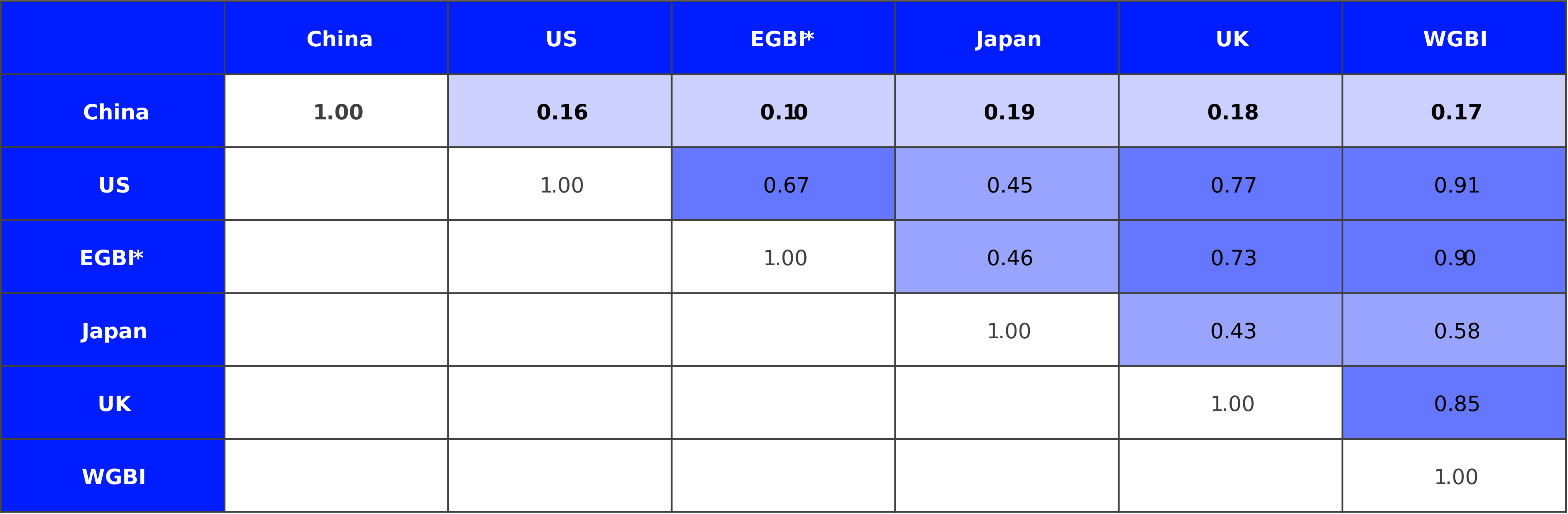
*FTSE EMU Government Bond Index
Source: FTSE Russell. Local currency total returns from August 2011 to July 2026. Past performance is not a guide to future returns. Please see the end for important legal disclosures.
Expansion of the offshore market
Alongside the opening of the onshore bond market, the offshore “Dim Sum” bond market has developed as a supplementary funding and investment channel. Dim Sum bonds are renminbi-denominated bonds issued and settled outside mainland China, primarily in Hong Kong. The universe has recently expanded sharply: the market value of the FTSE Dim Sum (Offshore CNY [note2]) Bond Index increased from RMB 141.6bn at end-2021 to RMB 723.5bn at end-June 2026, a more than fivefold rise.
For issuers, the Dim Sum market provides an additional RMB funding source and access to a broader investor base. For investors, it offers RMB-denominated fixed income exposure through an established offshore infrastructure. Relative to the broader onshore fixed income market, the offshore market generally offers higher yields and shorter duration.
At end-July 2026, the FTSE Dim Sum (Offshore CNY) Bond Index had a yield to maturity of 2.20% and an effective duration of 4.31 years, compared with 1.69% and 6.30 years, respectively, for the FTSE Chinese (Onshore CNY) Broad Bond Index (see Figure 3).
The differences in liquidity and investor bases between the offshore and onshore Chinese bond markets can lead to differences in pricing, while market composition also plays an important role. Corporate bonds accounted for 55% of the offshore index, compared with 18% of the onshore index. By contrast, sovereign, regional government and government-related bonds together represented 82% of the onshore index, compared with 45% of the offshore index (see Figure 4).
Recent policy measures [note3] may provide additional momentum for the growth of the Dim Sum bond market. These measures include enhancements to the Southbound Bond Connect scheme (a higher annual investment quota, the development of the repo market using Southbound Bond Connect bonds as collateral, a broader product scope and connectivity with the Macao bond market), as well as the Hong Kong Monetary Authority’s (HKMA’s) plan to explore offshore RMB short-term debt issuance to support the development of the offshore RMB yield curve. Together with the Dim Sum bond market’s relatively higher yield profile, these developments could increase the attractiveness of offshore RMB bonds for both international and onshore investors.
Figure 3: Yield to maturity and effective duration of selected Chinese bond market segments
Figure 4: China onshore and offshore bond markets by issuer type
Investability across market segments
Despite substantial progress in market access and infrastructure, international participation in China’s fixed income market remains concentrated in government and policy bank bonds, reflecting these bonds’ superior liquidity, benchmark representation and credit quality. Expanding foreign participation into local government and corporate bonds will require further improvements in market liquidity, price discovery, credit research coverage and risk management tools. The market’s breadth therefore creates demand for more granular benchmarks that distinguish among sectors with different characteristics and which support more targeted portfolio construction.
Combining global standards with local market expertise
Collaboration between global index providers and domestic financial institutions is one response to this demand. FTSE Russell works with Chinese financial institutions to develop indices that combine globally consistent index standards with local market expertise.
Recent co-branded initiatives illustrate this approach. The FTSE BOC China Local Government Bond Index Series, developed with Bank of China, provides dedicated benchmarks for Chinese regional government bonds, with short-, medium- and long-term maturity segments. The FTSE CCB Dim Sum (Offshore CNY) Green Bond Index, developed with China Construction Bank, combines offshore RMB exposure with green bond eligibility criteria that are aligned with internationally recognised standards.
Together, these recent collaborations show how benchmarks can segment the RMB bond market by sector, sustainability characteristics and issuance channel, providing more clearly defined exposures for portfolio construction.
The next stage of international participation
China's fixed income market has made significant progress over the past decade, evolving from a largely domestic market into an increasingly important component of global fixed income portfolios. The next phase of development, however, is likely to be determined less by market access and more by investability.
For international investors, interest in RMB bonds will likely continue to be influenced by factors including diversification characteristics, liquidity, benchmark representation and risk-adjusted returns. For domestic investors, the growing offshore RMB market offers an additional channel for income generation and portfolio diversification, particularly as Dim Sum bonds currently provide a yield advantage over comparable onshore segments.
Supported by ongoing reforms, expanding benchmark coverage and the HKMA's recent measures to strengthen Hong Kong's role as an offshore RMB hub, the onshore and offshore markets are becoming increasingly complementary. Recent initiatives, including the expansion of the RMB Business Facility with longer tenors, the exploration of a seven-day offshore RMB liquidity tender mechanism and the issuance of offshore RMB short-term debt instruments, are helping to enhance both markets’ depth and functionality. Together, they contribute to a broader RMB fixed income ecosystem that may influence the next stage of RMB internationalisation.

footnotes
[1] Data from LSEG Data & Analytics. | Back to Note 1
[2] Renminbi is the official currency of the People’s Republic of China and the yuan is the renminbi’s unit of account. The terms are often used interchangeably. | Back to Note 2
[3] New Measures to support development of Hong Kong's fixed income and currency market and offshore Renminbi business | Back to Note 3

Disclaimer
© [2026] London Stock Exchange Group plc and its applicable group undertakings (“LSEG”). LSEG includes (1) FTSE International Limited (“FTSE”), (2) Frank Russell Company (“Russell”), (3) FTSE Global Debt Capital Markets Inc. “FTSE Canada”, (4) FTSE Fixed Income LLC (“FTSE FI”), (5) FTSE (Beijing) Consulting Limited (“WOFE”), (6) FTSE EU SAS ("FES"). All rights reserved.
FTSE Russell® is a trading name of FTSE, Russell, FTSE Canada, FTSE FI, WOFE, FTSE EU and other LSEG entities providing LSEG Benchmark and Index services. “FTSE®”, “Russell®”, “FTSE Russell®”, “FTSE4Good®”, “ICB®”, “Refinitiv”, “WMR™” “FR™” and all other trademarks and service marks used herein (whether registered or unregistered) are trademarks and/or service marks owned or licensed by the applicable member of LSEG or their respective licensors.
FTSE International Limited is authorised as a Benchmark Administrator and regulated in the United Kingdom (UK) by the Financial Conduct Authority ("FCA") according to the UK Benchmark Regulation, FCA Reference Number 796803. FTSE EU SAS is authorised as Benchmark Administrator and regulated in the European Union (EU) by the Autorité des Marches Financiers (“AMF”) according to the EU Benchmark Regulation.
All information is provided for information purposes only. All information and data contained in this publication is obtained by LSEG, from sources believed by it to be accurate and reliable. Because of the possibility of human and mechanical inaccuracy as well as other factors, however, such information and data is provided "as is" without warranty of any kind. No member of LSEG nor their respective directors, officers, employees, partners or licensors make any claim, prediction, warranty or representation whatsoever, expressly or impliedly, either as to the accuracy, timeliness, completeness, merchantability of any information or LSEG Products, or of results to be obtained from the use of LSEG products, including but not limited to indices, rates, data and analytics, or the fitness or suitability of the LSEG products for any particular purpose to which they might be put. The user of the information assumes the entire risk of any use it may make or permit to be made of the information.
No responsibility or liability can be accepted by any member of LSEG nor their respective directors, officers, employees, partners or licensors for (a) any loss or damage in whole or in part caused by, resulting from, or relating to any inaccuracy (negligent or otherwise) or other circumstance involved in procuring, collecting, compiling, interpreting, analysing, editing, transcribing, transmitting, communicating or delivering any such information or data or from use of this document or links to this document or (b) any direct, indirect, special, consequential or incidental damages whatsoever, even if any member of LSEG is advised in advance of the possibility of such damages, resulting from the use of, or inability to use, such information.
No member of LSEG nor their respective directors, officers, employees, partners or licensors provide investment advice and nothing in this document should be taken as constituting financial or investment advice. No member of LSEG nor their respective directors, officers, employees, partners or licensors make any representation regarding the advisability of investing in any asset or whether such investment creates any legal or compliance risks for the investor. A decision to invest in any such asset should not be made in reliance on any information herein. Indices and rates cannot be invested in directly. Inclusion of an asset in an index or rate is not a recommendation to buy, sell or hold that asset nor confirmation that any particular investor may lawfully buy, sell or hold the asset or an index or rate containing the asset. The general information contained in this publication should not be acted upon without obtaining specific legal, tax, and investment advice from a licensed professional.
Past performance is no guarantee of future results. Charts and graphs are provided for illustrative purposes only. Index and/or rate returns shown may not represent the results of the actual trading of investable assets. Certain returns shown may reflect back-tested performance. All performance presented prior to the index or rate inception date is back-tested performance. Back-tested performance is not actual performance, but is hypothetical. The back-test calculations are based on the same methodology that was in effect when the index or rate was officially launched. However, back-tested data may reflect the application of the index or rate methodology with the benefit of hindsight, and the historic calculations of an index or rate may change from month to month based on revisions to the underlying economic data used in the calculation of the index or rate.
This document may contain forward-looking assessments. These are based upon a number of assumptions concerning future conditions that ultimately may prove to be inaccurate. Such forward-looking assessments are subject to risks and uncertainties and may be affected by various factors that may cause actual results to differ materially. No member of LSEG nor their licensors assume any duty to and do not undertake to update forward-looking assessments.
No part of this information may be reproduced, stored in a retrieval system or transmitted in any form or by any means, electronic, mechanical, photocopying, recording or otherwise, without prior written permission of the applicable member of LSEG. Use and distribution of LSEG data requires a licence from LSEG and/or its licensors.