
Developed, emerging or both?
Some “world” indices include developed markets only; others include both developed and emerging markets. There’s no consistency in labelling amongst index providers, so you need to know what you’re gaining exposure to.
Here’s how the FTSE Global Equity Index Series (FTSE GEIS) does it. Our flagship FTSE All-World index, which is part of the FTSE GEIS, includes large- and mid-cap stocks from nearly 50 developed and emerging markets, shown in Figure 1 (developed markets are in dark blue, emerging markets in light blue).
Figure 1: FTSE Russell’s equity country classifications
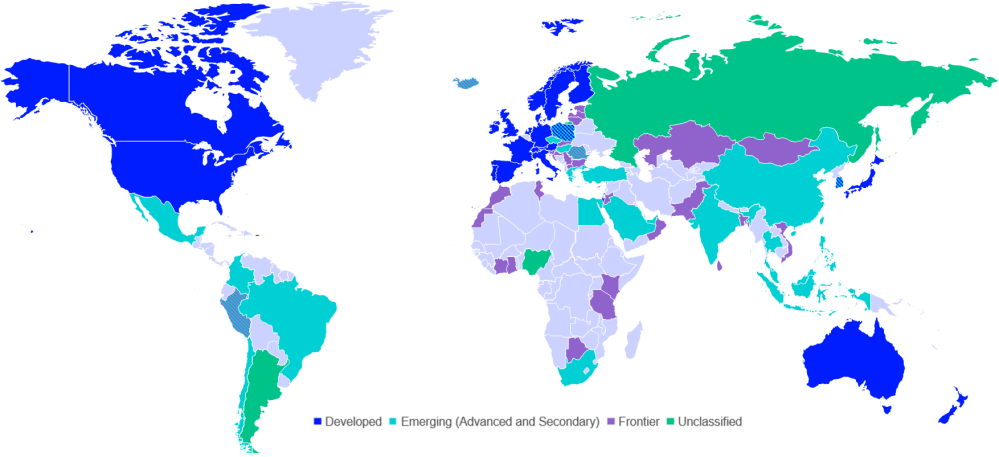
Source: FTSE Russell, data as of September 2025. For further details, please visit: Equity Country Classification | LSEG. The FTSE Frontier Index Series is maintained separately from FTSE GEIS; see the FTSE Frontier Index Series Ground Rules for more information. FTSE Russell will reclassify Vietnam from Frontier to Secondary Emerging in September 2026, subject to an interim review in March 2026. Greece will be reclassified from Advanced Emerging to Developed in September 2026. Past performance is not a guide to future returns. Please see the end for important legal disclosures.
Not all index providers classify developed and emerging markets in the same way, so it’s worth checking how they do this (see the next section).
For over 25 years, the FTSE All-World Index has quietly done something very important: it’s empowered investors to see how global equity markets behave, across regions, sectors, currencies and every kind of market cycle (see Figure 2).
In the first decade of the 21st century, emerging markets gave a much higher return than their developed counterparts. This trend was then reversed for the subsequent 15 years. Is it now switching course again? In recent FTSE Russell research, Indrani De, Zhaoyi Yang and Indhu Raghavan suggest that emerging markets may be undergoing a structural rerating after years of underperformance.
Figure 2: Developed/emerging market performance in FTSE All-World index
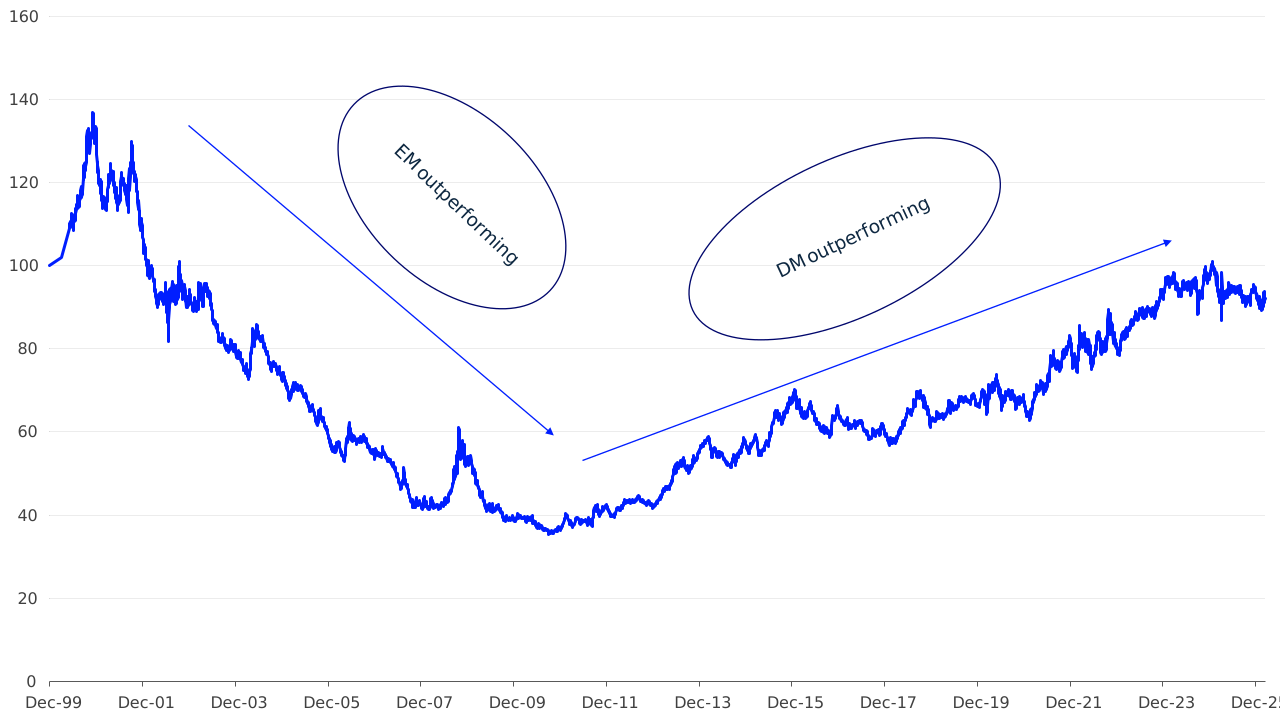
Source: FTSE Russell, data from 31/12/1999-16/3/2026. Chart shows the total return of the FTSE Developed index divided by the total return of the FTSE Emerging index, rebased to 100 on 31/12/1999. The FTSE Developed index and the FTSE Emerging index sum to the FTSE All-World index. Past performance is not a guide to future returns.
Classifying countries
FTSE Russell uses a rigorous and transparent approach to classify global equity markets, using our “quality of markets” framework to score countries (see Figure 3). The country classification framework produces a unique four-tiered classification system, consisting of frontier, secondary emerging, advanced emerging and developed markets. To move from a less to a more developed equity market classification category requires a higher total score in the quality of markets matrix.
Our equity country classification team is supported by an independent external advisory committee that includes both internal experts and market practitioners. Final decisions are taken by the FTSE Russell Index Governance Board.
Figure 3: FTSE Russell’s quality of markets matrix (with required scores for each classification category)
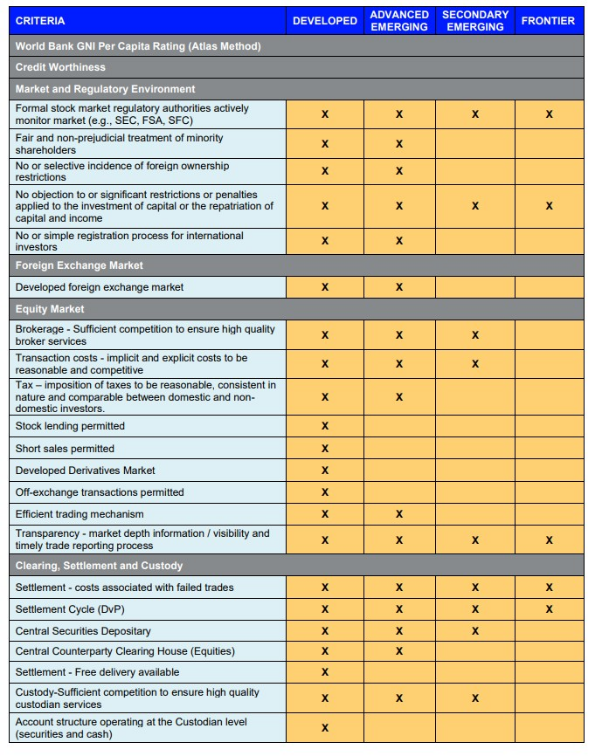
Source: FTSE Russell, as at September 2025. Past performance is not a guide to future returns. Please see the end for important legal disclosures.
Coverage
The FTSE All-World index includes large- and mid-cap stocks from the developed and emerging markets in this classification framework. That means it covers around 90% of the global equity market opportunity set (and just over 4250 stocks, as of September 2025)—see Figure 4.
FTSE Russell has more inclusive global equity indices: the FTSE Global All Cap index adds small-cap stocks to the FTSE All-World, while the FTSE Global Total Cap index adds micro-cap stocks as well.
Figure 4: FTSE Global Total Cap, Global All Cap and All-World indices
| FTSE GEIS Index | Coverage & Scope | Size | Constituents |
|---|---|---|---|
| FTSE Global Total Cap | ~99% Global | Large, Mid, Small & Micro | 19,141 |
| FTSE Global All Cap | ~98% Global | Large, Mid & Small | 10,107 |
| FTSE All-World | ~90% Global Large & Mid | Large & Mid | 4,254 |
Source: FTSE Russell, as at September 2025. Past performance is not a guide to future returns. Please see the end for important legal disclosures.
How we measure size
But how do we measure company size for this purpose? We define size within nine distinct geographical regions: Asia Pacific ex China ex Japan, Canada, China, Developed Europe, Emerging Europe, Japan, Latin America, Middle East and Africa, USA.
For each region, around the top 70% of stocks by market capitalisation are considered large caps, the next 20% are mid-caps and the remaining 10% of stocks are defined as small caps and micro caps. This design approach supports many asset managers’ and asset owners’ historical preference for viewing the global equity market as the sum of distinct geographical and macroeconomic zones.
Other index providers may define regional affiliations, company size categories and the breakpoints between size bands differently.
Screening for liquidity
For an equity index to be of practical use to investors, it has to consider the accessibility of stocks. For this reason, we apply a liquidity screen consistently across the developed and emerging markets in the FTSE All-World index: we require a daily median trading volume of at least 0.04% of their shares in issue in eight months of the preceding year for existing constituents to stay in the FTSE GEIS. There’s a higher threshold for potential new entrants (a daily median trading volume of at least 0.05% in ten months of the preceding year).
Knowing your index better
There may be other methodological differences between world equity indices from different providers. For example, these could cover the frequency of index rebalancing, industry and sector classifications, the procedures for admitting new issues (IPOs), the calculation of free float (investability), the nationality of constituents and the treatment of China’s “A-Share” market.
There’s a comprehensive set of resources on the FTSE Russell website for anyone wanting to find out more about the FTSE All-World index and our other global equity benchmarks.

Read more about

Disclaimer
© [2026] London Stock Exchange Group plc and its applicable group undertakings (“LSEG”). LSEG includes (1) FTSE International Limited (“FTSE”), (2) Frank Russell Company (“Russell”), (3) FTSE Global Debt Capital Markets Inc. “FTSE Canada”, (4) FTSE Fixed Income LLC (“FTSE FI”), (5) FTSE (Beijing) Consulting Limited (“WOFE”), (6) FTSE EU SAS ("FES"). All rights reserved.
FTSE Russell® is a trading name of FTSE, Russell, FTSE Canada, FTSE FI, WOFE, FTSE EU and other LSEG entities providing LSEG Benchmark and Index services. “FTSE®”, “Russell®”, “FTSE Russell®”, “FTSE4Good®”, “ICB®”, “Refinitiv”, “WMR™” “FR™” and all other trademarks and service marks used herein (whether registered or unregistered) are trademarks and/or service marks owned or licensed by the applicable member of LSEG or their respective licensors.
FTSE International Limited is authorised as a Benchmark Administrator and regulated in the United Kingdom (UK) by the Financial Conduct Authority ("FCA") according to the UK Benchmark Regulation, FCA Reference Number 796803. FTSE EU SAS is authorised as Benchmark Administrator and regulated in the European Union (EU) by the Autorité des Marches Financiers (“AMF”) according to the EU Benchmark Regulation.
All information is provided for information purposes only. All information and data contained in this publication is obtained by LSEG, from sources believed by it to be accurate and reliable. Because of the possibility of human and mechanical inaccuracy as well as other factors, however, such information and data is provided "as is" without warranty of any kind. No member of LSEG nor their respective directors, officers, employees, partners or licensors make any claim, prediction, warranty or representation whatsoever, expressly or impliedly, either as to the accuracy, timeliness, completeness, merchantability of any information or LSEG Products, or of results to be obtained from the use of LSEG products, including but not limited to indices, rates, data and analytics, or the fitness or suitability of the LSEG products for any particular purpose to which they might be put. The user of the information assumes the entire risk of any use it may make or permit to be made of the information.
No responsibility or liability can be accepted by any member of LSEG nor their respective directors, officers, employees, partners or licensors for (a) any loss or damage in whole or in part caused by, resulting from, or relating to any inaccuracy (negligent or otherwise) or other circumstance involved in procuring, collecting, compiling, interpreting, analysing, editing, transcribing, transmitting, communicating or delivering any such information or data or from use of this document or links to this document or (b) any direct, indirect, special, consequential or incidental damages whatsoever, even if any member of LSEG is advised in advance of the possibility of such damages, resulting from the use of, or inability to use, such information.
No member of LSEG nor their respective directors, officers, employees, partners or licensors provide investment advice and nothing in this document should be taken as constituting financial or investment advice. No member of LSEG nor their respective directors, officers, employees, partners or licensors make any representation regarding the advisability of investing in any asset or whether such investment creates any legal or compliance risks for the investor. A decision to invest in any such asset should not be made in reliance on any information herein. Indices and rates cannot be invested in directly. Inclusion of an asset in an index or rate is not a recommendation to buy, sell or hold that asset nor confirmation that any particular investor may lawfully buy, sell or hold the asset or an index or rate containing the asset. The general information contained in this publication should not be acted upon without obtaining specific legal, tax, and investment advice from a licensed professional.
Past performance is no guarantee of future results. Charts and graphs are provided for illustrative purposes only. Index and/or rate returns shown may not represent the results of the actual trading of investable assets. Certain returns shown may reflect back-tested performance. All performance presented prior to the index or rate inception date is back-tested performance. Back-tested performance is not actual performance, but is hypothetical. The back-test calculations are based on the same methodology that was in effect when the index or rate was officially launched. However, back-tested data may reflect the application of the index or rate methodology with the benefit of hindsight, and the historic calculations of an index or rate may change from month to month based on revisions to the underlying economic data used in the calculation of the index or rate.
This document may contain forward-looking assessments. These are based upon a number of assumptions concerning future conditions that ultimately may prove to be inaccurate. Such forward-looking assessments are subject to risks and uncertainties and may be affected by various factors that may cause actual results to differ materially. No member of LSEG nor their licensors assume any duty to and do not undertake to update forward-looking assessments.
No part of this information may be reproduced, stored in a retrieval system or transmitted in any form or by any means, electronic, mechanical, photocopying, recording or otherwise, without prior written permission of the applicable member of LSEG. Use and distribution of LSEG data requires a licence from LSEG and/or its licensors.