

Robin Marshall
Bond issuance and creditworthiness
Struggling companies or governments often need to issue more debt to cover their outgoings. Often, these financing pressures are temporary. But there’s a tail risk if things don’t improve. And passive (index-based) investors could become overexposed to less creditworthy bond issuers at the time when their ability to service debts is waning.
Developed market government bonds have always been considered the least risky financial asset—even a risk-free asset, as far as investment textbooks go. Since the bonds are issued in local currency, default risks are extremely low. But this characterisation is less sure than it once was.
In early 2000, over 85% of the FTSE World Government Bond index (FTSE WGBI) was represented by entities with the highest (AAA) credit rating. By April 2026, 11% of the index was in AAA-rated bonds, and BBB and A ratings took up nearly 40%.
FTSE World Government Bond Index—index share by credit rating
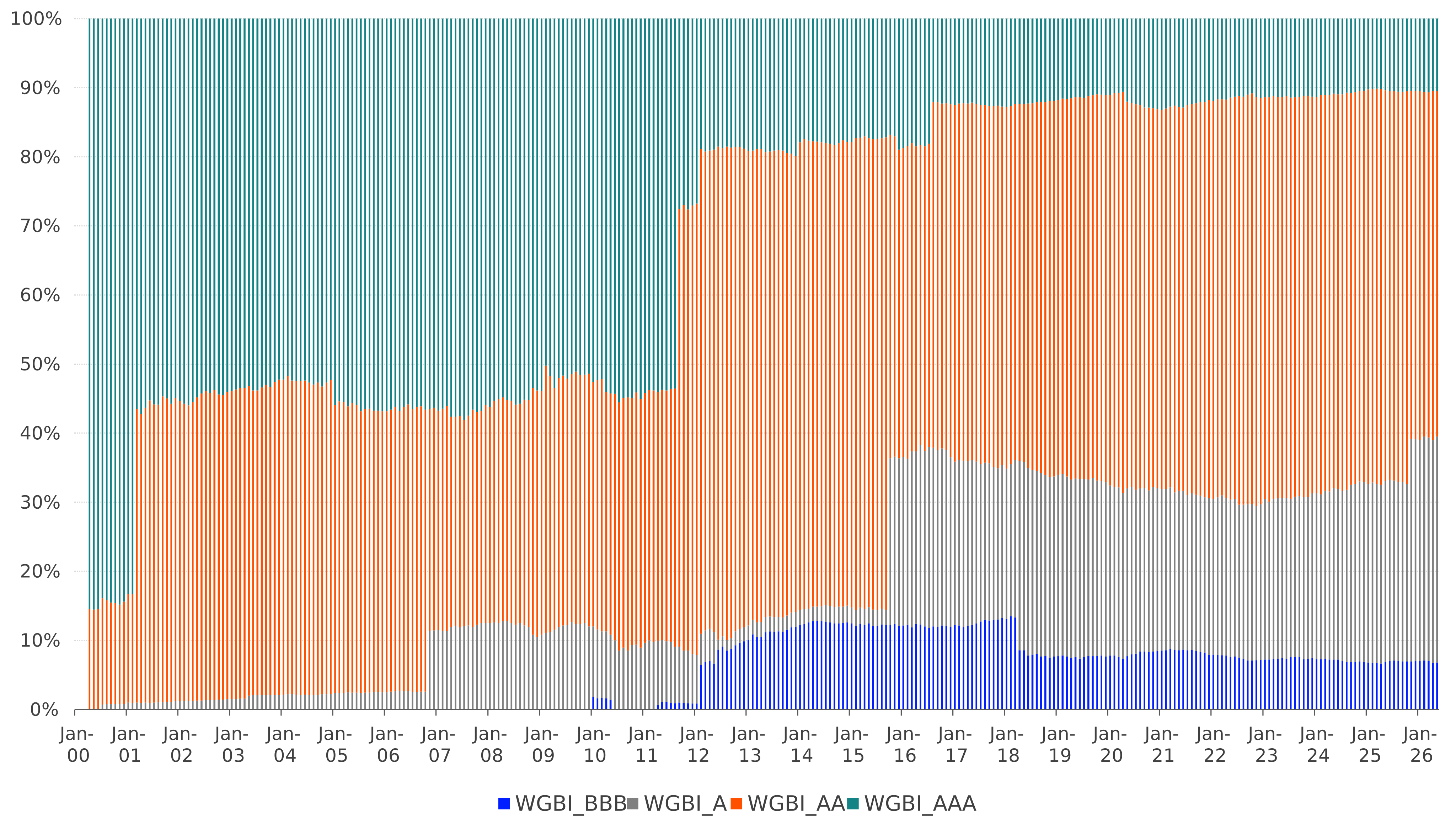
Source: FTSE Russell, January 2000-April 2026. Past performance is not a reliable guide to future returns.
Changes in the FTSE WGBI
Part of this evolution reflects both changes in the index and shifts in credit profiles over time. The FTSE WGBI has expanded from nine markets at its inception (in 1984) to 25 in April 2026, including the addition of select emerging market sovereign bonds. Importantly, all constituents (developed and emerging) must have a minimum “investment grade” credit rating (BBB- from S&P and Baa3 from Moody’s) to stay in the index.
However, there’s been some slippage amongst credits once considered as impeccable. Several European governments were downgraded from AAA during the eurozone debt crisis of 2009-2011. The increasingly indebted Japanese and US governments lost their AAA ratings in 2001 and 2011, respectively. The UK was downgraded from AAA in 2013 and currently sits at Aa3, three notches below the top grade.
FTSE WGBI remains the market benchmark
FTSE WGBI eligibility doesn’t depend on credit ratings alone: sovereign bond issuers must pass FTSE Russell’s strict inclusion criteria before joining the index. Specifically, they must meet a market accessibility level of 2 (the highest level) under FTSE’s fixed income country classification framework. This emphasises a strong macroeconomic and regulatory environment, adequate liquidity and investability in foreign exchange and an efficient and competitive domestic bond market.
These features help ensure that the FTSE WGBI continues to build on its 40-year legacy as an unbiased representation of the major global local currency sovereign bond markets.
Market accessibility requirements for local currency government bond markets
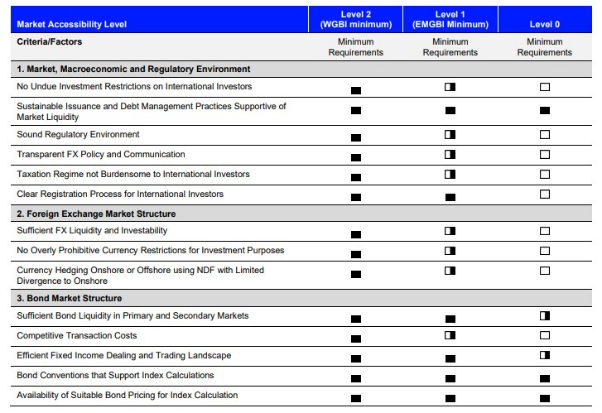
Source: FTSE Russell, as at May 2026. Past performance is not a guide to future returns. Please see the end for important legal disclosures.
Currency fluctuations in the FTSE WGBI
There’s another potential source of unpredictability facing those using market-weighted fixed income benchmarks—currency risk.
The FTSE WGBI measures the performance of fixed-rate, local currency, investment-grade sovereign bonds. So the index’s issuer weightings reflect both the amount of domestic debt issued by individual countries and the value that global markets attribute to those countries’ currencies.
Other things being equal, a sharp rise in the volume of a country’s domestic currency government debt might be accompanied by a fall in the value of that currency, offsetting the overall impact on the index. However, fluctuations in foreign exchange rates do have a role in setting FTSE WGBI country shares.
For example, in early 1985, a time of unprecedented dollar strength, US Treasuries’ share in the index was over 55%. Twenty years later, US Treasuries’ FTSE WGBI index weight fell to a low of under 20%. And another two decades on, it sits at over 40% again.
Japanese government bonds’ (JGBs’) index weight is around a quarter of its 2012 high, largely reflecting recent weakness in the yen, while there’s recently been a sharp rise in the index presence of Chinese government bonds (the first tranche of Chinese government bonds was added to the FTSE WGBI in 2021).
FTSE World Government Bond Index—aggregate government bond weightings by currency of denomination
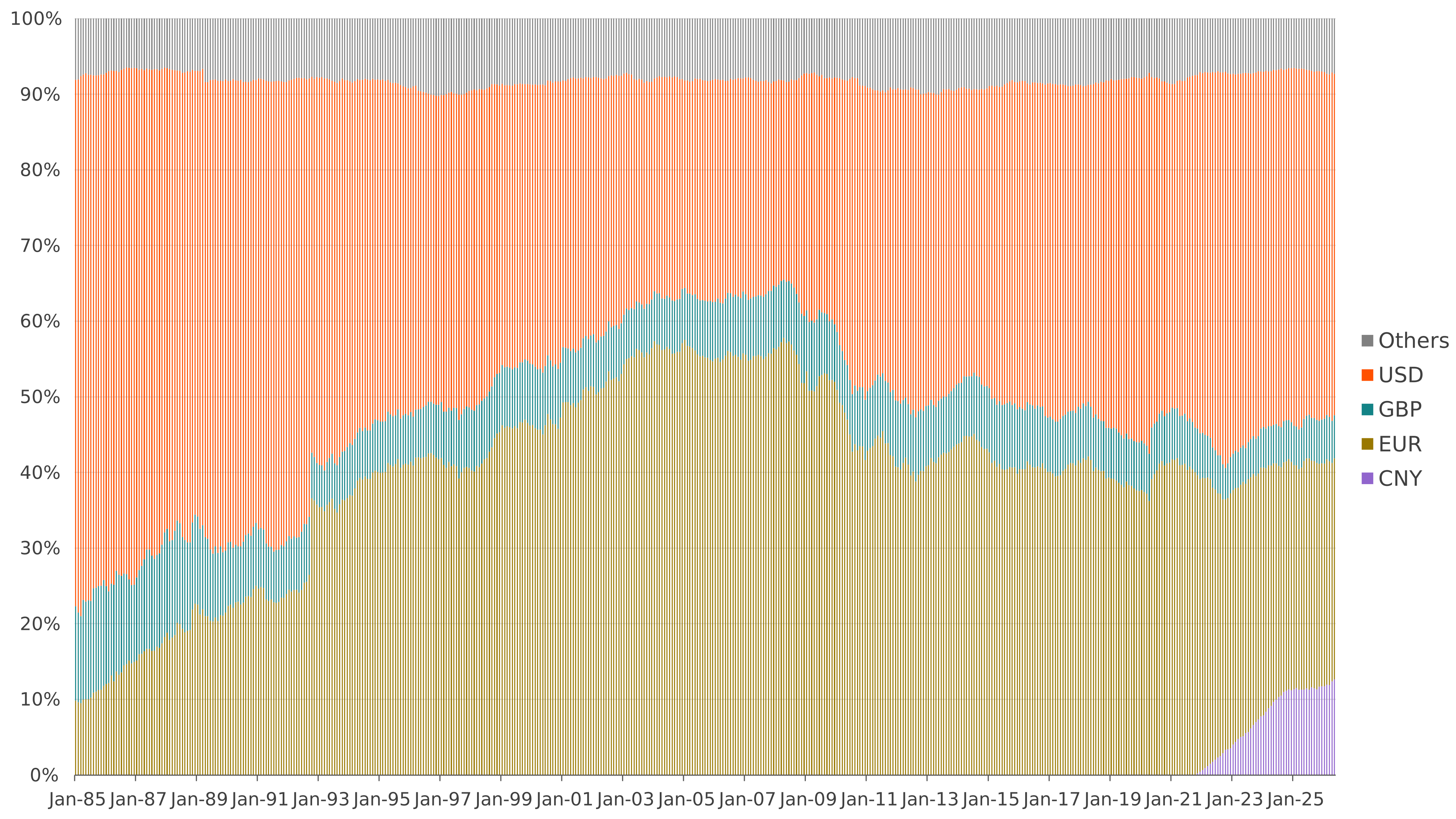
Source: FTSE Russell, January 1985-April 2026. Past performance is not a guide to future returns. Please see the end for important legal disclosures.
Weighting by economic footprint
Weighting a government bond index by economic footprint, rather than the market value of debt in issue, could give a more stable outcome: reducing both the exposure to potential overborrowing and, potentially, to currency volatility.
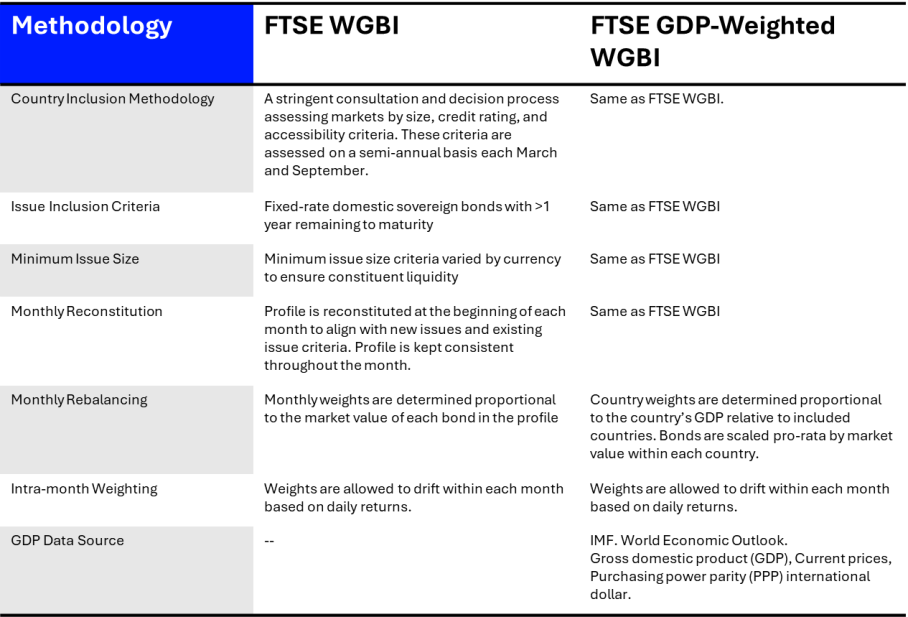
The FTSE GDP-Weighted World Government Bond index series (FTSE GDP-Weighted WGBI) is constructed using countries’ economic output as the determinant of the index weight.
We source gross domestic product data from the International Monetary Fund’s (IMF’s) World Economic Outlook database, measuring GDP in purchasing power parity (PPP), rather than nominal terms. Using PPP rather than floating FX rates helps reduce the impact of currency fluctuations.
The FTSE GDP-Weighted WGBI follows its parent index (the FTSE WGBI) in terms of country selection, issue inclusion criteria, minimum issue size and rebalancing frequency.
FTSE WGBI and GDP-Weighted WGBI—methodology
Factors supporting a GDP-weighting approach
Other factors support GDP-based weighting as a fixed income index approach.
First, GDP growth and GDP size are important measures of debt capacity, so linking constituent weights to GDP should help mitigate sovereign default risk.
GDP-weighting recognises the impact of recent shifts in the structure of the global economy, particularly the faster relative economic growth rates seen in emerging markets.
Partly as a result of this economic outperformance, emerging market governments are also less indebted than their developed market counterparts: according to the IMF, the general government gross debt of emerging markets averages 77% of GDP in 2026, compared to 108% of GDP for advanced economies.
Interest rising in alternative bond index methodologies
GDP-weighting the 40-year-old FTSE WGBI is just an example of the rising interest in alternative bond index methodologies. These index variants have the attraction of protecting investors from concentration risk and mitigating the debtor bias seen in pure market-value indices. They can also help increase the weighting of faster growing economies and, in the credit space, companies with more debt service capacity.
For more on this topic, read “Getting smarter - the case for global GDP weighted sov.bond indexes strengthens”.


Disclaimer
© [2026] London Stock Exchange Group plc and its applicable group undertakings (“LSEG”). LSEG includes (1) FTSE International Limited (“FTSE”), (2) Frank Russell Company (“Russell”), (3) FTSE Global Debt Capital Markets Inc. “FTSE Canada”, (4) FTSE Fixed Income LLC (“FTSE FI”), (5) FTSE (Beijing) Consulting Limited (“WOFE”), (6) FTSE EU SAS ("FES"). All rights reserved.
FTSE Russell® is a trading name of FTSE, Russell, FTSE Canada, FTSE FI, WOFE, FTSE EU and other LSEG entities providing LSEG Benchmark and Index services. “FTSE®”, “Russell®”, “FTSE Russell®”, “FTSE4Good®”, “ICB®”, “Refinitiv”, “WMR™” “FR™” and all other trademarks and service marks used herein (whether registered or unregistered) are trademarks and/or service marks owned or licensed by the applicable member of LSEG or their respective licensors.
FTSE International Limited is authorised as a Benchmark Administrator and regulated in the United Kingdom (UK) by the Financial Conduct Authority ("FCA") according to the UK Benchmark Regulation, FCA Reference Number 796803. FTSE EU SAS is authorised as Benchmark Administrator and regulated in the European Union (EU) by the Autorité des Marches Financiers (“AMF”) according to the EU Benchmark Regulation.
All information is provided for information purposes only. All information and data contained in this publication is obtained by LSEG, from sources believed by it to be accurate and reliable. Because of the possibility of human and mechanical inaccuracy as well as other factors, however, such information and data is provided "as is" without warranty of any kind. No member of LSEG nor their respective directors, officers, employees, partners or licensors make any claim, prediction, warranty or representation whatsoever, expressly or impliedly, either as to the accuracy, timeliness, completeness, merchantability of any information or LSEG Products, or of results to be obtained from the use of LSEG products, including but not limited to indices, rates, data and analytics, or the fitness or suitability of the LSEG products for any particular purpose to which they might be put. The user of the information assumes the entire risk of any use it may make or permit to be made of the information.
No responsibility or liability can be accepted by any member of LSEG nor their respective directors, officers, employees, partners or licensors for (a) any loss or damage in whole or in part caused by, resulting from, or relating to any inaccuracy (negligent or otherwise) or other circumstance involved in procuring, collecting, compiling, interpreting, analysing, editing, transcribing, transmitting, communicating or delivering any such information or data or from use of this document or links to this document or (b) any direct, indirect, special, consequential or incidental damages whatsoever, even if any member of LSEG is advised in advance of the possibility of such damages, resulting from the use of, or inability to use, such information.
No member of LSEG nor their respective directors, officers, employees, partners or licensors provide investment advice and nothing in this document should be taken as constituting financial or investment advice. No member of LSEG nor their respective directors, officers, employees, partners or licensors make any representation regarding the advisability of investing in any asset or whether such investment creates any legal or compliance risks for the investor. A decision to invest in any such asset should not be made in reliance on any information herein. Indices and rates cannot be invested in directly. Inclusion of an asset in an index or rate is not a recommendation to buy, sell or hold that asset nor confirmation that any particular investor may lawfully buy, sell or hold the asset or an index or rate containing the asset. The general information contained in this publication should not be acted upon without obtaining specific legal, tax, and investment advice from a licensed professional.
Past performance is no guarantee of future results. Charts and graphs are provided for illustrative purposes only. Index and/or rate returns shown may not represent the results of the actual trading of investable assets. Certain returns shown may reflect back-tested performance. All performance presented prior to the index or rate inception date is back-tested performance. Back-tested performance is not actual performance, but is hypothetical. The back-test calculations are based on the same methodology that was in effect when the index or rate was officially launched. However, back-tested data may reflect the application of the index or rate methodology with the benefit of hindsight, and the historic calculations of an index or rate may change from month to month based on revisions to the underlying economic data used in the calculation of the index or rate.
This document may contain forward-looking assessments. These are based upon a number of assumptions concerning future conditions that ultimately may prove to be inaccurate. Such forward-looking assessments are subject to risks and uncertainties and may be affected by various factors that may cause actual results to differ materially. No member of LSEG nor their licensors assume any duty to and do not undertake to update forward-looking assessments.
No part of this information may be reproduced, stored in a retrieval system or transmitted in any form or by any means, electronic, mechanical, photocopying, recording or otherwise, without prior written permission of the applicable member of LSEG. Use and distribution of LSEG data requires a licence from LSEG and/or its licensors.