

Catherine Yoshimoto

Sarah McCarthy
A “naïve” construction approach still requires design choices
The Russell US Indexes, launched in 1984, follow a “naïve” construction methodology. This means that the indexes should yield the return and risk an investor could obtain from exposure to the broad US equity market, without any extraordinary knowledge of the opportunity set.
By taking this naïve approach, the Russell US Indexes differ from some competitors. There is no committee deciding which stocks should make it in and when. There is also no requirement for companies to be profitable before joining.
As long as a stock is US-listed and meets the other eligibility criteria, it can join the Russell. The index rules are written to be objective, transparent and straightforward to understand.
This doesn’t mean the index runs itself. The manager of the index still faces important choices. For example, should newly listed companies join on the day of the IPO, a few days later, next month, quarter or next year?
Other index design questions—for example, on nationality, exchange of listing, company structure, permissible share type, minimum free float and minimum voting rights—don’t have right or wrong answers either.
In setting out these design decisions, the index manager has to balance the potentially competing requirements of different client categories, while staying true to the objective of the benchmark.
How the Russell US Indexes have added IPOs in the past
When the Russell US Indexes were launched, they added newly listed companies in alignment with the overall index reconstitution schedule. This meant quarterly from 1984-1987, semi-annually until 1989, then annually from 1989 until 2004.
Since 2004, we have added IPOs to the Russell US Indexes quarterly, making the addition of new entrants more frequent than reconstitution.
What has this meant in practice? IPO additions to the small-cap Russell 2000 index since 2010 have averaged 21 per quarter, whereas IPO additions to the large-cap Russell 1000 have averaged just three per quarter. However, the IPO market is highly cyclical and for the Russell 2000, where IPOs are more common, additions have varied from low single figures per quarter to over 60 (in the third quarter of 2021).
Russell US Indexes Quarterly IPO additions
Source: FTSE Russell, data from Q1 2010-Q2 2026. Q2 2026 data effective as of June 29 2026 US equity market open. Past performance is not a guide to future returns.
Projected mega-cap listings led us to consult index users
2026 has posed a new challenge. The projected listing of several potential “mega-cap” IPOs (including SpaceX, OpenAI and Anthropic) on US exchanges led FTSE Russell to ask stakeholders in February whether we should bring large new companies into the Russell US Indexes more quickly.
Given the likelihood that, at the outset, some of these mega-caps may list only a small percentage of their shares, we also asked stakeholders whether we should relax the 5% minimum free float and 5% minimum voting rights rules.
The main argument for bringing in large, newly listed stocks to the Russell US Indexes more quickly is that the indexes would then be more closely representative of the US equity market as a whole at any point in time.
Fast-entry index inclusion would also enable index-tracking funds to participate in large IPOs closer to the day of listing (rather than waiting for the next quarterly index rebalancing), while minimising potential tracking error against the index.
A fast-entry rule would also bring the Russell US Indexes in line with other well-known FTSE Russell equity benchmarks. The FTSE 100 index, launched in 1984, has had a fast entry rule for potential large new index constituents since the year of its creation. The FTSE Global Equity Index Series (FTSE GEIS), which includes the FTSE All-World index, also allows fast entry for larger companies.
It’s worth stressing that, by comparison with competing US equity benchmarks, the Russell US Indexes have always had a policy of including newly listed companies early. This has helped the Russell 2000 and Russell 1000 indexes include some notable future market winners over a decade before those competitors.
Timely past IPO inclusion in the Russell US Indexes
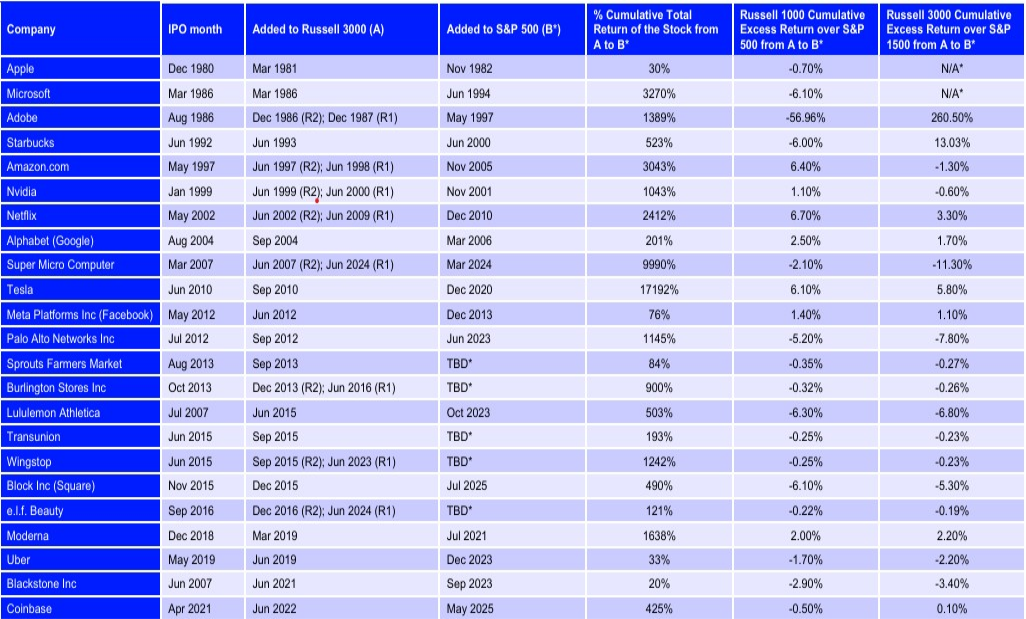
Source: FTSE Russell. Data as of April 30, 2026. Russell 3000 additions are assigned to the Russell 1000 unless otherwise noted for the Russell 2000. The inception date of the Russell 3000 Index is January 1, 1984. All performance shown prior to the index inception date reflects back‑tested results. Past performance is no guarantee of future returns. Please see the end of this document for important disclosures. *The S&P 1500 Index inception date is January 31, 1995; index performance is not available prior to this date. If the S&P 500 has not yet added the stock, performance is shown as of April 30, 2026.
New Russell US Indexes rule—fast entry on day five for large IPOs
FTSE Russell confirmed on 26 May 2026 that, following the feedback we had received from clients, we would implement a new fast entry rule for the Russell US Indexes with immediate effect. However, we made no changes to the existing minimum free float or minimum voting rights rules.
The new fast entry rule will allow companies that would make it into the Russell Top 500 index (i.e., the largest 500 companies from the Russell 3000) to be added to the index after the close of trading on the fifth day following the initial listing.
There are restrictions concerning the lock-down periods that precede each semi-annual Russell index reconstitution and regarding the type of IPO. For full details, consult our technical notice.
Index effect of fast-entry IPOs
Given the potential size of some of the projected 2026 IPOs, there has been a lot of press commentary on the potential impact of newly listed companies on the broader US equity market.
Just as a small number of mega-cap tech firms have recently had an outsize influence on the behaviour of US stock benchmarks, including the Russell 1000, 2000 and 3000, any potential new equity market giants could also play a significant role.
However, the inclusion of new entrants after the end of the fifth day of trading, rather than immediately on listing, should help address any immediate post-IPO share price volatility.
And it’s important to remember that any IPOs eligible for fast entry to the Russell US Indexes will only be included at their free float market capitalization. In other words, if a company lists its shares with a 5% free float, only 5% of its total market capitalization will be used in the index calculation.
This policy—adjusting share counts to reflect only those shares that are freely available to investors—was one of the original design steps taken by the managers of the Russell US Indexes. It’s still in force over four decades later.
Not all US equity indexes follow the same practices on free float, so it’s worth checking this important component of the index methodology.
Methodological enhancements and changes in a changing securities market are inevitable. But the goal of the Russell US Indexes hasn’t changed—to reflect the US equity market as it is.

Disclaimer
© [2026] London Stock Exchange Group plc and its applicable group undertakings (“LSEG”). LSEG includes (1) FTSE International Limited (“FTSE”), (2) Frank Russell Company (“Russell”), (3) FTSE Global Debt Capital Markets Inc. “FTSE Canada”, (4) FTSE Fixed Income LLC (“FTSE FI”), (5) FTSE (Beijing) Consulting Limited (“WOFE”), (6) FTSE EU SAS ("FES"). All rights reserved.
FTSE Russell® is a trading name of FTSE, Russell, FTSE Canada, FTSE FI, WOFE, FTSE EU and other LSEG entities providing LSEG Benchmark and Index services. “FTSE®”, “Russell®”, “FTSE Russell®”, “FTSE4Good®”, “ICB®”, “Refinitiv”, “WMR™” “FR™” and all other trademarks and service marks used herein (whether registered or unregistered) are trademarks and/or service marks owned or licensed by the applicable member of LSEG or their respective licensors.
FTSE International Limited is authorised as a Benchmark Administrator and regulated in the United Kingdom (UK) by the Financial Conduct Authority ("FCA") according to the UK Benchmark Regulation, FCA Reference Number 796803. FTSE EU SAS is authorised as Benchmark Administrator and regulated in the European Union (EU) by the Autorité des Marches Financiers (“AMF”) according to the EU Benchmark Regulation.
All information is provided for information purposes only. All information and data contained in this publication is obtained by LSEG, from sources believed by it to be accurate and reliable. Because of the possibility of human and mechanical inaccuracy as well as other factors, however, such information and data is provided "as is" without warranty of any kind. No member of LSEG nor their respective directors, officers, employees, partners or licensors make any claim, prediction, warranty or representation whatsoever, expressly or impliedly, either as to the accuracy, timeliness, completeness, merchantability of any information or LSEG Products, or of results to be obtained from the use of LSEG products, including but not limited to indices, rates, data and analytics, or the fitness or suitability of the LSEG products for any particular purpose to which they might be put. The user of the information assumes the entire risk of any use it may make or permit to be made of the information.
No responsibility or liability can be accepted by any member of LSEG nor their respective directors, officers, employees, partners or licensors for (a) any loss or damage in whole or in part caused by, resulting from, or relating to any inaccuracy (negligent or otherwise) or other circumstance involved in procuring, collecting, compiling, interpreting, analysing, editing, transcribing, transmitting, communicating or delivering any such information or data or from use of this document or links to this document or (b) any direct, indirect, special, consequential or incidental damages whatsoever, even if any member of LSEG is advised in advance of the possibility of such damages, resulting from the use of, or inability to use, such information.
No member of LSEG nor their respective directors, officers, employees, partners or licensors provide investment advice and nothing in this document should be taken as constituting financial or investment advice. No member of LSEG nor their respective directors, officers, employees, partners or licensors make any representation regarding the advisability of investing in any asset or whether such investment creates any legal or compliance risks for the investor. A decision to invest in any such asset should not be made in reliance on any information herein. Indices and rates cannot be invested in directly. Inclusion of an asset in an index or rate is not a recommendation to buy, sell or hold that asset nor confirmation that any particular investor may lawfully buy, sell or hold the asset or an index or rate containing the asset. The general information contained in this publication should not be acted upon without obtaining specific legal, tax, and investment advice from a licensed professional.
Past performance is no guarantee of future results. Charts and graphs are provided for illustrative purposes only. Index and/or rate returns shown may not represent the results of the actual trading of investable assets. Certain returns shown may reflect back-tested performance. All performance presented prior to the index or rate inception date is back-tested performance. Back-tested performance is not actual performance, but is hypothetical. The back-test calculations are based on the same methodology that was in effect when the index or rate was officially launched. However, back-tested data may reflect the application of the index or rate methodology with the benefit of hindsight, and the historic calculations of an index or rate may change from month to month based on revisions to the underlying economic data used in the calculation of the index or rate.
This document may contain forward-looking assessments. These are based upon a number of assumptions concerning future conditions that ultimately may prove to be inaccurate. Such forward-looking assessments are subject to risks and uncertainties and may be affected by various factors that may cause actual results to differ materially. No member of LSEG nor their licensors assume any duty to and do not undertake to update forward-looking assessments.
No part of this information may be reproduced, stored in a retrieval system or transmitted in any form or by any means, electronic, mechanical, photocopying, recording or otherwise, without prior written permission of the applicable member of LSEG. Use and distribution of LSEG data requires a licence from LSEG and/or its licensors.