

Tae Yoon Kim, CFA, FRM

Alex Nae, M.Sc
- A beneficiary of nearshoring, Mexico is a “real economy” market with indirect exposure to the AI infrastructure build-out
- Recent relative outperformance driven by industrials and materials, with supportive valuations and a rate-cutting cycle
- The 2026 United States-Mexico-Canada Agreement (USMCA) [note1] review is the key near-term event, likely to shape future investment flows and trade dynamics
Following Brazil[note2] , we continue the series of short insights into LatAm markets with an overview of Mexico. Since 2023, Mexico has become the most important US trading partner, accounting for 15.4% of total US imports; IMF [note3] estimates indicate that between 2017–2023, $70 billion (or circa. 45%) of Mexico’s export gains were attributable to US tariffs on China.
This trade diversion effect has been further reinforced by global supply-chain shifts following the Covid pandemic and geopolitical disruptions, including the war in Ukraine [note4]. Together, these factors have positioned Mexico as a central hub in North American manufacturing.
The FTSE Mexico Index performance (TR, USD) was 54.1% in 2025 and 10.6% year-to-date [note5] in 2026, whilst the FTSE Emerging and FTSE All-World indices returned 26.5% (7.3% YTD) and 23.1% (6.8% YTD) respectively.
As a net exporter of crude oil, Mexico is relatively insulated from the effects of the Iran conflict. This aligns with our earlier note on Brazil, where we discussed how EM markets that are net oil exporters show a higher level of resilience to oil supply shocks. Thus, a continuation of the conflict is likely to have a milder negative impact on growth.
Nearshoring ("Friendshoring")
Figure 1: Value of US imports (U.S. Census Bureau).
Mexico has been one of the largest beneficiaries of the nearshoring trend, as proximity to the US makes it the de facto manufacturing hub for North America. As such, Mexico is part of the USMCA, where compliant exports receive preferential treatment, boosting trade and improving competitiveness for the country.
Over 80% of its exports (>25% of GDP) go to the US and supply chains are deeply integrated. Thus, Mexico has seen improving exports in tariff-affected industries such as electronics, machinery or autos. For instance, high-technology exports currently represent 17.6% of the country’s manufactured exports.
Despite these tailwinds, GDP expanded by a modest 0.8% in 2025. Whilst exports grew by 7.6%, resulting in the first trade surplus since 2020, and FDI rose by 10.8%, the economy continues to operate with a negative output gap and lagging domestic investment. The IMF [note6] projects a more moderate GDP growth of 1.6% in 2026 and 2.2% in 2027.
As part of the EM structural re-rating story
We have previously highlighted [note7] the structural improvement underway across EMs, driven by stronger policy frameworks and economic fundamentals. Mexico can be viewed within this broader re-rating narrative, as it receives support from a combination of targeted fiscal initiatives and credible monetary policy.
To address the weak growth, President Sheinbaum launched “Plan Mexico” in 2025, a six-year strategy to reduce inequality by boosting economic growth. Its three pillars are facilitating private investment, closing infrastructure gaps and promoting domestic supply chains, with the following goals:
- Raise investment to 25-28% of GDP (from current 22%)
- Create 1.5 million jobs in manufacturing and strategic sectors
- Expand public-private partnerships and infrastructure spending
Still in its early stages, Plan Mexico provides a credible framework, signalling the government’s intent to address supply-side bottlenecks in energy and infrastructure. However, progress against its own targets has so far been gradual, and whilst investor sentiment has improved, markets still await greater policy clarity and real implementation.
central bank policy rates
Figure 2: Central bank policy rates.
On the monetary policy front, the Bank of Mexico (Banxico) began its tightening cycle in 2021, much earlier than its DM peers, which helped anchor expectations. With inflation now expected to ease closer to its 3% target, Banxico has been in a rate-cutting cycle, last lowering to 6.75% in March ‘26 despite projected tightening from other central banks stemming from inflation risks from the Middle East.
The 2026 USMCA review is a key catalyst
Apart from a slowdown in growth, a greater near-term risk driver for Mexico lies in the USMCA review, with a deadline of 1st of July. The 2026 review is not a full renegotiation but an assessment whereby the three countries must decide whether to extend it for 16 years. In the case of no extension, the agreement would enter a joint review cycle every year until 2036.
The backdrop is not the most congenial. The US is increasingly wary of Chinese companies setting up shop in Mexico to circumvent tariffs, hence is pushing for tighter rules of origin, stricter domestic content thresholds and curbs on Chinese FDI.
On a more positive note, US and Mexico continue to trade broadly under the USMCA framework (leaving a number of US tariff increases aside), and the base case remains that the close trade relationship and integration will be preserved. President Sheinbaum has pursued maximum accommodation, conceding on US demands regarding immigration and security.
Mexico has shown resilience navigating through periods of policy uncertainty and trade tensions. The upcoming review will be a pivotal moment that could either unlock delayed FDI or create new volatility.
A Value Market with Structural Tailwinds
Figure 3: Mexico vs All-World vs Emerging vs India vs China vs US: Forward PE and ROE
The FTSE Mexico Index trades at a 12M Forward PE of 12.9x, compared with 13.1x for the FTSE Emerging Index. Their respective ROEs stand at 15.6% and 12.8%.
Performance Comparison (Rebased to 100)
Figure 4: Select FTSE Indices 2026 YTD performance.
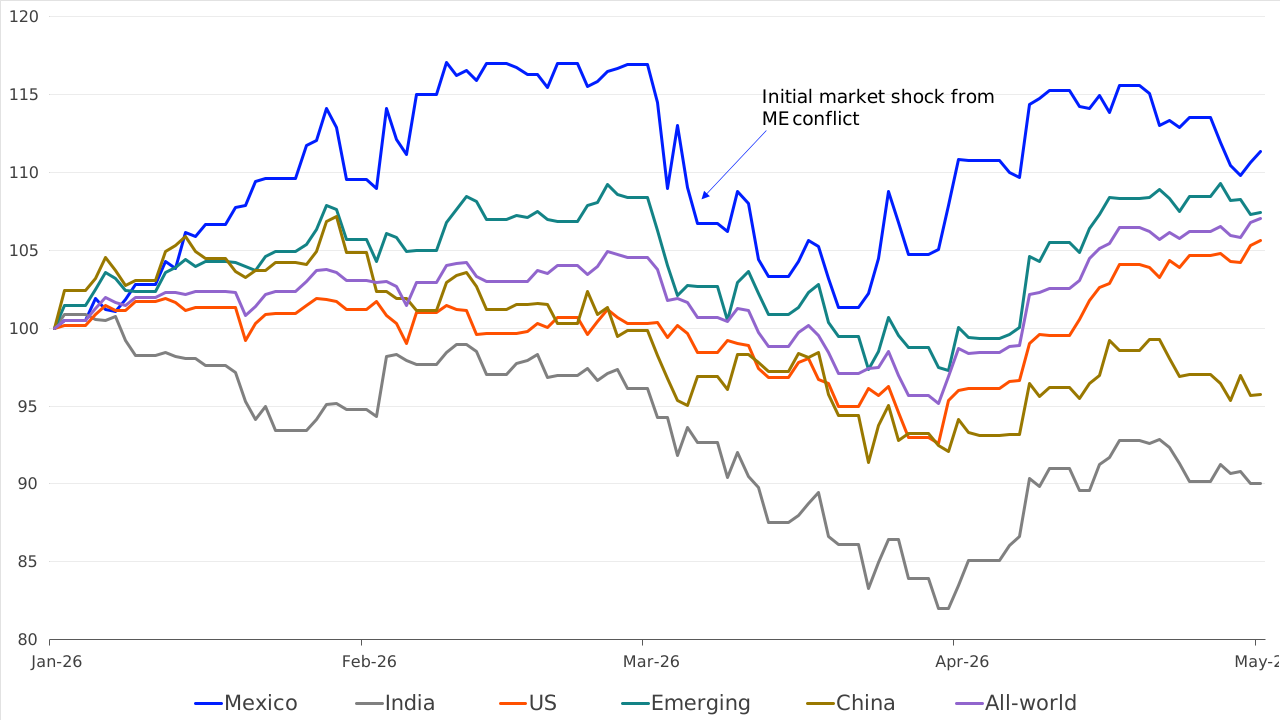
Source: FTSE Russell/LSEG. Data as of 1st of May 2026. Past performance is not a guide to future returns. Please see the end for important legal disclosures.
Robust gains were mainly driven by Basic Materials and Industrials. Though to a lesser extent than Brazil, Mexico is partly a commodity-linked economy, benefitting from exposure to industrial metals such as copper and silver, alongside green energy transition and the AI infrastructure build-out. Increasing demand for construction of nearshore data centres has helped cement Mexico’s position as a “picks and shovels” beneficiary of AI.
Conclusion
Against the recent backdrop of geopolitical uncertainty, Mexico has been underpinned by its structural drivers, namely nearshoring, deep supply-chain integration with the US and its industrials/materials tilt. The upcoming USMCA review and progress under Plan Mexico will be key signals to gauge whether investment, infrastructure and policy can align to sustain momentum and support a broader market re-rating.
footnotes
[1] In effect from 1st of July, 2020, the USMCA replaced the North American Free Trade Agreement (NAFTA) implemented in 1994. The USMCA is a modernisation of its predecessor, mainly concerning intellectual property and digital trade. | Back to Note 1
[2] More than a barrel trade: Brazil | LSEG | Back to Note 2
[3] Relocation of Global Value Chains: The Role of Mexico, WP/25/180, September 2025 | Back to Note 3
[4] The conflict further accelerated supply chain diversification trends already underway, as it highlighted the vulnerabilities of relying on long-distance, just-in-time supply chains, and prompted companies to look for more secure, nearby alternatives. Countries like Mexico were net beneficiaries of this reshuffling in supply chains. | Back to Note 4
[5] As of 30th of April 2026. | Back to Note 5
[6] World Economic Outlook, April 2026; Global Economy in the Shadow of War; April 14, 2026 | Back to Note 6
[7] Emerged: The structural re-rating of Emerging Markets | LSEG | Back to Note 7
Read more about

Disclaimer
© [2026] London Stock Exchange Group plc and its applicable group undertakings (“LSEG”). LSEG includes (1) FTSE International Limited (“FTSE”), (2) Frank Russell Company (“Russell”), (3) FTSE Global Debt Capital Markets Inc. “FTSE Canada”, (4) FTSE Fixed Income LLC (“FTSE FI”), (5) FTSE (Beijing) Consulting Limited (“WOFE”), (6) FTSE EU SAS ("FES"). All rights reserved.
FTSE Russell® is a trading name of FTSE, Russell, FTSE Canada, FTSE FI, WOFE, FTSE EU and other LSEG entities providing LSEG Benchmark and Index services. “FTSE®”, “Russell®”, “FTSE Russell®”, “FTSE4Good®”, “ICB®”, “Refinitiv”, “WMR™” “FR™” and all other trademarks and service marks used herein (whether registered or unregistered) are trademarks and/or service marks owned or licensed by the applicable member of LSEG or their respective licensors.
FTSE International Limited is authorised as a Benchmark Administrator and regulated in the United Kingdom (UK) by the Financial Conduct Authority ("FCA") according to the UK Benchmark Regulation, FCA Reference Number 796803. FTSE EU SAS is authorised as Benchmark Administrator and regulated in the European Union (EU) by the Autorité des Marches Financiers (“AMF”) according to the EU Benchmark Regulation.
All information is provided for information purposes only. All information and data contained in this publication is obtained by LSEG, from sources believed by it to be accurate and reliable. Because of the possibility of human and mechanical inaccuracy as well as other factors, however, such information and data is provided "as is" without warranty of any kind. No member of LSEG nor their respective directors, officers, employees, partners or licensors make any claim, prediction, warranty or representation whatsoever, expressly or impliedly, either as to the accuracy, timeliness, completeness, merchantability of any information or LSEG Products, or of results to be obtained from the use of LSEG products, including but not limited to indices, rates, data and analytics, or the fitness or suitability of the LSEG products for any particular purpose to which they might be put. The user of the information assumes the entire risk of any use it may make or permit to be made of the information.
No responsibility or liability can be accepted by any member of LSEG nor their respective directors, officers, employees, partners or licensors for (a) any loss or damage in whole or in part caused by, resulting from, or relating to any inaccuracy (negligent or otherwise) or other circumstance involved in procuring, collecting, compiling, interpreting, analysing, editing, transcribing, transmitting, communicating or delivering any such information or data or from use of this document or links to this document or (b) any direct, indirect, special, consequential or incidental damages whatsoever, even if any member of LSEG is advised in advance of the possibility of such damages, resulting from the use of, or inability to use, such information.
No member of LSEG nor their respective directors, officers, employees, partners or licensors provide investment advice and nothing in this document should be taken as constituting financial or investment advice. No member of LSEG nor their respective directors, officers, employees, partners or licensors make any representation regarding the advisability of investing in any asset or whether such investment creates any legal or compliance risks for the investor. A decision to invest in any such asset should not be made in reliance on any information herein. Indices and rates cannot be invested in directly. Inclusion of an asset in an index or rate is not a recommendation to buy, sell or hold that asset nor confirmation that any particular investor may lawfully buy, sell or hold the asset or an index or rate containing the asset. The general information contained in this publication should not be acted upon without obtaining specific legal, tax, and investment advice from a licensed professional.
Past performance is no guarantee of future results. Charts and graphs are provided for illustrative purposes only. Index and/or rate returns shown may not represent the results of the actual trading of investable assets. Certain returns shown may reflect back-tested performance. All performance presented prior to the index or rate inception date is back-tested performance. Back-tested performance is not actual performance, but is hypothetical. The back-test calculations are based on the same methodology that was in effect when the index or rate was officially launched. However, back-tested data may reflect the application of the index or rate methodology with the benefit of hindsight, and the historic calculations of an index or rate may change from month to month based on revisions to the underlying economic data used in the calculation of the index or rate.
This document may contain forward-looking assessments. These are based upon a number of assumptions concerning future conditions that ultimately may prove to be inaccurate. Such forward-looking assessments are subject to risks and uncertainties and may be affected by various factors that may cause actual results to differ materially. No member of LSEG nor their licensors assume any duty to and do not undertake to update forward-looking assessments.
No part of this information may be reproduced, stored in a retrieval system or transmitted in any form or by any means, electronic, mechanical, photocopying, recording or otherwise, without prior written permission of the applicable member of LSEG. Use and distribution of LSEG data requires a licence from LSEG and/or its licensors.