
LISTEN TO THE PODCAST
FTSE Russell's weight explainer is a visual tool designed to increase transparency in index construction.
The weight explainer enables index users to understand the drivers behind specific company or sector weightings. It decomposes index weights and weight changes into their underlying drivers, offering a concise, investor-focused way to communicate how each factor influences final allocations.
Hannah Layman, head of sustainable index research and design at FTSE Russell, recently joined the Index Ideas podcast to talk about this increasingly popular index tool.
Why the need for a weight explainer?
“We found that our clients are getting significant inbound questions about our indices’ relative weight positions,” Layman says in the podcast.
“For example, why does stock A have such a high weight in my ESG product? Or why does stock A have a higher weight than stock B in my green revenues product? That’s the sort of thing that the weight explainer allows you to visualise and answer,” Layman says.
By breaking down the transition from initial benchmark to index weight into a series of multiplicative tilts, the weight explainer maps how each input contributes to the final position. It provides a transparent link between index objectives and constituent-level outcomes.
How the weight explainer works
For example, Amazon.com received a weighting boost in the FTSE Developed Paris-Aligned benchmark by comparison with the starting universe (the FTSE Developed index) at the September 2025 review date—from 2.73% in the starting benchmark to 5% in the FTSE Developed Paris-Aligned benchmark.
The weight explainer shows that this increase in the index weight was driven by three factors: Amazon’s low carbon emissions, its green revenues exposure and its strong TPI Management Quality (TPM MQ) score.
In this index, a capping factor (which reduces the maximum index weight to 5%) is imposed to mitigate potential concentration risk.
Amazon.com in the FTSE Developed Paris-Aligned benchmark as at September 2025 review date
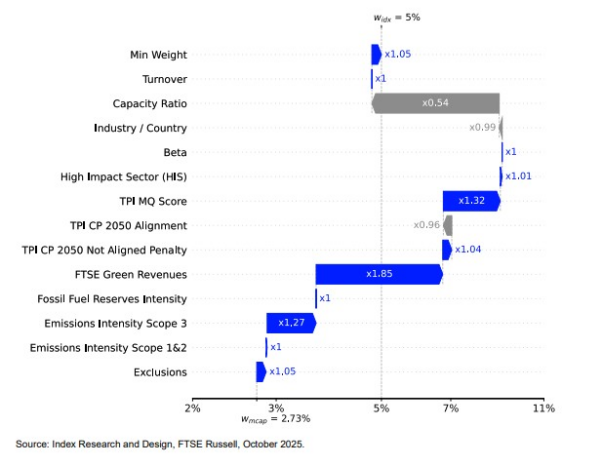
Source: Index Research and Design, FTSE Russell,October 2025. Past performance is not a guide to future returns. Please see the end for important legal disclosures.
Choosing sustainability factors
According to Layman, choosing the right sustainability factors is also important when it comes to index design.
“It’s very common practice to put multiple objectives into an index that are correlated,” she says in the podcast.
“For example, you might have someone who wants to design a product that tracks an index that tilts away from companies with exposure to fossil fuels ownership. Now, the same investor might want the index to tilt towards companies that have exposure to green revenues. However, these are often the same companies.”
“You're effectively reducing the solution space because you're trying to find companies that both have low fossil fuels ownership and have green revenues exposure. It just makes that balance even more important,” she says.
As well as choosing the right factors, other index design factors also come into play, says Layman.
“When you add multiple tilts and particularly in the sustainable space, it's really important to balance the number of objectives with investability,” she says.
“You do that by monitoring metrics such as concentration, diversification, turnover, and making sure that you're not putting too much pressure, you're not asking too much of your index.”
Positive feedback on the weight explainer
How have FTSE Russell’s clients reacted to the introduction of this index tool?
“We've had really positive feedback from our clients,” Layman says in the podcast.
“What this tool enabled them to do was really quickly both visualise and explain but also share that visualisation to be able to explain it to their own clients.”
To listen to the Index Ideas podcast featuring Hannah Layman, click here.

Read more about

Disclaimer
© [2026] London Stock Exchange Group plc and its applicable group undertakings (“LSEG”). LSEG includes (1) FTSE International Limited (“FTSE”), (2) Frank Russell Company (“Russell”), (3) FTSE Global Debt Capital Markets Inc. “FTSE Canada”, (4) FTSE Fixed Income LLC (“FTSE FI”), (5) FTSE (Beijing) Consulting Limited (“WOFE”), (6) FTSE EU SAS ("FES"). All rights reserved.
FTSE Russell® is a trading name of FTSE, Russell, FTSE Canada, FTSE FI, WOFE, FTSE EU and other LSEG entities providing LSEG Benchmark and Index services. “FTSE®”, “Russell®”, “FTSE Russell®”, “FTSE4Good®”, “ICB®”, “Refinitiv”, “WMR™” “FR™” and all other trademarks and service marks used herein (whether registered or unregistered) are trademarks and/or service marks owned or licensed by the applicable member of LSEG or their respective licensors.
FTSE International Limited is authorised as a Benchmark Administrator and regulated in the United Kingdom (UK) by the Financial Conduct Authority ("FCA") according to the UK Benchmark Regulation, FCA Reference Number 796803. FTSE EU SAS is authorised as Benchmark Administrator and regulated in the European Union (EU) by the Autorité des Marches Financiers (“AMF”) according to the EU Benchmark Regulation.
All information is provided for information purposes only. All information and data contained in this publication is obtained by LSEG, from sources believed by it to be accurate and reliable. Because of the possibility of human and mechanical inaccuracy as well as other factors, however, such information and data is provided "as is" without warranty of any kind. No member of LSEG nor their respective directors, officers, employees, partners or licensors make any claim, prediction, warranty or representation whatsoever, expressly or impliedly, either as to the accuracy, timeliness, completeness, merchantability of any information or LSEG Products, or of results to be obtained from the use of LSEG products, including but not limited to indices, rates, data and analytics, or the fitness or suitability of the LSEG products for any particular purpose to which they might be put. The user of the information assumes the entire risk of any use it may make or permit to be made of the information.
No responsibility or liability can be accepted by any member of LSEG nor their respective directors, officers, employees, partners or licensors for (a) any loss or damage in whole or in part caused by, resulting from, or relating to any inaccuracy (negligent or otherwise) or other circumstance involved in procuring, collecting, compiling, interpreting, analysing, editing, transcribing, transmitting, communicating or delivering any such information or data or from use of this document or links to this document or (b) any direct, indirect, special, consequential or incidental damages whatsoever, even if any member of LSEG is advised in advance of the possibility of such damages, resulting from the use of, or inability to use, such information.
No member of LSEG nor their respective directors, officers, employees, partners or licensors provide investment advice and nothing in this document should be taken as constituting financial or investment advice. No member of LSEG nor their respective directors, officers, employees, partners or licensors make any representation regarding the advisability of investing in any asset or whether such investment creates any legal or compliance risks for the investor. A decision to invest in any such asset should not be made in reliance on any information herein. Indices and rates cannot be invested in directly. Inclusion of an asset in an index or rate is not a recommendation to buy, sell or hold that asset nor confirmation that any particular investor may lawfully buy, sell or hold the asset or an index or rate containing the asset. The general information contained in this publication should not be acted upon without obtaining specific legal, tax, and investment advice from a licensed professional.
Past performance is no guarantee of future results. Charts and graphs are provided for illustrative purposes only. Index and/or rate returns shown may not represent the results of the actual trading of investable assets. Certain returns shown may reflect back-tested performance. All performance presented prior to the index or rate inception date is back-tested performance. Back-tested performance is not actual performance, but is hypothetical. The back-test calculations are based on the same methodology that was in effect when the index or rate was officially launched. However, back-tested data may reflect the application of the index or rate methodology with the benefit of hindsight, and the historic calculations of an index or rate may change from month to month based on revisions to the underlying economic data used in the calculation of the index or rate.
This document may contain forward-looking assessments. These are based upon a number of assumptions concerning future conditions that ultimately may prove to be inaccurate. Such forward-looking assessments are subject to risks and uncertainties and may be affected by various factors that may cause actual results to differ materially. No member of LSEG nor their licensors assume any duty to and do not undertake to update forward-looking assessments.
No part of this information may be reproduced, stored in a retrieval system or transmitted in any form or by any means, electronic, mechanical, photocopying, recording or otherwise, without prior written permission of the applicable member of LSEG. Use and distribution of LSEG data requires a licence from LSEG and/or its licensors.