

Felix Fouret

Julien Blanc

Jaakko Kooroshy
Financial institutions are often expected to demonstrate how their portfolios align with global climate objectives. To do so, they can draw on a growing set of tools designed to measure alignment. [note1] Among them is Implied Temperature Rise (ITR) [note2], a methodology that translates an entity's forward-looking climate performance into a temperature score.
While ITR scores are commonly used to measure and communicate portfolio climate alignment, differences in modelling choices can lead to materially different outcomes and fuel ongoing discussions about methodological divergence. [note3]
One modelling choice is particularly influential. Because ITR scores rely on emissions projections, future emissions are typically estimated either from disclosed GHG emissions reduction targets or by extrapolating historical emissions trends. As a result, the treatment of climate targets can have a material impact on implied temperature outcomes.[note4]
Effectively, all temperature alignment methodologies face the same challenge: should they trust a company's stated ambitions or its observed emissions trajectory? Targets remain a measure of ambition and can be revised or delayed over time. [note5] Conversely, historical emissions trends capture realised performance but may understate future emissions reductions that companies are already planning to deliver.
The difference is material. For the FTSE All-World Index, the ITR score falls from 3.11°C when targets are ignored to 1.87°C when targets are included (Figure 1). LSEG already provides both views, [note6] each of which offers a different perspective on climate alignment.
Balancing ambition with credibility
Rather than choosing between the two, the key question perhaps becomes how much confidence should be placed in a company's climate targets. TPI Management Quality (MQ) scores, which measure how a company manages its GHG emissions and the risks and opportunities related to the low-carbon transition, provide one potential answer. Our previous research [note7] shows that companies with stronger TPI MQ scores are more likely to decarbonise and typically do so faster. The score therefore provides a useful signal of a company's ability to translate climate ambitions into action. This assessment remains relevant even if a company downgrades, delays or drops its targets.
Building on this insight, we can use the TPI MQ score as a proxy for the credibility of a company’s climate targets and as a weighting factor for an ITR estimate. Companies with higher TPI MQ scores receive a greater weight on the target-based ITR, while companies with lower scores receive a greater weight on the trend-based ITR (the weights assigned are provided in Figure 3, located at the end of this article). By incorporating target credibility, the methodology produces a temperature score of 2.26°C for the FTSE All-World Index (Figure 1), sitting between the target-based and trend-based outcomes and offering a more balanced perspective.
Figure 1: Effect of target inclusion and credibility weighting on ITR, using the FTSE All-World Index
The distribution analysis reinforces this finding (Figure 2). A simple target-based approach classifies many more companies as “1.5°C aligned” than the credibility-weighted methodology. Once credibility is considered, the number of “1.5°C aligned” companies in the FTSE All-World Index falls materially: from 27% to just 8%. In other words, for a substantial share of companies, there is a gap between the ambition reflected in their climate targets and the evidence of management practices and strategic processes associated with delivering on those targets.
Figure 2: Distribution of alignment outcomes (1.5°C / <2°C / Not Aligned) under the different approaches
The results illustrate why the choice of methodology matters. Projecting corporate emissions based on targets produces much lower implied temperature scores than approaches that extrapolate from current emissions trajectories. Factoring in TPI MQ scores effectively acts as a credibility adjustment. It creates a middle ground between stated ambition and observed performance by assigning greater weight to firms whose climate ambitions are supported by strong climate governance and planning – signalling which emission outcomes are plausible, not merely promised.
Figure 3: TPI MQ score and associated weights

Climate MAP in practice: Combining management and ambition
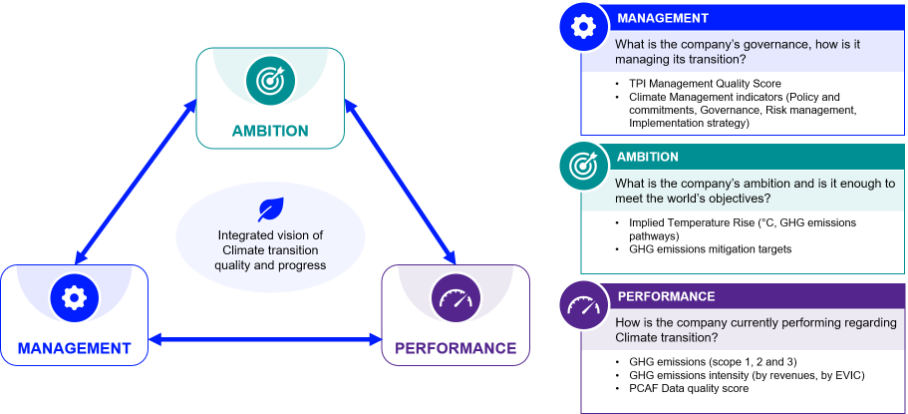
LSEG’s Climate MAP is a multi-dimensional assessment framework designed to provide a holistic view of corporate climate transition readiness, rather than relying on any single metric. It organises climate-transition signals across three complementary pillars: Management assesses whether governance, strategy and transition planning support execution; Ambition evaluates whether a company's forward-looking emissions trajectory is aligned with climate goals; and Performance examines its current emissions profile and evidence of delivery. Read together, the pillars can reveal inconsistencies - such as ambitious targets unsupported by credible governance or emissions progress - and support portfolio monitoring, stewardship, reporting and the identification of potential inconsistencies between stated climate ambitions and observed performance.
footnotes
[1] The Alignment Cookbook 2, 2024, [Institut Louis Bachelier (ILB)] | Back to Note 1
[2] As defined by the Portfolio Alignment Team (PAT), Implied Temperature Rise (ITR) expresses the global warming outcome that would result if the entire economy followed the same level of ambition as a company or issuer | Back to Note 2
[3] Deep dive: Taking stock of temperature scores | Back to Note 3
[4] See Exploring Implied Temperature Rise scores | Back to Note 4
[5] See Are corporates walking the walk on climate pledges? | LSEG. Similar results have been found for a broader sample in a recent academic study in Nature Climate Change | Back to Note 5
[6] See Deep dive: Taking stock of temperature scores | Back to Note 6
[7] See Still tracking: analysing corporate decarbonisation intentions with TPI MQ scores | Back to Note 7
Read more about

Legal Disclaimer
Republication or redistribution of LSE Group content is prohibited without our prior written consent.
The content of this publication is for informational purposes only and has no legal effect, does not form part of any contract, does not, and does not seek to constitute advice of any nature and no reliance should be placed upon statements contained herein. Whilst reasonable efforts have been taken to ensure that the contents of this publication are accurate and reliable, LSE Group does not guarantee that this document is free from errors or omissions; therefore, you may not rely upon the content of this document under any circumstances and you should seek your own independent legal, investment, tax and other advice. Neither We nor our affiliates shall be liable for any errors, inaccuracies or delays in the publication or any other content, or for any actions taken by you in reliance thereon.
Copyright © 2026 London Stock Exchange Group. All rights reserved.
The content of this publication is provided by London Stock Exchange Group plc, its applicable group undertakings and/or its affiliates or licensors (the “LSE Group” or “We”) exclusively.
Neither We nor our affiliates guarantee the accuracy of or endorse the views or opinions given by any third party content provider, advertiser, sponsor or other user. We may link to, reference, or promote websites, applications and/or services from third parties. You agree that We are not responsible for, and do not control such non-LSE Group websites, applications or services.
The content of this publication is for informational purposes only. All information and data contained in this publication is obtained by LSE Group from sources believed by it to be accurate and reliable. Because of the possibility of human and mechanical error as well as other factors, however, such information and data are provided "as is" without warranty of any kind. You understand and agree that this publication does not, and does not seek to, constitute advice of any nature. You may not rely upon the content of this document under any circumstances and should seek your own independent legal, tax or investment advice or opinion regarding the suitability, value or profitability of any particular security, portfolio or investment strategy. Neither We nor our affiliates shall be liable for any errors, inaccuracies or delays in the publication or any other content, or for any actions taken by you in reliance thereon. You expressly agree that your use of the publication and its content is at your sole risk.
To the fullest extent permitted by applicable law, LSE Group, expressly disclaims any representation or warranties, express or implied, including, without limitation, any representations or warranties of performance, merchantability, fitness for a particular purpose, accuracy, completeness, reliability and non-infringement. LSE Group, its subsidiaries, its affiliates and their respective shareholders, directors, officers employees, agents, advertisers, content providers and licensors (collectively referred to as the “LSE Group Parties”) disclaim all responsibility for any loss, liability or damage of any kind resulting from or related to access, use or the unavailability of the publication (or any part of it); and none of the LSE Group Parties will be liable (jointly or severally) to you for any direct, indirect, consequential, special, incidental, punitive or exemplary damages, howsoever arising, even if any member of the LSE Group Parties are advised in advance of the possibility of such damages or could have foreseen any such damages arising or resulting from the use of, or inability to use, the information contained in the publication. For the avoidance of doubt, the LSE Group Parties shall have no liability for any losses, claims, demands, actions, proceedings, damages, costs or expenses arising out of, or in any way connected with, the information contained in this document.
LSE Group is the owner of various intellectual property rights ("IPR”), including but not limited to, numerous trademarks that are used to identify, advertise, and promote LSE Group products, services and activities. Nothing contained herein should be construed as granting any licence or right to use any of the trademarks or any other LSE Group IPR for any purpose whatsoever without the written permission or applicable licence terms.