Jinan Al Taitoon
key takeaways
- Islamic finance and climate finance are a natural fit, sharing a focus on human welfare and the environment, and a link to real assets.
- Sustainable Islamic finance is still nascent, but ESG sukuk have strong momentum, with issuance up 54% in 2025 and the market reaching US$76.7 billion since 2017.
- Demand, project pipelines and financing frameworks support further growth in ESG sukuk, but scaling climate finance may depend on the industry’s capability to navigate its complexities.
At an estimated US$6.5 trillion in assets, Islamic finance is no longer a niche market. Industry assets are projected to reach US$10.5 trillion by 2030. Much of that growth sits in markets facing significant climate investment needs, from hydrocarbon producers diversifying their economies to countries highly exposed to the impact of climate change.
That makes Islamic finance hard to overlook as COP31 opens in Antalya on 9 November. Türkiye is the fourth member of the Organisation of Islamic Cooperation (OIC) to host the UN climate summit in five years. This year’s agenda centres on implementation: turning climate commitments into action, with the mobilisation of climate finance a key priority.
Implementation needs capital. So, can Islamic finance help scale climate finance?
Islamic finance and climate finance are a natural fit
Climate finance is funding that reduces emissions or helps economies and communities adapt to climate change. Its objectives overlap closely with the principles of Islamic finance. These principles are rooted in Maqasid al-Shariah, the higher objectives of Islamic law, which centre on protecting human welfare. Alongside this sits the concept of humans as stewards of the earth. Protecting the environment and limiting climate-related harm therefore sit within Islamic finance’s own ethical framework.
There is a structural fit as well. Islamic financing must be tied to assets or real economic activity, so it lends itself to funding tangible projects, such as renewable energy, water infrastructure and green buildings, that are at the heart of climate investment.
Areas of alignment between ESG and Maqasid al-Shariah
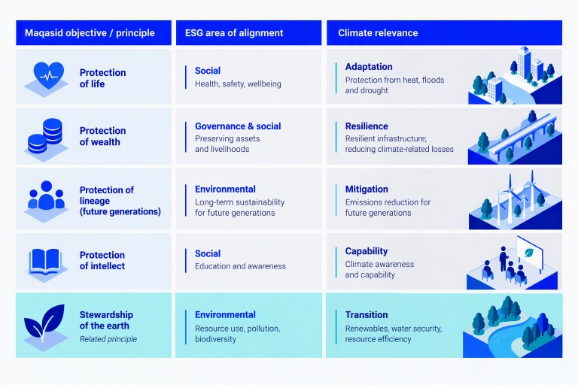
Sukuk, the Islamic equivalent of bonds, are one of the main Islamic financing channels, with a global market exceeding US$1 trillion. Their scale brings two advantages:
- They reach investors whose mandates allow only Shariah-compliant assets.
- They are also familiar to conventional investors, so one issuance can draw on both investor groups.
ESG sukuk: from niche to momentum
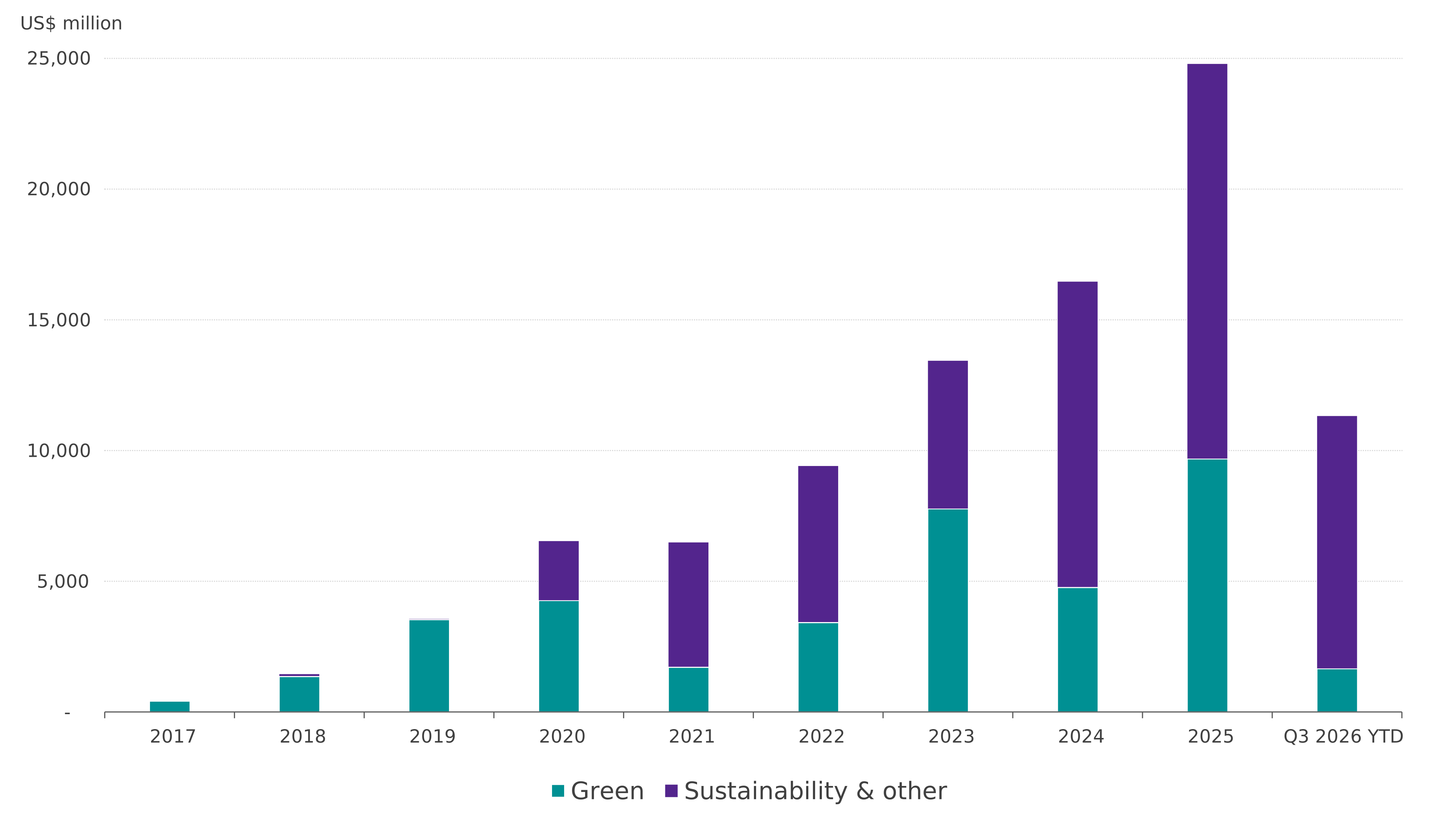
Sustainable Islamic finance is still nascent, but ESG sukuk have grown consistently. Since the first such sukuk was issued in 2017, the market has reached US$76.7 billion by Q3 2026. ESG sukuk issuance reached a record US$24.9 billion in 2025, up 54% from 2024.
ESG and green sukuk historical issuance
Source: LSEG data. Past performance is not a guide to future returns. Please see the end for important legal disclosures.
| Period | Green (US$m) | Sustainability & other (US$m) | Total (US$m) |
|---|---|---|---|
| 2017 | ~500 | ~0 | ~500 |
| 2018 | ~1,400 | ~100 | ~1,500 |
| 2019 | ~3,600 | ~0 | ~3,600 |
| 2020 | ~4,300 | ~2,300 | ~6,600 |
| 2021 | ~1,700 | ~4,800 | ~6,500 |
| 2022 | ~3,400 | ~6,000 | ~9,400 |
| 2023 | ~7,800 | ~5,700 | ~13,500 |
| 2024 | ~4,800 | ~11,700 | ~16,500 |
| 2025 | ~9,700 | ~15,200 | ~24,900 |
| Q3 2026 YTD | ~1,700 | ~9,700 | ~11,400 |
A pause, not a reversal
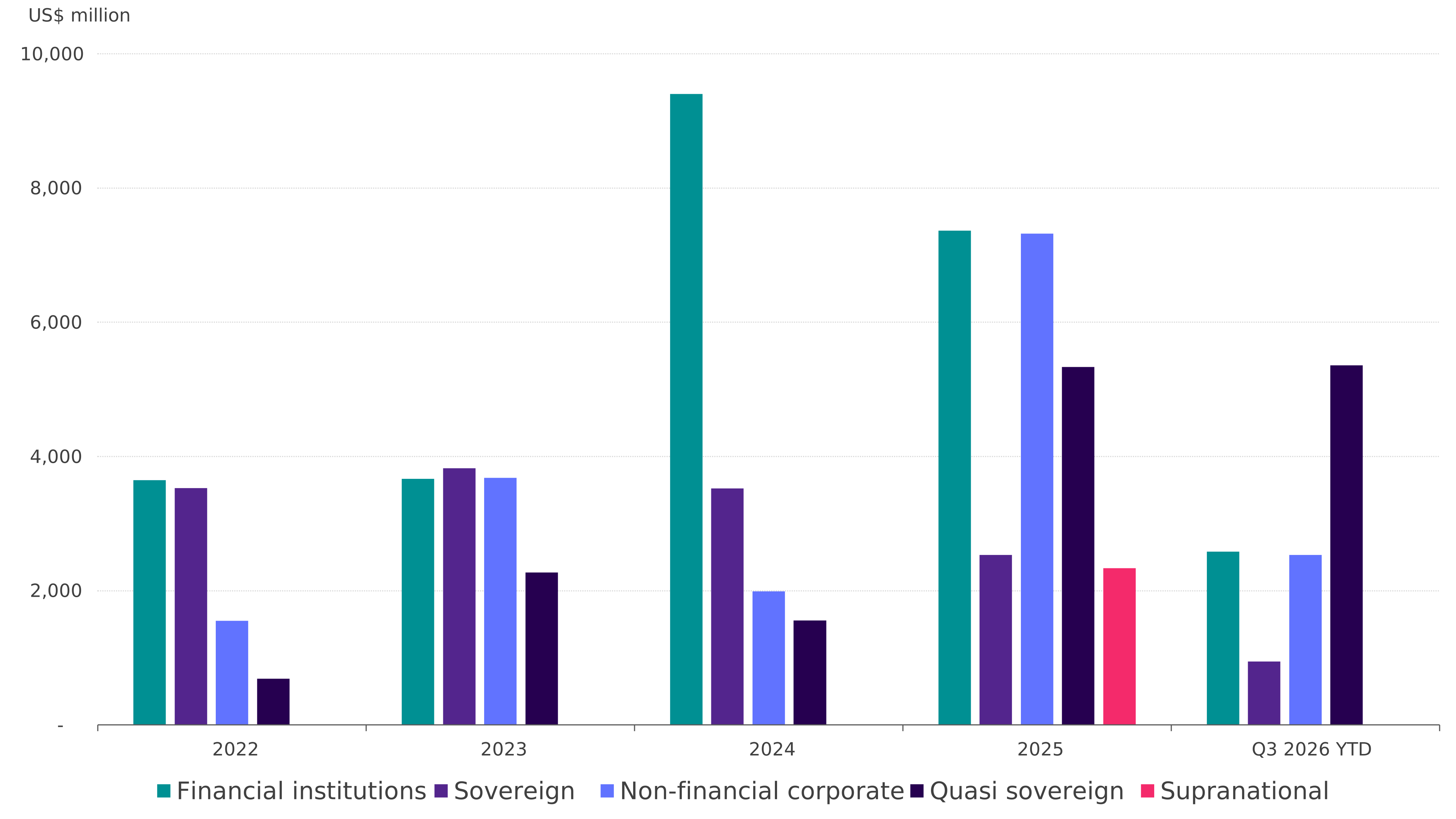
Momentum has slowed in 2026. ESG sukuk issuance totalled US$11.4 billion by the end of Q3 2026, as many corporate issuers postponed deals amid persistent geopolitical tensions. Corporates are the main driver of the market, accounting for 59% of ESG sukuk issuance in 2025, so their caution has had an outsized effect.
ESG sukuk issuance by issuer type
Source: LSEG data. Past performance is not a guide to future returns. Please see the end for important legal disclosures.
| Period | Financial institutions | Sovereign | Non-financial corporate | Quasi-sovereign | Supranational |
|---|---|---|---|---|---|
| 2022 | ~3,600 | ~3,500 | ~1,600 | ~700 | 0 |
| 2023 | ~3,700 | ~3,800 | ~3,700 | ~2,300 | 0 |
| 2024 | ~9,400 | ~3,500 | ~2,000 | ~1,600 | 0 |
| 2025 | ~7,400 | ~2,500 | ~7,300 | ~5,300 | ~2,300 |
| Q3 2026 YTD | ~2,600 | ~900 | ~2,500 | ~5,300 | 0 |
Three factors suggest that issuance should recover once conditions improve:
- A growing pipeline. Net-zero targets and economic diversification plans across the Gulf Cooperation Council (GCC) will require sustained investment in renewable energy, utilities and infrastructure over the next 5–15 years.
- Frameworks already in place. Sovereigns across core markets, including the GCC, Malaysia, Indonesia and Türkiye, have published green or sustainability financing frameworks that provide for sukuk. Indonesia is already a regular issuer of sovereign green sukuk.
- A widening scope. This year saw the world’s first two blue sukuk, both issued in Malaysia to fund water infrastructure. Instruments like these extend Islamic climate finance beyond emissions reduction to adaptation, an increasingly pressing agenda in markets such as Indonesia and Pakistan.
So, can Islamic finance help scale climate finance?
On its own and at a global level, probably not. ESG sukuk still account for a small share of global ESG bond issuance, and Islamic finance alone will not close the climate finance gap.
Within markets where Islamic finance is well established, however, the case is stronger. These markets combine growing investor demand, a pipeline of green and transition projects and familiarity with Islamic financing structures. The building blocks are therefore in place.
Connecting them is harder. Project readiness and bankability are one constraint. Another is the capacity of issuers, arrangers and investors to navigate the added layers that climate financing brings, from eligibility criteria and external reviews to allocation and impact reporting, on top of Shariah compliance. As COP31 turns to implementation, closing that capability gap may matter as much as the capital itself.


Legal Disclaimer
Republication or redistribution of LSE Group content is prohibited without our prior written consent.
The content of this publication is for informational purposes only and has no legal effect, does not form part of any contract, does not, and does not seek to constitute advice of any nature and no reliance should be placed upon statements contained herein. Whilst reasonable efforts have been taken to ensure that the contents of this publication are accurate and reliable, LSE Group does not guarantee that this document is free from errors or omissions; therefore, you may not rely upon the content of this document under any circumstances and you should seek your own independent legal, investment, tax and other advice. Neither We nor our affiliates shall be liable for any errors, inaccuracies or delays in the publication or any other content, or for any actions taken by you in reliance thereon.
Copyright © 2026 London Stock Exchange Group. All rights reserved.
The content of this publication is provided by London Stock Exchange Group plc, its applicable group undertakings and/or its affiliates or licensors (the “LSE Group” or “We”) exclusively.
Neither We nor our affiliates guarantee the accuracy of or endorse the views or opinions given by any third party content provider, advertiser, sponsor or other user. We may link to, reference, or promote websites, applications and/or services from third parties. You agree that We are not responsible for, and do not control such non-LSE Group websites, applications or services.
The content of this publication is for informational purposes only. All information and data contained in this publication is obtained by LSE Group from sources believed by it to be accurate and reliable. Because of the possibility of human and mechanical error as well as other factors, however, such information and data are provided "as is" without warranty of any kind. You understand and agree that this publication does not, and does not seek to, constitute advice of any nature. You may not rely upon the content of this document under any circumstances and should seek your own independent legal, tax or investment advice or opinion regarding the suitability, value or profitability of any particular security, portfolio or investment strategy. Neither We nor our affiliates shall be liable for any errors, inaccuracies or delays in the publication or any other content, or for any actions taken by you in reliance thereon. You expressly agree that your use of the publication and its content is at your sole risk.
To the fullest extent permitted by applicable law, LSE Group, expressly disclaims any representation or warranties, express or implied, including, without limitation, any representations or warranties of performance, merchantability, fitness for a particular purpose, accuracy, completeness, reliability and non-infringement. LSE Group, its subsidiaries, its affiliates and their respective shareholders, directors, officers employees, agents, advertisers, content providers and licensors (collectively referred to as the “LSE Group Parties”) disclaim all responsibility for any loss, liability or damage of any kind resulting from or related to access, use or the unavailability of the publication (or any part of it); and none of the LSE Group Parties will be liable (jointly or severally) to you for any direct, indirect, consequential, special, incidental, punitive or exemplary damages, howsoever arising, even if any member of the LSE Group Parties are advised in advance of the possibility of such damages or could have foreseen any such damages arising or resulting from the use of, or inability to use, the information contained in the publication. For the avoidance of doubt, the LSE Group Parties shall have no liability for any losses, claims, demands, actions, proceedings, damages, costs or expenses arising out of, or in any way connected with, the information contained in this document.
LSE Group is the owner of various intellectual property rights ("IPR”), including but not limited to, numerous trademarks that are used to identify, advertise, and promote LSE Group products, services and activities. Nothing contained herein should be construed as granting any licence or right to use any of the trademarks or any other LSE Group IPR for any purpose whatsoever without the written permission or applicable licence terms.