

Nataliya Manifold
Since its launch in 2019, the Green Economy Mark cohort have raised nearly £18 billion [note1]. Today more than £77 billion of institutional capital is invested [note2] in the companies and funds with the Green Economy Mark, demonstrating powerful momentum behind sustainable investing.
The Green Economy Mark, which recognises issuers (both companies and funds) contributing to the green economy, has become a powerful enabler for those seeking access to capital that supports their sustainability-focused growth. The Green Economy Mark also provides a vital signal for investors seeking to allocate capital towards issuers with demonstrable environmental impact.
On 31 October 2025, renewable energy developer Cindrigo listed on the Main Market of the London Stock Exchange, becoming the latest company to join the Green Economy Mark cohort. This follows a strong year for the cohort, which raised more than £634 million in 2025.
How the Green Economy Mark works
London-listed companies and funds, on all segments of the Main Market and AIM, may be provided the Green Economy Mark if at least half of their revenues are generated from products and services that contribute to the global green economy. For pre-revenue issuers, they must demonstrate that 100% of their business activity is derived from environmental products and services to be classified as green.
The Green Economy Mark draws upon the LSEG Green Revenues Classification System (GRCS), which identifies environmental products and services across the whole equity value chain, covering 10 sectors, 64 subsectors and 133 microsectors. Each microsector is assessed against seven environmental objectives:
- Climate change mitigation
- Climate change adaptation
- Pollution prevention and control
- Protection of healthy ecosystems
- Sustainable use and protection of water and marine resources
- Transition to a circular economy, waste prevention and recycling
- Sustainable and efficient agriculture
These microsectors are allocated to one of three tiers based on their overall environmental impact across the environmental objectives.
- Tier 1 comprises activities with clear and significant environmental benefits (e.g., solar energy generation).
- Tier 2 includes activities that provide more limited but still net positive environmental benefits (e.g., water utilities).
- Tier 3 covers activities that may have some environmental benefits but are assessed as overall net neutral or negative (e.g., nuclear energy generation).
To meet the criteria of the Green Economy Mark, currently only Tier 1 and Tier 2 microsectors are taken into account.
A growing part of the global economy
LSEG data shows that, over the past decade, the market capitalisation of the global green economy has expanded at a compound annual rate of 15% – faster than any other sector apart from Technology. It is now valued at US$7.9 trillion globally (as of Q1 2025), equivalent to 8.6% of global listed equity markets. If it was a standalone sector, the green economy would be the world’s fourth largest, after Technology, Industrials and Healthcare.
Not only is the green economy growing fast, but that growth is likely to accelerate. According to LSEG research, meeting global climate goals will require investment of between US$109 trillion and US$275 trillion by 2050. This represents an enormous demand for capital and an important source of investment returns for the providers of that funding.
Investor momentum behind the green economy
This growth has not gone unnoticed by investors. In debt markets, for example, the total of outstanding green bonds exceeded US$3 trillion for the first time at the end of the third quarter of 2025.
The green economy is broader than many market participants might initially assume. As well as obvious pureplay sub-sectors such as renewable energy or electric vehicles, the GRCS encompasses a broad range of activities. For example, Energy Management and Efficiency, the green economy’s largest sector, includes electrical equipment, construction materials and infrastructure construction.
The environmental outcomes of the sub-sectors are also wide ranging, from products which can help reduce energy consumption in transport, to solutions that enable the reduction or prevention of pollution, and the manufacture of materials that improve the recyclability of products.
What the Green Economy Mark delivers for investors
By using the GRCS to identify the green revenues of individual companies and funds, the Green Economy Mark helps identify companies whose environmental credentials may not be immediately obvious. For example:
- Raspberry Pi (provided the Green Economy Mark in 2024) manufactures high performance, low-cost computing products, which are around 90% more energy efficient than traditional PCs. [note3]
- Synthomer (provided the Green Economy Mark in 2021) is a specialty chemicals company with a large proportion of its revenues derived from products that deliver defined sustainability benefits. Approximately 80% of its products consist of water‑based dispersions, which significantly reduce harmful emissions compared with solvent‑based alternatives. [note4]
- Persimmon (provided the Green Economy Mark in 2022) has advanced the development of net zero ready homes, helping to reduce carbon emissions and support the transition to a low carbon future. Its focus on building energy efficient housing and integrating low carbon design features demonstrates strong sustainability credentials within the building and property sector. [note5]
Funds investing in GRCS-aligned activities are also eligible for the Green Economy Mark and account for c.25% of the cohort, as of June 2025. For example, Impax Asset Management holds the Green Economy Mark at both an asset manager and fund level; its listed flagship investment trust, Impax Environmental Markets Plc, has a market capitalisation of c. £760 million. Similarly, Foresight Group, an ESG-focused infrastructure and private equity asset manager, obtained the Green Economy Mark at its £277 million IPO in 2021; its listed investment trusts - Foresight Solar Fund Limited and Foresight Environmental Infrastructure Limited - also both hold the Green Economy Mark.
A diversified universe
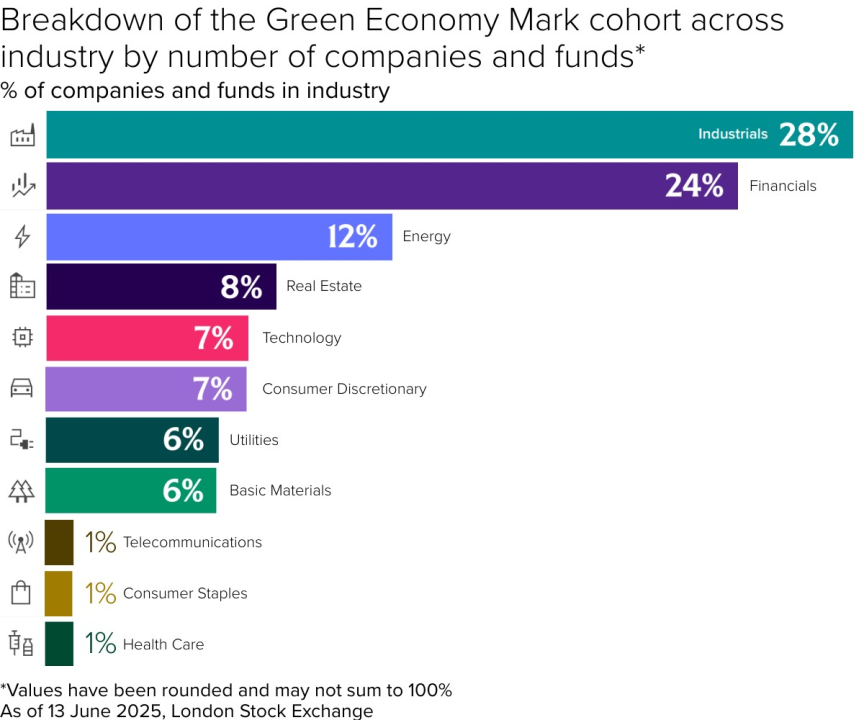
One of the key attractions of the Green Economy Mark for investors is the breadth and diversity of issuers it recognises. Industrials, Financials (including investment funds) and Energy collectively account for 63% of the cohort by number. Technology and Real Estate combined comprise 15% of the cohort, by number.[note6]
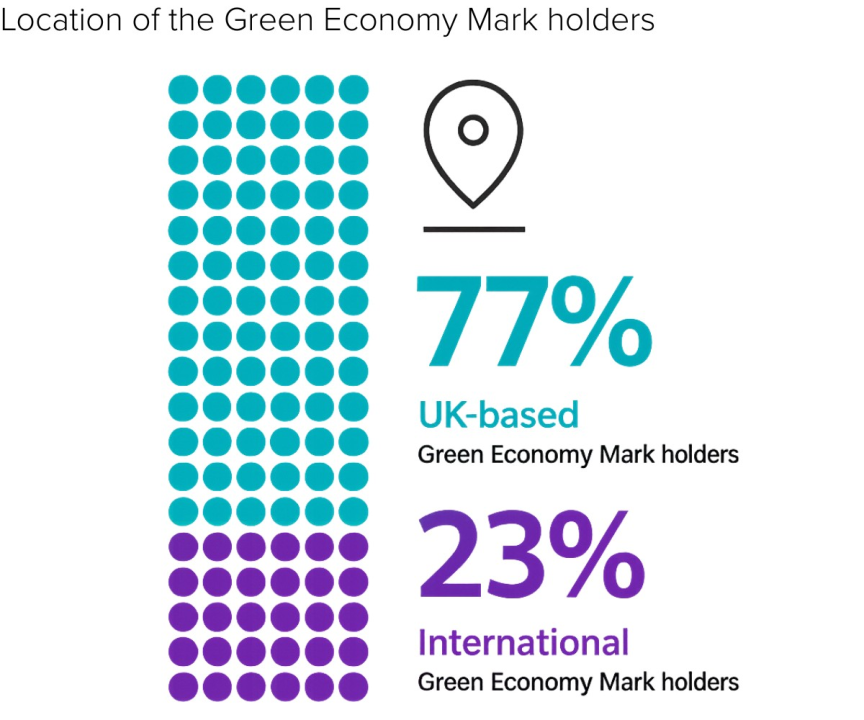
Green Economy Mark companies and funds are also diversified by geography. As of June 2025, 77% were UK based, while 23%, (which account for 60% of its market capitalisation), were international, a testament to London’s global reach as a hub for green finance. [note7]
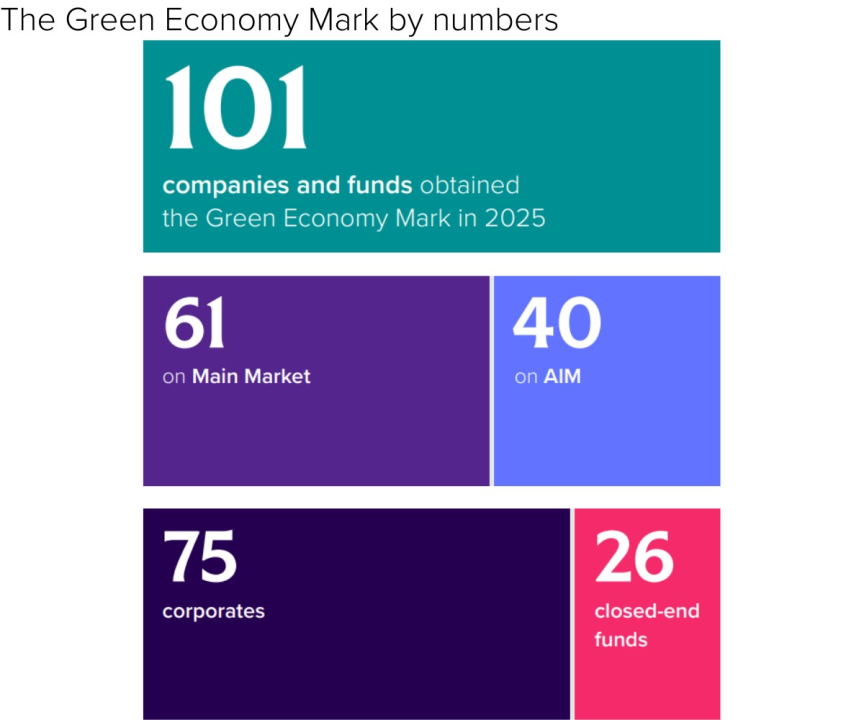
They are also diversified by size: 61 are listed on the Main Market, and 40 on AIM. [note8] This breadth creates a truly international investable universe of green economy equities, offering investors broad exposure across sectors rather than a concentrated focus on a narrow subset.
Follow-on opportunities
A significant share of capital raised by Green Economy Mark issuers takes place through follow-on offerings. In 2025, issuers within the Green Economy Mark cohort collectively raised £633 million through follow‑on offerings.
These transactions provide investors with an opportunity to deploy additional capital into companies and funds that have already demonstrated strong environmental credentials, proven business models, and clear green revenues. For investors, follow-on rounds offer a way to increase exposure to issuers showing sustained growth and market traction, benefiting from greater visibility into performance once key milestones have been met.
For issuers, follow-on offerings provide a valuable route back into the public markets enabling them to access liquidity and raise additional capital when needed. This flexibility supports continued expansion, the development of new green projects, and broader scaling of their businesses, all while reinforcing market confidence through repeated engagement with an established investor base.
Rigorous, objective and regularly reviewed
The Green Economy Mark is underpinned by a data driven methodology, that reinforces the authenticity of an issuer’s green credentials and the tangible environmental impact it delivers.
The underlying LSEG Green Revenues Classification System is transparent, rules based and independent from the Green Economy Mark assessment process. The Green Revenues of the Green Economy Mark cohort are reviewed periodically to confirm that issuers continue to generate at least 50% of their revenues from environmental products and services in line with the classification. This provides investors with confidence that the cohort remains aligned with the green economy, while offering issuers continued credibility and market recognition as their businesses evolve.
Connecting capital and green growth
The transition to a sustainable global economy will require unprecedented levels of investment, capital that drives green growth, support innovation, creates jobs and delivers competitive returns with purpose. The Green Economy Mark serves as a guide for investors seeking to deploy that capital, reinforcing the London Stock Exchange’s role as a convenor in the green economy. With a growing proportion of market participants seeking to deploy capital into sustainable investments, the Green Economy Mark can be used to identify a universe of green economy equities and funds.

Sources
Statements regarding companies and funds are based on information supplied by those companies or funds.
[1] Dealogic, London Stock Exchange. Data as of 31st December 2025 | Back to Note 1
[2] LSEG Workspace, London Stock Exchange. Data as of 22nd January 2026 | Back to Note 2
[3] Raspberry Pi | Back to Note 3
[4] Sustainability at Synthomer | Synthomer | Back to Note 4
[5] Building sustainable homes | Persimmon Homes | Back to Note 5
[6]Green Economy Mark Report 2025 | London Stock Exchange | Back to Note 6
[7] Green Economy Mark Report 2025 | London Stock Exchange | Back to Note 7
[8] Green Economy Mark Report 2025 | London Stock Exchange| Back to Note 8

Legal Disclaimer
Republication or redistribution of LSEG content is prohibited without our prior written consent.
The content of this publication is for informational purposes only and has no legal effect, does not form part of any contract, does not, and does not seek to constitute advice of any nature and no reliance should be placed upon statements contained herein. Whilst reasonable efforts have been taken to ensure that the contents of this publication are accurate and reliable, LSEG does not guarantee that this document is free from errors or omissions; therefore, you may not rely upon the content of this document under any circumstances and you should seek your own independent legal, investment, tax and other advice. Neither We nor our affiliates shall be liable for any errors, inaccuracies or delays in the publication or any other content, or for any actions taken by you in reliance thereon.
Copyright © 2025 London Stock Exchange Group. All rights reserved.
The content of this publication is provided by London Stock Exchange Group plc, its applicable group undertakings and/or its affiliates or licensors (the “LSE Group” or “We”) exclusively.
Neither We nor our affiliates guarantee the accuracy of or endorse the views or opinions given by any third party content provider, advertiser, sponsor or other user. We may link to, reference, or promote websites, applications and/or services from third parties. You agree that We are not responsible for, and do not control such non-LSE Group websites, applications or services.
The content of this publication is for informational purposes only. All information and data contained in this publication is obtained by LSE Group from sources believed by it to be accurate and reliable. Because of the possibility of human and mechanical error as well as other factors, however, such information and data are provided "as is" without warranty of any kind. You understand and agree that this publication does not, and does not seek to, constitute advice of any nature. You may not rely upon the content of this document under any circumstances and should seek your own independent legal, tax or investment advice or opinion regarding the suitability, value or profitability of any particular security, portfolio or investment strategy. Neither We nor our affiliates shall be liable for any errors, inaccuracies or delays in the publication or any other content, or for any actions taken by you in reliance thereon. You expressly agree that your use of the publication and its content is at your sole risk.
To the fullest extent permitted by applicable law, LSE Group, expressly disclaims any representation or warranties, express or implied, including, without limitation, any representations or warranties of performance, merchantability, fitness for a particular purpose, accuracy, completeness, reliability and non-infringement. LSE Group, its subsidiaries, its affiliates and their respective shareholders, directors, officers employees, agents, advertisers, content providers and licensors (collectively referred to as the “LSE Group Parties”) disclaim all responsibility for any loss, liability or damage of any kind resulting from or related to access, use or the unavailability of the publication (or any part of it); and none of the LSE Group Parties will be liable (jointly or severally) to you for any direct, indirect, consequential, special, incidental, punitive or exemplary damages, howsoever arising, even if any member of the LSE Group Parties are advised in advance of the possibility of such damages or could have foreseen any such damages arising or resulting from the use of, or inability to use, the information contained in the publication. For the avoidance of doubt, the LSE Group Parties shall have no liability for any losses, claims, demands, actions, proceedings, damages, costs or expenses arising out of, or in any way connected with, the information contained in this document.
LSE Group is the owner of various intellectual property rights ("IPR”), including but not limited to, numerous trademarks that are used to identify, advertise, and promote LSE Group products, services and activities. Nothing contained herein should be construed as granting any licence or right to use any of the trademarks or any other LSE Group IPR for any purpose whatsoever without the written permission or applicable licence terms.