
Deteriorating fiscal outlook
In its April 2026 World Economic Outlook, the International Monetary Fund (IMF) warned of deteriorating government finances around the world.
“Larger fiscal deficits and increasing public debt, starting from a position where fiscal buffers are already eroded, could put pressure on long-term interest rates and, in turn, on broader financial conditions,” the IMF said.
It expects the ratio of the world’s gross government debt to GDP to exceed 100% later this decade, continuing a two-decade-long trend of rising indebtedness among advanced economies and a more recent acceleration of the debt levels of emerging market and developing economies.
General government gross debt as % of GDP
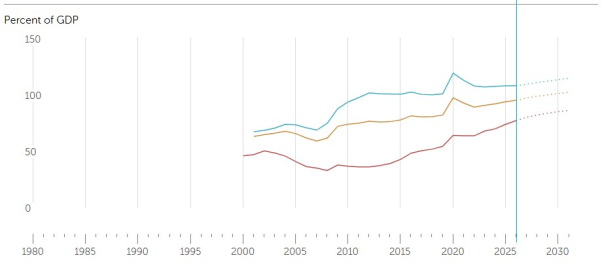
Source: IMF World Economic Outlook, April 2026. Past performance is not a guide to future returns. Please see the end for important legal disclosures.
The US, the largest sovereign borrower in the global debt markets, provides an example of this trend: despite relatively strong recent economic growth in the country, the IMF expects US gross government debt to rise from an average of 99% of GDP in 2008-2017 to 141% of GDP by 2031.
General government fiscal balances and debt: advanced economies and US
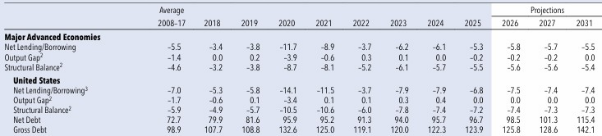
Source: IMF World Economic Outlook, April 2026. Past performance is not a guide to future returns. Please see the end for important legal disclosures.
Rising demand for smarter fixed income benchmarks
Rising debt levels and the increasing competition for financial resources are driving a search for alternative index methodologies amongst fixed income asset allocators who are reluctant for their portfolio weightings to be determined solely by the volume of past bond issuance.
In different ways, the FTSE GDP-weighted World Government Bond index series (GDP WGBI), the FTSE Debt Capacity World Government Bond index (DC WGBI) and the FTSE Canada Bank Credit Spread index series address this demand.
Weight by economic footprint, not market value
One way of rethinking sovereign bond index exposures is to weight by economic footprint, rather than the market value of debt in issue.
This approach could give a more stable outcome by reducing both the exposure to potential overborrowing and, potentially, to currency volatility.
The FTSE GDP-Weighted World Government Bond index series (GDP WGBI), launched in 2026, uses countries’ economic output as the determinant of the index weight, with GDP measured in purchasing power parity (PPP), rather than nominal terms.
The FTSE GDP-Weighted WGBI follows its parent index (the FTSE World Government Bond Index) in terms of country selection, issue inclusion criteria, minimum issue size and rebalancing frequency.
Focus on the ability to repay
A second approach to reweighting sovereign bond exposures follows traditional credit analysis and focuses on borrowers’ ability to repay debts.
The FTSE Debt Capacity World Government Bond index (Debt Capacity WGBI), launched in 2015, uses the ratios of gross debt to GDP and debt service costs to GDP as primary metrics for debt capacity and sustainability.
In contrast to a market value-weighted index, the Debt Capacity WGBI has an in-built sensitivity to changes in countries’ relative debt capacity: if the relevant debt sustainability metrics improve, the index increases the respective countries’ weightings accordingly, while weightings are reduced if the debt sustainability ratios deteriorate.
Country weight differences under alternative methodologies
In both alternatively weighted indices, the country weight of the US drops sharply by comparison with the standard, market value-weighted benchmark (from a starting weight of 40.6% in the FTSE WGBI, the US’s weight falls by 16.5% in the GDP WGBI and by 14.5% in the Debt Capacity WGBI).
By comparison with the value-weighted FTSE WGBI, China receives a substantial country weight increase in the GDP WGBI, reflecting the country’s economic strength. However, its weight in the Debt Capacity WGBI falls slightly by comparison with the parent index, reflecting a sharp post-COVID rise in the ratio of China’s gross debt to the country’s GDP.
Other countries seeing a decline in their weights in the Debt Capacity WGBI (in relation to the value weighted FTSE WGBI) include France, Italy and Japan, while Scandinavian countries and several emerging markets increase their index footprints from those in the FTSE WGBI.
Country weight differences from value-weighted government bond index (%)
Express a view on credit risk, yield and duration
A third alternative fixed income index approach allows index users to blend views on credit risk, yield and duration.
The FTSE Canada Bank Credit Spread index series, launched in 2025, offers a standardised gauge of credit market conditions in Canada. The index series captures the yield differential (spread) between a basket of Canadian Bank bonds and benchmark Government of Canada securities, providing a measure of Canadian financial sector credit risk.
The index series offers insights into credit risk dynamics within the Canadian investment-grade market, facilitating informed decision making for investors. It also now underlies a first-of-its-kind credit derivative product, Canada Bank Credit Index Futures (BCS), which are traded on the Montreal Exchange.
This futures contract, launched in 2026, gives market participants a tool to manage credit exposure, hedge risk and implement strategic investment views.
Debt pressures force a shift in index thinking
Market value-weighted fixed income benchmarks like the FTSE World Government Bond index remain the primary performance measurement tool for asset allocators and portfolio managers.
However, rising debt levels and widespread financing pressures make the debtor bias inherent in standard indices more prominent.
In this environment, we are witnessing a shift in fixed income index thinking, with a rise in demand for index versions that move away from a rigid adherence to debt-based portfolio weights. The three index variants profiled in this FTSE Russell Insight are an example of the active product development in this area. Smarter fixed income indexing is a trend we expect to intensify over coming years.
Read more about

Disclaimer
© [2026] London Stock Exchange Group plc and its applicable group undertakings (“LSEG”). LSEG includes (1) FTSE International Limited (“FTSE”), (2) Frank Russell Company (“Russell”), (3) FTSE Global Debt Capital Markets Inc. “FTSE Canada”, (4) FTSE Fixed Income LLC (“FTSE FI”), (5) FTSE (Beijing) Consulting Limited (“WOFE”), (6) FTSE EU SAS ("FES"). All rights reserved.
FTSE Russell® is a trading name of FTSE, Russell, FTSE Canada, FTSE FI, WOFE, FTSE EU and other LSEG entities providing LSEG Benchmark and Index services. “FTSE®”, “Russell®”, “FTSE Russell®”, “FTSE4Good®”, “ICB®”, “Refinitiv”, “WMR™” “FR™” and all other trademarks and service marks used herein (whether registered or unregistered) are trademarks and/or service marks owned or licensed by the applicable member of LSEG or their respective licensors.
FTSE International Limited is authorised as a Benchmark Administrator and regulated in the United Kingdom (UK) by the Financial Conduct Authority ("FCA") according to the UK Benchmark Regulation, FCA Reference Number 796803. FTSE EU SAS is authorised as Benchmark Administrator and regulated in the European Union (EU) by the Autorité des Marches Financiers (“AMF”) according to the EU Benchmark Regulation.
All information is provided for information purposes only. All information and data contained in this publication is obtained by LSEG, from sources believed by it to be accurate and reliable. Because of the possibility of human and mechanical inaccuracy as well as other factors, however, such information and data is provided "as is" without warranty of any kind. No member of LSEG nor their respective directors, officers, employees, partners or licensors make any claim, prediction, warranty or representation whatsoever, expressly or impliedly, either as to the accuracy, timeliness, completeness, merchantability of any information or LSEG Products, or of results to be obtained from the use of LSEG products, including but not limited to indices, rates, data and analytics, or the fitness or suitability of the LSEG products for any particular purpose to which they might be put. The user of the information assumes the entire risk of any use it may make or permit to be made of the information.
No responsibility or liability can be accepted by any member of LSEG nor their respective directors, officers, employees, partners or licensors for (a) any loss or damage in whole or in part caused by, resulting from, or relating to any inaccuracy (negligent or otherwise) or other circumstance involved in procuring, collecting, compiling, interpreting, analysing, editing, transcribing, transmitting, communicating or delivering any such information or data or from use of this document or links to this document or (b) any direct, indirect, special, consequential or incidental damages whatsoever, even if any member of LSEG is advised in advance of the possibility of such damages, resulting from the use of, or inability to use, such information.
No member of LSEG nor their respective directors, officers, employees, partners or licensors provide investment advice and nothing in this document should be taken as constituting financial or investment advice. No member of LSEG nor their respective directors, officers, employees, partners or licensors make any representation regarding the advisability of investing in any asset or whether such investment creates any legal or compliance risks for the investor. A decision to invest in any such asset should not be made in reliance on any information herein. Indices and rates cannot be invested in directly. Inclusion of an asset in an index or rate is not a recommendation to buy, sell or hold that asset nor confirmation that any particular investor may lawfully buy, sell or hold the asset or an index or rate containing the asset. The general information contained in this publication should not be acted upon without obtaining specific legal, tax, and investment advice from a licensed professional.
Past performance is no guarantee of future results. Charts and graphs are provided for illustrative purposes only. Index and/or rate returns shown may not represent the results of the actual trading of investable assets. Certain returns shown may reflect back-tested performance. All performance presented prior to the index or rate inception date is back-tested performance. Back-tested performance is not actual performance, but is hypothetical. The back-test calculations are based on the same methodology that was in effect when the index or rate was officially launched. However, back-tested data may reflect the application of the index or rate methodology with the benefit of hindsight, and the historic calculations of an index or rate may change from month to month based on revisions to the underlying economic data used in the calculation of the index or rate.
This document may contain forward-looking assessments. These are based upon a number of assumptions concerning future conditions that ultimately may prove to be inaccurate. Such forward-looking assessments are subject to risks and uncertainties and may be affected by various factors that may cause actual results to differ materially. No member of LSEG nor their licensors assume any duty to and do not undertake to update forward-looking assessments.
No part of this information may be reproduced, stored in a retrieval system or transmitted in any form or by any means, electronic, mechanical, photocopying, recording or otherwise, without prior written permission of the applicable member of LSEG. Use and distribution of LSEG data requires a licence from LSEG and/or its licensors.