

David McNay, CFA
- Equity option skew and oil futures curves provide a useful pulse for the markets expectation of the speed of resolution of the conflict. This insight explains how we are viewing them.
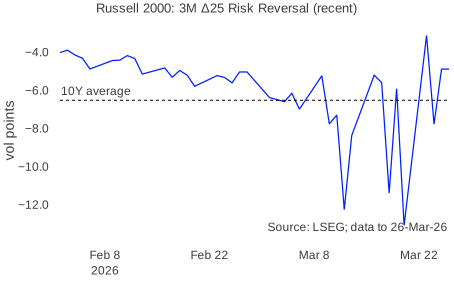
- Russell 2000 skew was slow to price downside risk, and very quickly priced in de-escalation after President Trump’s Truth social post on March 23. Although with news flow dominating price action, markets have become more volatile and this is a moving target."
- Russell 2000 skew was slow to price downside risk, and very quickly priced in de-escalation after President Trump’s Truth social post on March 23. Although pricing has been volatile.
Is the conflict in the Middle East over? Because after Donald Trump’s March 23t [note1] on Truth Social, the Russell 2000 options market was ready to price de-escalation.
We don’t have the answer. Even if we did, volatility is elevated, and price action is being dominated by sentiment and news flow, rather than fundamentals – meaning analysis can become stale quickly. With this short insight we explain how we are looking at two charts [note2] which we have found helpful to frame the question.
Option skew: the cost of insurance
At a high level we measure skew using risk-reversals, which act as measure of market risk sentiment, reflecting relative demand for protection – when the skew is negative markets are paying more to protect downside risk than the upside.
Skew itself is just the difference in implied volatility between a call option and a put [note3]. Remembering that being long a call option gives one the right, but not the obligation, to buy the underlying at a specified price whilst a put-option provides the right to sell.
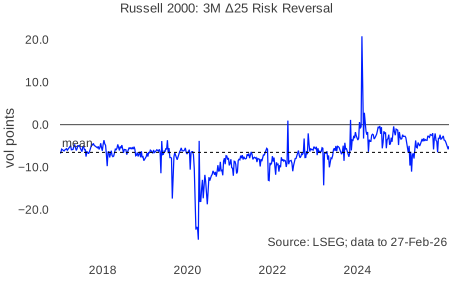
Figure 1: Russell 2000 3M 25-delta risk reversal and long term history
Source: FTSE Russell, LSEG Datastream; data to 25 March 2026. Past performance is not a guide to future returns. Please see the end for important legal disclosures.
Equities indicies generally expect negative skew – an entirely rational response to investors asymmetric risk tolerance, and willingness to pay for protection. We observe this in the10Y history of Russell 2000 3M Δ25 risk-reversals, which had an average skew of around -6.5 volatility points for a 3M contract.
We also threw in the term Δ25 (25-delta) which deserves explanation. Delta is the less intuitive [note4] cousin of moneyness. Moneyness being quoted as a percentage from spot, e.g. a strike of $110 vs. an underlying of $100 maybe 10% out-the-money (OTM). Delta is similar and can be thought of as the sensitivity of the option price to the underlying asset price. So for a Δ25 option we may anticipate a $0.25 move in the option price per $1.00 move in the underlying.
Risk reversals through the conflict
Considering the Russell 2000 3M Δ25 risk-reversal, at the start of the conflict the options market weren’t pricing for downside risk, at least relative to the 10Y history. There was volatility in the measure, but when we published our Asset Allocation Insights report (March 17, 2026) the skew was only -5.6. In the proceeding period it fell sharply to -13.1 (March 20, 2026) as the market began to anticipate a more protracted conflict, before adding +10 points to -3.1 Trump posted that the US was holding off on further strikes. Observing price patterns, it wouldn’t be a surprise if the cost of protection was very volatile as more news flow comes in.
Figure 2: Close up of the Russell 2000 3M 25-delta risk reversal and 10Y average.
Source: FTSE Russell, LSEG Datastream; data to 25 March 2026. Past performance is not a guide to future returns. Please see the end for important legal disclosures.
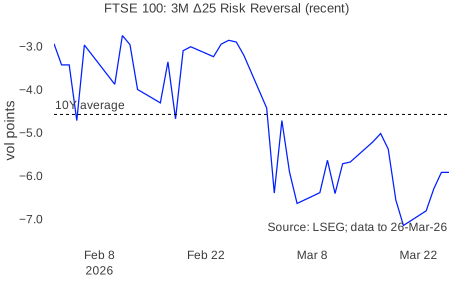
The FTSE 100 was less sanguine; skew became more negative (implying a higher cost to protect positions) at the start of the conflict. Despite the de-escalatory rhetoric, skew in the FTSE 100 continued to get lower.
The difference between the Russell 2000 and the FTSE 100 risk reversals potentially reflect the relative safe-haven nature of the US, the FTSE 100 being sterling denominated, and the relative industry composition between the two.
Figure 3: FTSE 100 3M 25-delta risk reversal & 10Y average.
Source: FTSE Russell, LSEG Datastream; data to 25 March 2026. Past performance is not a guide to future returns. Please see the end for important legal disclosures.
The oil futures curve
When we talk about oil prices we can talk about ‘spot’, the price today and what most people are used to seeing, and ‘forward’ the price sometime in the future. Forward prices allow us to lock in the future price today for delivery in n-months. Oil can trade in either contango [note5] (forward oil to be priced higher than spot) or backwardation (forward prices below spot).
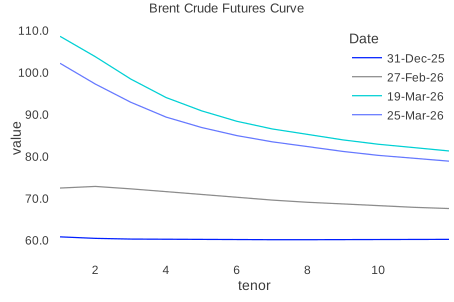
Since the start of the Iranian conflict oil futures have moved into a steep backwardation. Since the start of the Iranian conflict oil futures have moved into a steep backwardation.
Figure 4: Brent crude futures curve for various delivery dates and delivery tenors (in months).
FTSE Russell and LSEG Datastream, data from 31-Dec-25 to 25-Mar-26. Past performance is not a guide to future returns. Please see the end for important legal disclosures.
Energy prices are the dominant transmission vector for the conflict into markets – and we’ve been watching the slope and level of the oil futures curve closely. Slope is a reflection of how quickly markets expect energy supply-demand dynamics, and inventory levels, to normalize; on March 20, 2026 the curve showed a steep fall over the next 1-6 months implying a normalization of supply.
The level gives us insight into the risk-premium disruption from the war has passed. In other words, the curve may imply a protracted period of higher cost of energy if markets believe the conflict has raised the probability of future supply interruptions and increased the cost of securing physical flows.
Conclusion
Neither chart tells us when the conflict will be over. But taken together we get a picture of how markets are pricing the likelihood of a swift resolution. Currently Brent crude futures point to extreme tightness that dissipates quickly – but leaves a higher risk premium. Meanwhile options have been relatively sanguine (25 March), at least for the US, but with volatility having increased and sentiment dominating price this is a moving target.

footnotes
[1] https://truthsocial.com/@realDonaldTrump/posts/116278232362967212 | Back to Note 1
[2] We don’t limit ourselves to just these measures – but these are the charts which have garnered the most attention in client meetings since we published our Asset Allocation Insights for March. | Back to Note 2
[3] Specifically options with the same tenor and the same delta and usually quoted Call IV – Put IV | Back to Note 3
[4] Whilst less intuitive, delta incorporates time to expiry and implied volatility, making it a more consistent measure for comparing options in risk terms. | Back to Note 4
[5] Textbooks often teach the cost-of-carry framework, where forward prices would exceed spot to reflect financing, storage and insurance costs, offset by any convenience yield. In practice, oil curves move between contango and backwardation as inventories, prompt physical tightness and geopolitical risk change. We can see that Brent was functionally flat around $60/barrel at the start of the year. | Back to Note 5

Disclaimer
© [2026] London Stock Exchange Group plc and its applicable group undertakings (“LSEG”). LSEG includes (1) FTSE International Limited (“FTSE”), (2) Frank Russell Company (“Russell”), (3) FTSE Global Debt Capital Markets Inc. “FTSE Canada”, (4) FTSE Fixed Income LLC (“FTSE FI”), (5) FTSE (Beijing) Consulting Limited (“WOFE”), (6) FTSE EU SAS ("FES"). All rights reserved.
FTSE Russell® is a trading name of FTSE, Russell, FTSE Canada, FTSE FI, WOFE, FTSE EU and other LSEG entities providing LSEG Benchmark and Index services. “FTSE®”, “Russell®”, “FTSE Russell®”, “FTSE4Good®”, “ICB®”, “Refinitiv”, “WMR™” “FR™” and all other trademarks and service marks used herein (whether registered or unregistered) are trademarks and/or service marks owned or licensed by the applicable member of LSEG or their respective licensors.
FTSE International Limited is authorised as a Benchmark Administrator and regulated in the United Kingdom (UK) by the Financial Conduct Authority ("FCA") according to the UK Benchmark Regulation, FCA Reference Number 796803. FTSE EU SAS is authorised as Benchmark Administrator and regulated in the European Union (EU) by the Autorité des Marches Financiers (“AMF”) according to the EU Benchmark Regulation.
All information is provided for information purposes only. All information and data contained in this publication is obtained by LSEG, from sources believed by it to be accurate and reliable. Because of the possibility of human and mechanical inaccuracy as well as other factors, however, such information and data is provided "as is" without warranty of any kind. No member of LSEG nor their respective directors, officers, employees, partners or licensors make any claim, prediction, warranty or representation whatsoever, expressly or impliedly, either as to the accuracy, timeliness, completeness, merchantability of any information or LSEG Products, or of results to be obtained from the use of LSEG products, including but not limited to indices, rates, data and analytics, or the fitness or suitability of the LSEG products for any particular purpose to which they might be put. The user of the information assumes the entire risk of any use it may make or permit to be made of the information.
No responsibility or liability can be accepted by any member of LSEG nor their respective directors, officers, employees, partners or licensors for (a) any loss or damage in whole or in part caused by, resulting from, or relating to any inaccuracy (negligent or otherwise) or other circumstance involved in procuring, collecting, compiling, interpreting, analysing, editing, transcribing, transmitting, communicating or delivering any such information or data or from use of this document or links to this document or (b) any direct, indirect, special, consequential or incidental damages whatsoever, even if any member of LSEG is advised in advance of the possibility of such damages, resulting from the use of, or inability to use, such information.
No member of LSEG nor their respective directors, officers, employees, partners or licensors provide investment advice and nothing in this document should be taken as constituting financial or investment advice. No member of LSEG nor their respective directors, officers, employees, partners or licensors make any representation regarding the advisability of investing in any asset or whether such investment creates any legal or compliance risks for the investor. A decision to invest in any such asset should not be made in reliance on any information herein. Indices and rates cannot be invested in directly. Inclusion of an asset in an index or rate is not a recommendation to buy, sell or hold that asset nor confirmation that any particular investor may lawfully buy, sell or hold the asset or an index or rate containing the asset. The general information contained in this publication should not be acted upon without obtaining specific legal, tax, and investment advice from a licensed professional.
Past performance is no guarantee of future results. Charts and graphs are provided for illustrative purposes only. Index and/or rate returns shown may not represent the results of the actual trading of investable assets. Certain returns shown may reflect back-tested performance. All performance presented prior to the index or rate inception date is back-tested performance. Back-tested performance is not actual performance, but is hypothetical. The back-test calculations are based on the same methodology that was in effect when the index or rate was officially launched. However, back-tested data may reflect the application of the index or rate methodology with the benefit of hindsight, and the historic calculations of an index or rate may change from month to month based on revisions to the underlying economic data used in the calculation of the index or rate.
This document may contain forward-looking assessments. These are based upon a number of assumptions concerning future conditions that ultimately may prove to be inaccurate. Such forward-looking assessments are subject to risks and uncertainties and may be affected by various factors that may cause actual results to differ materially. No member of LSEG nor their licensors assume any duty to and do not undertake to update forward-looking assessments.
No part of this information may be reproduced, stored in a retrieval system or transmitted in any form or by any means, electronic, mechanical, photocopying, recording or otherwise, without prior written permission of the applicable member of LSEG. Use and distribution of LSEG data requires a licence from LSEG and/or its licensors.