

Robin Marshall

Jack Fischer
Inflation linked bonds fell sharply in the 2022-23 inflation shock, due to higher rates…
…..but high real yields and inflation compensation now support the asset class
Chart 1 –
…..and on a relative basis versus nominals, linkers are also attractively valued
Inflation breakevens, which measure the inflation compensation investors receive for holding nominal bonds versus the real yield on linkers, also suggest linkers are now attractively valued. After the global inflation shock in 2021-22, nominal bond yields spiked as investors sought extra yield inflation protection. So inflation breakevens soared, as Chart 2 shows, particularly in short dated maturities. But since inflation has fallen back in 2024-25, breakeven inflation compensation has fallen in nominal bonds, relative to inflation linked bonds, as they recovered and nominal yields fell, and is now barely above 2% per annum for all maturities, as the Chart 2 shows.
Chart 2
…...and inflation linked also attractive versus credit, with spreads near 10 year lows
The relative value case for inflation linked govt bonds, within the fixed income asset class, is reinforced by credit spreads, which are at, or very close to 10 yr lows, and well below 10 yr means, as Chart 3 shows.
Chart 3- Global Credit spreads
Linkers are often a forgotten asset class….
Most discussion of international fixed income focusses on sovereign (nominal) debt, investment-grade and high yield credits, packaged into developed market, or emerging market exposures, so ILS are often overlooked. Lower issuance in ILS versus nominals may also explain why linkers are often a forgotten asset class - since 2008, the ILS market has accounted for only 8.0% of the international total for fixed-rate, local currency sovereign debt issuance, as tracked by FTSE Russell indices. But despite both Canada and Germany announcing they will no longer be issuing new inflation-linked debt, the amount outstanding in international ILS has still grown 24% over the past five years.
…but they offer protection against both inflation and deflation, provided policy rates don’t spike
For investors, inflation linked govt bonds offer protection both against inflation, and deflation, ie, an outright decline in price levels, unlike nominal bonds with fixed nominal coupons (although there are some subtle structural differences across countries, ie, UK and Canadian linkers do not have deflation floors). They are very rare financial assets in that regard, with virtually no credit risk, given they are issued in local currencies.
A potentially weaker dollar makes international inflation linked indices more attractive
FTSE Russell’s range of international linker indices includes both those with exposure to US Treasury inflation protected securities (Tips) and those without Tips. Having a range of international inflation linked indices gives an investor the opportunity to play this investment theme globally, excluding US Tips and dollar exposure if required, and also adding EM exposure. Table 1 shows a summary of three indices: the FTSE Russell World inflation linked securities index (WILSI), the WILSI ex-US, and the FTSE International Inflation-Linked Securities Select Index (SILSI), which includes EM economies.
Table I, Key statistics for selected FTSE Russell international inflation linked indices
Key statistics |
WILSI |
WILSI-ex US |
SILSI |
|---|---|---|---|
No of bonds |
169 |
120 |
182 |
No of countries |
13 |
12 |
19 |
No of currencies |
10 |
9 |
16 |
Full MV weighted |
|
|
|
Average coupon (%) |
1.25 |
1.28 |
1.63 |
YTW (%) |
4.21 |
4.40 |
6.69 |
Effec. Duration |
7.03 |
8.55 |
6.08 |
OAS (bps) |
2 |
7 |
37 |
Ave. Credit rating |
AA |
A+ |
A+ |
Duration dollar weighted |
|
|
|
Average coupon (%) |
1.18 |
1.15 |
1.73 |
YTW |
4.74 |
4.90 |
5.96 |
Eff.Duration |
12.01 |
13.71 |
10.23 |
OAS (bps) |
2 |
2 |
7 |
Credit quality (%) |
|
|
|
Investment grade |
100.0 |
100.0 |
83.2 |
High yield |
- |
- |
16.8 |
Country Classification |
|
|
|
Developed Markets |
93.5% |
88.7% |
67.4% |
Emerging Markets |
6.5% |
11.3% |
32.6% |
Like WGBI, the WILSI has a high US country weight of over 40%
Risk characteristics show higher real yields and less duration in the SILSI index…
Chart 4: Historical real yields
Chart 5: Country allocation of WILSI-ex US and SILSI indices.
…nor is credit rating compromised in SILSI versus WILSI
The average index credit rating is also worth noting. SILSI (A+) matches the index-level weighted average credit quality of WILSI (A+) despite SILSI having a broader distribution. The only two broad-based international focused indices with higher average ratings are WGBI ex-US (AA-) and WorldBIG ex-USD (AA-)—WGBI ex-US comprises about 70% of WorldBIG ex-USD.
SILSI also attractive on other risk metrics
Finally, within the fixed income asset class, combining duration and spread into the composite metric of duration times spread (DTS), SILSI scores well against alternative linker indices. The attraction of DTS as a metric is that it captures the two primary risk factors to fixed income – credit risk and interest rate risk. Chart 6 shows DTS on the X-axis, while the y-axis shows yield-to-worst.
Chart 6: Total risk and yield on selected FTSE Russell indices
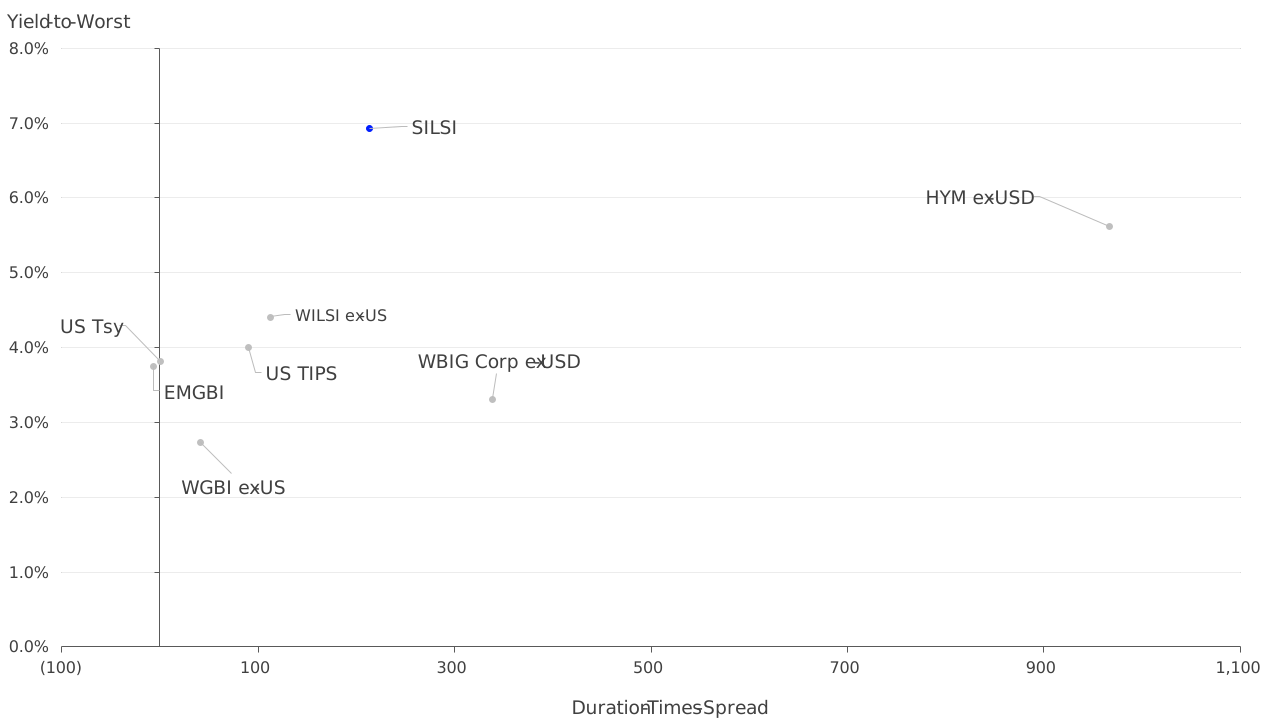
Source: FTSE Russell, Index module, data as of November 30,2025. Past performance is not a guide to future returns. Please see the end for important legal disclosures.
In summary, FTSE international inflation linked indices are on modest valuations….
In conclusion, both absolute real yields and relative valuation metrics suggest inflation linked govt bonds may now be undervalued against other asset classes within fixed income, notably credit but also conventional govt bonds. A more stable inflation and interest rate environment enhances the appeal of international inflation-linked bonds, with solid inflation accruals.
….and offer the option of minimizing USD exposure
For investors anxious to reduce and minimise US dollar risk, given the more uncertain dollar outlook, there are FTSE Russell indices available to play the international inflation linked investment narrative, excluding US Tips, both with, and without EM exposure.
Indices with some EM exposure, like the SILSI index are particularly attractive. It offers significantly higher real yields than WILSI, ex-US, shorter duration risk, low breakevens, high real yields and inflation protection with non-USD sovereign backing.

Sources
[1] See Time to trim some (inflation) hedges? | LSEG | Back to Note 1
[2] A Re-Emerging Portfolio Building Block: The Case for International Inflation-Linked Securities | Back to Note 2
[3] See Do valuations correlate to long-term returns? Examining US equities through various size and style indices | LSEG | Back to Note 3
[4] FTSE World Government Bond Index (WGBI) Series | LSEG | Back to Note 4
[5] For further details on FTSE Russell’s Fixed Income country classification framework, please see: Fixed Income Country Classification | Back to Note 5

Disclaimer
© [2026] London Stock Exchange Group plc and its applicable group undertakings (“LSEG”). LSEG includes (1) FTSE International Limited (“FTSE”), (2) Frank Russell Company (“Russell”), (3) FTSE Global Debt Capital Markets Inc. “FTSE Canada”, (4) FTSE Fixed Income LLC (“FTSE FI”), (5) FTSE (Beijing) Consulting Limited (“WOFE”), (6) FTSE EU SAS ("FES"). All rights reserved.
FTSE Russell® is a trading name of FTSE, Russell, FTSE Canada, FTSE FI, WOFE, FTSE EU and other LSEG entities providing LSEG Benchmark and Index services. “FTSE®”, “Russell®”, “FTSE Russell®”, “FTSE4Good®”, “ICB®”, “Refinitiv”, “WMR™” “FR™” and all other trademarks and service marks used herein (whether registered or unregistered) are trademarks and/or service marks owned or licensed by the applicable member of LSEG or their respective licensors.
FTSE International Limited is authorised as a Benchmark Administrator and regulated in the United Kingdom (UK) by the Financial Conduct Authority ("FCA") according to the UK Benchmark Regulation, FCA Reference Number 796803. FTSE EU SAS is authorised as Benchmark Administrator and regulated in the European Union (EU) by the Autorité des Marches Financiers (“AMF”) according to the EU Benchmark Regulation.
All information is provided for information purposes only. All information and data contained in this publication is obtained by LSEG, from sources believed by it to be accurate and reliable. Because of the possibility of human and mechanical inaccuracy as well as other factors, however, such information and data is provided "as is" without warranty of any kind. No member of LSEG nor their respective directors, officers, employees, partners or licensors make any claim, prediction, warranty or representation whatsoever, expressly or impliedly, either as to the accuracy, timeliness, completeness, merchantability of any information or LSEG Products, or of results to be obtained from the use of LSEG products, including but not limited to indices, rates, data and analytics, or the fitness or suitability of the LSEG products for any particular purpose to which they might be put. The user of the information assumes the entire risk of any use it may make or permit to be made of the information.
No responsibility or liability can be accepted by any member of LSEG nor their respective directors, officers, employees, partners or licensors for (a) any loss or damage in whole or in part caused by, resulting from, or relating to any inaccuracy (negligent or otherwise) or other circumstance involved in procuring, collecting, compiling, interpreting, analysing, editing, transcribing, transmitting, communicating or delivering any such information or data or from use of this document or links to this document or (b) any direct, indirect, special, consequential or incidental damages whatsoever, even if any member of LSEG is advised in advance of the possibility of such damages, resulting from the use of, or inability to use, such information.
No member of LSEG nor their respective directors, officers, employees, partners or licensors provide investment advice and nothing in this document should be taken as constituting financial or investment advice. No member of LSEG nor their respective directors, officers, employees, partners or licensors make any representation regarding the advisability of investing in any asset or whether such investment creates any legal or compliance risks for the investor. A decision to invest in any such asset should not be made in reliance on any information herein. Indices and rates cannot be invested in directly. Inclusion of an asset in an index or rate is not a recommendation to buy, sell or hold that asset nor confirmation that any particular investor may lawfully buy, sell or hold the asset or an index or rate containing the asset. The general information contained in this publication should not be acted upon without obtaining specific legal, tax, and investment advice from a licensed professional.
Past performance is no guarantee of future results. Charts and graphs are provided for illustrative purposes only. Index and/or rate returns shown may not represent the results of the actual trading of investable assets. Certain returns shown may reflect back-tested performance. All performance presented prior to the index or rate inception date is back-tested performance. Back-tested performance is not actual performance, but is hypothetical. The back-test calculations are based on the same methodology that was in effect when the index or rate was officially launched. However, back-tested data may reflect the application of the index or rate methodology with the benefit of hindsight, and the historic calculations of an index or rate may change from month to month based on revisions to the underlying economic data used in the calculation of the index or rate.
This document may contain forward-looking assessments. These are based upon a number of assumptions concerning future conditions that ultimately may prove to be inaccurate. Such forward-looking assessments are subject to risks and uncertainties and may be affected by various factors that may cause actual results to differ materially. No member of LSEG nor their licensors assume any duty to and do not undertake to update forward-looking assessments.
No part of this information may be reproduced, stored in a retrieval system or transmitted in any form or by any means, electronic, mechanical, photocopying, recording or otherwise, without prior written permission of the applicable member of LSEG. Use and distribution of LSEG data requires a licence from LSEG and/or its licensors.