

Catherine Yoshimoto
The Russell US Indexes reconstitution provides a clear snapshot of how the US equity market has evolved in recent months. With approximately $12.2 trillion benchmarked to Russell US Indexes [note1] and hundreds of billions of dollars traded around reconstitution [note2], the event is one of the most closely watched dates on the indexing calendar.
The June 2026 reconstitution arrives at an interesting moment. While the continued rise of mega-cap companies such as Nvidia and Alphabet has reshaped the top of the market-cap spectrum, preliminary reconstitution data also points to improving breadth beneath the surface. In this FTSE Russell Insight, we examine what the latest Russell reconstitution reveals about the US equity market.
A new era for Russell reconstitution
For the Russell US Indexes, 2026 marks the shift from an annual to a semi-annual reconstitution schedule. While June remains the primary reconstitution event—particularly for the Russell US Style indexes—the addition of a December reconstitution will allow market changes to be reflected more frequently throughout the year.
The reconstitution process began with rank day on April 30, when eligible US companies were ranked by market capitalization. Preliminary membership lists were released on May 22, followed by a series of updates during the transition period. The newly reconstituted indexes will take effect after market close on June 26.
The move to semi-annual reconstitution reflects the Russell index philosophy of maintaining accurate, transparent representation of the evolving US equity market while balancing the practical considerations of index turnover and implementation.
The US equity market got bigger
The June 2026 Russell reconstitution reflects a US equity market that expanded significantly over the past year. Based on preliminary reconstitution data, the total market capitalization of the Russell 3000® Index increased 29% from $58.4 trillion at the 2025 reconstitution to $75.6 trillion on this year’s rank day (April 30, 2026). The Russell 3000 index is a broad measure of the US equity market and was designed to represent approximately 98% of the investable market capitalization.
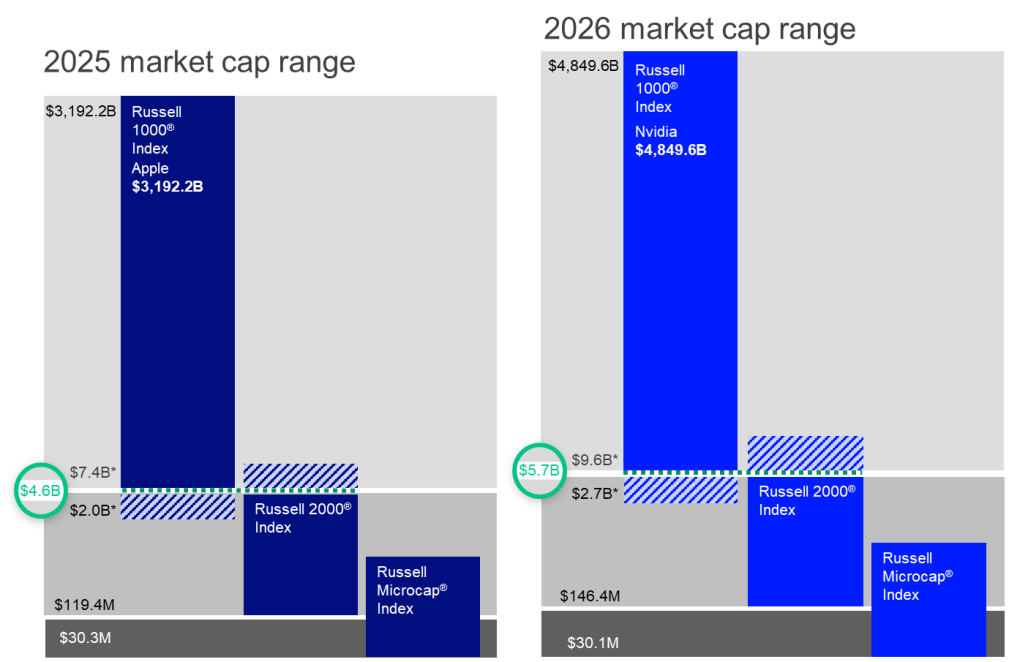
One of the clearest signs of the US equity market’s growth can be seen in the breakpoint between the large-cap Russell 1000® Index and the small-cap Russell 2000® Index (Figure 1). The market capitalization threshold separating large-cap and small-cap companies increased from $4.6 billion in 2025 to $5.7 billion in 2026, representing a 24% jump. The market's expansion was also reflected in the retention band surrounding the Russell 1000/Russell 2000 breakpoint—a buffer designed to reduce unnecessary turnover for companies near the cutoff. The band widened from a market-cap range of approximately $2.0 billion to $7.4 billion in 2025 to $2.7 billion to $9.6 billion in 2026.
Figure 1. Breakpoints between US large and small cap indexes increased
Source: FTSE Russell. Reflects banding. Data as of April 30, 2025 and April 30, 2026, respectively. Past performance is not a guide to future returns. Please see the end for important legal disclosures.
Growth was evident across the market-cap spectrum. At the top end, Nvidia became the largest company in the Russell universe with a market capitalization of $4.8 trillion, compared with Apple's $3.2 trillion position as the largest constituent at the June 2025 reconstitution. At the other end of the market, the smallest member of the Russell 2000 increased from $119 million to $146 million.
Mega-cap leadership changes
While the June 2026 reconstitution highlighted growth across the market-cap spectrum, some of the most visible changes occurred at the very top of the Russell US Indexes universe (Figure 2).
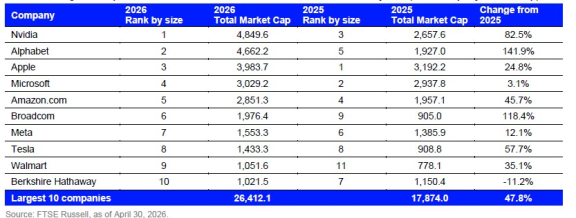
For over four decades, in particular over the past 15 years, Apple and Microsoft have tended to trade places among the largest two US tech stocks and more recently as the largest two companies in the Russell US Indexes, reflecting their dominant roles in the US equity market. The June 2026 reconstitution marks a notable departure from that pattern. Amidst the ongoing boom in artificial intelligence stocks, Nvidia rose from third place in 2025 to become the largest company in the Russell 3000 and Russell 1000 indexes, while Alphabet climbed from fifth to second place. Apple and Microsoft moved to third and fourth place, respectively.
The changes were marked by extraordinary growth in capitalization amongst the market's largest companies during the year. Nvidia's market capitalization increased 82.5% year-over-year to $4.8 trillion, while Alphabet posted the largest increase among the top ten constituents, rising 141.9% to $4.7 trillion. Broadcom also climbed the rankings, moving from ninth to sixth after more than doubling in size.
Figure 2. Largest companies in the Russell 3000 Index/Russell 1000 Index by size (total company market cap)
Source: FTSE Russell, as of April 30, 2026. Past performance is not a guide to future returns. Please see the end for important legal disclosures.
The broader trend toward market concentration remained intact. All ten of the largest Russell constituents exceeded $1 trillion in market capitalization at the June 2026 reconstitution, compared with seven companies a year earlier. Collectively, the top ten companies grew from $17.9 trillion to $26.4 trillion in market capitalization, an increase of 48% since last year’s reconstitution that underscores the influence of a relatively small group of mega-cap stocks on the broader US equity market.
Small caps joined the rally
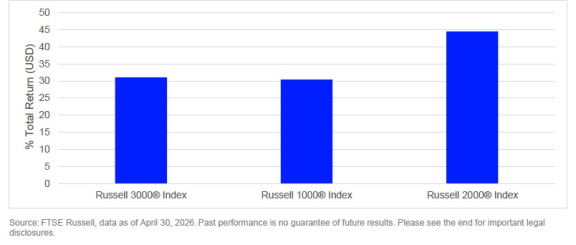
However, the June 2026 reconstitution also showed that the market's gains were not confined to its largest constituents. In fact, preliminary reconstitution data points to improving breadth across the US equity market. During the one-year period ending on rank day, the Russell 2000 outperformed the Russell 1000, reflecting renewed strength among smaller companies (Figure 3). The total market capitalization of the Russell 2000 increased from $2.7 trillion at the 2025 reconstitution to $3.5 trillion in 2026, while the market-cap threshold for Russell 2000 membership also moved higher.
Figure 3. Small caps outperformed large caps in the one-year period ended April 30, 2026
Source: FTSE Russell, as of April 30, 2026. Past performance is not a guide to future returns. Please see the end for important legal disclosures.
Why banding matters
Russell reconstitution is designed to reflect changes in the market, but not every company that moves above or below a market-cap breakpoint automatically changes indexes. Instead, the Russell methodology applies banding around key breakpoints to reduce unnecessary turnover and promote index stability.
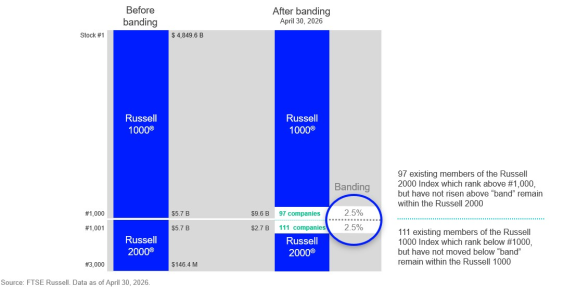
Preliminary data for the June 2026 reconstitution shows 97 existing Russell 2000 constituents ranked above the Russell 1000 breakpoint based on market capitalization but remained in the small-cap index because they fell within the retention band. Likewise, 111 Russell 1000 constituents ranked below the breakpoint but retained their large-cap membership (Figure 4).
Figure 4. June 2026 Russell US Indexes reconstitution size banding
Source: FTSE Russell, as of April 30, 2026. Past performance is not a guide to future returns. Please see the end for important legal disclosures.
Companies such as Urban Outfitters (Russell 2000 member) and Crocs (Russell 1000 member) illustrate how the process works in practice. Although their market capitalizations placed them near the Russell 1000/Russell 2000 dividing line, both remained in their existing indexes because they fell within the band. In contrast, Bloom Energy grew well beyond the breakpoint and moved from the Russell 2000 into the Russell 1000.
By helping to prevent companies from moving back and forth between indexes based on relatively small changes in market capitalization, banding supports a balance between accurate market representation and practical implementation.
Looking ahead: Faster inclusion and more frequent updates
The June 2026 reconstitution reflects a US equity market that continued to evolve, from shifting leadership among the largest companies to stronger participation from smaller firms. Looking ahead, the transition to semi-annual reconstitution and the introduction of a new fast entry rule for eligible large IPOs will further enhance the representativeness of the Russell US Indexes. These changes reinforce Russell's longstanding objective of providing an accurate and comprehensive representation of the US equity market.
To learn more, visit the Russell Reconstitution Hub and watch the latest episodes of the FTSE Russell Index Ideas podcast.

footnotes
[1] Data as of June 30, 2025 as reported on November 15, 2025 by eVestment for active institutional funds, Morningstar for active retail mutual funds, insurance products, and ETFs, and passive assets directly collected by FTSE Russell. AUM includes blended benchmarks and excludes futures and options. AUM data does not include active and passive assets not reported to a 3rd party source or FTSE Russell. For funds where the AUM was not reported as of June 30, 2025, the previous period AUM was used as an estimate. No assurances are given by FTSE Russell as to the accuracy of the data. | Back to Note 1
[2] More than $200 billion traded at the close of the June 2025 reconstitution. Source: Nasdaq and NYSE, data as of June 2025. | Back to Note 2

Disclaimer
© [2026] London Stock Exchange Group plc and its applicable group undertakings (“LSEG”). LSEG includes (1) FTSE International Limited (“FTSE”), (2) Frank Russell Company (“Russell”), (3) FTSE Global Debt Capital Markets Inc. “FTSE Canada”, (4) FTSE Fixed Income LLC (“FTSE FI”), (5) FTSE (Beijing) Consulting Limited (“WOFE”), (6) FTSE EU SAS ("FES"). All rights reserved.
FTSE Russell® is a trading name of FTSE, Russell, FTSE Canada, FTSE FI, WOFE, FTSE EU and other LSEG entities providing LSEG Benchmark and Index services. “FTSE®”, “Russell®”, “FTSE Russell®”, “FTSE4Good®”, “ICB®”, “Refinitiv”, “WMR™” “FR™” and all other trademarks and service marks used herein (whether registered or unregistered) are trademarks and/or service marks owned or licensed by the applicable member of LSEG or their respective licensors.
FTSE International Limited is authorised as a Benchmark Administrator and regulated in the United Kingdom (UK) by the Financial Conduct Authority ("FCA") according to the UK Benchmark Regulation, FCA Reference Number 796803. FTSE EU SAS is authorised as Benchmark Administrator and regulated in the European Union (EU) by the Autorité des Marches Financiers (“AMF”) according to the EU Benchmark Regulation.
All information is provided for information purposes only. All information and data contained in this publication is obtained by LSEG, from sources believed by it to be accurate and reliable. Because of the possibility of human and mechanical inaccuracy as well as other factors, however, such information and data is provided "as is" without warranty of any kind. No member of LSEG nor their respective directors, officers, employees, partners or licensors make any claim, prediction, warranty or representation whatsoever, expressly or impliedly, either as to the accuracy, timeliness, completeness, merchantability of any information or LSEG Products, or of results to be obtained from the use of LSEG products, including but not limited to indices, rates, data and analytics, or the fitness or suitability of the LSEG products for any particular purpose to which they might be put. The user of the information assumes the entire risk of any use it may make or permit to be made of the information.
No responsibility or liability can be accepted by any member of LSEG nor their respective directors, officers, employees, partners or licensors for (a) any loss or damage in whole or in part caused by, resulting from, or relating to any inaccuracy (negligent or otherwise) or other circumstance involved in procuring, collecting, compiling, interpreting, analysing, editing, transcribing, transmitting, communicating or delivering any such information or data or from use of this document or links to this document or (b) any direct, indirect, special, consequential or incidental damages whatsoever, even if any member of LSEG is advised in advance of the possibility of such damages, resulting from the use of, or inability to use, such information.
No member of LSEG nor their respective directors, officers, employees, partners or licensors provide investment advice and nothing in this document should be taken as constituting financial or investment advice. No member of LSEG nor their respective directors, officers, employees, partners or licensors make any representation regarding the advisability of investing in any asset or whether such investment creates any legal or compliance risks for the investor. A decision to invest in any such asset should not be made in reliance on any information herein. Indices and rates cannot be invested in directly. Inclusion of an asset in an index or rate is not a recommendation to buy, sell or hold that asset nor confirmation that any particular investor may lawfully buy, sell or hold the asset or an index or rate containing the asset. The general information contained in this publication should not be acted upon without obtaining specific legal, tax, and investment advice from a licensed professional.
Past performance is no guarantee of future results. Charts and graphs are provided for illustrative purposes only. Index and/or rate returns shown may not represent the results of the actual trading of investable assets. Certain returns shown may reflect back-tested performance. All performance presented prior to the index or rate inception date is back-tested performance. Back-tested performance is not actual performance, but is hypothetical. The back-test calculations are based on the same methodology that was in effect when the index or rate was officially launched. However, back-tested data may reflect the application of the index or rate methodology with the benefit of hindsight, and the historic calculations of an index or rate may change from month to month based on revisions to the underlying economic data used in the calculation of the index or rate.
This document may contain forward-looking assessments. These are based upon a number of assumptions concerning future conditions that ultimately may prove to be inaccurate. Such forward-looking assessments are subject to risks and uncertainties and may be affected by various factors that may cause actual results to differ materially. No member of LSEG nor their licensors assume any duty to and do not undertake to update forward-looking assessments.
No part of this information may be reproduced, stored in a retrieval system or transmitted in any form or by any means, electronic, mechanical, photocopying, recording or otherwise, without prior written permission of the applicable member of LSEG. Use and distribution of LSEG data requires a licence from LSEG and/or its licensors.