

Catherine Yoshimoto
With more than $11 trillion in benchmarked assets under management[1], the Russell US Indexes—including the widely recognized Russell 2000® and Russell 1000® Indexes, as well as their Growth and Value segments—are the benchmarks of choice for many large asset owners and institutional investors.
The rise of index investing, coupled with the growth of US equity markets over the past decade, have contributed to the substantial growth of benchmarked assets tracking a Russell US index.
In this update, we:
- Summarize the criteria for inclusion in the Russell US Indexes at the regular index reconstitution, including eligible company structures, share types, minimum free float and voting rights.
- Explain when IPOs are added to the Russell US indexes.
- Update readers on the 2026 changes to the index reconstitution schedule.
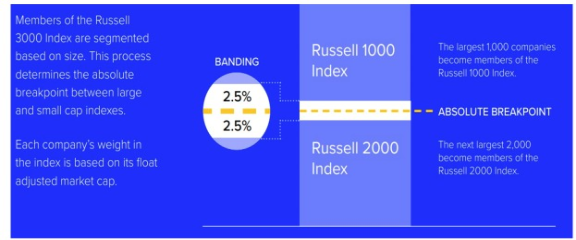
- Describe how companies are ranked by size and how index breakpoints determine membership in the Russell 1000 and Russell 2000 indexes.
Joining the Russell US Indexes
For more than forty years, the Russell US Indexes have mapped the composition of the investable US equity market using a simple, transparent and consistent approach.
One of the questions we’re most often asked by C-suite executives is: “How can my company join the Russell US Indexes?”
Unlike some other popular US equity indexes, there’s nothing subjective about the Russell US Indexes’ inclusion criteria. [note1] There’s no committee deciding who joins. If a company’s stock meets the eligibility rules, it qualifies.
US nationality
In today’s global marketplace, determining a company’s nationality is not always straightforward. Many companies operate internationally and maintain multiple legal entities. A corporation may be incorporated in one jurisdiction, have its headquarters in another, be tax-resident in a third country and have its assets and revenues distributed globally.
Here’s how we define nationality for the purpose of the Russell US Indexes: if a company is incorporated in, has its headquarters in and its shares are traded on a standard exchange[3] in same country, it’s assigned that country’s nationality.
Microsoft, for example, is incorporated and headquartered in the US state of Washington. Its shares are traded on the Nasdaq stock exchange, based in New York. So, it’s clearly a US stock for the purposes of the Russell US Indexes.
However, if any of the above three criteria (country of incorporation, country of headquarters or location of share listing) do not match, we conduct a series of checks, the full details of which can be read in the index ground rules.
The general idea is to define three indicators of nationality, then to cross-reference them against the location of a company’s assets or revenues. If the results are still inconclusive, the location of the company’s headquarters or of its most liquid stock exchange listing makes the final determination.
Not all index firms define nationality in the same way, so it’s worth reading this section of the index rules carefully if your company has a complex legal and operational structure. We hear from market participants how much they appreciate the transparency FTSE Russell provides into the rules of inclusion-based nationality attributes.
Eligible exchange
Equities traded on the CBOE, NYSE, NYSE American, NYSE ARCA and Nasdaq exchanges are eligible for inclusion in the Russell US Indexes. Bulletin board, pink-sheet or over-the-counter (OTC) traded securities are not eligible for inclusion, nor are securities for which prices are displayed on the FINRA Alternative Display Facility (ADF).
Minimum share price and market cap
A stock must have a closing price at or above $1.00 on its primary exchange on rank day (see below for a definition of rank day) to be eligible for inclusion. To reduce unnecessary index turnover, a 30-day average stock price is used for existing index members. A company must have a total market capitalization of $30 million or greater on rank day to be eligible for index inclusion.
Company structure
The following company structures are excluded from the Russell US Indexes: royalty trusts, US limited liability companies, closed-end investment companies, blank check companies, special-purpose acquisition companies (SPACs) and limited partnerships. Exchange-traded funds (ETFs) and mutual funds are also excluded.
Types of shares
The following types of shares are excluded from the indexes: preferred and convertible preferred stock, redeemable shares, preferred stock participating, warrants, rights, depositary receipts, installment receipts and trust receipts.
Minimum free float and voting rights
Companies must have a minimum 5% free float[4] to be eligible for the Russell US Indexes. At least 5% of voting rights, aggregated across all a company’s equity securities, must be in the hands of unrestricted shareholders.
Mark your calendar: Rank day
Starting in 2026, FTSE Russell will return to a semi-annual reconstitution of the Russell US Indexes, with the first reconstitution happening in June (at the launch of the Russell US Indexes in 1984, the indexes were reconstituted quarterly, with the reconstitution frequency changing to semi-annual in 1987 and annual in 1989). The first rank day, on which index eligibility is assessed, occurs on the last business day of April (April 30, 2026).
May and June are transition months for the Russell US Indexes. Beginning on May 22, the preliminary constituent lists are communicated to the marketplace and updates are provided on May 29, June 5, June 12, and June 18. These updates reflect changes that may occur between rank day and the reconstitution, including eligibility adjustments that affect additions and deletions. Publishing updated lists throughout the reconstitution process helps maintain transparency and allows market participants to monitor expected index membership ahead of the effective date. The newly reconstituted indexes take effect after US market close on June 26.
Stocks must be listed on rank day and FTSE Russell must have access to documentation on that date supporting the company’s eligibility for index inclusion. This includes the corporate description, the verification of incorporation, the number of shares outstanding and other information needed to determine eligibility.
Similarly, the second 2026 semi-annual reconstitution of the Russell US Indexes will take effect after the close of the second Friday in December, based on data from the second index rank day, the last business day in October. However, for the December reconstitution, changes to the Russell US Style Indexes will only be made with respect to index additions and deletions or movements between the Russell 1000 and Russell 2000 (see below for further detail on eligibility for the Russell US Style Indexes).
Ranking by size and index breakpoints
Weighting, style membership and maintenance
Shares are included in the Russell indexes at their investable market capitalization, i.e., after adjustment for any free float restrictions.
As of the April rank day, we also calculate index constituents’ style attributes, which determine their membership in the Russell US Style—Growth and Value—indexes, which currently represent about two-thirds of all assets benchmarked to a Russell index. Russell US Style Indexes are fully reconstituted each June, along with other Russell US Indexes. Russell US Style Indexes also apply a capping methodology to help funds tracking the indexes stay within registered investment company (RIC) 5/50 diversification limits, while maintaining exposure to growth and value stocks.
For the December semi-annual reconstitution, Russell US Style Index changes will be made only to new additions or membership movements: for example, if a stock moves from the Russell 1000 Index to the Russell 2000 Index (or vice versa). This is to prevent the extra index turnover that would occur if FTSE Russell updated all stocks’ style membership twice a year.
IPOs
We add eligible IPOs to the Russell US Indexes each quarter (in March, June, September and December), ensuring that new additions to the investable equity universe are reflected in representative indexes. More details are available in the methodology guide. Please note that FTSE Russell has recently consulted the market on whether to add eligible significant-sized IPOs outside of the quarterly review periods.
Why would I want to be in the Russell US Indexes?
According to Nasdaq, “[b]eing included in an index is important for companies….Not surprisingly, [Nasdaq’s] studies of Russell inclusions show that index inclusion almost always brings new long-term investors into a company’s shareholder base and, with that, increased liquidity and trading.”
Where can I find more information about the Russell Reconstitution process?
If you are joining the Russell US Indexes during the upcoming 2026 reconstitution, you can find additional resources on our dedicated webpage, including the templates for press releases. The first preliminary list of additions to the Russell US Indexes will be announced after 6pm EST on May 22, 2026—see you then!
footnotes
[1] Inclusion may be subject to FTSE Russell's policy on expert judgment in some scenarios with a link to this policy. | Back to Note 1

Disclaimer
© [2026] London Stock Exchange Group plc and its applicable group undertakings (“LSEG”). LSEG includes (1) FTSE International Limited (“FTSE”), (2) Frank Russell Company (“Russell”), (3) FTSE Global Debt Capital Markets Inc. “FTSE Canada”, (4) FTSE Fixed Income LLC (“FTSE FI”), (5) FTSE (Beijing) Consulting Limited (“WOFE”), (6) FTSE EU SAS ("FES"). All rights reserved.
FTSE Russell® is a trading name of FTSE, Russell, FTSE Canada, FTSE FI, WOFE, FTSE EU and other LSEG entities providing LSEG Benchmark and Index services. “FTSE®”, “Russell®”, “FTSE Russell®”, “FTSE4Good®”, “ICB®”, “Refinitiv”, “WMR™” “FR™” and all other trademarks and service marks used herein (whether registered or unregistered) are trademarks and/or service marks owned or licensed by the applicable member of LSEG or their respective licensors.
FTSE International Limited is authorised as a Benchmark Administrator and regulated in the United Kingdom (UK) by the Financial Conduct Authority ("FCA") according to the UK Benchmark Regulation, FCA Reference Number 796803. FTSE EU SAS is authorised as Benchmark Administrator and regulated in the European Union (EU) by the Autorité des Marches Financiers (“AMF”) according to the EU Benchmark Regulation.
All information is provided for information purposes only. All information and data contained in this publication is obtained by LSEG, from sources believed by it to be accurate and reliable. Because of the possibility of human and mechanical inaccuracy as well as other factors, however, such information and data is provided "as is" without warranty of any kind. No member of LSEG nor their respective directors, officers, employees, partners or licensors make any claim, prediction, warranty or representation whatsoever, expressly or impliedly, either as to the accuracy, timeliness, completeness, merchantability of any information or LSEG Products, or of results to be obtained from the use of LSEG products, including but not limited to indices, rates, data and analytics, or the fitness or suitability of the LSEG products for any particular purpose to which they might be put. The user of the information assumes the entire risk of any use it may make or permit to be made of the information.
No responsibility or liability can be accepted by any member of LSEG nor their respective directors, officers, employees, partners or licensors for (a) any loss or damage in whole or in part caused by, resulting from, or relating to any inaccuracy (negligent or otherwise) or other circumstance involved in procuring, collecting, compiling, interpreting, analysing, editing, transcribing, transmitting, communicating or delivering any such information or data or from use of this document or links to this document or (b) any direct, indirect, special, consequential or incidental damages whatsoever, even if any member of LSEG is advised in advance of the possibility of such damages, resulting from the use of, or inability to use, such information.
No member of LSEG nor their respective directors, officers, employees, partners or licensors provide investment advice and nothing in this document should be taken as constituting financial or investment advice. No member of LSEG nor their respective directors, officers, employees, partners or licensors make any representation regarding the advisability of investing in any asset or whether such investment creates any legal or compliance risks for the investor. A decision to invest in any such asset should not be made in reliance on any information herein. Indices and rates cannot be invested in directly. Inclusion of an asset in an index or rate is not a recommendation to buy, sell or hold that asset nor confirmation that any particular investor may lawfully buy, sell or hold the asset or an index or rate containing the asset. The general information contained in this publication should not be acted upon without obtaining specific legal, tax, and investment advice from a licensed professional.
Past performance is no guarantee of future results. Charts and graphs are provided for illustrative purposes only. Index and/or rate returns shown may not represent the results of the actual trading of investable assets. Certain returns shown may reflect back-tested performance. All performance presented prior to the index or rate inception date is back-tested performance. Back-tested performance is not actual performance, but is hypothetical. The back-test calculations are based on the same methodology that was in effect when the index or rate was officially launched. However, back-tested data may reflect the application of the index or rate methodology with the benefit of hindsight, and the historic calculations of an index or rate may change from month to month based on revisions to the underlying economic data used in the calculation of the index or rate.
This document may contain forward-looking assessments. These are based upon a number of assumptions concerning future conditions that ultimately may prove to be inaccurate. Such forward-looking assessments are subject to risks and uncertainties and may be affected by various factors that may cause actual results to differ materially. No member of LSEG nor their licensors assume any duty to and do not undertake to update forward-looking assessments.
No part of this information may be reproduced, stored in a retrieval system or transmitted in any form or by any means, electronic, mechanical, photocopying, recording or otherwise, without prior written permission of the applicable member of LSEG. Use and distribution of LSEG data requires a licence from LSEG and/or its licensors.