
As the June 2026 reconstitution of the Russell US Indexes nears, we share three key considerations:
1. The Russell recon follows a well-orchestrated timeline
The Russell US Indexes are designed to reflect the ever-changing US equity market, and semi-annual reconstitution (“recon”) is critical to maintaining accurate representation. The reconstitution process involves redefining the breakpoints between large-, mid-, and small-cap stocks to ensure market changes are captured. We also re-evaluate companies to determine where they lie along the investment style spectrum.
The Russell recon process follows a well-orchestrated timeline that spans several weeks—giving market participants a transparent view into the key events leading up to each recon day.
In 2026, FTSE Russell will return to a semi-annual reconstitution of the Russell US Indexes, with the first reconstitution happening in June and the second in December (at the launch of the Russell US Indexes in 1984, the indexes were reconstituted quarterly, with the reconstitution frequency changing to semi-annual in 1987 and annual in 1989).
The first rank day in 2026, on which index eligibility is assessed, will occur on the last business day of April (April 30, 2026).
Ahead of the first semi-annual reconstitution, May and June can be considered as transition months for the Russell US Indexes. Beginning on May 22, the preliminary constituent lists are communicated to the marketplace and updates are provided on May 29, June 5, June 12, and June 18 (instead of June 19 due to the Juneteenth holiday in the US).
These updates reflect changes that may occur between rank day and the reconstitution effective day, including eligibility adjustments that affect additions and deletions. Publishing updated lists throughout the reconstitution process helps maintain transparency and allows market participants to monitor expected index membership changes ahead of the effective date. The newly reconstituted indexes will take effect after US market close on June 26, 2026.
Similarly, the second semi-annual reconstitution of the Russell US Indexes will take effect after the close of the second Friday in December, based on data from the second index rank day in 2026, the last business day in October. However, for the December reconstitution, changes to the Russell US Style Indexes will only be made with respect to index additions and deletions or movements between the Russell 1000® Index and Russell 2000® Index (in other words, we won’t change the Russell US Indexes’ constituents’ style probabilities—or a stock’s allocation to the growth or value index—in December if they remain in the same parent index as at the June 2026 reconstitution).
Please visit our Russell recon page for further information and updates.
2. How big a deal is recon day?
The Russell US Indexes are very widely used amongst investors of all types and recon day typically concludes as one of the highest trading volume days of the year—as market participants rebalance their portfolios to account for index changes. 2025 was no exception: on the effective day for the 2025 reconstitution (June 27 last year), a record $102.5bn was traded on the Nasdaq and $114.7bn on the NYSE.
The heightened trading volume on recon day leaves many investors wondering about the resulting impact on stock prices—and whether the recon puts upward pricing pressure on additions to the indexes and downward pressure on deletions. There is undoubtedly some market impact from the index changes; however, the past short-term impact of Russell recon on index constituents’ stock prices hasn’t reliably followed such a pattern.
The reason this pricing pressure logic doesn’t apply on recon day is that FTSE Russell has designed the process to give investors considerable lead time before the actual index reconstitution takes place. Per the timeline above, our upcoming “rank day”—when we rank the eligible companies to form the preliminary recon portfolio—will take place on April 30, a full eight weeks before the 2026 recon day. And in the weeks prior to recon day, we communicate updates on the preliminary changes to the newly reconstituted Russell US Indexes.
As a result of this advance notice, traders can position their books and investors can position their portfolios well in advance of the date on which the actual index additions and deletions take place. So, by the time the actual recon day arrives, any index impact is typically already priced into the stocks. In fact, at times trading in anticipation of the recon date goes too far—where index adds are overbought and deletes are oversold. In these cases, actual recon day trades go in the opposite direction, with index additions declining in price and deletions rallying.
Furthermore, methodology enhancements made over the years—for example, the adoption of the Nasdaq closing cross on recon day—have reduced the impact of reconstitution, reflecting the enhanced efficiency of closing auction prices. A total of 2.5bn shares were transacted in the Nasdaq closing cross on recon day in 2025, executed in 0.878 seconds [note1].
For liquidity and hedging risk, some market participants turn to derivatives. Recon day trading volumes tend to be higher than the June daily average volume across CME Group’s E-mini Russell futures (RTY) and Micro E-mini Russell 2000 Index futures (M2K), as well as Cboe’s Russell 2000 Index options (RUT).
3. Russell recon is an occasion to reflect—and look forward
Our annual Russell recon isn’t only a time to reshuffle our indexes to reflect the present-day US equity market—it’s also a chance to reflect on the evolving narrative. Each year, a distinct market story takes shape when we examine Russell Index performance.
One of the defining recent features of US equity markets has been the continuing influence of a small group of mega-cap technology companies. Strong investor enthusiasm around artificial intelligence (AI) and related technologies helped propel several of the largest firms to outsized gains.
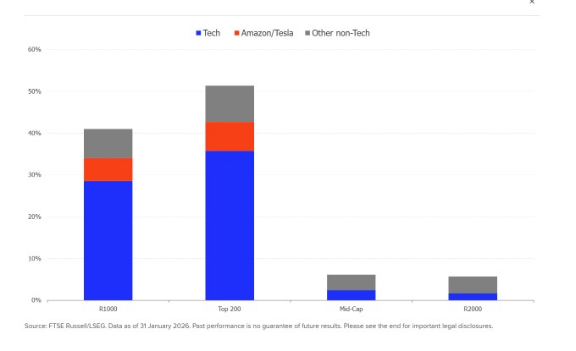
In Figure 1, we show the top 10 stock weights in several Russell US Indexes, disaggregated into Tech and non-Tech components. For the Russell 1000 Index and Russell Top 200 Index, we also highlight the weights of Amazon and Tesla, which are technically in the Consumer Discretionary industry, but are firmly entrenched in the AI ecosystem. Because of this weight concentration, Tech and related stocks have recently tended to dictate the performance of the Russell 1000 and the Russell Top 200.
Figure 1. Index weights of the largest 10 stocks as of January 31, 2026
Source: FTSE Russell/LSEG. Data as of 31 January 2026. Past performance is not a guide to future returns. Please see the end for important legal disclosures.
| Index | Tech | Amazon and Tesla | Other non-Tech | Total weight of largest 10 stocks |
|---|---|---|---|---|
| Russell 1000 Index | 28.5% | 5.5% | 6.5% | 40.5% |
| Russell Top 200 Index | 35.5% | 6.5% | 9.0% | 51.0% |
| Russell Midcap Index | 2.0% | 0.0% | 4.0% | 6.0% |
| Russell 2000 Index | 1.5% | 0.0% | 4.5% | 6.0% |
This concentration has also translated into meaningful dispersion across market capitalization segments. Large-cap companies—particularly those tied to the AI ecosystem—have delivered much stronger returns than many smaller firms operating in the same industries.
However, recent wobbles in the AI narrative may be encouraging investors to think about how US equity performance is broadening.
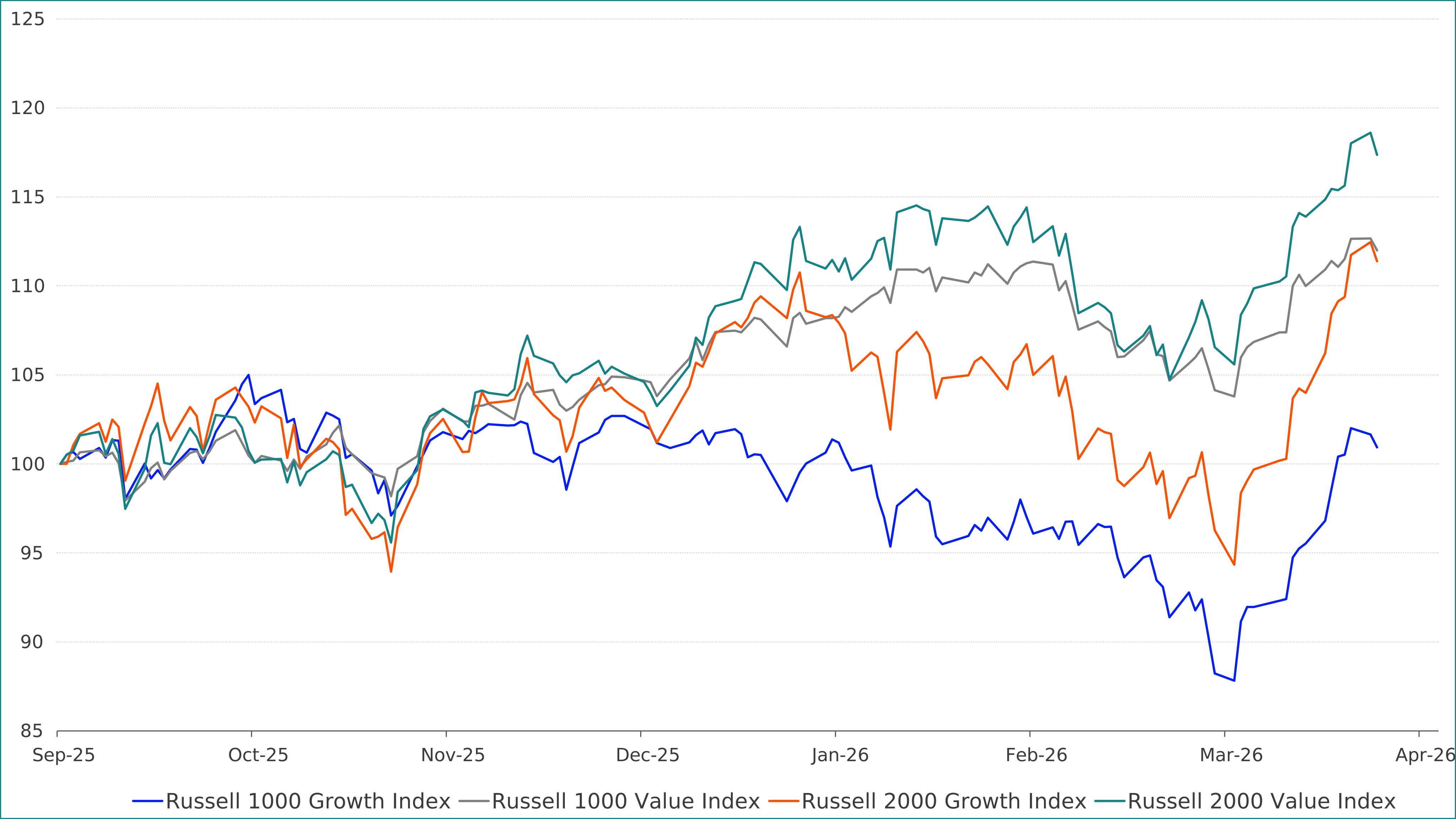
In Figure 2, we illustrate the recent performance of the Russell US Style Indexes, showing both a period of AI skepticism, starting at the end of October 2025, as well as a more recent sell-off starting in February 2026. We can see dispersion between the Russell US Style Indexes, with the Russell 2000 Value Index outperforming others and the Russell 1000 Value Index following closely behind. While both Growth indexes suffered from the latest sell-off, the worst performing index was Russell 1000 Growth Index. This dynamic may reflect investors’ search for value during the later stages of the equity bull market, when overall US equity valuations are high relative to history. It is also reflective of other market drivers asserting themselves as the tech rally moderates and evolves.
Figure 2. Russell US Style Indexes cumulative performance (USD, TR, rebased October 31, 2025)
Source: FTSE Russell, LSEG. Data as of 21 April 2026. Past performance is not a guide to future returns. Please see the end for important legal disclosures.
| Period | Russell 1000 Growth Index | Russell 1000 Value Index | Russell 2000 Growth Index | Russell 2000 Value Index |
|---|---|---|---|---|
| Starting value | 100.0 | 100.0 | 100.0 | 100.0 |
| September 2025 | 103.5 | 102.0 | 104.0 | 102.5 |
| October 2025 | 101.5 | 102.5 | 101.0 | 103.0 |
| November 2025 | 101.0 | 104.0 | 103.0 | 105.0 |
| December 2025 | 100.0 | 108.5 | 108.0 | 111.5 |
| January 2026 | 96.5 | 111.0 | 105.0 | 113.0 |
| February 2026 | 88.0 | 104.0 | 96.0 | 106.0 |
| March 2026 | 101.0 | 112.5 | 111.5 | 117.5 |
These patterns highlight how market participants have begun to exercise greater discretion regarding US tech-related stock valuations and the expected winners and losers. As investors look ahead to the upcoming Russell Reconstitution, this provides useful context for evaluating the evolving composition of the US equity market.
Postscript
A recon-related question we often receive is how a company can join the Russell indexes. We’ve highlighted the most relevant index rules for prospective joiners in a separate insight.

Sources
Legal Disclaimer
Republication or redistribution of LSE Group content is prohibited without our prior written consent.
The content of this publication is for informational purposes only and has no legal effect, does not form part of any contract, and does not seek to constitute advice of any nature and no reliance should be placed upon statements contained herein. Whilst reasonable efforts have been taken to ensure that the contents of this publication are accurate and reliable, LSE Group does not guarantee that this document is free from errors or omissions; therefore, you may not rely upon the content of this document under any circumstances and you should seek your own independent legal, investment, tax and other advice. Neither we nor our affiliates shall be liable for any errors, inaccuracies or delays in the publication or any other content, or for any actions taken by you in reliance thereon.
Copyright © 2026 London Stock Exchange Group. All rights reserved.