
The foreign exchange (FX) market trades around the world, around the clock and without a central trading venue. Yet FX liquidity tends to aggregate at a particular time in a single place—the end of the London trading day.
In a new FTSE Russell paper, quantitative currency researcher Robert Gaudiosi examines the utility of the London 4pm fix, showing that it remains a particularly resilient global liquidity point, even for Asia-Pacific (APAC) currencies whose “home” time is far removed from Britain’s.
Trade FX locally or in London?
4pm London falls between 11pm and 4am for FX traders in Singapore, Japan, China, Australia and New Zealand. Given this time difference, says Gaudiosi, there has been understandable interest in transacting more APAC currency business during local trading hours.
In Singapore, for example, recent industry work highlights the benefits and practical considerations of adopting Asian time-zone benchmarks for FX execution.
To test the relative advantages of different FX execution windows, Gaudiosi used data sourced from LSEG Tick History and LSEG Workspace, focusing on five major APAC currency pairs: AUD/USD, USD/CNH, USD/JPY, NZD/USD and USD/SGD.
For each pair, he compared trade activity, time-weighted bid-ask spreads and price impact per trade across hourly WMR benchmark windows, expressed in each currency’s local time.
The results showed that London 4pm remained the benchmark window with the deepest liquidity overall. Across the five currency pairs, it was associated with the highest trade activity, the tightest bid-ask spreads and the lowest price impact per trade.
The pattern was strongest for AUD/USD and NZD/USD, where London 4pm was clearly the deepest point of liquidity.
USD/JPY also exhibited high liquidity at London 4pm, although the 10am Tokyo WMR fix was comparably liquid. For USD/CNH and USD/SGD, the picture was more balanced: local afternoon benchmark windows exhibited substantial liquidity, with trade activity and spreads often close to London 4pm levels.
Trade frequency and time-weighted bid-ask spreads for AUD/USD, USD/CNH, USD/JPY, NZD/USD and USD/SGD
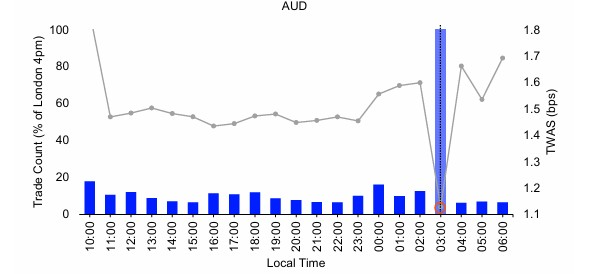
Source: LSEG Tick History. Data from 2 January 2024 to 27 February 2026. Past performance is not a guide to future returns.
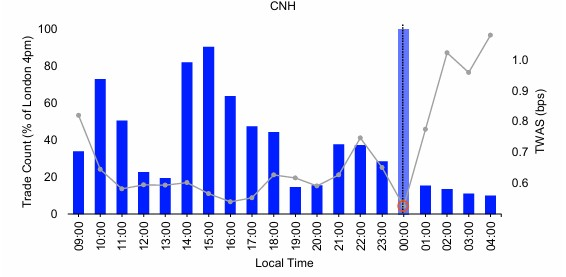
Source: LSEG Tick History. Data from 2 January 2024 to 27 February 2026. Past performance is not a guide to future returns.
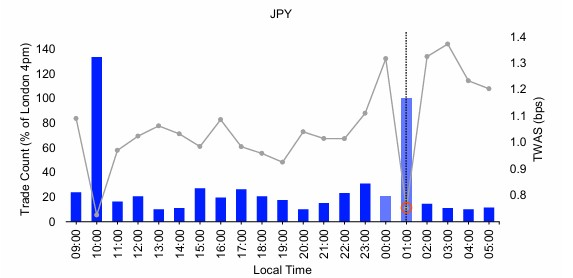
Source: LSEG Tick History. Data from 2 January 2024 to 27 February 2026. Past performance is not a guide to future returns.
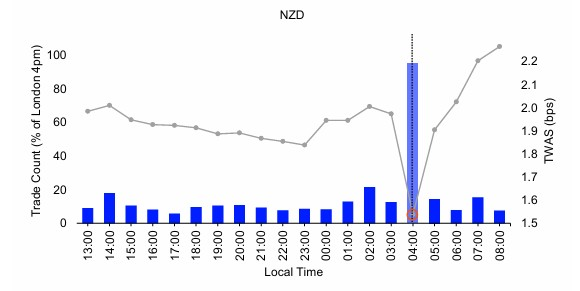
Source: LSEG Tick History. Data from 2 January 2024 to 27 February 2026. Past performance is not a guide to future returns.
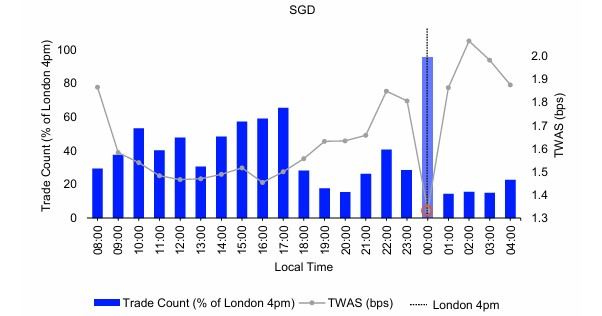
Source: LSEG Tick History. Data from 2 January 2024 to 27 February 2026. Past performance is not a guide to future returns.
Liquidity differences over time
Gaudiosi also examined how the liquidity differences between local benchmark windows and the London 4pm fix have evolved over time.
He found that, for AUD/USD and NZD/USD, London 4pm consistently exhibited higher trade activity and narrower bid-ask spreads than local benchmark windows. For USD/JPY, trade counts at the 10am WMR Tokyo benchmark have exceeded London 4pm levels since around 2022, alongside a relative tightening in bid-ask spreads.
In USD/CNH and USD/SGD, the results were more balanced, with local benchmark windows often matching or exceeding London 4pm in both trade activity and bid-ask spreads.
However, several episodes stood out in which the liquidity differentials between local benchmark windows and London end-of-day trading widened sharply, with traders placing more orders in what they saw as the deepest market—London.
The clearest example was the Covid market stress period, when the gap in trading activity increased materially for AUD/USD, NZD/USD and USD/JPY, alongside larger bid-ask spread differentials for AUD/USD and USD/JPY.
USD/CNH also experienced a temporary widening in local bid-ask spreads relative to London 4pm in Q4 2022, Gaudiosi found, potentially reflecting China-specific policy and economic uncertainty, including developments around the zero-Covid policy and rising US-China tensions.
Testing stress and month-end events
Using regression analysis, Gaudiosi then tested more formally whether the London 4pm FX fix becomes relatively more liquid during periods of elevated market-wide uncertainty and at month end, when benchmark-related portfolio rebalancing activity is typically highest.
He found that, on end-of-month days, the percentage of trading in local benchmark windows relative to London 4pm fell by more than 50%, while bid-ask spreads at London 4pm tightened by around 0.07 basis points relative to local benchmark windows and the price impact per trade was reduced by 0.09 basis points.
Similarly, a 10-point increase in the VIX (CBOE implied volatility index for the S&P 500) was associated with an approximately 13% reduction in local benchmark window trading relative to London 4pm, a further 0.05 basis point spread advantage for the London fix and a price impact reduction of 0.074 basis points per trade.
Conclusions
Gaudiosi concluded that the WMR London 4pm benchmark reflects the deepest point of FX market liquidity overall, with, on average, the highest trade activity, the tightest bid-ask spreads and the smallest price impact per trade.
These findings were strongest for AUD/USD and NZD/USD and also evident for USD/JPY, despite the domestic importance of the 10am WMR Tokyo fix. For USD/CNH and USD/SGD, the evidence was more mixed, with local afternoon benchmark windows showing substantial liquidity, and trade counts, spreads and price impact often close to London 4pm levels.
The London 4pm benchmark fix becomes relatively more liquid at month end and during periods of elevated market uncertainty, a finding that is consistent with liquidity converging on established global benchmarks when portfolio rebalancing needs are high or market conditions are more stressed.
Finally, while the London 4pm benchmark remains a key global liquidity point, the strong FX liquidity observed at specific local benchmark times—notably for USD/JPY, USD/CNH and USD/SGD—highlights the potential for broader use of intraday WMR benchmarks for execution, Gaudiosi predicts.


Disclaimer
© [2026] London Stock Exchange Group plc and its applicable group undertakings (“LSEG”). LSEG includes (1) FTSE International Limited (“FTSE”), (2) Frank Russell Company (“Russell”), (3) FTSE Global Debt Capital Markets Inc. “FTSE Canada”, (4) FTSE Fixed Income LLC (“FTSE FI”), (5) FTSE (Beijing) Consulting Limited (“WOFE”), (6) FTSE EU SAS ("FES"). All rights reserved.
FTSE Russell® is a trading name of FTSE, Russell, FTSE Canada, FTSE FI, WOFE, FTSE EU and other LSEG entities providing LSEG Benchmark and Index services. “FTSE®”, “Russell®”, “FTSE Russell®”, “FTSE4Good®”, “ICB®”, “Refinitiv”, “WMR™” “FR™” and all other trademarks and service marks used herein (whether registered or unregistered) are trademarks and/or service marks owned or licensed by the applicable member of LSEG or their respective licensors.
FTSE International Limited is authorised as a Benchmark Administrator and regulated in the United Kingdom (UK) by the Financial Conduct Authority ("FCA") according to the UK Benchmark Regulation, FCA Reference Number 796803. FTSE EU SAS is authorised as Benchmark Administrator and regulated in the European Union (EU) by the Autorité des Marches Financiers (“AMF”) according to the EU Benchmark Regulation.
All information is provided for information purposes only. All information and data contained in this publication is obtained by LSEG, from sources believed by it to be accurate and reliable. Because of the possibility of human and mechanical inaccuracy as well as other factors, however, such information and data is provided "as is" without warranty of any kind. No member of LSEG nor their respective directors, officers, employees, partners or licensors make any claim, prediction, warranty or representation whatsoever, expressly or impliedly, either as to the accuracy, timeliness, completeness, merchantability of any information or LSEG Products, or of results to be obtained from the use of LSEG products, including but not limited to indices, rates, data and analytics, or the fitness or suitability of the LSEG products for any particular purpose to which they might be put. The user of the information assumes the entire risk of any use it may make or permit to be made of the information.
No responsibility or liability can be accepted by any member of LSEG nor their respective directors, officers, employees, partners or licensors for (a) any loss or damage in whole or in part caused by, resulting from, or relating to any inaccuracy (negligent or otherwise) or other circumstance involved in procuring, collecting, compiling, interpreting, analysing, editing, transcribing, transmitting, communicating or delivering any such information or data or from use of this document or links to this document or (b) any direct, indirect, special, consequential or incidental damages whatsoever, even if any member of LSEG is advised in advance of the possibility of such damages, resulting from the use of, or inability to use, such information.
No member of LSEG nor their respective directors, officers, employees, partners or licensors provide investment advice and nothing in this document should be taken as constituting financial or investment advice. No member of LSEG nor their respective directors, officers, employees, partners or licensors make any representation regarding the advisability of investing in any asset or whether such investment creates any legal or compliance risks for the investor. A decision to invest in any such asset should not be made in reliance on any information herein. Indices and rates cannot be invested in directly. Inclusion of an asset in an index or rate is not a recommendation to buy, sell or hold that asset nor confirmation that any particular investor may lawfully buy, sell or hold the asset or an index or rate containing the asset. The general information contained in this publication should not be acted upon without obtaining specific legal, tax, and investment advice from a licensed professional.
Past performance is no guarantee of future results. Charts and graphs are provided for illustrative purposes only. Index and/or rate returns shown may not represent the results of the actual trading of investable assets. Certain returns shown may reflect back-tested performance. All performance presented prior to the index or rate inception date is back-tested performance. Back-tested performance is not actual performance, but is hypothetical. The back-test calculations are based on the same methodology that was in effect when the index or rate was officially launched. However, back-tested data may reflect the application of the index or rate methodology with the benefit of hindsight, and the historic calculations of an index or rate may change from month to month based on revisions to the underlying economic data used in the calculation of the index or rate.
This document may contain forward-looking assessments. These are based upon a number of assumptions concerning future conditions that ultimately may prove to be inaccurate. Such forward-looking assessments are subject to risks and uncertainties and may be affected by various factors that may cause actual results to differ materially. No member of LSEG nor their licensors assume any duty to and do not undertake to update forward-looking assessments.
No part of this information may be reproduced, stored in a retrieval system or transmitted in any form or by any means, electronic, mechanical, photocopying, recording or otherwise, without prior written permission of the applicable member of LSEG. Use and distribution of LSEG data requires a licence from LSEG and/or its licensors.