
Environmental, social and governance (ESG) considerations have evolved from niche allocations to core drivers of investment decision-making. As a result, investors are increasingly focused on how to integrate sustainability insights into their primary portfolio exposures—without compromising alignment to widely used benchmarks.
The Russell 1000 Blossom Index and the Russell 1000 Blossom Sector Relative Index combine two well-established FTSE Russell structures—the Russell US Indexes and the FTSE Blossom methodology—to identify large-cap US companies with stronger ESG practices. The combination delivers core US equity exposure while minimizing any industry or sector bias and incorporating ESG considerations in a transparent and systematic way.
The Russell 1000® Index: a flagship benchmark for US equities
Launched in 1984, the Russell US Indexes provide a comprehensive, modular framework for representing the US equity opportunity set. The indexes are capitalization-weighted and float-adjusted [note1], enabling them to capture approximately 99% of the US equity market’s investable market capitalization. More than $11 trillion in assets are benchmarked to Russell US Indexes across asset management, ETF and institutional portfolios worldwide [note2].
The large-cap benchmark of the Russell US Indexes is the Russell 1000®, which measures the performance of the largest 1,000 US companies. Several characteristics have helped establish the Russell 1000 Index as a widely adopted benchmark:
- Transparent and objective methodology – Constituents are determined using clear, rules-based criteria rather than discretionary selection.
- Comprehensive market representation – The index captures the largest companies within the broader Russell 3000® Index universe, providing broad coverage of the US large-cap segment.
- Predictable semi-annual reconstitution – Russell US Indexes are reconstituted twice each year, ensuring the benchmark reflects ongoing changes in market capitalization and company growth.
- Investability and liquidity – Float adjustment and liquidity screens help ensure the index remains suitable for index-tracking products and institutional portfolios.
Building the Russell 1000 Blossom indexes
The FTSE Blossom Index Series was originally developed for the first ESG index-tracking fund in Japan, run by Japan’s Government Pension Investment Fund (GPIF). The FTSE Blossom Japan index was designed to identify Japanese companies demonstrating stronger ESG practices, while maintaining neutrality in industry weights relative to the capitalization-weighted market benchmark.
In 2025, FTSE Russell extended the Blossom methodology to select indexes of global stocks, choosing the Russell 1000 as the starting universe for the US equity market. The Russell 1000 Blossom Index and the Russell 1000 Blossom Sector Relative Index integrate sustainability considerations into a flagship US large-cap benchmark, while preserving the broad market characteristics investors expect from a core equity allocation.
The methodology for the Russell 1000 Blossom indexes draws on FTSE Russell ESG Scores, which evaluate corporate sustainability practices across a range of relevant dimensions.
Companies are assessed across three ESG pillars, which are further divided into multiple themes covering issues such as climate change, biodiversity, supply chain labor standards, human rights, health and safety, corporate governance and anti-corruption practices (see Figure 1). These themes are built from numerous underlying indicators that evaluate company disclosures, policies and management practices.
Figure 1. One ESG score, 3 pillars and 14 themes
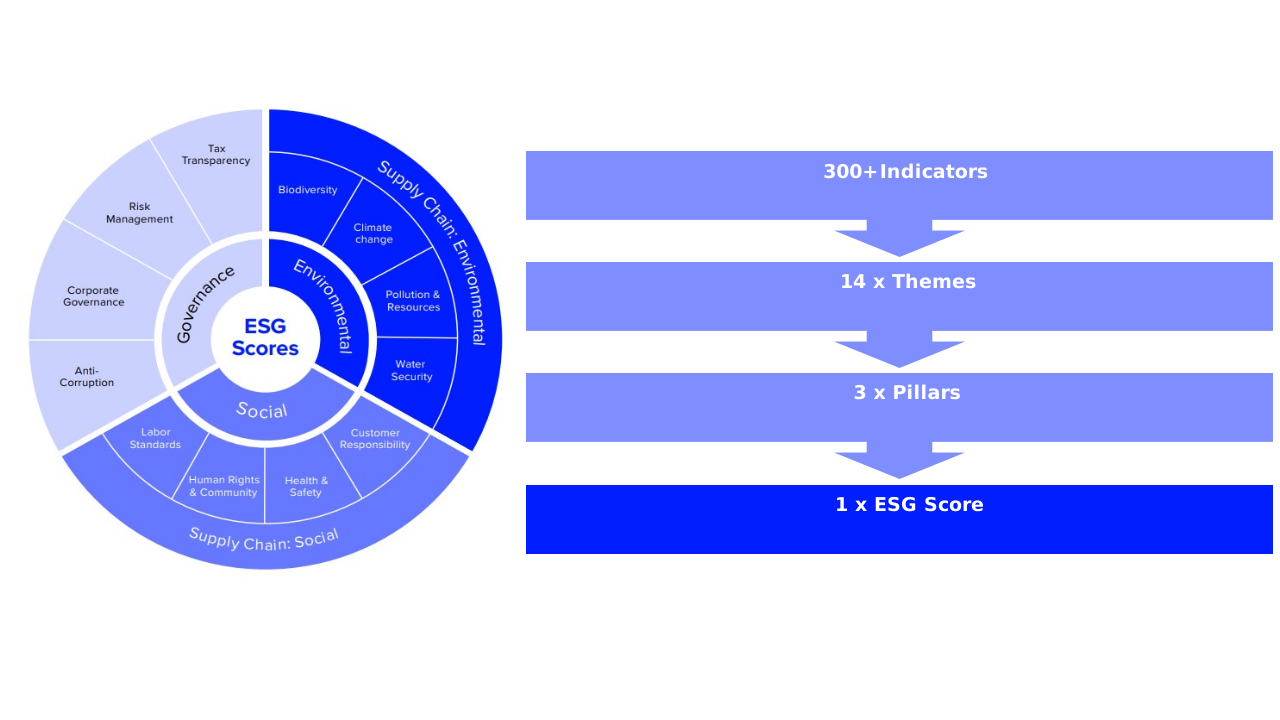
Source: Based on publicly available data. Past performance is not a guide to future returns. Please see the end for important legal disclosures.
Using these ESG scores, the Blossom methodology identifies companies that meet defined ESG thresholds while excluding those involved in certain controversial activities or with weaker ESG practices (Figure 2).
For the Russell 1000 Blossom Index, index inclusion is conditional on an overall FTSE ESG score of 3.3 or above. There is a “buffer” between the ESG scores required for index inclusion and exclusion: constituents with an overall ESG score below 2.9 (or having one or more ESG themes assessed as high exposure with a corresponding score of zero) are at risk of deletion from the index. Additional inclusion criteria cover nuclear power generation, climate change score thresholds and high exposure themes.
To incentivize better ESG disclosure and to encourage engagement with potential index members, constituents are allowed a one-year grace period to meet the index eligibility criteria—but will be deleted at the index review one year later if the eligibility criteria are still not met.
As at end-February 2026, the Russell 1000 Blossom index had 431 constituents, compared to 1006 in the Russell 1000 index[note3].
The Russell 1000 Blossom Sector Relative Index is built slightly differently: it draws stocks from the top 50% of ESG performers, based on FTSE ESG scores, in each ICB sector (subject to a minimum ESG score of 2.0).
In the Russell 1000 Blossom Sector Relative Index, we set another inclusion criterion: a Transition Pathway Initiative Management Quality (TPI MQ) score of 3 or above for the top 10% of greenhouse gas emitters in the index. TPI MQ scores evaluate and track the quality of companies’ governance of their greenhouse gas emissions, and the risks and opportunities related to the low-carbon transition.
As at end-February 2026, the Russell 1000 Blossom Sector Relative index had 517 constituents, compared to 1006 in the Russell 1000 index.
The final index construction step in both the Russell 1000 Blossom and the Russell 1000 Blossom Sector Relative indexes ensures industry or sector neutrality: the Russell 1000 Blossom Index is built to ensure neutrality with respect to the ICB industry weightings of the underlying index; in the Russell 1000 Blossom Sector Relative Index, we ensure neutrality with respect to the ICB sector weightings of the relevant underlying index.
Figure 2. Index construction steps
| Russell 1000 Blossom Index | Russell 1000 Blossom Sector Relative Index | |
| Underlying Index | Russell 1000 Index | |
| Exclusion | Apply minimum set of exclusions | |
| Stock Selection | FTSE ESG Scores >=3.3 and may exclude ESG Scores <2.9* Applicable high exposure theme score >=2.0* Climate Change score of 3 required for primary impact sector, 2 required in secondary impact sector* |
Top 50% in each ICB sector and FTSE ESG Scores >=2.0 TPI MQ score >=3.0 required for top 10% GHG emitters of the underlying universe |
| Industry / Sector Neutrality | Each ICB industry weight is equal to that of the underlying index | Each ICB sector weight is equal to that of the underlying index |
*If lower scores, at risk of deletion from the index
The methodology of the Russell 1000 Blossom indexes is overseen by FTSE Russell’s ESG Advisory Committee, which includes independent investment professionals with expertise in environmental, social and governance issues. Together with transparent rules and publicly available index documentation, this governance helps support the credibility and consistency of the index methodology.
The Russell 1000 Blossom indexes can serve a range of investment purposes. They may be used as a performance benchmark for ESG-oriented US equity strategies or as the basis for index-linked investment products, including index-tracking funds, derivatives and ETFs. For investors seeking to incorporate ESG considerations while maintaining alignment with a widely used large-cap benchmark, the indexes provide a transparent basis for integrating sustainability insights into core US equity exposure.
To learn more about the Russell 1000 Blossom indexes or other FTSE Russell sustainable investment indexes, please reach out to the FTSE Russell team or explore our latest sustainable investment research and insights.

Sources
[1] Float adjustment means we remove restricted shares, shares that are never traded, or shares otherwise not available for purchase from the index to help ensure its liquidity. See Free Float Restrictions (FTSE Russell) | Back to Note 1
[2] Data as of December 31, 2024 as reported on May 15, 2025 by eVestment for active institutional funds, Morningstar for active retail mutual funds, insurance products, and ETFs, and passive assets directly collected by FTSE Russell. AUM includes blended benchmarks and excludes futures and options. AUM data does not include active and passive assets not reported to a third-party source or FTSE Russell. For funds where the AUM was not reported as of December 31, 2024, the previous period AUM was used as an estimate. No assurances are given by FTSE Russell as to the accuracy of the data. | Back to Note 2
[3] Between the periodic index reconstitutions, the number of constituents in the Russell 1000 index may differ from the 1000-stock target because of index additions (for example, as a result of initial public offerings) and deletions (for example, as a result of delistings) | Bank of England | Back to Note 3
Read more about

Disclaimer
© [2026] London Stock Exchange Group plc and its applicable group undertakings (“LSEG”). LSEG includes (1) FTSE International Limited (“FTSE”), (2) Frank Russell Company (“Russell”), (3) FTSE Global Debt Capital Markets Inc. “FTSE Canada”, (4) FTSE Fixed Income LLC (“FTSE FI”), (5) FTSE (Beijing) Consulting Limited (“WOFE”), (6) FTSE EU SAS ("FES"). All rights reserved.
FTSE Russell® is a trading name of FTSE, Russell, FTSE Canada, FTSE FI, WOFE, FTSE EU and other LSEG entities providing LSEG Benchmark and Index services. “FTSE®”, “Russell®”, “FTSE Russell®”, “FTSE4Good®”, “ICB®”, “Refinitiv”, “WMR™” “FR™” and all other trademarks and service marks used herein (whether registered or unregistered) are trademarks and/or service marks owned or licensed by the applicable member of LSEG or their respective licensors.
FTSE International Limited is authorised as a Benchmark Administrator and regulated in the United Kingdom (UK) by the Financial Conduct Authority ("FCA") according to the UK Benchmark Regulation, FCA Reference Number 796803. FTSE EU SAS is authorised as Benchmark Administrator and regulated in the European Union (EU) by the Autorité des Marches Financiers (“AMF”) according to the EU Benchmark Regulation.
All information is provided for information purposes only. All information and data contained in this publication is obtained by LSEG, from sources believed by it to be accurate and reliable. Because of the possibility of human and mechanical inaccuracy as well as other factors, however, such information and data is provided "as is" without warranty of any kind. No member of LSEG nor their respective directors, officers, employees, partners or licensors make any claim, prediction, warranty or representation whatsoever, expressly or impliedly, either as to the accuracy, timeliness, completeness, merchantability of any information or LSEG Products, or of results to be obtained from the use of LSEG products, including but not limited to indices, rates, data and analytics, or the fitness or suitability of the LSEG products for any particular purpose to which they might be put. The user of the information assumes the entire risk of any use it may make or permit to be made of the information.
No responsibility or liability can be accepted by any member of LSEG nor their respective directors, officers, employees, partners or licensors for (a) any loss or damage in whole or in part caused by, resulting from, or relating to any inaccuracy (negligent or otherwise) or other circumstance involved in procuring, collecting, compiling, interpreting, analysing, editing, transcribing, transmitting, communicating or delivering any such information or data or from use of this document or links to this document or (b) any direct, indirect, special, consequential or incidental damages whatsoever, even if any member of LSEG is advised in advance of the possibility of such damages, resulting from the use of, or inability to use, such information.
No member of LSEG nor their respective directors, officers, employees, partners or licensors provide investment advice and nothing in this document should be taken as constituting financial or investment advice. No member of LSEG nor their respective directors, officers, employees, partners or licensors make any representation regarding the advisability of investing in any asset or whether such investment creates any legal or compliance risks for the investor. A decision to invest in any such asset should not be made in reliance on any information herein. Indices and rates cannot be invested in directly. Inclusion of an asset in an index or rate is not a recommendation to buy, sell or hold that asset nor confirmation that any particular investor may lawfully buy, sell or hold the asset or an index or rate containing the asset. The general information contained in this publication should not be acted upon without obtaining specific legal, tax, and investment advice from a licensed professional.
Past performance is no guarantee of future results. Charts and graphs are provided for illustrative purposes only. Index and/or rate returns shown may not represent the results of the actual trading of investable assets. Certain returns shown may reflect back-tested performance. All performance presented prior to the index or rate inception date is back-tested performance. Back-tested performance is not actual performance, but is hypothetical. The back-test calculations are based on the same methodology that was in effect when the index or rate was officially launched. However, back-tested data may reflect the application of the index or rate methodology with the benefit of hindsight, and the historic calculations of an index or rate may change from month to month based on revisions to the underlying economic data used in the calculation of the index or rate.
This document may contain forward-looking assessments. These are based upon a number of assumptions concerning future conditions that ultimately may prove to be inaccurate. Such forward-looking assessments are subject to risks and uncertainties and may be affected by various factors that may cause actual results to differ materially. No member of LSEG nor their licensors assume any duty to and do not undertake to update forward-looking assessments.
No part of this information may be reproduced, stored in a retrieval system or transmitted in any form or by any means, electronic, mechanical, photocopying, recording or otherwise, without prior written permission of the applicable member of LSEG. Use and distribution of LSEG data requires a licence from LSEG and/or its licensors.