

Catherine Yoshimoto
The Russell US Indexes are reconstituted on a semi-annual basis to reflect changes in the investable US equity market. While much of the attention surrounding reconstitution focuses on companies moving between large- and small-cap indexes, the process also updates another important dimension of index membership: style.
Russell pioneered style indexes in 1987, introducing a transparent, rules-based framework for distinguishing between growth and value companies. Today, Russell US Style Indexes account for approximately two-thirds of the $12.2 trillion in assets benchmarked to Russell US Indexes. [note1]
The June 2026 Russell reconstitution highlights how style classifications evolve alongside the market itself. Here, we explore how Russell determines growth and value membership and what the latest reconstitution reveals about the style profile of some of the market's most influential companies.
Why style classification matters
Growth and value are among the most widely used concepts in equity investing, yet there is no universal definition of either style. Index providers can use different metrics, weighting schemes and classification approaches, which means the same company may be treated differently across competing style benchmarks.
For investors, those differences can have meaningful implications. Style indexes are commonly used for asset allocation, manager benchmarking and product construction, making the methodology behind a style framework just as important as the resulting index exposures.
Russell's approach is designed to provide a comprehensive and transparent representation of the US equity market. Rather than assigning companies to growth or value based on a single characteristic, the Russell methodology evaluates multiple measures of valuation and growth potential to determine each company's style profile.
Russell's style indexes are designed to work together as complementary building blocks: The growth and value indexes are constructed so that, when combined, they recreate the parent index without gaps or overlap.
Growth, value or both?
One of the distinguishing features of the Russell style methodology is that we evaluate each company using a combination of valuation and growth measures.
We represent value characteristics using a company's book-to-price ratio and growth characteristics using a combination of medium-term earnings growth forecasts and historical sales-per-share growth. Together, these metrics are used to calculate a style probability for each company (Figure 1).
Figure 1. How Russell Defines Growth and Value
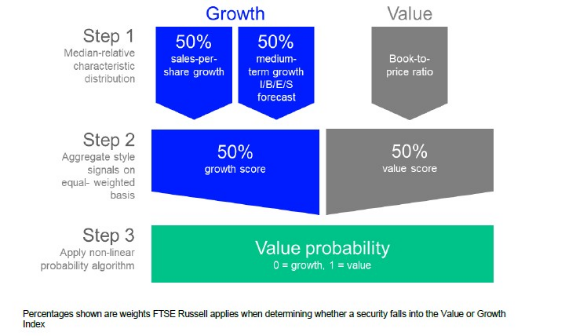
As a result of this process, some companies are assigned entirely to a single style index, while others are allocated across both growth and value (see Figure 2). Companies B, C and D, with strong growth characteristics, are assigned 100% to the growth index. Companies H and F are value stocks and belong entirely to the value index. However, companies A, G and E have both growth and value traits and have their market capitalizations split between the two indexes.
Figure 2. How Russell Allocates Stocks to Growth and Value Categories
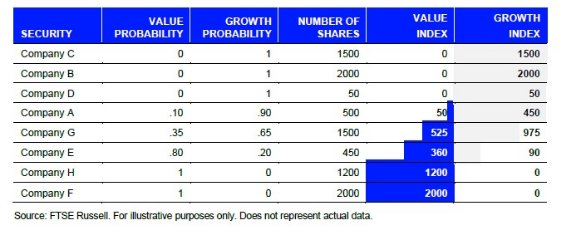
Source: FTSE Russell. For illustrative purpsoses only. Does not respresent actual data. Please see the end for important legal disclosures.
As part of the Russell US Indexes’ June reconstitution, we recalculate style assignments using the latest available data, ensuring that style membership evolves alongside changes in company fundamentals and market conditions.
June 2026 reconstitution: Notable style shifts
The June 2026 reconstitution produced several significant changes among the market's largest companies. Based on preliminary data, [note2] Alphabet and Advanced Micro Devices transitioned to 100% growth and were among the largest removals from the Russell 1000® Value Index. [note3] Other significant additions to the Russell 1000 Growth Index include Micron Technology and SanDisk, reflecting continued strength in semiconductor and computer hardware companies amid the ongoing momentum in AI. In contrast, Amazon.com moved further into value territory, landing at 92% value versus 27% value last year.
Other large technology companies shifted toward a more balanced style profile. Apple and Microsoft, which were previously classified entirely as growth, became notable additions to the Russell 1000 Value Index as their style assignments shifted to a blend of growth and value. Apple became 46% value and 54% growth, and Microsoft moved to 50% value and 50% growth.
At the June 2026 reconstitution, Space Exploration Technologies Corp will be added to the Russell 1000 Index as 90.4% growth and 9.6% value, using the available fundamental data (book-to-price ratio) and applying subsector substitution for unavailable variables. Given its status as a fast entry IPO addition at the June 2026 reconstitution, SpaceX’s style will be fully re-evaluated at the December 2026 reconstitution.
Figure 3: Growth company styles of the largest 10 companies in the Russell 3000 Index, plus Space Exploration Technologies Corp (fast entry IPO)
Company |
2026 style |
2025 style |
|---|---|---|
Nvidia |
100% growth |
100% growth |
Alphabet |
100% growth |
65% growth |
Apple |
54% growth |
100% growth |
Microsoft |
50% growth |
100% growth |
Amazon.com |
8% growth |
73% growth |
Space Exploration Technologies (fast entry IPO) |
90% growth |
N/A |
Broadcom |
100% growth |
100% growth |
Meta |
82% growth |
82% growth |
Tesla |
100% growth |
100% growth |
Walmart |
9% growth |
10% growth |
Berkshire Hathaway |
0% growth |
0% growth |
Source: FTSE Russell, data as of April 30, 2026. Data as of April 30, 2025 and April 30, 2026, respectively. Past performance is not a guide to future returns. Please see the end for important legal disclosures.
Notable companies shifting to 100% growth in 2026
Company |
2026 style |
2025 style |
|---|---|---|
Micron Technology |
100% growth |
0% growth |
Caterpillar |
100% growth |
12% growth |
Advanced Micro Devices |
100% growth |
59% growth |
Applied Materials |
100% growth |
28% growth |
SanDisk |
100% growth |
0% growth |
Source: FTSE Russell, data as of April 30, 2026. Data as of April 30, 2025 and April 30, 2026, respectively. Past performance is not a guide to future returns. Please see the end for important legal disclosures.
Looking ahead
The Russell US Indexes have returned to a semi-annual reconstitution schedule, with reconstitutions now occurring in June and December. Style index membership, however, will continue to be determined annually as part of the June reconstitution, providing investors with a consistent and comprehensive assessment of style characteristics across the US equity market.
To learn more, visit the Russell Reconstitution Hub and watch the latest episodes of the FTSE Russell Index Ideas podcast.

footnotes
[1] Data as of June 30, 2025 as reported on November 15, 2025 by eVestment for active institutional funds, Morningstar for active retail mutual funds, insurance products, and ETFs, and passive assets directly collected by FTSE Russell. AUM includes blended benchmarks and excludes futures and options. AUM data does not include active and passive assets not reported to a 3rd party source or FTSE Russell. For funds where the AUM was not reported as of June 30, 2025, the previous period AUM was used as an estimate. No assurances are given by FTSE Russell as to the accuracy of the data. | Back to Note 1
[2] Source: FTSE Russell, as of May 22, 2026. Preliminary data based on April 30, 2025 (rank date), effective at the open of June 29, 2026. | Back to Note 2
[3] Effective March 2025, Russell US Style Indexes apply a capping methodology in consideration of RIC 5/50 diversification limits. The Russell US Style Indexes that do not apply capping include “Benchmark” in the index name, e.g. Russell 1000 Growth Benchmark Index. The preliminary membership changes announced on May 22, 2026 are for the Benchmark indexes, and capped weights will be calculated after the close of June 17, 2026, effective for the open of June 29, 2026. | Back to Note 3
[4] research.ftserussell.com/products/index-notices/home/getnotice/?id=2621018 | Back to Note 4

Disclaimer
© [2026] London Stock Exchange Group plc and its applicable group undertakings (“LSEG”). LSEG includes (1) FTSE International Limited (“FTSE”), (2) Frank Russell Company (“Russell”), (3) FTSE Global Debt Capital Markets Inc. “FTSE Canada”, (4) FTSE Fixed Income LLC (“FTSE FI”), (5) FTSE (Beijing) Consulting Limited (“WOFE”), (6) FTSE EU SAS ("FES"). All rights reserved.
FTSE Russell® is a trading name of FTSE, Russell, FTSE Canada, FTSE FI, WOFE, FTSE EU and other LSEG entities providing LSEG Benchmark and Index services. “FTSE®”, “Russell®”, “FTSE Russell®”, “FTSE4Good®”, “ICB®”, “Refinitiv”, “WMR™” “FR™” and all other trademarks and service marks used herein (whether registered or unregistered) are trademarks and/or service marks owned or licensed by the applicable member of LSEG or their respective licensors.
FTSE International Limited is authorised as a Benchmark Administrator and regulated in the United Kingdom (UK) by the Financial Conduct Authority ("FCA") according to the UK Benchmark Regulation, FCA Reference Number 796803. FTSE EU SAS is authorised as Benchmark Administrator and regulated in the European Union (EU) by the Autorité des Marches Financiers (“AMF”) according to the EU Benchmark Regulation.
All information is provided for information purposes only. All information and data contained in this publication is obtained by LSEG, from sources believed by it to be accurate and reliable. Because of the possibility of human and mechanical inaccuracy as well as other factors, however, such information and data is provided "as is" without warranty of any kind. No member of LSEG nor their respective directors, officers, employees, partners or licensors make any claim, prediction, warranty or representation whatsoever, expressly or impliedly, either as to the accuracy, timeliness, completeness, merchantability of any information or LSEG Products, or of results to be obtained from the use of LSEG products, including but not limited to indices, rates, data and analytics, or the fitness or suitability of the LSEG products for any particular purpose to which they might be put. The user of the information assumes the entire risk of any use it may make or permit to be made of the information.
No responsibility or liability can be accepted by any member of LSEG nor their respective directors, officers, employees, partners or licensors for (a) any loss or damage in whole or in part caused by, resulting from, or relating to any inaccuracy (negligent or otherwise) or other circumstance involved in procuring, collecting, compiling, interpreting, analysing, editing, transcribing, transmitting, communicating or delivering any such information or data or from use of this document or links to this document or (b) any direct, indirect, special, consequential or incidental damages whatsoever, even if any member of LSEG is advised in advance of the possibility of such damages, resulting from the use of, or inability to use, such information.
No member of LSEG nor their respective directors, officers, employees, partners or licensors provide investment advice and nothing in this document should be taken as constituting financial or investment advice. No member of LSEG nor their respective directors, officers, employees, partners or licensors make any representation regarding the advisability of investing in any asset or whether such investment creates any legal or compliance risks for the investor. A decision to invest in any such asset should not be made in reliance on any information herein. Indices and rates cannot be invested in directly. Inclusion of an asset in an index or rate is not a recommendation to buy, sell or hold that asset nor confirmation that any particular investor may lawfully buy, sell or hold the asset or an index or rate containing the asset. The general information contained in this publication should not be acted upon without obtaining specific legal, tax, and investment advice from a licensed professional.
Past performance is no guarantee of future results. Charts and graphs are provided for illustrative purposes only. Index and/or rate returns shown may not represent the results of the actual trading of investable assets. Certain returns shown may reflect back-tested performance. All performance presented prior to the index or rate inception date is back-tested performance. Back-tested performance is not actual performance, but is hypothetical. The back-test calculations are based on the same methodology that was in effect when the index or rate was officially launched. However, back-tested data may reflect the application of the index or rate methodology with the benefit of hindsight, and the historic calculations of an index or rate may change from month to month based on revisions to the underlying economic data used in the calculation of the index or rate.
This document may contain forward-looking assessments. These are based upon a number of assumptions concerning future conditions that ultimately may prove to be inaccurate. Such forward-looking assessments are subject to risks and uncertainties and may be affected by various factors that may cause actual results to differ materially. No member of LSEG nor their licensors assume any duty to and do not undertake to update forward-looking assessments.
No part of this information may be reproduced, stored in a retrieval system or transmitted in any form or by any means, electronic, mechanical, photocopying, recording or otherwise, without prior written permission of the applicable member of LSEG. Use and distribution of LSEG data requires a licence from LSEG and/or its licensors.