

Sergiy Lesyk

Matt Monach, CFA

Tom Chan, CFA
Value factor investing has faced persistent headwinds in recent years, leading some investors to question whether the value premium still works. Our evidence suggests a different conclusion.
The issue is not value itself, but how value is implemented. Over the last 20 years, a simple value tilt delivered a negative information ratio when applied to the FTSE Developed index. But when unintended factor, industry and country exposures were controlled, the information ratio improved to 0.43. This suggests that value does not need to be saved; it needs to be implemented with greater precision.
Recent challenges for value investors
Growth stocks, particularly large-cap technology firms, have recently dominated equity returns, benefiting from scalable business models, strong earnings momentum and a low-interest rate environment that has boosted the present value of future cash flows.
Several underlying trends have contributed to the challenges faced by value investors.
First, ultra-loose monetary policy compressed discount rates and supported long-duration assets, effectively favouring growth over value. Although the rate-hiking cycle that began in 2022 triggered a brief rotation into value, this proved short-lived as economic uncertainty, inflation volatility and an uneven earnings recovery limited sustained outperformance.
Second, some “value” stocks turned out to be value traps: these are companies that appear cheap based on traditional metrics, but which face deteriorating fundamentals. Such value traps undermine the effectiveness of simple valuation-based approaches.
Third, the way we define, and measure stocks’ value is increasingly contested. Traditional accounting metrics, such as book value to market price (“book-to-price”), may underestimate intangible assets, which are increasingly central to modern business models. This mismeasurement can cause systematic bias against high-quality firms that appear expensive, but which generate strong long-term returns.
There have been attempts to “save” value or explain its underperformance. One way is to take the long view. Using a longer timeframe, one that covers a full interest-rate cycle and/or industry rotation, might offer more information. Another way is to “fix” the value of a stock by taking intangibles into account when calculating book value.
A simpler way of addressing the value challenge
We believe there is a simpler solution.
The original Fama-French approach [note1] was innovative at the time but is perhaps too simplistic for the index designs of today. Although the Fama-French model segmented value into size segments, as markets gained in complexity and diverged, and as cycles lengthened, the design failed to keep pace.
The book-to-price ratio used by Fama-French to measure value may not account for intangible assets, but the FTSE Russell value factor uses earnings yield, cash-flow yield and the sales-to-price ratio, which reduces any reliance on accounting book value. Industry, country and factor neutralisation further help avoid structural biases linked to intangible-heavy sectors and regions.
Our evidence suggests that industry valuation rankings can be persistent, so uncontrolled industry exposure may add noise to the intended value signal.
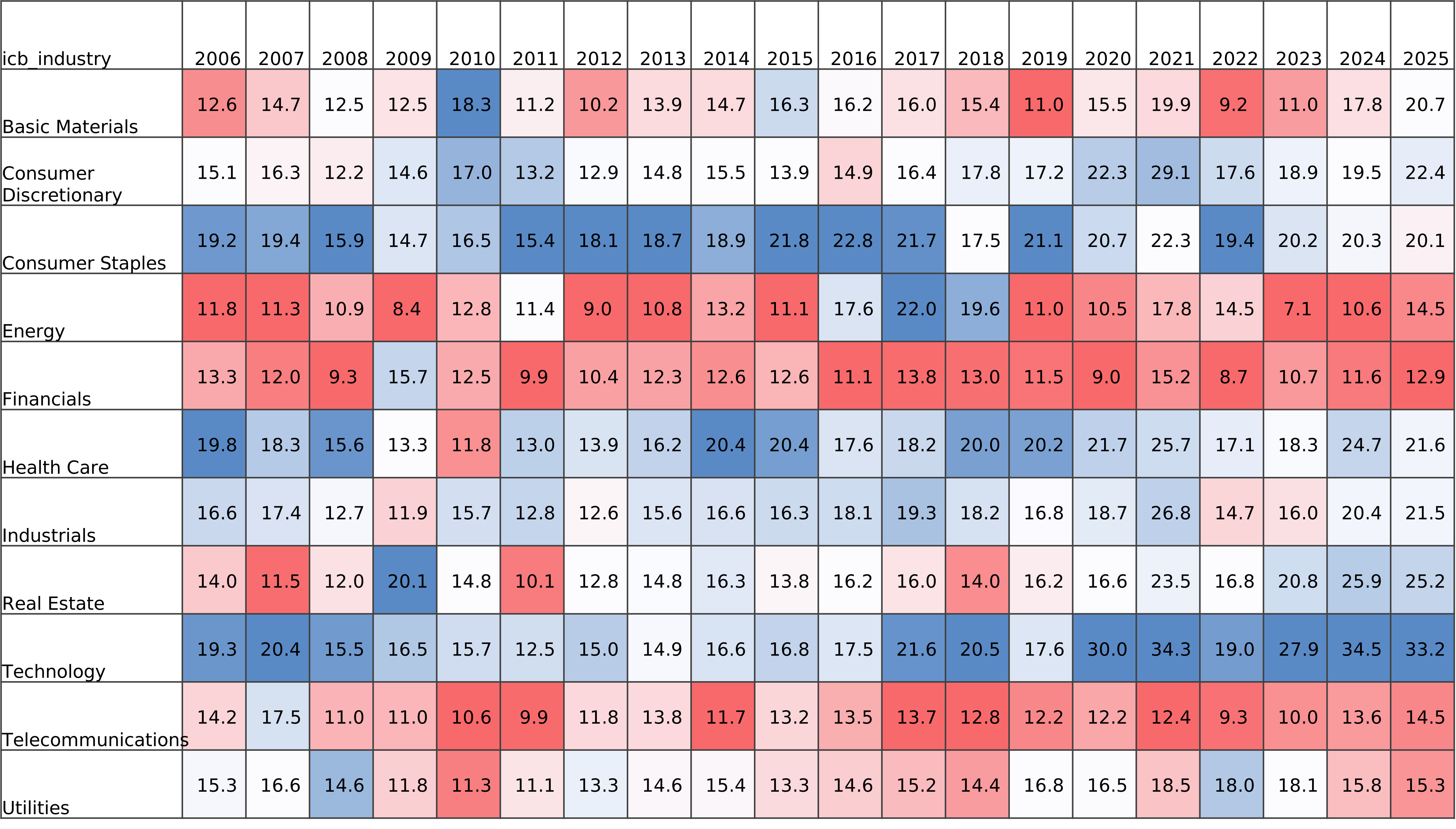
Chart 1: ICB Industry price/earnings ratios (2006-2025)
Source. FTSE Russell. FTSE Developed index data from December 2005-December 2025. Past performance is no guarantee of future results
In Chart 1, we show the price/earnings ratios of different Industry Classification Benchmark (ICB) industries over the period from 2005 to 2025. Although they are volatile, the rankings were mostly range-bound and not as cyclical as the industry-agnostic approach would imply.
We also now know [note2] that the index-weighting approach has a significant impact on factor exposures, particularly on off-target (undesired) factor exposures. By off-target exposures, we mean unintended tilts to other rewarded factors, such as momentum, quality, size or low volatility, that arise while trying to capture value (see Table 1).
Table 1: Average factor exposures for single fixed tilt portfolios

Source. FTSE Russell. FTSE Developed index data from December 2005-December 2025. Past performance is no guarantee of future results. Returns shown prior to index or rate launch reflect hypothetical historical performance.
Removing unintended exposures
A more refined value-factor index construction approach would therefore remove off-target exposures. FTSE’s Target Exposure Factor indices [note3] provide investors with the ability to pursue a variety of explicit factor exposures while reducing exposure to unwanted factors and controlling market, country and industry active bets.
Chart 2: Relative performance of fixed tilt to value and target exposure to value with off-target exposures neutralised
Table 2: Performance of FTSE Developed Index, Value (fixed tilt) and Value (target exposure) with off-target exposures removed
| FTSE Developed Index | Fixed tilt exposure to Value | Target exposure to Value with other factor exposures neutralised | |
|---|---|---|---|
| Performance (USD) | |||
| Geo. Return p.a. (%) | 9.05 | 8.99 | 9.19 |
| Volatility p.a. (%) | 16.18 | 16.44 | 16.45 |
| Risk/Reward Ratio | 0.56 | 0.55 | 0.56 |
| Max. Drawdown (%) | -57.37 | -58.42 | -58.07 |
| Relative Return p.a. (%) | -- | -0.05 | 0.13 |
| Tracking Error p.a. (%) | -- | 1.82 | 1.13 |
| Information Ratio | -- | -0.03 | 0.11 |
| Active Factor Exposures (avg) | |||
| Value | -- | 0.33 | 0.32 |
| Low Volatility | -- | 0.03 | 0 |
| Momentum | -- | -0.1 | 0 |
| Size | -- | 0.02 | 0 |
| Quality | -- | -0.04 | 0 |
Source: FTSE Russell. FTSE Developed index data from December 2005-December 2025. Past performance is no guarantee of future results. Returns shown prior to index or rate launch reflect hypothetical historical performance.
As we see in Table 2, the performance of the value factor improves significantly when off-target exposures are removed.
Furthermore, if we neutralise industry exposures, the value performance improves even further.
Chart 3: Relative performance of Value (target exposure) with off-target exposures neutralised and Value (target exposure) with off-target exposures and industry and country exposures neutralised
Table 3: Performance of FTSE Developed index, Value (target exposure) with off-target exposures neutralised and Value (target exposure) with off-target exposures and industry and country exposures neutralised
| FTSE Developed Index | Target exposure to Value with other factor exposures neutralised | Target exposure to value with other factor and industry country exposures neutralised | |
|---|---|---|---|
| Performance (USD) | |||
| Geo. Return p.a. (%) | 9.05 | 9.19 | 9.4 |
| Volatility p.a. (%) | 16.18 | 16.45 | 16.28 |
| Risk/Reward Ratio | 0.56 | 0.56 | 0.58 |
| Max. Drawdown (%) | -57.37 | -58.07 | -57.78 |
| Relative Return p.a. (%) | -- | 0.13 | 0.32 |
| Tracking Error p.a. (%) | -- | 1.13 | 0.75 |
| Information Ratio | -- | 0.11 | 0.43 |
| Active Factor Exposures (avg) | |||
| Value | -- | 0.32 | 0.32 |
| Low Volatility | -- | 0 | 0 |
| Momentum | -- | 0 | 0 |
| Size | -- | 0 | 0 |
| Quality | -- | 0 | 0 |
Source: FTSE Russell. FTSE Developed index data from December 2005-December 2025. Past performance is no guarantee of future results. Returns shown prior to index or rate launch reflect hypothetical historical performance.
Our conclusion is that the value factor does not need to be saved. It remains a classic factor, one of the key drivers of risk and return in a well-diversified portfolio.
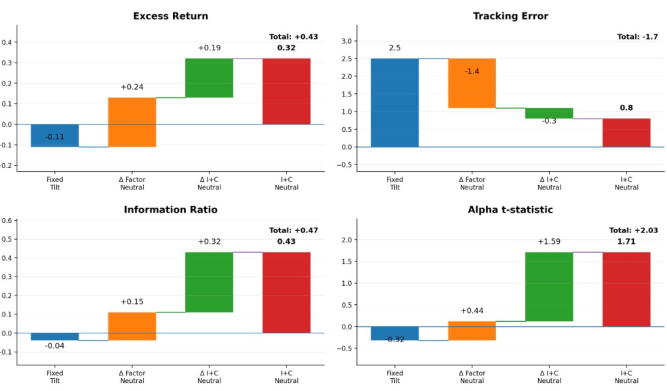
It needs, however, to be defined, calculated and applied in a more refined and accurate way: as a clean signal, with unintended style, industry and country exposures controlled. Using the FTSE Developed index as an example, the removal of off-target exposures and industry and country biases dramatically improved the information ratio of the value factor over the past 20 years: from -0.04 to 0.43.
Chart 4: Breakdown of impact of refinements to the value factor index design
Source: FTSE Russell. FTSE Developed index data from December 2005-December 2025. Past performance is no guarantee of future results. Returns shown prior to index or rate launch reflect hypothetical historical performance.
Table 4: Performance of FTSE Developed index, Value (fixed tilt), Value (target exposure) with off-target exposures neutralised and Value (target exposure) with off-target exposures and industry and country exposures neutralised
| FTSE Developed Index | Target 0.4 Exposure to Value | Fixed tilt exposure to Value | Target exposure to Value with other factor exposures neutralised | Target exposure to value with other factor and industry country exposures neutralised | |
|---|---|---|---|---|---|
| Performance (USD) | |||||
| Geo. Return p.a. (%) | 9.05 | 9.03 | 8.99 | 9.19 | 9.4 |
| Volatility p.a. (%) | 16.18 | 16.55 | 16.44 | 16.45 | 16.28 |
| Risk/Reward Ratio | 0.56 | 0.55 | 0.55 | 0.56 | 0.58 |
| Max. Drawdown (%) | -57.37 | -59.07 | -58.42 | -58.07 | -57.78 |
| Relative Return p.a. (%) | -- | -0.02 | -0.05 | 0.13 | 0.32 |
| Tracking Error p.a. (%) | -- | 1.6 | 1.82 | 1.13 | 0.75 |
| Information Ratio | -- | -0.01 | -0.03 | 0.11 | 0.43 |
| Active Factor Exposures (avg) | |||||
| Value | -- | 0.33 | 0.33 | 0.32 | 0.32 |
| Low Volatility | -- | -0.01 | 0.03 | 0 | 0 |
| Momentum | -- | -0.08 | -0.1 | 0 | 0 |
| Size | -- | 0.03 | 0.02 | 0 | 0 |
| Quality | -- | -0.06 | -0.04 | 0 | 0 |
Source: FTSE Russell. FTSE Developed index data from December 2005-December 2025. Past performance is no guarantee of future results. Returns shown prior to index or rate launch reflect hypothetical historical performance.
footnotes
[1] “Common risk factors in the returns on stocks and bonds”, Fama, French, 1993. | Back to Note 1
[2] Inverting factor strategies. No more “monkey business. Lesyk, Gunthorp, Dougan. 2020”
Target Exposure: Investment applications and solutions. Bi, Dougan, French, Gunthorp, Nebykova. 2020 | Back to Note 2
Read more about

Disclaimer
© [2026] London Stock Exchange Group plc and its applicable group undertakings (“LSEG”). LSEG includes (1) FTSE International Limited (“FTSE”), (2) Frank Russell Company (“Russell”), (3) FTSE Global Debt Capital Markets Inc. “FTSE Canada”, (4) FTSE Fixed Income LLC (“FTSE FI”), (5) FTSE (Beijing) Consulting Limited (“WOFE”), (6) FTSE EU SAS ("FES"). All rights reserved.
FTSE Russell® is a trading name of FTSE, Russell, FTSE Canada, FTSE FI, WOFE, FTSE EU and other LSEG entities providing LSEG Benchmark and Index services. “FTSE®”, “Russell®”, “FTSE Russell®”, “FTSE4Good®”, “ICB®”, “Refinitiv”, “WMR™” “FR™” and all other trademarks and service marks used herein (whether registered or unregistered) are trademarks and/or service marks owned or licensed by the applicable member of LSEG or their respective licensors.
FTSE International Limited is authorised as a Benchmark Administrator and regulated in the United Kingdom (UK) by the Financial Conduct Authority ("FCA") according to the UK Benchmark Regulation, FCA Reference Number 796803. FTSE EU SAS is authorised as Benchmark Administrator and regulated in the European Union (EU) by the Autorité des Marches Financiers (“AMF”) according to the EU Benchmark Regulation.
All information is provided for information purposes only. All information and data contained in this publication is obtained by LSEG, from sources believed by it to be accurate and reliable. Because of the possibility of human and mechanical inaccuracy as well as other factors, however, such information and data is provided "as is" without warranty of any kind. No member of LSEG nor their respective directors, officers, employees, partners or licensors make any claim, prediction, warranty or representation whatsoever, expressly or impliedly, either as to the accuracy, timeliness, completeness, merchantability of any information or LSEG Products, or of results to be obtained from the use of LSEG products, including but not limited to indices, rates, data and analytics, or the fitness or suitability of the LSEG products for any particular purpose to which they might be put. The user of the information assumes the entire risk of any use it may make or permit to be made of the information.
No responsibility or liability can be accepted by any member of LSEG nor their respective directors, officers, employees, partners or licensors for (a) any loss or damage in whole or in part caused by, resulting from, or relating to any inaccuracy (negligent or otherwise) or other circumstance involved in procuring, collecting, compiling, interpreting, analysing, editing, transcribing, transmitting, communicating or delivering any such information or data or from use of this document or links to this document or (b) any direct, indirect, special, consequential or incidental damages whatsoever, even if any member of LSEG is advised in advance of the possibility of such damages, resulting from the use of, or inability to use, such information.
No member of LSEG nor their respective directors, officers, employees, partners or licensors provide investment advice and nothing in this document should be taken as constituting financial or investment advice. No member of LSEG nor their respective directors, officers, employees, partners or licensors make any representation regarding the advisability of investing in any asset or whether such investment creates any legal or compliance risks for the investor. A decision to invest in any such asset should not be made in reliance on any information herein. Indices and rates cannot be invested in directly. Inclusion of an asset in an index or rate is not a recommendation to buy, sell or hold that asset nor confirmation that any particular investor may lawfully buy, sell or hold the asset or an index or rate containing the asset. The general information contained in this publication should not be acted upon without obtaining specific legal, tax, and investment advice from a licensed professional.
Past performance is no guarantee of future results. Charts and graphs are provided for illustrative purposes only. Index and/or rate returns shown may not represent the results of the actual trading of investable assets. Certain returns shown may reflect back-tested performance. All performance presented prior to the index or rate inception date is back-tested performance. Back-tested performance is not actual performance, but is hypothetical. The back-test calculations are based on the same methodology that was in effect when the index or rate was officially launched. However, back-tested data may reflect the application of the index or rate methodology with the benefit of hindsight, and the historic calculations of an index or rate may change from month to month based on revisions to the underlying economic data used in the calculation of the index or rate.
This document may contain forward-looking assessments. These are based upon a number of assumptions concerning future conditions that ultimately may prove to be inaccurate. Such forward-looking assessments are subject to risks and uncertainties and may be affected by various factors that may cause actual results to differ materially. No member of LSEG nor their licensors assume any duty to and do not undertake to update forward-looking assessments.
No part of this information may be reproduced, stored in a retrieval system or transmitted in any form or by any means, electronic, mechanical, photocopying, recording or otherwise, without prior written permission of the applicable member of LSEG. Use and distribution of LSEG data requires a licence from LSEG and/or its licensors.