

Emerald Yau
Technology has always fascinated investors—and for good reason.
It’s a sector that thrives on innovation, reinvention, excitement and disruption. From dial-up internet via a thick cable to 5G connectivity at your fingertips, from floppy disks to cloud storage and from search engines to generative AI, the pace of technological evolution has been relentless.
For years, US technology giants have dominated both investor attention and global equity indices. But the US is no longer the sole gravitational force in the global technology race. Amidst today’s unstoppable digitalisation trend and the awakening of the need to become technologically self-reliant, a new tech epicentre is emerging - Asia.
Asia’s technology revolution: transforming at full speed
Asia’s technology landscape is undergoing a profound transformation. Breakthroughs in AI, advanced manufacturing and digital platforms are reshaping different industries across the region. The momentum is propelled by strong government support and strategic policies: tech self-reliance is now more important than ever amidst a cluster of economic and political disruptions.
Another crucial factor is Asia’s demographic advantage. Not only is Asia the home to half of the world’s population, but its internet penetration has risen to 70%, above the world’s average [note1]. In fact, across China, Hong Kong, Taiwan, Singapore, South Korea and Japan, the penetration rate stands well over 90% on average. The region’s digitally native, mobile-first population is fuelling demand for online services such as e-commerce, gaming and digital health solutions.
And while Silicon Valley gains the headlines, Asia is no longer just a technology consumer—it is also an important technology creator. For example, China leads the world in 66 of 74 critical technologies, according to a recent study [note2], most notably in AI and robotics. Korea is a leader in memory chips and 5G, Japan in gaming, and Taiwan in advanced semiconductors. Together, these markets are setting the pace for global innovation.
Key technology exposure in the FTSE Asia Tech+ 50 Capped Index (by listing location)
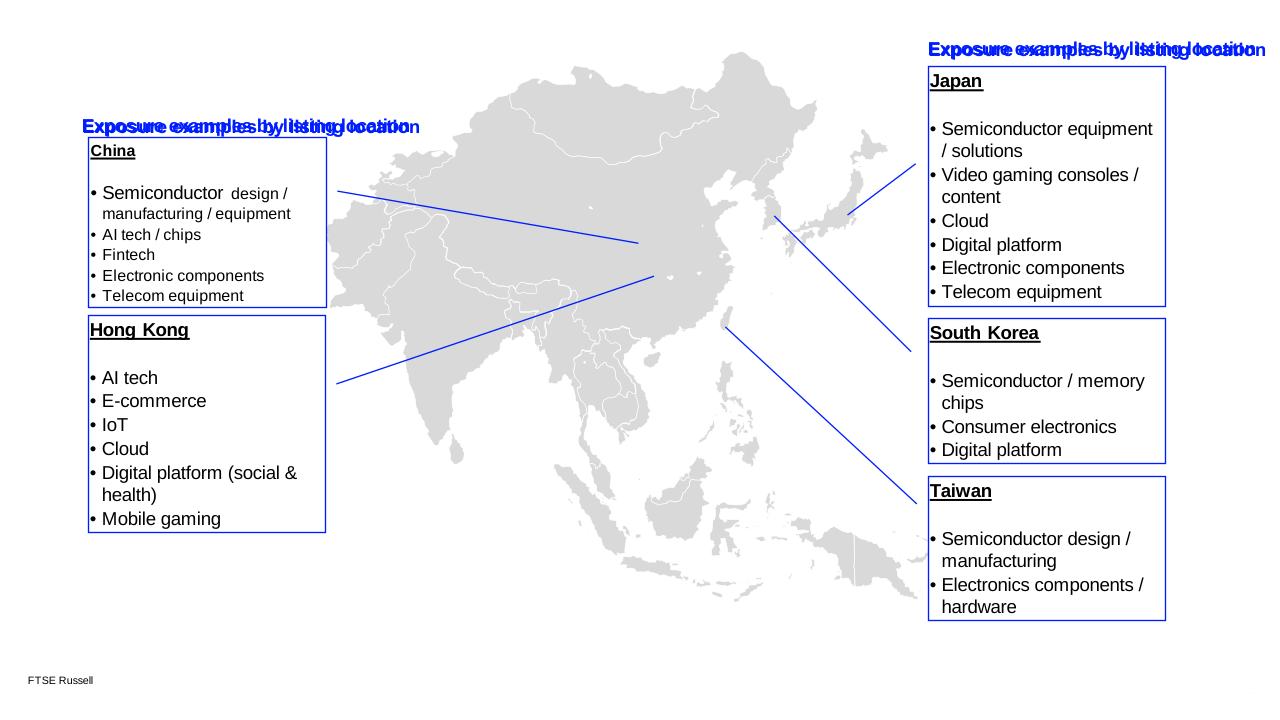
Source: FTSE Russell, as of 27 February 2026. Please see the end for important legal disclosures.
FTSE Asia Tech+ Index Series: capturing Asia’s innovation momentum
The scope of Asia’s technology businesses is vast—they span semiconductors, AI, gaming, digital health, advanced equipment and more. A single industry classification label cannot possibly capture all that innovation.
That’s why a multi-sector lens matters when looking at Asia’s technology investment opportunities. FTSE Asia Tech+ Index Series, launched in September 2025, is designed to do exactly that. It offers a multi-sector solution to capture the breadth and depth of the companies involved in Asia’s technology innovation.
Within the series, the flagship FTSE Asia Tech+ 50 Capped Index tracks the performance of the 50 largest pure tech and tech-related stocks listed across select Asian markets, including China, Hong Kong, Taiwan, Japan, Korea and Singapore.
The index, which is reviewed semi-annually, goes beyond traditional software and hardware tech firms to include companies driving innovation in areas such as e-commerce, the internet of things (“IoT”), digital health and advanced telecoms equipment. We apply a 15% company-level capping rule to mitigate single stock concentration risk. The rules-based, transparent methodology ensures investors gain exposure to Asia’s most influential technology leaders while maintaining diversification and liquidity.
Simply put, this index provides a transparent framework to observe Asia’s tech leaders and their role in global innovation.
FTSE Asia Tech+ 50 Capped index top 10 constituents by weight engage in a wide range of technology activities
Company |
Key Business |
Country |
ICB Subsector |
Weight |
|---|---|---|---|---|
Samsung Electronics |
Global leader in semiconductors, smartphones, consumer electronics, and display technologies. |
Korea |
Telecommunications Equipment |
19.5% |
Taiwan Semiconductor Manufacturing (TSMC) |
World’s largest pure‑play semiconductor foundry manufacturing advanced logic chips. |
Taiwan |
Semiconductors |
16.9% |
SK Hynix |
Major producer of memory semiconductors, primarily DRAM and NAND flash. |
Korea |
Semiconductors |
11.0% |
Alibaba Group Holding |
Leading Chinese e‑commerce and cloud services company operating online marketplaces and digital platforms. |
China |
Diversified Retailers |
9.0% |
Tencent Holdings |
Internet platform giant focused on social media, gaming, digital payments, and online services. |
China |
Consumer Digital Services |
8.9% |
Advantest Corp |
Supplier of automated test equipment used in semiconductor testing and validation. |
Japan |
Production Technology Equipment |
3.5% |
Tokyo Electron |
Provider of semiconductor manufacturing equipment for wafer fabrication processes. |
Japan |
Production Technology Equipment |
3.5% |
Hon Hai Precision Industry |
World’s largest electronics manufacturing services provider (Foxconn), assembling devices for global brands. |
Taiwan |
Electronic Components |
2.6% |
MediaTek |
Fabless semiconductor designer specializing in mobile, connectivity, and consumer electronics chips. |
Taiwan |
Semiconductors |
2.5% |
Samsung Electronics Pfd. |
Preferred share class of Samsung Electronics with dividend priority and limited voting rights. |
Korea |
Telecommunications Equipment |
2.2% |
Total top 10 weight |
|
|
|
79.6% |
Source: FTSE Russell, data as of 27 February 2026 for the FTSE Asia Tech+ 50 Capped Index. Individual stock weights may exceed 15% cap between index rebalancing dates. Past performance is not a guide to future returns. Please see the end for important legal disclosures.
Does Asia compete with or complement the US in tech?
With the rise of the “Mag 7”, US mega-tech stocks dominate many equity investors’ portfolios. As Asian tech is now rising in prominence too, investors may be concerned about being overexposed to tech companies engaged in similar lines of business.
For investors, Asia’s tech stocks could offer a compelling complement to US tech companies. While US tech is dominated by mega-cap innovators focused largely on enterprise solutions, Asia’s consumer-driven tech ecosystem encompasses a broader innovation spectrum and plays a critical role in global technology supply chains.
The recent dominance of large US tech firms has been driven by large contracts, subscriptions. enterprise lock‑ins and the related services: for example, Amazon’s AWS alone generated US$128bn in revenues in 2025. Meanwhile, AWS, Microsoft’s Azure and Google Cloud together controlled around 63% of global cloud infrastructure revenue.
By contrast, Asia’s tech evolution has occurred largely mobile-first and across the region’s dense urban centres, with monetisation via daily consumer engagement, transactions and ecosystems: China’s “SuperApps” WeChat and Alipay show how a multi-function app within one consumer interface may support a whole range of services (such as messaging, mobile payments, e-commerce, mobility and entertainment) and the associated businesses.
Asia Pacific currently represents around 48% of global SuperApp revenue, led by China and Southeast Asia. Meanwhile, the US has fallen short on this trend, largely due to regulatory, cultural and legacy platform constraints.
Increasingly, Asia is also emerging as the manufacturing backbone for the development of global AI and cloud infrastructure: Taiwan and Korea dominate semiconductor fabrication and memory chip production, with Taiwan’s TSMC alone producing around 60% of global chips and around 90% of leading-edge logic.
These differences between the nature of tech innovation in the US and Asia enable equity investors to diversify across innovation cycles and consumer ecosystems in their portfolios, essentially capturing the growth from enterprise-driven innovation in the West and consumer-led digital transformation in the East.
From a valuation standpoint, the Asian tech sector also trades at lower multiples than its US counterpart, potentially offering a more reasonable entry point for investors: the forward 12-month P/E ratios of the FTSE Asia Tech+ 50 Capped Index and Russell Top 200 Technology Index were 13.6x and 22.7x, respectively, as of end of February 2026.
Asia Tech+ trades at a valuation discount to US large-cap Tech
5-year history of forward P/E ratio
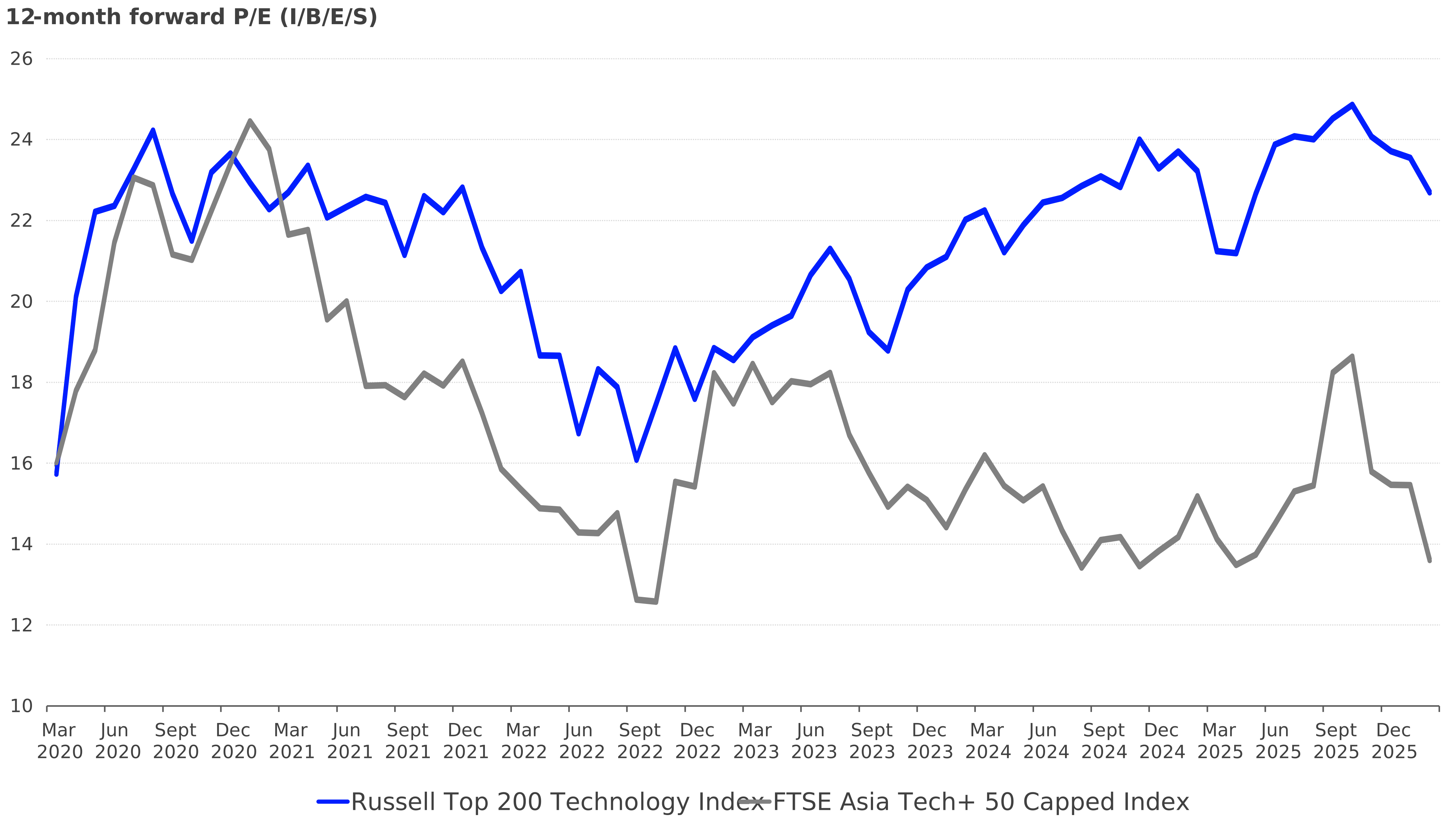
Source: FTSE Russell, as of 27 February 2026. Past performance is not a guide to future returns. Please see the end for important legal disclosures.
A lens on Asia’s digital future
Asia’s technological development is advancing at a remarkable speed. The region’s tech companies no longer play a supporting role in the global trend towards digitalisation; they’ve now advanced to become headline performers, complementing the US giants who have long dominated the stage.
For investors tracking this evolution, the FTSE Asia Tech+ Index Series offers a simple, transparent framework to observe and analyse the companies shaping Asia’s digital future. By covering multiple sectors and markets, it provides a clear view of how Asia’s tech leaders are influencing global innovation trends.
Available indices under the FTSE Asia Tech+ Index Series
| Index Name | Eligible Listing Markets of Constituents |
|---|---|
| FTSE Asia Tech+ 50 Capped Index | China, Hong Kong, Taiwan, Japan, Singapore, South Korea |
| FTSE Korea Tech+ 20 Capped Index | South Korea |
| FTSE Southbound Stock Connect Tech+ 20 Capped Index | Hong Kong (Southbound Stock Connect eligible) |
| FTSE Asia ex China ex Hong Kong Tech+ 20 Capped Index | Taiwan, Japan, Singapore, South Korea |

footnotes
[1] According to the World Bank (https://data.worldbank.org/), global internet penetration was 67.6% in 2024. | Back to Note 1
[2] ASPI’s Critical Technology Tracker: 2025 updates and 10 new technologies | The Strategist | Back to Note 2

Disclaimer
© [2026] London Stock Exchange Group plc and its applicable group undertakings (“LSEG”). LSEG includes (1) FTSE International Limited (“FTSE”), (2) Frank Russell Company (“Russell”), (3) FTSE Global Debt Capital Markets Inc. “FTSE Canada”, (4) FTSE Fixed Income LLC (“FTSE FI”), (5) FTSE (Beijing) Consulting Limited (“WOFE”), (6) FTSE EU SAS ("FES"). All rights reserved.
FTSE Russell® is a trading name of FTSE, Russell, FTSE Canada, FTSE FI, WOFE, FTSE EU and other LSEG entities providing LSEG Benchmark and Index services. “FTSE®”, “Russell®”, “FTSE Russell®”, “FTSE4Good®”, “ICB®”, “Refinitiv”, “WMR™” “FR™” and all other trademarks and service marks used herein (whether registered or unregistered) are trademarks and/or service marks owned or licensed by the applicable member of LSEG or their respective licensors.
FTSE International Limited is authorised as a Benchmark Administrator and regulated in the United Kingdom (UK) by the Financial Conduct Authority ("FCA") according to the UK Benchmark Regulation, FCA Reference Number 796803. FTSE EU SAS is authorised as Benchmark Administrator and regulated in the European Union (EU) by the Autorité des Marches Financiers (“AMF”) according to the EU Benchmark Regulation.
All information is provided for information purposes only. All information and data contained in this publication is obtained by LSEG, from sources believed by it to be accurate and reliable. Because of the possibility of human and mechanical inaccuracy as well as other factors, however, such information and data is provided "as is" without warranty of any kind. No member of LSEG nor their respective directors, officers, employees, partners or licensors make any claim, prediction, warranty or representation whatsoever, expressly or impliedly, either as to the accuracy, timeliness, completeness, merchantability of any information or LSEG Products, or of results to be obtained from the use of LSEG products, including but not limited to indices, rates, data and analytics, or the fitness or suitability of the LSEG products for any particular purpose to which they might be put. The user of the information assumes the entire risk of any use it may make or permit to be made of the information.
No responsibility or liability can be accepted by any member of LSEG nor their respective directors, officers, employees, partners or licensors for (a) any loss or damage in whole or in part caused by, resulting from, or relating to any inaccuracy (negligent or otherwise) or other circumstance involved in procuring, collecting, compiling, interpreting, analysing, editing, transcribing, transmitting, communicating or delivering any such information or data or from use of this document or links to this document or (b) any direct, indirect, special, consequential or incidental damages whatsoever, even if any member of LSEG is advised in advance of the possibility of such damages, resulting from the use of, or inability to use, such information.
No member of LSEG nor their respective directors, officers, employees, partners or licensors provide investment advice and nothing in this document should be taken as constituting financial or investment advice. No member of LSEG nor their respective directors, officers, employees, partners or licensors make any representation regarding the advisability of investing in any asset or whether such investment creates any legal or compliance risks for the investor. A decision to invest in any such asset should not be made in reliance on any information herein. Indices and rates cannot be invested in directly. Inclusion of an asset in an index or rate is not a recommendation to buy, sell or hold that asset nor confirmation that any particular investor may lawfully buy, sell or hold the asset or an index or rate containing the asset. The general information contained in this publication should not be acted upon without obtaining specific legal, tax, and investment advice from a licensed professional.
Past performance is no guarantee of future results. Charts and graphs are provided for illustrative purposes only. Index and/or rate returns shown may not represent the results of the actual trading of investable assets. Certain returns shown may reflect back-tested performance. All performance presented prior to the index or rate inception date is back-tested performance. Back-tested performance is not actual performance, but is hypothetical. The back-test calculations are based on the same methodology that was in effect when the index or rate was officially launched. However, back-tested data may reflect the application of the index or rate methodology with the benefit of hindsight, and the historic calculations of an index or rate may change from month to month based on revisions to the underlying economic data used in the calculation of the index or rate.
This document may contain forward-looking assessments. These are based upon a number of assumptions concerning future conditions that ultimately may prove to be inaccurate. Such forward-looking assessments are subject to risks and uncertainties and may be affected by various factors that may cause actual results to differ materially. No member of LSEG nor their licensors assume any duty to and do not undertake to update forward-looking assessments.
No part of this information may be reproduced, stored in a retrieval system or transmitted in any form or by any means, electronic, mechanical, photocopying, recording or otherwise, without prior written permission of the applicable member of LSEG. Use and distribution of LSEG data requires a licence from LSEG and/or its licensors.