

Maria Macarena Parot Hillmer
Geopolitical developments and enforcement actions can significantly influence sanctions exposure, financial crime risk, and compliance decision‑making. In recent years, increased attention in certain jurisdictions has been directed at allegations linking senior Venezuelan officials to illicit financial and narcotics‑related activity, often discussed under the term “Cartel de los Soles”.
For professionals working in sanctions compliance, financial crime prevention, and geopolitical risk analysis, understanding how this term is used (and the differing legal and political interpretations surrounding it) is essential when assessing risk in complex operating environments.
Is Cartel de los Soles a “cartel” in the traditional sense?
The term ‘Cartel de los Soles’ is used by certain authorities, most notably in the United States, to describe alleged networks of corruption and illicit activity involving individuals connected to military and security institutions.
It is important to note that:
- The term does not refer to a cartel in the traditional organised crime sense.
- Its use reflects allegations and designations, rather than findings adjudicated through a multilateral judicial process.
- Recognition and legal treatment of the term vary significantly by jurisdiction.
- Several Venezuelan officials who have been named in US legal actions have publicly denied these allegations.
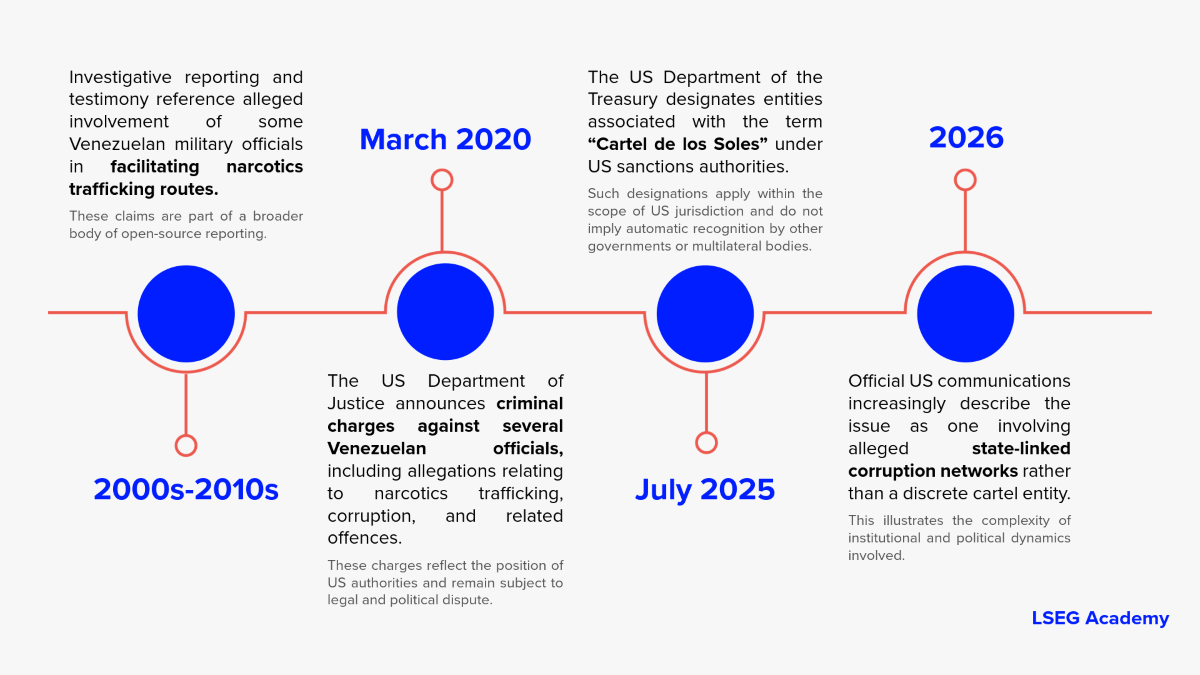
Key contextual milestones
Did you know?
The phrase “Cartel de los Soles” translates as “Cartel of the Suns” and is derived from the sun‑shaped insignia worn by senior officers in Venezuela’s National Guard. There is no single international or multilateral definition of the term, and its meaning, relevance, and legal impact depend on the jurisdiction, authority, and sanctions framework in which it is used.
Why terminology matters in risk frameworks
From a risk and compliance perspective, the relevance of the Cartel de los Soles narrative lies in how allegations, charges, and sanctions designations shape risk treatment, not in adjudicating their validity.
- The way a network is characterised (whether as organised crime, corruption‑linked activity, or terrorism‑associated financing) can directly influence sanctions screening logic because: diffuse networks present different risk‑mapping challenges than traditional criminal groups;
- exposure may arise through political connections, beneficial ownership structures, or opaque state‑linked entities rather than direct criminal affiliation.
Language plays a critical role in compliance operations. How a risk is labelled can affect:
- which sanctions regimes apply,
- how alerts are prioritised,
- escalation thresholds,
- what constitutes a red flag,
- internal compliance resourcing,
- and when enhanced due diligence is required.
For globally operating institutions:
- the distinction between allegation, charge, and designation is particularly important when navigating overlapping US, UK, EU, and UN frameworks.
- applying jurisdiction‑specific interpretation (rather than assuming universal recognition) is essential.
Practical considerations for risk and compliance teams
Professionals in the sector using screening tools such as World-Check One to monitor sanctions, PEPs, and financial‑crime, should pay particular attention to:
- exposure to politically exposed persons (PEPs);
- complex beneficial‑ownership structures involving state‑linked entities;
- cross‑border financial flows with unclear economic purpose;
- repeated indicators associated with transnational organised‑crime typologies.
These factors are especially relevant in environments where political authority, allegations of corruption, and illicit finance are reported to intersect.
Key takeaways
- “Cartel de los Soles” is a term used by certain authorities to describe alleged state‑linked corruption and illicit activity.
- It does not represent a conventional cartel structure.
- Legal recognition and sanctions treatment vary by jurisdiction.
- For compliance teams, the focus should remain on risk indicators, designation status, and applicable legal frameworks, rather than political narratives.
Learn more
Whether you work in compliance, risk analysis, intelligence, or adjacent fields, you can gain deeper insight by accessing the replay of these LSEG Academy webinars:
RECORDED WEBINAR
Mapping Transnational Crime Networks – Insights from Venezuela and Beyond
(LSEG–Fivecast Joint Intelligence Session)
This session took a closer look at transnational crime networks, using Venezuela as a case lens to explore how risk intelligence and open‑source signals are used in practice.
You can also explore a previous session that provides additional context:
Venezuela’s Changing Outlook: Assessing Sanctions, Risks, and Market Impacts
These sessions expand on the themes explored here, offering a closer look at transnational criminal ecosystems, OSINT‑driven intelligence gathering, and practical implications for compliance workflows.
Legal Disclaimer
Republication or redistribution of LSEG content is prohibited without our prior written consent.
The content of this publication is for informational purposes only and has no legal effect, does not form part of any contract, does not, and does not seek to constitute advice of any nature and no reliance should be placed upon statements contained herein. Whilst reasonable efforts have been taken to ensure that the contents of this publication are accurate and reliable, LSEG does not guarantee that this document is free from errors or omissions; therefore, you may not rely upon the content of this document under any circumstances and you should seek your own independent legal, investment, tax and other advice. Neither We nor our affiliates shall be liable for any errors, inaccuracies or delays in the publication or any other content, or for any actions taken by you in reliance thereon.
Copyright © 2025 London Stock Exchange Group. All rights reserved.
The content of this publication is provided by London Stock Exchange Group plc, its applicable group undertakings and/or its affiliates or licensors (the “LSE Group” or “We”) exclusively.
Neither We nor our affiliates guarantee the accuracy of or endorse the views or opinions given by any third party content provider, advertiser, sponsor or other user. We may link to, reference, or promote websites, applications and/or services from third parties. You agree that We are not responsible for, and do not control such non-LSE Group websites, applications or services.
The content of this publication is for informational purposes only. All information and data contained in this publication is obtained by LSE Group from sources believed by it to be accurate and reliable. Because of the possibility of human and mechanical error as well as other factors, however, such information and data are provided "as is" without warranty of any kind. You understand and agree that this publication does not, and does not seek to, constitute advice of any nature. You may not rely upon the content of this document under any circumstances and should seek your own independent legal, tax or investment advice or opinion regarding the suitability, value or profitability of any particular security, portfolio or investment strategy. Neither We nor our affiliates shall be liable for any errors, inaccuracies or delays in the publication or any other content, or for any actions taken by you in reliance thereon. You expressly agree that your use of the publication and its content is at your sole risk.
To the fullest extent permitted by applicable law, LSE Group, expressly disclaims any representation or warranties, express or implied, including, without limitation, any representations or warranties of performance, merchantability, fitness for a particular purpose, accuracy, completeness, reliability and non-infringement. LSE Group, its subsidiaries, its affiliates and their respective shareholders, directors, officers employees, agents, advertisers, content providers and licensors (collectively referred to as the “LSE Group Parties”) disclaim all responsibility for any loss, liability or damage of any kind resulting from or related to access, use or the unavailability of the publication (or any part of it); and none of the LSE Group Parties will be liable (jointly or severally) to you for any direct, indirect, consequential, special, incidental, punitive or exemplary damages, howsoever arising, even if any member of the LSE Group Parties are advised in advance of the possibility of such damages or could have foreseen any such damages arising or resulting from the use of, or inability to use, the information contained in the publication. For the avoidance of doubt, the LSE Group Parties shall have no liability for any losses, claims, demands, actions, proceedings, damages, costs or expenses arising out of, or in any way connected with, the information contained in this document.
LSE Group is the owner of various intellectual property rights ("IPR”), including but not limited to, numerous trademarks that are used to identify, advertise, and promote LSE Group products, services and activities. Nothing contained herein should be construed as granting any licence or right to use any of the trademarks or any other LSE Group IPR for any purpose whatsoever without the written permission or applicable licence terms.
