

Julien Moussavi

Astrid Sofia Flores Moya
Why investors need a holistic assessment of sovereign climate risk
Climate change is a material consideration for sovereign debt investors, yet fixed income markets have historically lagged other asset classes in the integration of environmental, social and governance (ESG) and climate data. Investors have had a limited range of tools to assess how transition and physical risks may affect long-term creditworthiness and portfolio outcomes.
However, demand for clearer insight is growing. As highlighted in our London Stock Exchange Group (LSEG) colleagues’ COP30 Net Zero Atlas, countries are following divergent climate pathways, with some exposed to rising heat and flood risk while others face transition pressures driven by carbon-intensive economic structures. Over time, these dynamics can influence fiscal stability and sovereign creditworthiness.
As a result, investors are seeking frameworks that assess climate risk in a holistic and comparable way, enabling climate considerations to become part of the core government bond allocation process.
Building a rigorous framework for sovereign climate risk assessment
The FTSE Climate Risk-Adjusted Government Bond Index Series is designed to address sovereign climate considerations. The index methodology combines historical and forward-looking indicators across three pillars: transition risk, physical risk and resilience (see Figure 1). The series measures the performance of fixed-rate, local currency, investment-grade sovereign bonds, adjusting country weights according to relative climate risk.
Figure 1. An overview of FTSE’s Climate Risk Assessment Methodology
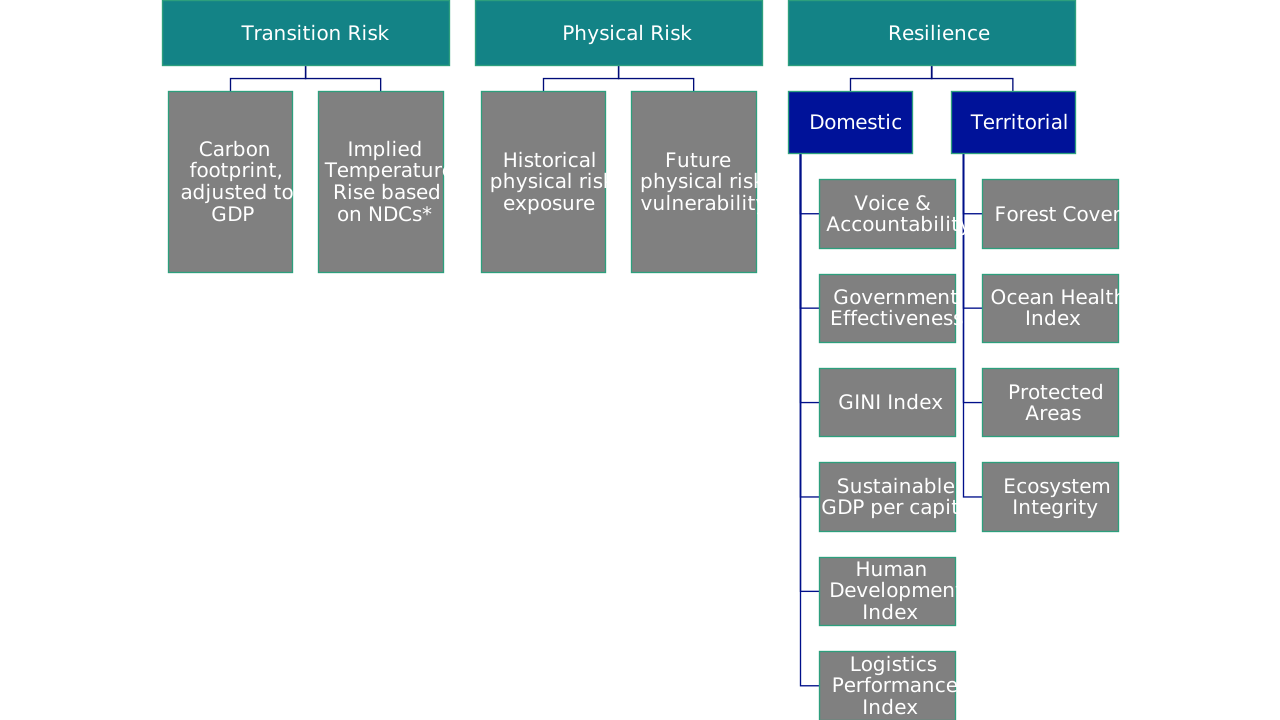
Notes. NDCs: Nationally Determined Contributions. For more information on the indicators, including their descriptions and sources, please refer to the FTSE Climate Risk Assessment Methodology.
The assessments shown in Figure 1 utilise LSEG’s Sovereign Sustainability Solutions, a data and analytics tool helping investors integrate ESG and climate factors into sovereign debt analysis, with high historical and country coverage.
The design approach of the FTSE Climate Risk-Adjusted Government Bond Index Series aims to lower portfolio exposure to greenhouse gas emissions, implied temperature rise and physical climate risk while maintaining replicability and managing tracking error and turnover.
The index methodology is also configurable, allowing for customised versions aligned to specific investment objectives. A methodology enhancement introduced in 2023 further strengthened alignment with market expectations and financial materiality.
The series draws on widely used and well-established sovereign fixed income benchmarks, such as the FTSE World Government Bond Index (WGBI) and the FTSE EMU Government Bond Index (EGBI). The FTSE WGBI marks its fortieth anniversary in January 2026, underscoring the depth and stability of the platform supporting the climate index frameworks.
Demonstrated outcomes: Index characteristics and performance
To illustrate how the FTSE Climate Risk-Adjusted Government Bond Index Series translates its objectives into measurable outcomes, below we present past performance and risk data from the index range, showing how the index methodology affects country weightings and delivers improvements in climate performance.
The Climate Risk-Adjusted Index Series consists of two sub-indices, the Climate Risk-Adjusted Index and the Advanced Climate Risk-Adjusted Index. The latter delivers a greater sustainability uplift than the classic version, driven by stronger tilts across the three climate pillars.
In Figure 2 and Figure 3, we compare the parent index of global government bonds (the FTSE WGBI) with its climate-adjusted counterparts, the FTSE Climate Risk-Adjusted World Government Bond Index and the FTSE Advanced Climate Risk-Adjusted World Government Bond Index (FTSE Climate WGBI and FTSE Advanced Climate WGBI, respectively).
In Figure 4 and Figure 5, we also review the parent index consisting of eurozone sovereign debt issuers (the FTSE EGBI) alongside the FTSE Climate Risk-Adjusted EMU Government Bond Index (Climate EGBI) and the FTSE Advanced Climate Risk-Adjusted EMU Government Bond Index (Advanced Climate EGBI).
Together, Figures 2-5 show that the World and EMU climate-adjusted variants have tracked the performance and characteristics of their market value-weighted parent index closely, while effectively integrating climate risk factors.
Figure 2. Historical performance of WGBI, Climate WGBI and Advanced Climate WGBI
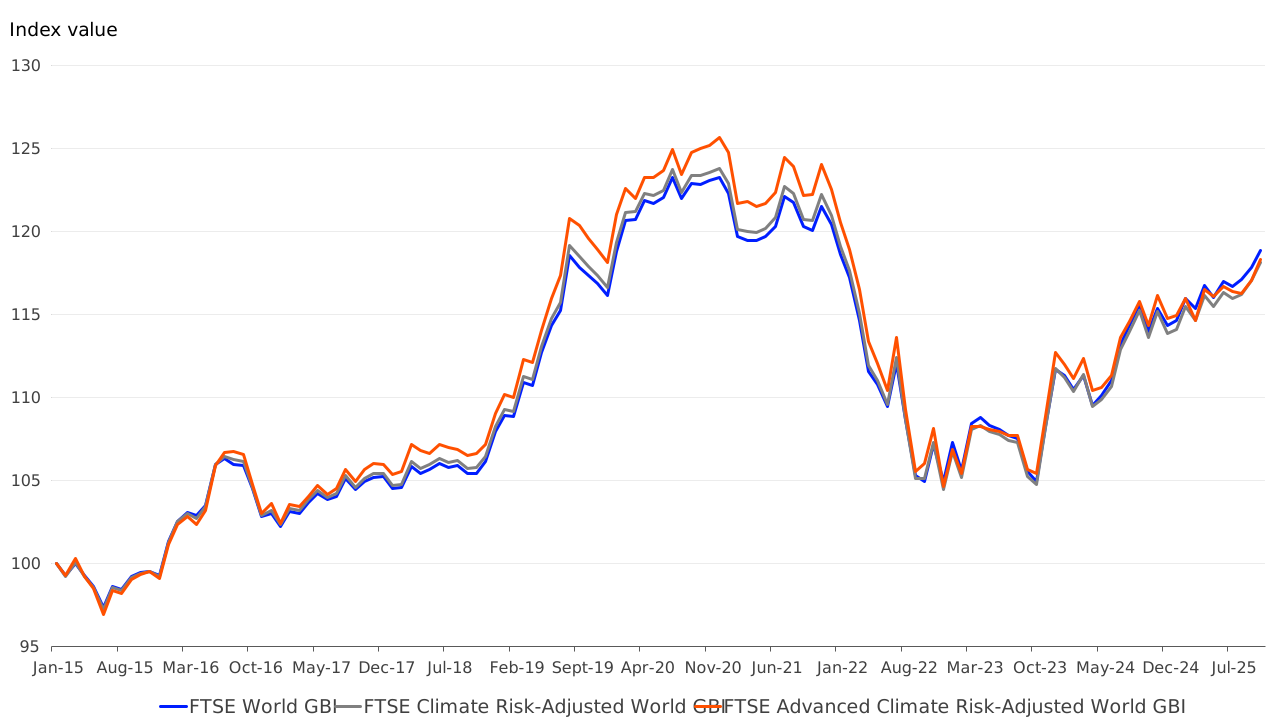
Source: FTSE Russell, 1 January 2015-1 October 2025. USD-hedged index returns. Past performance is not a guide to future returns.
Figure 3. Risk and return statistics of WGBI, Climate WGBI and Advanced Climate WGBI
WGBI |
CLMWGBI |
ACLMWGBI |
|
|---|---|---|---|
Annualised Return |
1.62% |
1.56% |
1.58% |
1Y Return |
4.32% |
3.98% |
3.50% |
YtD Return |
3.72% |
3.55% |
2.93% |
Annualised Volatility |
4.15% |
4.32% |
4.60% |
Risk-Adjusted Return |
39.10% |
36.21% |
34.28% |
Annualised Tracking Error |
0.35% |
0.96% |
|
Return Correlation |
100% |
98% |
|
Current Yield |
2.84% |
2.79% |
2.58% |
Yield to Maturity |
3.20% |
3.35% |
3.19% |
Effective Duration |
6.83 |
7.02 |
7.42 |
Number of Bonds |
1331 |
1331 |
1331 |
Source: FTSE Russell, 1 January 2025 - 1 October 2025. USD-hedged index returns. Past performance is not a guide to future returns.
Figure 4. Historical performance of FTSE EGBI, Climate EGBI and Advanced Climate EGBI
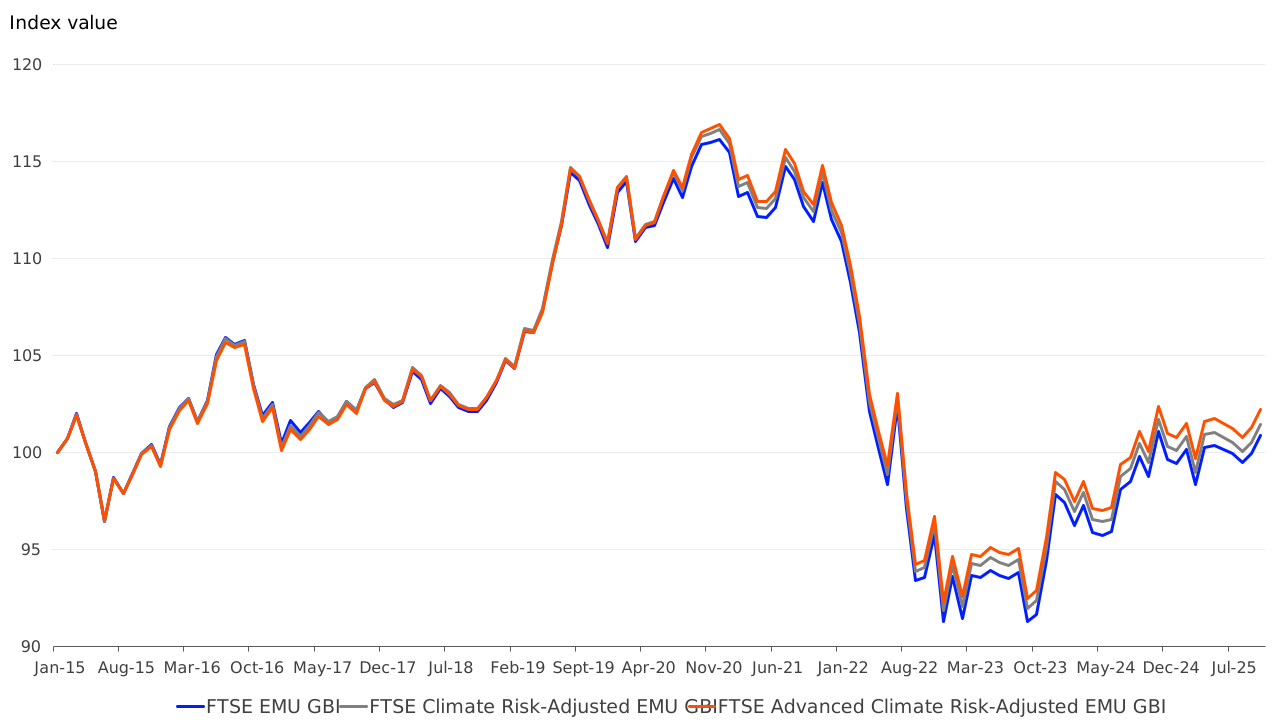
Source: FTSE Russell, 1 January 2015-1 October 2025. Past performance is not a guide to future returns. Please see the end for important legal disclosures.
Figure 5. Risk and return statistics of FTSE EGBI, Climate EGBI and Advanced Climate EGBI
Performance Metrics |
EGBI |
CLMEGBI |
ACLMEGBI |
|---|---|---|---|
Annualised Return |
0.08% |
0.13% |
0.20% |
1Y Return |
2.10% |
1.98% |
2.12% |
YtD Return |
1.42% |
1.34% |
1.40% |
Annualised Volatility |
5.45% |
5.43% |
5.39% |
Risk-Adjusted Return |
1.43% |
2.42% |
3.74% |
Annualised Tracking Error |
0.13% |
0.24% |
|
Return Correlation |
100% |
100% |
|
Current Yield |
2.38% |
2.34% |
2.35% |
Yield to Maturity |
2.84% |
2.85% |
2.86% |
Effective Duration |
7.10 |
7.10 |
7.09 |
Number of Bonds |
411 |
411 |
411 |
Source: FTSE Russell, 1 January 2015-1 October 2025. Past performance is not a guide to future returns.
In Figure 6, we compare country weights in the parent EGBI with those in its two climate-adjusted variants. The results illustrate how the tilting methodology reallocates capital according to issuers’ climate risk profiles.
In the Climate EGBI, Italy receives a reduction of 4.7% in its country weight relative to the parent index, while France’s country weight increases by 5.9%. This result is driven by Italy’s expected high vulnerability to physical risks (by 2050) and its poor government effectiveness scores. France, by contrast, is the country with the second-lowest physical risk.
The Advanced Climate EGBI shows a more pronounced adjustment, with the weightings of Germany and Italy each reduced by 5% (relative to the parent index), reflecting their high exposure to physical risks, in addition to their low ecosystem integrity scores. The country weights of Spain and France each increased by 5%: these are the two countries least exposed to transition risks, given their relatively low carbon footprint and Paris-aligned implied temperature rise (ITR) [note1], measured based on their nationally determined contributions (NDCs).
Figure 6. Country weights of FTSE EGBI, Climate EGBI and Advanced Climate EGBI
Difference, Climate EGBI vs. EGBI |
Difference, Advanced Climate EGBI vs. EGBI |
|
|---|---|---|
Austria |
0.66 |
3.24 |
Belgium |
-1.50 |
-2.43 |
Germany |
-1.15 |
-5.00 |
Spain |
1.98 |
5.00 |
Finland |
0.44 |
1.85 |
France |
5.90 |
5.00 |
Ireland |
-0.14 |
0.11 |
Italy |
-4.68 |
-5.00 |
Netherlands |
-1.40 |
-3.02 |
Portugal |
-0.11 |
0.24 |
Source: FTSE Russell, as of 1 October 2025. Past performance is not a guide to future returns. Please see the end for important legal disclosures.
Finally, we examine climate metrics for the world government bond segment to assess the impact of applying the index methodology, as shown in Figure 7.
Both the Climate WGBI and Advanced Climate WGBI delivered meaningful improvements in their emissions profiles and implied temperature rise metrics, as well as in their Physical, Transition and Resilience scores, when compared with the conventional market value-weighted index. This is especially true for the Advanced Climate WGBI, which aligns with a temperature pathway below 2°C (vs 2.26°C for the WGBI) and proposes a 20% reduction in consumed GHG emissions by comparison with the parent index.
Figure 7. Climate metrics for FTSE WGBI, Climate WGBI and Advanced Climate WGBI
WGBI |
CLMTWGBI |
ACLMTWGBI |
|
|---|---|---|---|
Implied Temperature Rise (Degrees Celsius) |
2.26 |
2.15 |
1.97 |
Consumed GHG Emissions per Capita (Including LULUCF) - tCO2e per Capita |
13.19 |
12.91 |
10.54 |
Transition Risk Score |
0.40 |
0.48 |
0.65 |
Physical Risk Score |
0.58 |
0.63 |
0.67 |
Resilience Score |
0.69 |
0.75 |
0.75 |
Conclusion
The FTSE Climate Risk-Adjusted Government Bond Index Series demonstrates how rigorous climate analysis can be integrated into sovereign fixed income index design, combining a balanced risk-return profile with effective climate risk management. To learn more about the methodology or explore customised applications, please contact our sustainable investment team.
Sources
[1] Implied Temperature Rise assesses countries’ implied temperatures in 2100, based on their national commitments to climate change mitigation, in line with their Nationally Determined Contributions (NDCs) submitted to the UNFCCC in the framework of the Paris Agreement. | Back to Note 1

Disclaimer
© 2025 London Stock Exchange Group plc and its applicable group undertakings (“LSEG”). LSEG includes (1) FTSE International Limited (“FTSE”), (2) Frank Russell Company (“Russell”), (3) FTSE Global Debt Capital Markets Inc. and FTSE Global Debt Capital Markets Limited (together, “FTSE Canada”), (4) FTSE Fixed Income Europe Limited (“FTSE FI Europe”), (5) FTSE Fixed Income LLC (“FTSE FI”), (6) FTSE (Beijing) Consulting Limited (“WOFE”) (7) Refinitiv Benchmark Services (UK) Limited (“RBSL”), (8) Refinitiv Limited (“RL”) and (9) Beyond Ratings S.A.S. (“BR”). All rights reserved.
FTSE Russell® is a trading name of FTSE, Russell, FTSE Canada, FTSE FI, FTSE FI Europe, WOFE, RBSL, RL, and BR. “FTSE®”, “Russell®”, “FTSE Russell®”, “FTSE4Good®”, “ICB®”, “Refinitiv” , “Beyond Ratings®”, “WMR™” , “FR™” and all other trademarks and service marks used herein (whether registered or unregistered) are trademarks and/or service marks owned or licensed by the applicable member of LSEG or their respective licensors and are owned, or used under licence, by FTSE, Russell, FTSE Canada, FTSE FI, FTSE FI Europe, WOFE, RBSL, RL or BR. FTSE International Limited is authorised and regulated by the Financial Conduct Authority as a benchmark administrator. Refinitiv Benchmark Services (UK) Limited is authorised and regulated by the Financial Conduct Authority as a benchmark administrator.
All information is provided for information purposes only. All information and data contained in this publication is obtained by LSEG, from sources believed by it to be accurate and reliable. Because of the possibility of human and mechanical inaccuracy as well as other factors, however, such information and data is provided "as is" without warranty of any kind. No member of LSEG nor their respective directors, officers, employees, partners or licensors make any claim, prediction, warranty or representation whatsoever, expressly or impliedly, either as to the accuracy, timeliness, completeness, merchantability of any information or LSEG Products, or of results to be obtained from the use of LSEG products, including but not limited to indices, rates, data and analytics, or the fitness or suitability of the LSEG products for any particular purpose to which they might be put. The user of the information assumes the entire risk of any use it may make or permit to be made of the information.
No responsibility or liability can be accepted by any member of LSEG nor their respective directors, officers, employees, partners or licensors for (a) any loss or damage in whole or in part caused by, resulting from, or relating to any inaccuracy (negligent or otherwise) or other circumstance involved in procuring, collecting, compiling, interpreting, analysing, editing, transcribing, transmitting, communicating or delivering any such information or data or from use of this document or links to this document or (b) any direct, indirect, special, consequential or incidental damages whatsoever, even if any member of LSEG is advised in advance of the possibility of such damages, resulting from the use of, or inability to use, such information.
No member of LSEG nor their respective directors, officers, employees, partners or licensors provide investment advice and nothing in this document should be taken as constituting financial or investment advice. No member of LSEG nor their respective directors, officers, employees, partners or licensors make any representation regarding the advisability of investing in any asset or whether such investment creates any legal or compliance risks for the investor. A decision to invest in any such asset should not be made in reliance on any information herein. Indices and rates cannot be invested in directly. Inclusion of an asset in an index or rate is not a recommendation to buy, sell or hold that asset nor confirmation that any particular investor may lawfully buy, sell or hold the asset or an index or rate containing the asset. The general information contained in this publication should not be acted upon without obtaining specific legal, tax, and investment advice from a licensed professional.
Past performance is no guarantee of future results. Charts and graphs are provided for illustrative purposes only. Index and/or rate returns shown may not represent the results of the actual trading of investable assets. Certain returns shown may reflect back-tested performance. All performance presented prior to the index or rate inception date is back-tested performance. Back-tested performance is not actual performance, but is hypothetical. The back-test calculations are based on the same methodology that was in effect when the index or rate was officially launched. However, back-tested data may reflect the application of the index or rate methodology with the benefit of hindsight, and the historic calculations of an index or rate may change from month to month based on revisions to the underlying economic data used in the calculation of the index or rate.
This document may contain forward-looking assessments. These are based upon a number of assumptions concerning future conditions that ultimately may prove to be inaccurate. Such forward-looking assessments are subject to risks and uncertainties and may be affected by various factors that may cause actual results to differ materially. No member of LSEG nor their licensors assume any duty to and do not undertake to update forward-looking assessments.
No part of this information may be reproduced, stored in a retrieval system or transmitted in any form or by any means, electronic, mechanical, photocopying, recording or otherwise, without prior written permission of the applicable member of LSEG. Use and distribution of LSEG data requires a licence from LSEG and/or its licensors.