Vishal Relhan
- Financial institutions in EMEA face a "perfect storm" of rising financial crime, stricter regulations and resource constraints – making efficient risk screening more critical than ever
- Our latest report reveals that 98% of leaders value real-time data, but delays and manual reviews still hold back progress
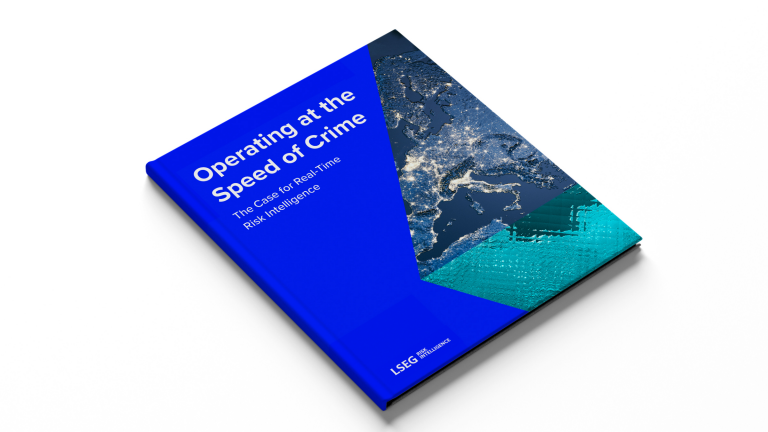
Our latest risk intelligence report for EMEA, based on a global research survey, takes a detailed look at the on-the-ground challenges facing financial institutions in the region and unpacks the perceived high value of trusted real-time data.
The insights from 400 risk and compliance leaders in France, Germany, Italy, Denmark, Norway, Sweden, Spain, Switzerland, UAE and UK reveal persistent delays and inefficiencies in screening processes – and finds that half (50%) of all respondents in the region believe access to real-time data can help them manage fast-moving risk more effectively.
Our report calls out a "perfect storm" of rising financial crime, ever-stricter regulatory requirements and limited resources and delves into most persistent challenges that financial institutions face today – as well as the key elements that can help to solve these challenges going forward.
Key findings in EMEA
- 81% across EMEA experience screening-related delays "at least occasionally".
- A substantial 98% of respondents in the region say access to real-time sanctions and risk data is important to their compliance workflows, but barriers to adoption remain, with 43% saying that manual review is required regardless of data speed.
- Institutions across the region value the potential of AI and automation, and are the most explicit about ensuring that AI does not replace humans.
What challenges persist today?
Our report reveals widespread delays in screening, with 81% of respondents saying they experience screening-related delays "at least occasionally". Stark regional differences are apparent, however, with this percentage rising to 88% in Switzerland and falling to 66% in the UK.
The most commonly reported challenges when screening for sanctions, PEPs and adverse media screening in EMEA are manual review and remediation workload (78%), integration issues with existing systems (76%) and high false positives (74%).
The same challenges top the list of global responses, but the order differs. Again, regional variations are apparent: manual review is more widely reported in Italy (88%), integration issues are highlighted most in Switzerland (88%), and high levels of false positives are reported by the most respondents in UAE (98%).
When asked how confident they are in the accuracy and completeness of their current sanctions and risk screening data, 45% in EMEA report that they are "very confident". This compares to 44% in APAC and 53% in North America.
Is real-time data valued?
A substantial 98% of EMEA respondents consider real-time data important to their compliance workflows.
Across all markets surveyed, real-time data access also emerges as the most important factor when considering a customer screening tool – and this sentiment is reflected in EMEA.
Looking at the many benefits of data being available in real time, EMEA respondents note that it helps them to manage fast-moving risk more effectively (50%), avoid using outdated data (49%) and monitor risk continuously (48%).
Despite the value that respondents place on access to real-time data, there are widespread hurdles to adoption – the top barriers reported in the region are that manual review is required regardless of data speed (43%), and budget or resource constraints (41%).
AI has a role to play, but so do humans
Alongside the essential role of real-time data, financial institutions in EMEA also value automation and AI integration. 21% of respondents say that automation and AI integration could improve the effectiveness of their risk screening processes.
Importantly, a key insight evident across all regions surveyed is that respondents believe AI should enhance, not replace human judgement. This sentiment is even more pronounced in EMEA than in other regions surveyed.
Our report concludes that selecting the right risk intelligence partner is key – and that in order to ensure efficacy in fighting financial crime, such a partner should bring accurate, real-time data, advanced technology, and trusted human expertise to the table.

Legal Disclaimer
Republication or redistribution of LSEG content is prohibited without our prior written consent.
The content of this publication is for informational purposes only and has no legal effect, does not form part of any contract, does not, and does not seek to constitute advice of any nature and no reliance should be placed upon statements contained herein. Whilst reasonable efforts have been taken to ensure that the contents of this publication are accurate and reliable, LSEG does not guarantee that this document is free from errors or omissions; therefore, you may not rely upon the content of this document under any circumstances and you should seek your own independent legal, investment, tax and other advice. Neither We nor our affiliates shall be liable for any errors, inaccuracies or delays in the publication or any other content, or for any actions taken by you in reliance thereon.
Copyright © 2025 London Stock Exchange Group. All rights reserved.
The content of this publication is provided by London Stock Exchange Group plc, its applicable group undertakings and/or its affiliates or licensors (the “LSE Group” or “We”) exclusively.
Neither We nor our affiliates guarantee the accuracy of or endorse the views or opinions given by any third party content provider, advertiser, sponsor or other user. We may link to, reference, or promote websites, applications and/or services from third parties. You agree that We are not responsible for, and do not control such non-LSE Group websites, applications or services.
The content of this publication is for informational purposes only. All information and data contained in this publication is obtained by LSE Group from sources believed by it to be accurate and reliable. Because of the possibility of human and mechanical error as well as other factors, however, such information and data are provided "as is" without warranty of any kind. You understand and agree that this publication does not, and does not seek to, constitute advice of any nature. You may not rely upon the content of this document under any circumstances and should seek your own independent legal, tax or investment advice or opinion regarding the suitability, value or profitability of any particular security, portfolio or investment strategy. Neither We nor our affiliates shall be liable for any errors, inaccuracies or delays in the publication or any other content, or for any actions taken by you in reliance thereon. You expressly agree that your use of the publication and its content is at your sole risk.
To the fullest extent permitted by applicable law, LSE Group, expressly disclaims any representation or warranties, express or implied, including, without limitation, any representations or warranties of performance, merchantability, fitness for a particular purpose, accuracy, completeness, reliability and non-infringement. LSE Group, its subsidiaries, its affiliates and their respective shareholders, directors, officers employees, agents, advertisers, content providers and licensors (collectively referred to as the “LSE Group Parties”) disclaim all responsibility for any loss, liability or damage of any kind resulting from or related to access, use or the unavailability of the publication (or any part of it); and none of the LSE Group Parties will be liable (jointly or severally) to you for any direct, indirect, consequential, special, incidental, punitive or exemplary damages, howsoever arising, even if any member of the LSE Group Parties are advised in advance of the possibility of such damages or could have foreseen any such damages arising or resulting from the use of, or inability to use, the information contained in the publication. For the avoidance of doubt, the LSE Group Parties shall have no liability for any losses, claims, demands, actions, proceedings, damages, costs or expenses arising out of, or in any way connected with, the information contained in this document.
LSE Group is the owner of various intellectual property rights ("IPR”), including but not limited to, numerous trademarks that are used to identify, advertise, and promote LSE Group products, services and activities. Nothing contained herein should be construed as granting any licence or right to use any of the trademarks or any other LSE Group IPR for any purpose whatsoever without the written permission or applicable licence terms.