

Anshuman Gupta
As the low-carbon transition advances, investors are taking more sophisticated approaches to integrating climate considerations across asset classes, addressing both risks and opportunities. In this insight, we explore the forces propelling sustainable infrastructure investment and introduce the FTSE Sustainable Infrastructure Index Series.
- Broad access to the low-carbon economy - The FTSE Sustainable Infrastructure Index Series offers liquid, diversified access to listed infrastructure equities driving the global energy transition and climate adaptation.
- Three offerings - The series includes the FTSE Global Core Infrastructure TPI Climate Transition Index, the FTSE Global Core Infrastructure 50/50 Climate Transition (CTB) Index and the FTSE Green Revenues Select Infrastructure and Industrials Index.
- Noteworthy performance - The FTSE Green Revenues Select Infrastructure and Industrials Index outperformed conventional infrastructure benchmarks in the eight-year period ended September 2025.
Megatrends driving sustainable infrastructure investment
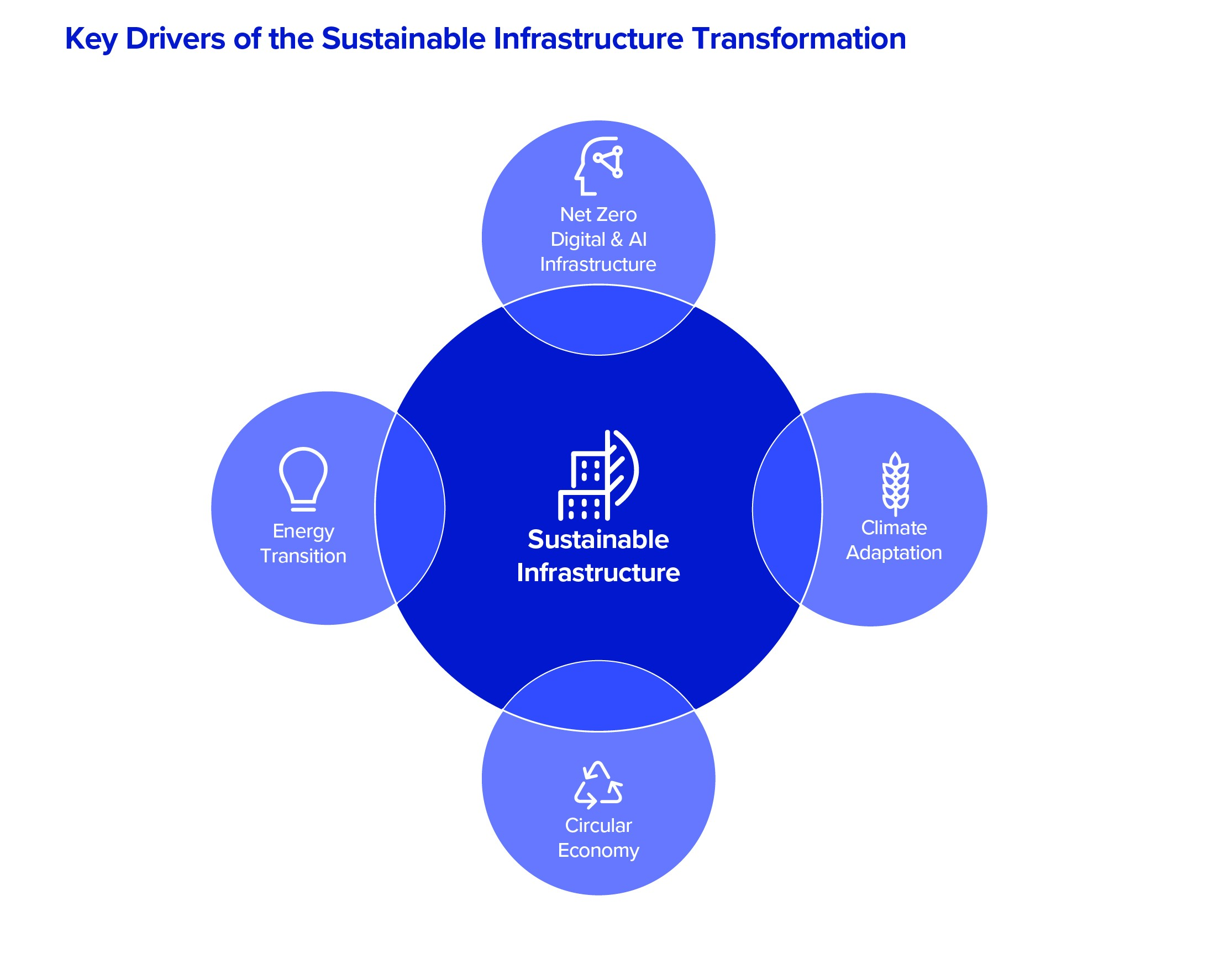
Global infrastructure capital needs and government indebtedness are intersecting with four megatrends to position sustainable infrastructure as the next major investment opportunity.
- Energy transition - The move to cleaner energy remains central to sustainable investing. Infrastructure attracts long-term capital for its resilience and its pivotal role in decarbonisation. Investment is accelerating across renewables, energy efficiency, green mobility and clean-fuel technologies, such as hydrogen and carbon capture. These areas not only advance global net-zero goals but also offer compelling growth potential as policy support and corporate action intensify.
- Digital and AI infrastructure -The surge in data demand is driving a boom in digital and AI infrastructure. Hyperscalers are expanding energy-efficient, renewably powered data centres—illustrating how digitalisation and decarbonisation now advance together. This convergence positions infrastructure at the crossroads of technological innovation and sustainability.
- Physical risk and climate adaptation - Climate change is exposing the fragility of existing systems. From floods to heatwaves, the economic and social costs of disruption continue to rise. In 2024, natural disasters caused $368 billion in losses, yet only 40% of the damages were insured.[Note1] As both a major emitter and a frontline defence against climate impacts, infrastructure faces a dual challenge: cutting emissions while building resilience.
- Circular economy and resource efficiency - The circular economy is emerging as a key lever for cutting waste and emissions. Solutions in water, waste and materials recovery can significantly cut carbon output while conserving scarce resources. Regulatory momentum—especially in Europe—is channelling capital toward innovations in recycling, biofuels and landfill diversion. For investors, the opportunity lies in companies that combine environmental benefit with durable growth potential.
Structural and financial forces underpin sustainable infrastructure investment case
Structural and financial drivers further strengthen the case for sustainable infrastructure. According to OECD, World Bank and UN Environment analysis, an estimated annual infrastructure investment of $6.9 trillion will be needed by 2030 to ensure compatibility with the Sustainable Development Goals and the Paris Agreement.[Note2] By one estimate, global demand for infrastructure investment will total $68 trillion between now and 2040.[Note3]
Investor appetite has grown in parallel, with assets under management in infrastructure funds nearly tripling over the past decade,[Note4] underscoring confidence in the asset class’s long-term resilience. Expanded policy support—through measures such as the EU Renewable Energy Directive and Japan’s GX Decarbonization Power Supply Bill—is accelerating capital flows to clean energy and low-carbon technologies.
The dual opportunity: Building and upgrading for a sustainable future
Sustainable infrastructure offers a dual investment opportunity:
- Building for transition - Investment is accelerating across renewables, energy-efficient buildings, clean fuels and circular-economy solutions, such as advanced waste and water systems. These sectors are essential to decarbonisation and net-zero goals while offering scalable growth across developed and emerging markets. Global renewable power capacity, for example, is expected to double between now and 2030, increasing by 4,600 gigawatts. This is roughly the equivalent of adding China, the European Union and Japan’s power generation capacity combined to the global energy mix.[Note5]
- Upgrading for adaptation – All markets are focused on modernising transport networks, utilities, smart grids and urban systems to strengthen resilience and efficiency. Measures such as green spaces and floodplain management protect assets and maintain essential services amid rising climate risks. 34% of the companies in the FTSE All World Index (covering over 4,000 large- and medium-sized publicly listed companies across advanced and emerging economies) now reference adaptation activities in response to physical climate risks in their corporate disclosures.[Note6]
Combined, these pathways offer a long-term growth opportunity aligned with sustainability goals.
Overview of the FTSE Sustainable Infrastructure index series
The FTSE Sustainable Infrastructure Index Series provides investors with transparent access to listed infrastructure equities that are driving the global energy transition and climate adaptation. Designed for those seeking stable, inflation-linked returns alongside credible sustainability objectives, the series captures companies leading the low-carbon transition.
The series includes:
- FTSE Global Core Infrastructure TPI Climate Transition index – Integrates the Transition Pathway Initiative (TPI) framework to align with corporate progress on decarbonisation.
- FTSE Global Core Infrastructure 50/50 Climate Transition (CTB) Index – aligns with the minimum requirements of the EU Climate Transition Benchmark (CTB).
- FTSE Green Revenues Select Infrastructure and Industrials Index – emphasises companies generating substantial revenue from solutions that enhance energy efficiency, cut emissions and pollution, and optimise land and resources.
Performance highlights
The FTSE Green Revenues Select Infrastructure and Industrials Index outperformed conventional infrastructure benchmarks in the eight-year period ended September 2025 (this includes a period of back-tested index data prior to the index launch in 2022).
Meanwhile, the FTSE Global Core Infrastructure TPI Climate Transition Index (launched in 2022) and the 50/50 CTB Index (launched in 2024) tracked their reference benchmarks closely, with modest variation due largely to geographic and sector weights. They provide broader infrastructure exposure with low tracking error.
ftse sustainable infrastructure indices - performance
As capital increasingly flows toward sustainable, resilient infrastructure, transparent benchmarks help investors measure progress, manage risk and seize opportunities across the low-carbon economy. The FTSE Sustainable Infrastructure Index Series offers a diversified framework to align portfolios with the long-term growth and resilience driving this transition.

Sources
[1] World Economic Forum: Why we must invest in sustainable infrastructure | World Economic Forum | Back to Note 1
[2] Massive investment is needed in sustainable infrastructure to build climate change resilience | OECD | Back to Note 2
[3] All roads lead to infrastructure | BlackRock | Back to Note 3
[4]All roads lead to infrastructure | BlackRock | Back to Note 4
[5] IEA Renewables 2025 Report: Renewables 2025 | Back to Note 5
[6] LSEG Green Economy Report: LSEG Green Economy Report - Investing in the green economy 2025 | Back to Note 6

Disclaimer
© 2025 London Stock Exchange Group plc and its applicable group undertakings (“LSEG”). LSEG includes (1) FTSE International Limited (“FTSE”), (2) Frank Russell Company (“Russell”), (3) FTSE Global Debt Capital Markets Inc. and FTSE Global Debt Capital Markets Limited (together, “FTSE Canada”), (4) FTSE Fixed Income Europe Limited (“FTSE FI Europe”), (5) FTSE Fixed Income LLC (“FTSE FI”), (6) FTSE (Beijing) Consulting Limited (“WOFE”) (7) Refinitiv Benchmark Services (UK) Limited (“RBSL”), (8) Refinitiv Limited (“RL”) and (9) Beyond Ratings S.A.S. (“BR”). All rights reserved.
FTSE Russell® is a trading name of FTSE, Russell, FTSE Canada, FTSE FI, FTSE FI Europe, WOFE, RBSL, RL, and BR. “FTSE®”, “Russell®”, “FTSE Russell®”, “FTSE4Good®”, “ICB®”, “Refinitiv” , “Beyond Ratings®”, “WMR™” , “FR™” and all other trademarks and service marks used herein (whether registered or unregistered) are trademarks and/or service marks owned or licensed by the applicable member of LSEG or their respective licensors and are owned, or used under licence, by FTSE, Russell, FTSE Canada, FTSE FI, FTSE FI Europe, WOFE, RBSL, RL or BR. FTSE International Limited is authorised and regulated by the Financial Conduct Authority as a benchmark administrator. Refinitiv Benchmark Services (UK) Limited is authorised and regulated by the Financial Conduct Authority as a benchmark administrator.
All information is provided for information purposes only. All information and data contained in this publication is obtained by LSEG, from sources believed by it to be accurate and reliable. Because of the possibility of human and mechanical inaccuracy as well as other factors, however, such information and data is provided "as is" without warranty of any kind. No member of LSEG nor their respective directors, officers, employees, partners or licensors make any claim, prediction, warranty or representation whatsoever, expressly or impliedly, either as to the accuracy, timeliness, completeness, merchantability of any information or LSEG Products, or of results to be obtained from the use of LSEG products, including but not limited to indices, rates, data and analytics, or the fitness or suitability of the LSEG products for any particular purpose to which they might be put. The user of the information assumes the entire risk of any use it may make or permit to be made of the information.
No responsibility or liability can be accepted by any member of LSEG nor their respective directors, officers, employees, partners or licensors for (a) any loss or damage in whole or in part caused by, resulting from, or relating to any inaccuracy (negligent or otherwise) or other circumstance involved in procuring, collecting, compiling, interpreting, analysing, editing, transcribing, transmitting, communicating or delivering any such information or data or from use of this document or links to this document or (b) any direct, indirect, special, consequential or incidental damages whatsoever, even if any member of LSEG is advised in advance of the possibility of such damages, resulting from the use of, or inability to use, such information.
No member of LSEG nor their respective directors, officers, employees, partners or licensors provide investment advice and nothing in this document should be taken as constituting financial or investment advice. No member of LSEG nor their respective directors, officers, employees, partners or licensors make any representation regarding the advisability of investing in any asset or whether such investment creates any legal or compliance risks for the investor. A decision to invest in any such asset should not be made in reliance on any information herein. Indices and rates cannot be invested in directly. Inclusion of an asset in an index or rate is not a recommendation to buy, sell or hold that asset nor confirmation that any particular investor may lawfully buy, sell or hold the asset or an index or rate containing the asset. The general information contained in this publication should not be acted upon without obtaining specific legal, tax, and investment advice from a licensed professional.
Past performance is no guarantee of future results. Charts and graphs are provided for illustrative purposes only. Index and/or rate returns shown may not represent the results of the actual trading of investable assets. Certain returns shown may reflect back-tested performance. All performance presented prior to the index or rate inception date is back-tested performance. Back-tested performance is not actual performance, but is hypothetical. The back-test calculations are based on the same methodology that was in effect when the index or rate was officially launched. However, back-tested data may reflect the application of the index or rate methodology with the benefit of hindsight, and the historic calculations of an index or rate may change from month to month based on revisions to the underlying economic data used in the calculation of the index or rate.
This document may contain forward-looking assessments. These are based upon a number of assumptions concerning future conditions that ultimately may prove to be inaccurate. Such forward-looking assessments are subject to risks and uncertainties and may be affected by various factors that may cause actual results to differ materially. No member of LSEG nor their licensors assume any duty to and do not undertake to update forward-looking assessments.
No part of this information may be reproduced, stored in a retrieval system or transmitted in any form or by any means, electronic, mechanical, photocopying, recording or otherwise, without prior written permission of the applicable member of LSEG. Use and distribution of LSEG data requires a licence from LSEG and/or its licensors.