

David McNay, CFA

Robin Marshall, MA, M.Phil
Key takeaways
- Financing AI infrastructure is less ‘circular’ and more of a web; it involves self-reinforcing valuations, concentration risk and creates opacity.
- NVIDIA has partnered with some of the biggest names in finance to establish an AI infrastructure financing platform to raise over $500 billion of external capital. This may formalise financing structures that are already being utilised.
- However, this is not 2008: public evidence still does not show the synthetic replication or complex derivative chains that amplified the GFC, and bank lending is also relatively limited. A closer analogue maybe the Telcom buildout in the late 1990s, which led to overcapacity when demand growth wasn’t met.
- It highlights another mechanism by which AI capex represents two-way risk. New financing vehicles open up new pools of capital, whilst some of the structures reduce transparency and potentially introduce some contagion risk.
What happens after you press enter?
We saw a meme recently of things you can’t unlearn, one of which was to the effect of “remember the cloud is just someone else’s computer,” but in the world of AI who owns that computer? And who is paying for it? This is a question we’ve been asked a lot recently, and understandably given media coverage of financing structures.
Anthropic may have the most advanced frontier models[note1], but it does not own its own datacentres. Instead in 2023 Anthropic selected Google Cloud to supply GPU and TPU[note2] compute; Google later enlarged its equity stake[note3] in Anthropic, creating a financing loop where Google becomes the vendor and a shareholder.
AI demand has come a long way since 2023, as have the financing structures. In one example, Anthropic still uses Google Cloud, and has expanded[note4] their use of Google’s TPUs. However, rather than capacity sitting entirely with Google Cloud, a five-year lease was agreed with Compute SPV[note5], (special purpose vehicle). The SPV buys TPU stacks from Google/Broadcom, financed by circa. $35 billion of third-party debt led by Apollo and Blackstone; with Broadcom providing a credit enhancement[note6].
That addresses the chips but leaves the parallel problem of where they will run.[note7]
One route is to engage a company like Fluidstack – an AI infrastructure operator – who integrate TPU stacks and infrastructure into datacentres running Anthropic workloads. Fluidstack provides the expertise and operating infrastructure but requires buildings and electricity to create a functioning Neocloud. For the build out of some of the datacentres they manage, they have turned to TeraWulf, historically a bitcoin miner. However, raising capital backed by a lease from a relative newcomer is challenging – to square the circle Google provides a backstop of Fluidstack’s lease obligations[note8]; and in exchange Google received 73.58 million warrants[note9] at an exercise price of $0.01 per share.
Mapping circular finance in AI
It is important to understand that the Google-Anthropic relationship is just one example. Recently, NVIDIA announced[note10] memorandums of understanding with Apollo, BlackRock, Blackstone, Brookfield, Goldman Sachs and KKR to establish an independent compute financing platforms aiming at mobilising over $500 billion of third-party capital. Details are scarce, but this move may help standardise the types of financing structures that have already been emerging.
In an attempt to visualise the circular financing web, we[note11] mapped news reports with references to financing or long-term contracts against company press releases. From there we constructed a directed network graph, where each edge is a financing leg, and each node is a company.
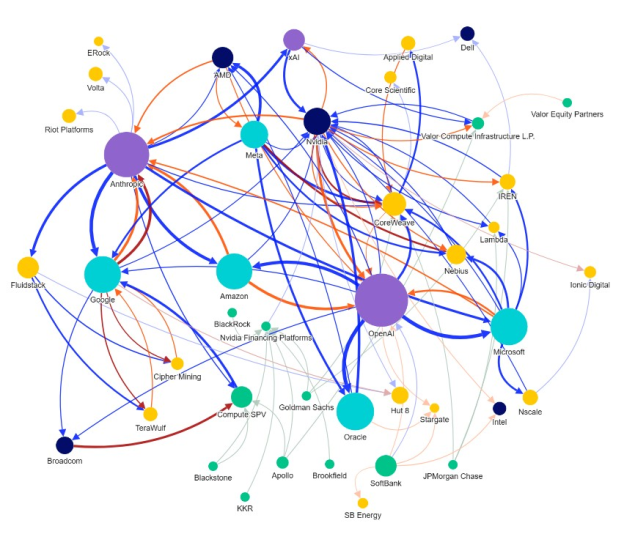
Figure 1: Subset of the AI financing map. Each arrow represents a source of financing, a backstop or a contractual revenue stream. The map is not comprehensive and shows only a subset of important connections. Since the data cut-off, the Anthropic–Broadcom relationship has become more explicit. Source: FTSE Russell data as at 18 August 2026. Past performance is not a guide to future returns. Please see the end for important legal disclosures.
Why this is not 2008
Critics argue this looks like the precursor to the Great Financial Crisis (GFC), but the analogy should not be over-worked, particularly on systemic risk. A lesson from the GFC is that securitisation can be problematic, if there are multiple claims on the same underlying collateral. Thus, a feature which amplified losses was the creation of synthetic CDOs[note12], which allowed the same underlying collateral to be referenced several times, making the financial exposure a multiple of the underlying cash bond notional. The systemic significance of these instruments arose not only from this multiplication of exposure, but from the mis-valuation and high correlation risk- the fact that highly rated tranches were held widely across leveraged bank balance sheets and treated as carrying very low credit risk. As their apparent safety evaporated, losses were therefore transmitted simultaneously across institutions with relatively thin equity buffers.
The public evidence to date does not appear to show the same multiple-referenced synthetic exposure mechanism in AI financing. Rather, as a Google executive quoted by the FT framed it “this is each of us [Google and Broadcom] putting our balance sheets to work”. However, there is some exposure. Recently it was reported a consortium of 10-banks[note13] agreed to provide $22 billion in chip-loan support to a Crux AI, a Blackstone-Alphabet cloud venture.
The NVIDIA preliminary partnerships could, if finalised, evolve to standardise AI asset-backed financing and potentially securitisation, creating a new sub-asset class and opening up new pools of capital.
What we are seeing is more akin to a sophisticated vendor-financing structure, but at an extraordinary scale. A closer analogue maybe the Telcom build-out in the late-1990s, where modelling of future demand led to overinvestment in infrastructure. And as well as these over-build risks, ownership webs can make tracking the revenue to earnings a forensic accounting exercise, which could add contagion risk to the system as structures become less transparent. More fundamentally, the web can make it increasingly difficult to establish where independent end-demand originates and who ultimately bears the credit and residual value risk on the underlying collateral.
Conclusion
Within the AI space, the web of relationships between firms – including competitors has become increasingly complex. But the public evidence to date looks more akin to sophisticated financial engineering than the GFC. These structures allow firms to utilise their balance sheets and potentially access new pools of capital but can also make the resulting financial relationships and ultimate risk exposures harder to trace.
The AI capex trade has 2-way risk. New pools of capital potentially sustaining demand for AI enablers, whilst debt and more complicated structures reduce transparency and potentially adds contagion risk.

footnotes
[1] Top of the Artificial Analysis Intelligence Index as of August 12, 2026 was Claude Opus 5, followed by Claude Fable, OpenAI’s GPT-5.6-Sol and Chinese competitor Kimi K3; the comparison uses max-reasoning results only. | Back to Note 1
[2] Tensor Processing Unit (TPU) is a custom chipset designed by Google with Broadcom. Similar conceptually to a Graphical Processing Unit (GPU) the TPU excels specifically at matrix mathematics which is the mathematical underpinning for neural-networks and functionally all AI workflows. | Back to Note 2
[3] New York Times reporting on March 11, 2025 stated that Google held a 14% shareholding in Anthropic in 2025, although with neither voting rights nor board seats or observer rights. | Back to Note 3
[4] In October 2025 they announced the use of circa 1 million chips or 1GW, with a separate announcement of the five-year lease with Compute SPV. Separately in April 2026 Broadcom announced a further collaboration of 3.5GW of next generation TPU compute that will begin in 2027 and support Anthropic workflows. | Back to Note 4
[5] An article by the FT from August 4, 2026 noted Compute SPV paid approximately $35 billion for 1GW of hardware, which is about 1 million TPUs. The same article cites Apollo and Blackstone as key private debt originators. Broadcom’s June 2026 SEC filing corroborates the five-year lease/backstop exposure, but names Apollo as the investor partner | Back to Note 5
[6] Broadcom’s SEC filing describes a five-year lease, with a maximum exposure of $29 billion. In the event of default Broadcom may assume the lease or arrange a sale of the AI racks; its exposure declines as the lease is repaid. | Back to Note 6
[7]It is important to recognise this is a parallel problem because data centres also have a lag. The initial >1GW SPV-financed deployment and the additional ~3.5GW announced in April are separate programs. | Back to Note 7
[8]The backstops provided by Google are quite specific but in an example from the TeraWulf filings, if Fluidstack becomes insolvent Google may either pay the relevant termination rent or take over the lease. An important subtlety is that Google is therefore supporting Fluidstack’s obligations to TeraWulf rather than providing the backstop to Fluidstack itself. | Back to Note 8
[9] TeraWulf press release from August 18, 2025 showed that Google’s backstop was increased to $3.2 billion which took Google’s pro forma ownership of TeraWulf to 14%. TeraWulf’s SEC filings provide more information. The $3.2-billion figure relates to the Lake Mariner project. | Back to Note 9
[10]NVIDIA Partners With Apollo, BlackRock, Blackstone, Brookfield, Goldman Sachs and KKR to Establish AI Compute Infrastructure Financing Platforms to Mobilize Over $500 Billion of Third-Party Capital| Back to Note 10
[11] In the interest 100% transparency “we” here means a research agent running GPT 5.6 Sol (High). Unfortunately we were unable to establish where the token credits went after we pressed enter. | Back to Note 11
[12]The Financial Crisis Inquiry Report (2011) concluded that the credit default swaps (CDS) enabled synthetic CDOs that amplified market losses by permitting multiple bets on the same underlying instrument; the
report highlights several examples including one in which a $15 million tranche of the Glacier Fund CDO 2006-4A, which was A-rated, was referenced in $85 million of synthetic CDOs. | Back to Note 12
[13]Reuters September 16, 2026: Banks provide $22 billion chip loan | Back to Note 13

Disclaimer
© [2026] London Stock Exchange Group plc and its applicable group undertakings (“LSEG”). LSEG includes (1) FTSE International Limited (“FTSE”), (2) Frank Russell Company (“Russell”), (3) FTSE Global Debt Capital Markets Inc. “FTSE Canada”, (4) FTSE Fixed Income LLC (“FTSE FI”), (5) FTSE (Beijing) Consulting Limited (“WOFE”), (6) FTSE EU SAS ("FES"). All rights reserved.
FTSE Russell® is a trading name of FTSE, Russell, FTSE Canada, FTSE FI, WOFE, FTSE EU and other LSEG entities providing LSEG Benchmark and Index services. “FTSE®”, “Russell®”, “FTSE Russell®”, “FTSE4Good®”, “ICB®”, “Refinitiv”, “WMR™” “FR™” and all other trademarks and service marks used herein (whether registered or unregistered) are trademarks and/or service marks owned or licensed by the applicable member of LSEG or their respective licensors.
FTSE International Limited is authorised as a Benchmark Administrator and regulated in the United Kingdom (UK) by the Financial Conduct Authority ("FCA") according to the UK Benchmark Regulation, FCA Reference Number 796803. FTSE EU SAS is authorised as Benchmark Administrator and regulated in the European Union (EU) by the Autorité des Marches Financiers (“AMF”) according to the EU Benchmark Regulation.
All information is provided for information purposes only. All information and data contained in this publication is obtained by LSEG, from sources believed by it to be accurate and reliable. Because of the possibility of human and mechanical inaccuracy as well as other factors, however, such information and data is provided "as is" without warranty of any kind. No member of LSEG nor their respective directors, officers, employees, partners or licensors make any claim, prediction, warranty or representation whatsoever, expressly or impliedly, either as to the accuracy, timeliness, completeness, merchantability of any information or LSEG Products, or of results to be obtained from the use of LSEG products, including but not limited to indices, rates, data and analytics, or the fitness or suitability of the LSEG products for any particular purpose to which they might be put. The user of the information assumes the entire risk of any use it may make or permit to be made of the information.
No responsibility or liability can be accepted by any member of LSEG nor their respective directors, officers, employees, partners or licensors for (a) any loss or damage in whole or in part caused by, resulting from, or relating to any inaccuracy (negligent or otherwise) or other circumstance involved in procuring, collecting, compiling, interpreting, analysing, editing, transcribing, transmitting, communicating or delivering any such information or data or from use of this document or links to this document or (b) any direct, indirect, special, consequential or incidental damages whatsoever, even if any member of LSEG is advised in advance of the possibility of such damages, resulting from the use of, or inability to use, such information.
No member of LSEG nor their respective directors, officers, employees, partners or licensors provide investment advice and nothing in this document should be taken as constituting financial or investment advice. No member of LSEG nor their respective directors, officers, employees, partners or licensors make any representation regarding the advisability of investing in any asset or whether such investment creates any legal or compliance risks for the investor. A decision to invest in any such asset should not be made in reliance on any information herein. Indices and rates cannot be invested in directly. Inclusion of an asset in an index or rate is not a recommendation to buy, sell or hold that asset nor confirmation that any particular investor may lawfully buy, sell or hold the asset or an index or rate containing the asset. The general information contained in this publication should not be acted upon without obtaining specific legal, tax, and investment advice from a licensed professional.
Past performance is no guarantee of future results. Charts and graphs are provided for illustrative purposes only. Index and/or rate returns shown may not represent the results of the actual trading of investable assets. Certain returns shown may reflect back-tested performance. All performance presented prior to the index or rate inception date is back-tested performance. Back-tested performance is not actual performance, but is hypothetical. The back-test calculations are based on the same methodology that was in effect when the index or rate was officially launched. However, back-tested data may reflect the application of the index or rate methodology with the benefit of hindsight, and the historic calculations of an index or rate may change from month to month based on revisions to the underlying economic data used in the calculation of the index or rate.
This document may contain forward-looking assessments. These are based upon a number of assumptions concerning future conditions that ultimately may prove to be inaccurate. Such forward-looking assessments are subject to risks and uncertainties and may be affected by various factors that may cause actual results to differ materially. No member of LSEG nor their licensors assume any duty to and do not undertake to update forward-looking assessments.
No part of this information may be reproduced, stored in a retrieval system or transmitted in any form or by any means, electronic, mechanical, photocopying, recording or otherwise, without prior written permission of the applicable member of LSEG. Use and distribution of LSEG data requires a licence from LSEG and/or its licensors.