

Tae Yoon Kim, CFA, FRM

Belle Chang, MBA
- Korea is the hardware backbone of the AI-driven supercycle, continuing to drive earnings, exports and equity market outperformance
- The “old” heavy manufacturing model has evolved into a more strategic industrial base, with defence, shipbuilding and autos among its core pillars
- Valuations remain unchallenging, but index concentration and dependence on imported energy are the principal risks to monitor
In Korean Equities: Macro Recovery, Reform and AI [note1], we discussed how Korea’s recovery in 2025 was supported by an improving macro backdrop, resilient export growth and government-led corporate reforms. Korean equities have delivered their strongest returns since the late 1990s, exports exceeded USD 700 billion for the first time, and the country sits at the heart of the global AI infrastructure buildout. Here in part 2, we examine some of the main industries driving that outperformance and their respective weights within the FTSE Korea Index.
Exhibit 1: Total return since the Middle East conflict outbreak (USD, Rebased to 100)
The onset of the Middle East conflict in March triggered a sharp drawdown, due to Korea’s dependence on energy imports from the region and the high foreign participation in its equity market. The sell-off proved short-lived however, as geopolitical fears eased and investors refocused on underlying fundamentals. Korea’s hardware-heavy market composition drove a rapid recovery, and the index has extended its gains into 2026, with 113.6% (TR, USD) year-to-date.
Exhibit 2: FTSE Korea Industry weights relative to the FTSE All-World
While FTSE has classified Korea as a developed market since 2009 [note2], its industry breakdown differs significantly from peers. Relative to the FTSE All-World Index, FTSE Korea is heavily overweight Telecommunications and broadly on par with Technology (although this is skewed by Samsung Electronics being classified as a Telecom company), while underweight all other industries. In absolute terms, Telecommunications and Technology together account for 72.2% of the index, with Industrials a further 9.9% and Consumer Discretionary 6.4%.
Telecommunications and technology: Key drivers of outperformance
Korean Technology stocks gained 99.7% in the three months to end-of-May, while Telecom rose 39.4%, driven by continued demand for memory chips and advanced hardware. Unlike the US, where equity leadership has become concentrated in hyperscalers and software companies, Korea has emerged as a ‘picks and shovels’ market, providing the physical infrastructure that powers AI systems globally.
Exhibit 3: US Hyperscalers 12M Forward Capex (USD millions)
Semiconductors have continued to benefit as AI capex accelerated through 2025 and into 2026, with booming hardware demand driving strong earnings revisions and record export growth. Korean firms dominate the High Bandwidth Memory (HBM) market, a critical component used in AI servers, controlling around 80% of global supply. The numbers reflect that dominance, as semiconductors alone accounted for nearly 30% of Korean exports in 2025, and shipments have risen more than 169% year-on-year in May 2026.
Korea’s HBM leadership is difficult to replicate quickly, as new fab investment cycles can take three to five years, creating significant barriers to entry. A supply shortfall in HBM has seen prices surge, with shortages expected to persist for years, leaving SK Hynix and Samsung Electronics as the primary beneficiaries of this supercycle. SK Hynix overtook Samsung as the world’s largest DRAM supplier in Q1 2025, holds around 60% of the global HBM market and counts Nvidia as its largest customer. Samsung, meanwhile, had seen its market capitalisation decline substantially in prior years amid slowing smartphone demand and cyclical memory weakness, before recovering sharply in 2025 as investors rotated back into semiconductor and hardware leaders.
A shroud of uncertainty was recently lifted from the industry after Samsung averted strikes over compensation tied to the semiconductor boom. The dispute centred on the company’s bonus cap and workers’ demands for a larger share of profits, particularly after SK Hynix agreed more generous terms with its own employees earlier in the year. A government-mediated deal was eventually reached and ratified in late May 2026, easing near-term supply concerns. Under the new structure, Samsung removed the 50% salary cap on special bonuses and agreed to allocate 10.5% of semiconductor operating profit to employee bonuses, comparable to SK Hynix’s 10% cash profit-sharing arrangement.
Industrials and Autos: Strategic manufacturing
The heavy manufacturing model of earlier decades has given way to a more strategic industrial base, with defence, shipbuilding and autos as its main pillars (the former two sit within ‘Industrials’, while autos is classified under ‘Consumer Discretionary’).
Exhibit 4: Total return since 2025 (USD, Rebased to 100)
Defence: Korea’s 2025 defence exports were up 60% year-on-year, as rising geopolitical tensions and increased global defence spending created powerful tailwinds. European rearmament and global munitions demand have generated sustained order flow across artillery systems, armoured vehicles and ammunition supply chains. Korean manufacturers have been better placed than most Western contractors to meet this demand, as the country’s decades-long security environment with North Korea has kept production lines active and ready to scale rapidly. The Lee administration’s target of increasing defence spending to 3.6% of GDP (from 2.3%) reinforces the domestic demand backdrop.
Shipbuilding: Korea maintains a leading global position in high-end shipbuilding, particularly in LNG carriers and specialised vessels linked to energy transportation, and has recently benefited from both regulatory and geopolitical shifts. On the regulatory side, the International Maritime Organisation (IMO) greenhouse gas reduction targets are driving the transition towards alternative-fuel vessels, an area where Korean firms have filed approximately 85% of all global methanol marine-fuel technology patents between 2023 and 2026. On the geopolitical side, US regulatory pressure on Chinese-built vessels has redirected order flow towards Korea.
Autos: Once a primary engine of Korea’s growth, autos remain an important and resilient part of the country’s economic landscape, as Hyundai and Kia navigated the recent global slowdown in electric vehicle demand by pragmatically pivoting towards hybrid vehicles. Korean automakers are increasingly being viewed less as traditional manufacturers and more as advanced technology companies, with deeper integration into the AI ecosystem through autonomous driving and strategic partnerships. However, the sector still faces structural headwinds, including trade tariff uncertainty, intensifying Chinese competition and softer demand across parts of the global EV supply chain.
Conclusion
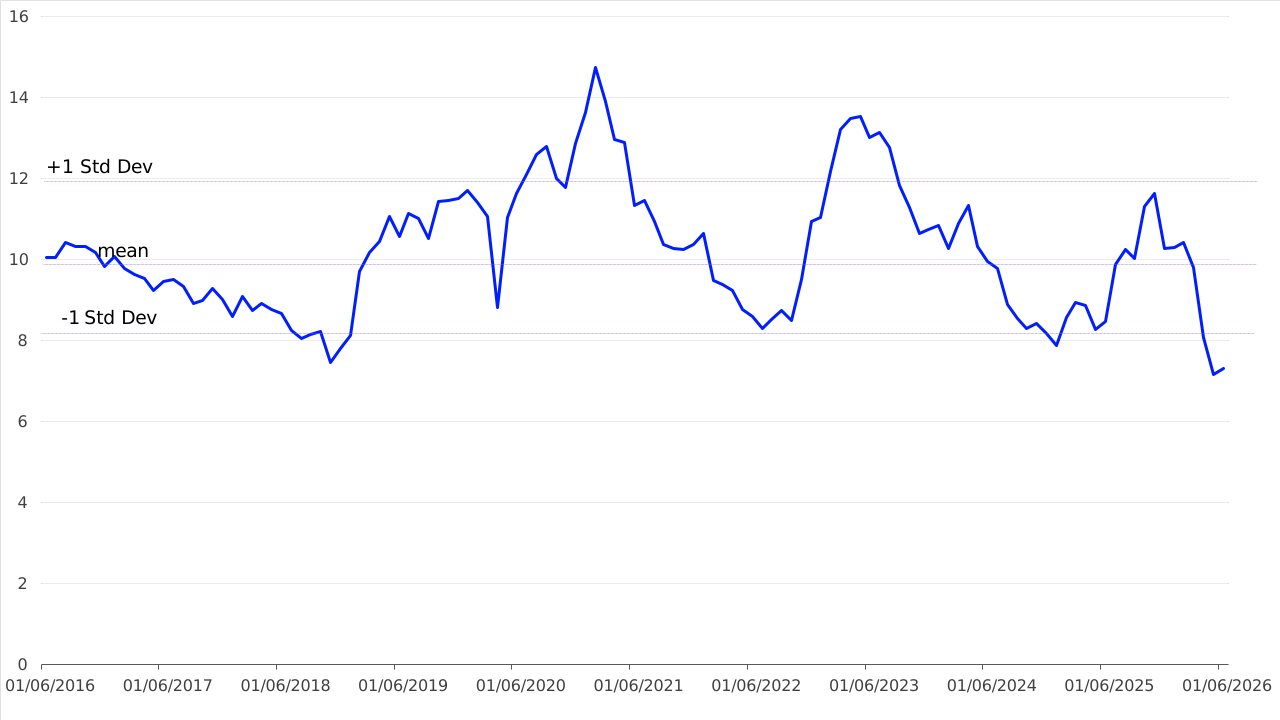
Exhibit 5: FTSE Korea 12M Forward PE
Source: FTSE Russell/LSEG. Data as of May 2026. Past performance is no guarantee of future results. Please see the end for important legal disclosures.
Despite its extraordinary rally, Korea’s valuation currently sits below its 10Y average on a forward earnings basis, leaving room for further re-rating if earnings momentum is sustained and governance reforms gain traction. The Corporate Value-Up Program, much like Japan’s reforms over the past decade, provides a structural tailwind through rising dividend expectations and improving capital discipline, with Financials (5.9% index weight) among the potential key beneficiaries.
Leaving aside its vulnerability to energy disruptions, as seen in the March drawdown, the FTSE Korea Index provides concentrated exposure to global technology cycles and advanced manufacturing, effectively a HALO (Heavy Assets, Low Obsolescence) trade. Korea’s economy today is far less dependent on the “old” manufacturing model that drove growth in previous decades, and its role as the hardware backbone of the AI supercycle makes it a compelling alternative for investors looking beyond the US.
Sources

Disclaimer
© [2026] London Stock Exchange Group plc and its applicable group undertakings (“LSEG”). LSEG includes (1) FTSE International Limited (“FTSE”), (2) Frank Russell Company (“Russell”), (3) FTSE Global Debt Capital Markets Inc. “FTSE Canada”, (4) FTSE Fixed Income LLC (“FTSE FI”), (5) FTSE (Beijing) Consulting Limited (“WOFE”), (6) FTSE EU SAS ("FES"). All rights reserved.
FTSE Russell® is a trading name of FTSE, Russell, FTSE Canada, FTSE FI, WOFE, FTSE EU and other LSEG entities providing LSEG Benchmark and Index services. “FTSE®”, “Russell®”, “FTSE Russell®”, “FTSE4Good®”, “ICB®”, “Refinitiv”, “WMR™” “FR™” and all other trademarks and service marks used herein (whether registered or unregistered) are trademarks and/or service marks owned or licensed by the applicable member of LSEG or their respective licensors.
FTSE International Limited is authorised as a Benchmark Administrator and regulated in the United Kingdom (UK) by the Financial Conduct Authority ("FCA") according to the UK Benchmark Regulation, FCA Reference Number 796803. FTSE EU SAS is authorised as Benchmark Administrator and regulated in the European Union (EU) by the Autorité des Marches Financiers (“AMF”) according to the EU Benchmark Regulation.
All information is provided for information purposes only. All information and data contained in this publication is obtained by LSEG, from sources believed by it to be accurate and reliable. Because of the possibility of human and mechanical inaccuracy as well as other factors, however, such information and data is provided "as is" without warranty of any kind. No member of LSEG nor their respective directors, officers, employees, partners or licensors make any claim, prediction, warranty or representation whatsoever, expressly or impliedly, either as to the accuracy, timeliness, completeness, merchantability of any information or LSEG Products, or of results to be obtained from the use of LSEG products, including but not limited to indices, rates, data and analytics, or the fitness or suitability of the LSEG products for any particular purpose to which they might be put. The user of the information assumes the entire risk of any use it may make or permit to be made of the information.
No responsibility or liability can be accepted by any member of LSEG nor their respective directors, officers, employees, partners or licensors for (a) any loss or damage in whole or in part caused by, resulting from, or relating to any inaccuracy (negligent or otherwise) or other circumstance involved in procuring, collecting, compiling, interpreting, analysing, editing, transcribing, transmitting, communicating or delivering any such information or data or from use of this document or links to this document or (b) any direct, indirect, special, consequential or incidental damages whatsoever, even if any member of LSEG is advised in advance of the possibility of such damages, resulting from the use of, or inability to use, such information.
No member of LSEG nor their respective directors, officers, employees, partners or licensors provide investment advice and nothing in this document should be taken as constituting financial or investment advice. No member of LSEG nor their respective directors, officers, employees, partners or licensors make any representation regarding the advisability of investing in any asset or whether such investment creates any legal or compliance risks for the investor. A decision to invest in any such asset should not be made in reliance on any information herein. Indices and rates cannot be invested in directly. Inclusion of an asset in an index or rate is not a recommendation to buy, sell or hold that asset nor confirmation that any particular investor may lawfully buy, sell or hold the asset or an index or rate containing the asset. The general information contained in this publication should not be acted upon without obtaining specific legal, tax, and investment advice from a licensed professional.
Past performance is no guarantee of future results. Charts and graphs are provided for illustrative purposes only. Index and/or rate returns shown may not represent the results of the actual trading of investable assets. Certain returns shown may reflect back-tested performance. All performance presented prior to the index or rate inception date is back-tested performance. Back-tested performance is not actual performance, but is hypothetical. The back-test calculations are based on the same methodology that was in effect when the index or rate was officially launched. However, back-tested data may reflect the application of the index or rate methodology with the benefit of hindsight, and the historic calculations of an index or rate may change from month to month based on revisions to the underlying economic data used in the calculation of the index or rate.
This document may contain forward-looking assessments. These are based upon a number of assumptions concerning future conditions that ultimately may prove to be inaccurate. Such forward-looking assessments are subject to risks and uncertainties and may be affected by various factors that may cause actual results to differ materially. No member of LSEG nor their licensors assume any duty to and do not undertake to update forward-looking assessments.
No part of this information may be reproduced, stored in a retrieval system or transmitted in any form or by any means, electronic, mechanical, photocopying, recording or otherwise, without prior written permission of the applicable member of LSEG. Use and distribution of LSEG data requires a licence from LSEG and/or its licensors.