

Catherine Yoshimoto

Kathleen Dobyns
Why should a dividend index be smart?
Stocks with above-average dividend yields often represent mature businesses with resilient earnings and disciplined management. These are precisely the types of investments that can provide an anchor of stability in volatile market conditions.
However, advisers who simply chase the highest dividend yields risk exposing their clients to capital losses and income disruption. Abnormally high yields, often called “yield traps”, can be a precursor to dividend cuts: traders usually anticipate such cuts by marking down share prices, and dividend yields are calculated using backward-looking data.
A more strategic high-income equity solution can capture the benefits of dividend stocks while avoiding the pitfalls of overly simplistic approaches. To meet growing investor interest in these smarter strategies, FTSE Russell launched the FTSE Global Equity High Income Index Series in May 2024.
The index series uses a simple, capitalisation-weighted methodology to reflect the performance of global stocks with relatively high tax-adjusted dividend yields, while also addressing concerns about potential yield traps.
Six steps to the FTSE Global Equity High Income Index Series
High-dividend indices vary in the complexity of their construction methodologies. For this index series, we have adopted a simple rank-and-select rule to choose constituents. The index series follows six intuitive design steps:
Use forward-looking dividend statements. We use forecast dividends rather than trailing, or historic, dividends to rank potential index constituents. Although there is close alignment between the two measures, and past dividends are often a reliable indicator of future payments, forecast dividends cover almost all global equity markets and are more responsive to changes in market conditions.
Look at after-tax dividend yields. We rank potential index constituents by net-of-tax yield, recognising that index users often receive dividends after withholding tax has been deducted.
Avoid stocks with no dividends or negative returns. To reduce the risk of yield traps, we exclude stocks with zero forecast or trailing dividends and those in the bottom fifth percentile of companies with negative one-year returns. This step screens out some of the stocks most at risk of cutting dividends.
Consider global exposure. To enable easier country or regional carve-outs of the index series, we rank stocks within each of the nine regional universes for the FTSE Global Equity Index Series: Asia Pacific ex China ex Japan, China, Japan, Developed Europe, Emerging Europe, Middle East & Africa, Latin America, Canada and the US.
Stick to the top 50% of dividend payers in each region. To support diversification, limit concentration risk and aid investability, we select the top 50% of securities by dividend yield within each regional universe and weight them by market capitalisation.
Perform regular maintenance. To constrain turnover while ensuring regular index maintenance, we incorporate buffer rules and rebalance the index annually, with quarterly removal of securities with zero forecast or trailing dividends.
All-World Equity High Income has delivered higher risk-adjusted returns
FTSE Russell’s flagship FTSE All-World Index includes large- and mid-cap stocks from nearly 50 developed and emerging markets. Over the last decade, one principal trend has stood out: performance has been dominated by the US market and, within it, by a handful of mega-cap technology companies.
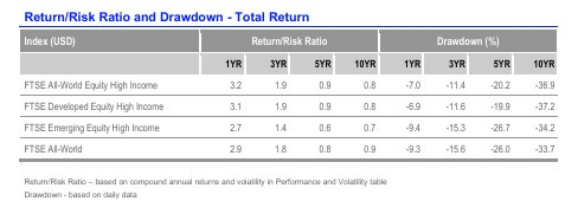
However, over one, three and five years to the end of May 2026, and including back-tested data before the index launch in May 2024, the high-income version of this popular benchmark — the FTSE All-World Equity High Income Index — has provided a higher return-to-risk ratio than the FTSE All-World Index (Figure 1).
Based on a back-test of the index strategy from 2002, the FTSE All-World Equity High Income Index has also generated around double the dividend income of the FTSE All-World Index (Figure 2).
Figure 1: Return-to-risk ratio of the FTSE All-World Equity High Income Index
Source: FTSE Russell, 31/5/2016-29/5/2026. Total return index values are rebased at 100 on 20/9/2002. Past performance is no guarantee of future results. Charts and graphs are provided for illustrative purposes only. Index and/or rate returns shown may not represent the results of the actual trading of investable assets. Certain returns shown may reflect back-tested performance. All performance presented prior to the index or rate inception date is back-tested performance. Back-tested performance is not actual performance, but is hypothetical. The back-test calculations are based on the same methodology that was in effect when the index or rate was officially launched. However, back-tested data may reflect the application of the index or rate methodology with the benefit of hindsight, and the historic calculations of an index or rate may change from month to month based on revisions to the underlying economic data used in the calculation of the index or rate.
Figure 2: Dividend yields of the FTSE All-World Equity High Income Index
A more diversified and less concentrated global equity index
Compared with the FTSE All-World Index, whose top ten holdings at the end of May 2026 were all in the technology, technology-related retail and tech-driven automobiles sectors, the FTSE All-World Equity High Income Index had a more diversified sector spread across its top ten stocks, including banks, technology hardware and equipment, oil, gas and coal, pharmaceuticals and biotechnology, telecommunications equipment and industrial engineering (Figure 3). The aggregate weight of the top ten stocks was also lower in the FTSE All-World Equity High Income Index than in the FTSE All-World Index: 14.91% versus 24.51%.
Figure 3: Top ten holdings
| Holding | FTSE All-World | % weight | FTSE All-World Equity High Income | % weight |
|---|---|---|---|---|
| 1 | Nvidia | 4.47 | Broadcom | 3.59 |
| 2 | Apple | 4.00 | JP Morgan Chase | 2.00 |
| 3 | Microsoft | 3.00 | Exxon Mobil | 1.80 |
| 4 | Amazon | 2.19 | Johnson & Johnson | 1.48 |
| 5 | Alphabet Class A | 1.83 | Chevron | 0.97 |
| 6 | Broadcom | 1.56 | AbbVie | 0.97 |
| 7 | Alphabet Class C | 1.49 | Procter & Gamble | 0.85 |
| 8 | TSMC | 1.47 | Caterpillar | 0.82 |
| 9 | Meta | 1.37 | Home Depot | 0.82 |
| 10 | Tesla | 1.15 | Bank of America | 0.80 |
| TOTAL | 22.53 | TOTAL | 14.10 |
Source: FTSE Russell, as at 29/5/2026. Past performance is not a guide to future returns. Please see the end for important legal disclosures.
Balancing growth, income and risk
By balancing growth, income and risk management, the FTSE All-World Equity High Income Index adds to the solution set for equity investors seeking a way to diversify away from persistently high levels of index concentration.
Using a sophisticated yet intuitive approach, the index does the heavy lifting for income-focused investors. It enables wealth managers to help clients tap into resilient global equity dividend streams while reducing the risk of yield traps.

Disclaimer
© [2026] London Stock Exchange Group plc and its applicable group undertakings (“LSEG”). LSEG includes (1) FTSE International Limited (“FTSE”), (2) Frank Russell Company (“Russell”), (3) FTSE Global Debt Capital Markets Inc. “FTSE Canada”, (4) FTSE Fixed Income LLC (“FTSE FI”), (5) FTSE (Beijing) Consulting Limited (“WOFE”), (6) FTSE EU SAS ("FES"). All rights reserved.
FTSE Russell® is a trading name of FTSE, Russell, FTSE Canada, FTSE FI, WOFE, FTSE EU and other LSEG entities providing LSEG Benchmark and Index services. “FTSE®”, “Russell®”, “FTSE Russell®”, “FTSE4Good®”, “ICB®”, “Refinitiv”, “WMR™” “FR™” and all other trademarks and service marks used herein (whether registered or unregistered) are trademarks and/or service marks owned or licensed by the applicable member of LSEG or their respective licensors.
FTSE International Limited is authorised as a Benchmark Administrator and regulated in the United Kingdom (UK) by the Financial Conduct Authority ("FCA") according to the UK Benchmark Regulation, FCA Reference Number 796803. FTSE EU SAS is authorised as Benchmark Administrator and regulated in the European Union (EU) by the Autorité des Marches Financiers (“AMF”) according to the EU Benchmark Regulation.
All information is provided for information purposes only. All information and data contained in this publication is obtained by LSEG, from sources believed by it to be accurate and reliable. Because of the possibility of human and mechanical inaccuracy as well as other factors, however, such information and data is provided "as is" without warranty of any kind. No member of LSEG nor their respective directors, officers, employees, partners or licensors make any claim, prediction, warranty or representation whatsoever, expressly or impliedly, either as to the accuracy, timeliness, completeness, merchantability of any information or LSEG Products, or of results to be obtained from the use of LSEG products, including but not limited to indices, rates, data and analytics, or the fitness or suitability of the LSEG products for any particular purpose to which they might be put. The user of the information assumes the entire risk of any use it may make or permit to be made of the information.
No responsibility or liability can be accepted by any member of LSEG nor their respective directors, officers, employees, partners or licensors for (a) any loss or damage in whole or in part caused by, resulting from, or relating to any inaccuracy (negligent or otherwise) or other circumstance involved in procuring, collecting, compiling, interpreting, analysing, editing, transcribing, transmitting, communicating or delivering any such information or data or from use of this document or links to this document or (b) any direct, indirect, special, consequential or incidental damages whatsoever, even if any member of LSEG is advised in advance of the possibility of such damages, resulting from the use of, or inability to use, such information.
No member of LSEG nor their respective directors, officers, employees, partners or licensors provide investment advice and nothing in this document should be taken as constituting financial or investment advice. No member of LSEG nor their respective directors, officers, employees, partners or licensors make any representation regarding the advisability of investing in any asset or whether such investment creates any legal or compliance risks for the investor. A decision to invest in any such asset should not be made in reliance on any information herein. Indices and rates cannot be invested in directly. Inclusion of an asset in an index or rate is not a recommendation to buy, sell or hold that asset nor confirmation that any particular investor may lawfully buy, sell or hold the asset or an index or rate containing the asset. The general information contained in this publication should not be acted upon without obtaining specific legal, tax, and investment advice from a licensed professional.
Past performance is no guarantee of future results. Charts and graphs are provided for illustrative purposes only. Index and/or rate returns shown may not represent the results of the actual trading of investable assets. Certain returns shown may reflect back-tested performance. All performance presented prior to the index or rate inception date is back-tested performance. Back-tested performance is not actual performance, but is hypothetical. The back-test calculations are based on the same methodology that was in effect when the index or rate was officially launched. However, back-tested data may reflect the application of the index or rate methodology with the benefit of hindsight, and the historic calculations of an index or rate may change from month to month based on revisions to the underlying economic data used in the calculation of the index or rate.
This document may contain forward-looking assessments. These are based upon a number of assumptions concerning future conditions that ultimately may prove to be inaccurate. Such forward-looking assessments are subject to risks and uncertainties and may be affected by various factors that may cause actual results to differ materially. No member of LSEG nor their licensors assume any duty to and do not undertake to update forward-looking assessments.
No part of this information may be reproduced, stored in a retrieval system or transmitted in any form or by any means, electronic, mechanical, photocopying, recording or otherwise, without prior written permission of the applicable member of LSEG. Use and distribution of LSEG data requires a licence from LSEG and/or its licensors.