

Tajinder Dhillon, CFA

Dewi John

Robin Marshall
- Despite the view financial flows have a larger impact on equity market valuations than widely acknowledged, there is little compelling evidence in our market data that investment sentiment or financial flows are good predictors of these turning points.
- Indeed, correlation between annual equity flows and returns for the following year are statistically insignificant.
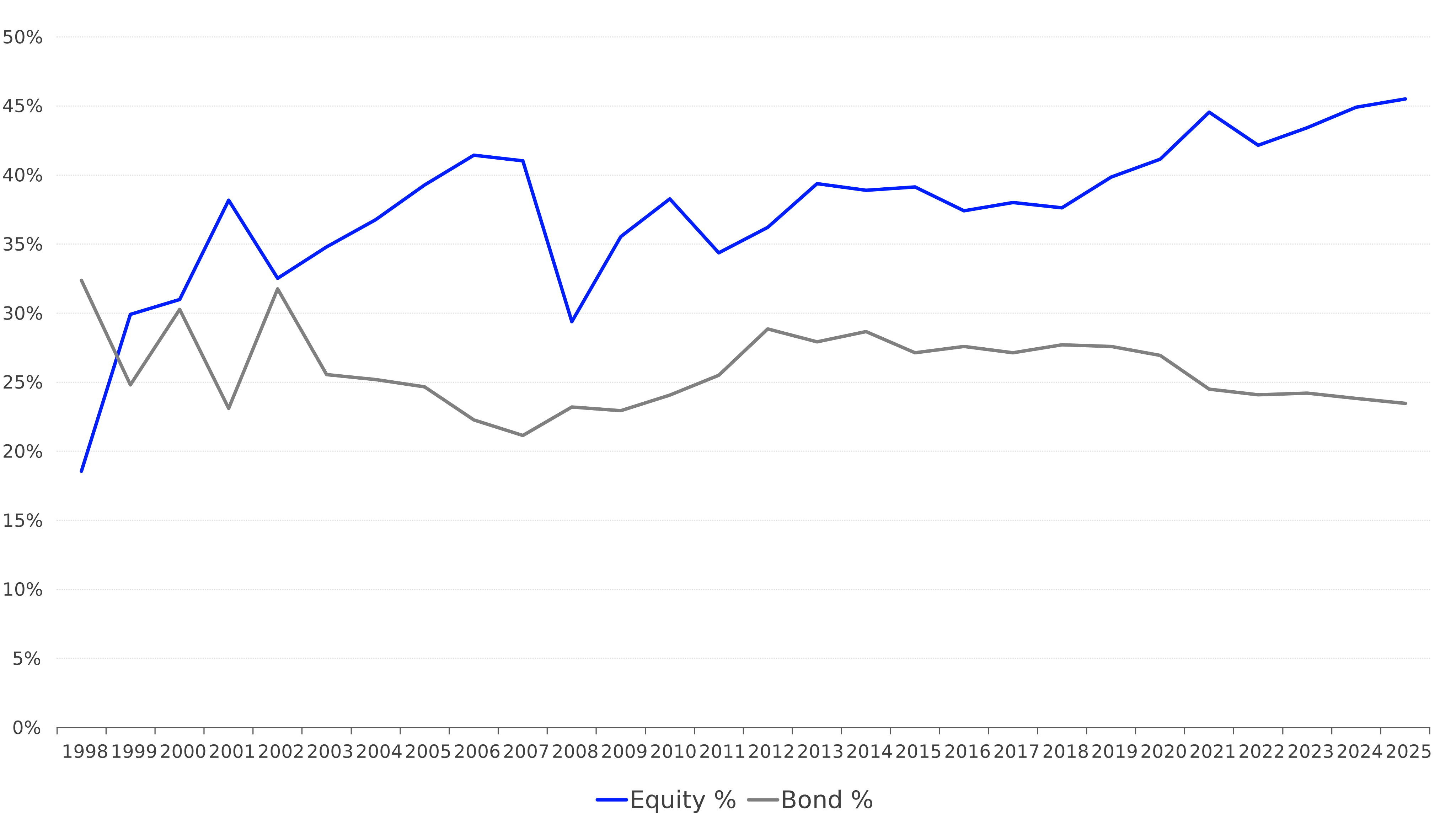
- Similarly, investment fund equity exposure is often cited as a good guide to turning points. This reached more than 40% since 2020, and 45.53% at end-2025 — a 30 year high, but that doesn’t mean it can’t go higher.
- These exposures are also an effect of revaluation of the asset class, and decline in the value of govt bond holdings, rather than any kind of mechanical guide to turning points.
- Given these issues, we assess Financial Conditions Indicators (FCIs) as a guide to market turning points. Since the GFC, FCIs have become popular with both investors and policy-makers alike as a guide to market performance and financial stability.
- The FTSE Russell US FCI back-tests well against US equity market performance and both the scale and rate of change of the FCI are important.
- This does not mean FCIs can be relied upon mechanically to predict equity market turning points, but does suggest they provide valuable information for investors.
In recent months, market focus has turned to equity valuations and “bubbles”
Market participants seem increasingly focused on whether equity markets are in bubble territory and, if so, how far. For example, a 950%-plus increase in “AI bubble” Google searches was recorded between late 2024 and late 2025. This paper doesn’t attempt to call that, but instead reviews certain metrics used to identify equity market peaks and troughs.
Is sentiment a good guide to turning points?
Firstly, we’ll briefly look at popular measures of investor sentiment. While it’s important to mention that these aren’t intended as tools to identify such turning points, they are often interpreted as such.
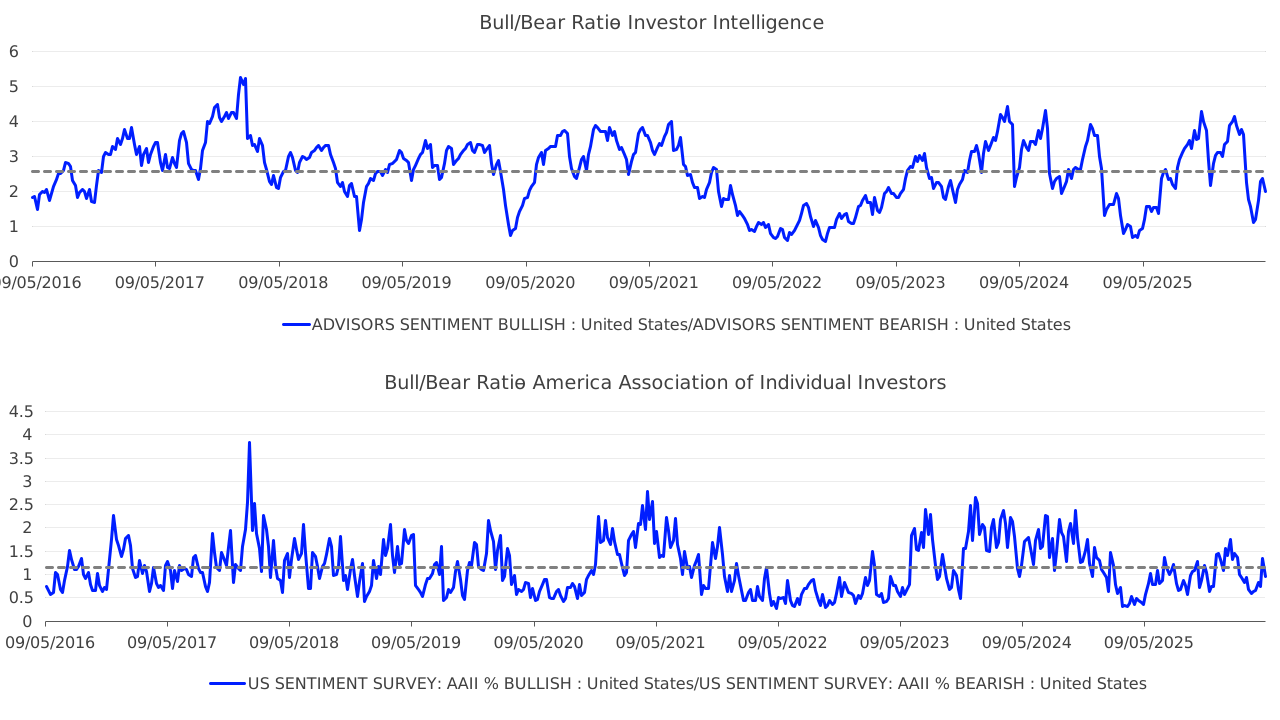
Two indicators that are often mentioned in the media – Investors Intelligence (chart 1, top) and AAII (bottom) –are surveys where investors indicate whether they are bullish or bearish. Strategists say if the ratio between those who are bullish vs. those who are bearish (bull/bear ratio) is very high (see black dashed lines as long-term averages), then this can signal a ‘pull-back’ in the S&P 500. But when plotted these against the S&P 500, it doesn’t appear to do all that good of a job in calling market turns. There is no identifiable point where “bullish” becomes “too bullish”.
Chart 1: Investor sentiment ratios
Source: LSEG Datastream. Past performance is not a guide to future returns. Please see the end for important legal disclosures.
Or is investment fund equity exposure a key metric?
Investment fund total net assets (TNA) and flows are also referenced as harbingers of equity market turning points. We’ll first take equity exposure is a leading indicator of out- and underperformance for the asset class.
Using LSEG Lipper data for all European-domiciled mutual funds and ETFs for the century so far, we looked at the relationship of both total net assets and funds flows relative to the performance of both the FTSE All World TR EUR index and Lipper’s Equity Global fund classification.
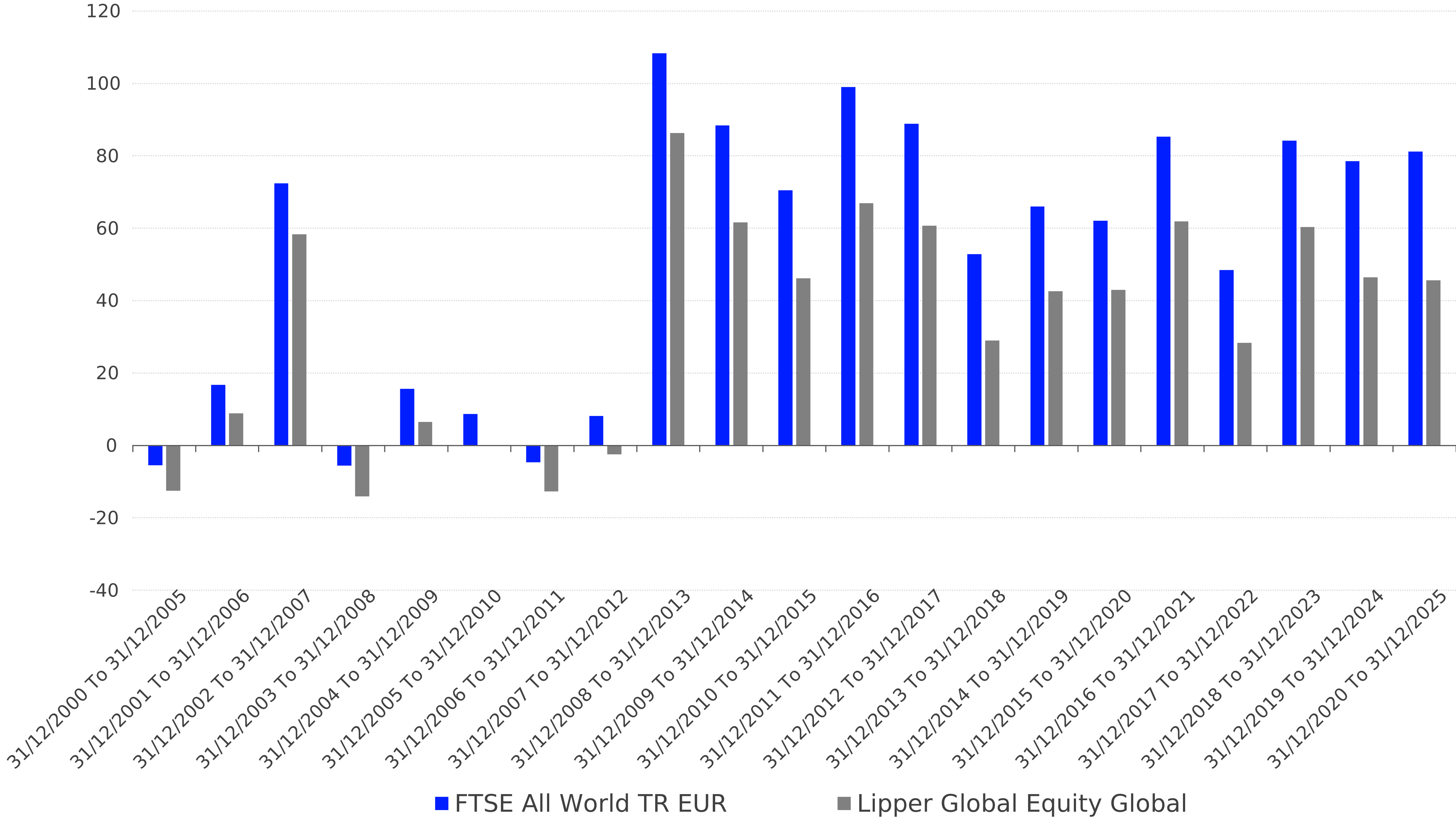
Some things do tally. For example, the last equity peak as a percentage of all fund assets was in 2006-7 (41.44%), prior to the global financial crisis. For 2006-11, the five-year return for the FTSE All World TR EUR was -4.65%, and for Equity Global, -12.69%. The average rolling five-year return between 2000 and 2020 was 47.99% for the FTSE All World TR EUR and 30.06% for the Lipper’s Equity Global index. (see chart 2).
Chart 2: Rolling Five-Year Returns, FTSE All World TR and Lipper Equity Global (EUR, %)
Source: LSEG Lipper. Past performance is not a guide to future returns. Please see the end for important legal disclosures.
Chart 3: Equity and Bond Proportion of Total European Investor Fund Assets, 1998-2025 (%)
Source: LSEG Lipper. Past performance is not a guide to future returns. Please see the end for important legal disclosures.
Equity exposure has been more than 40% since 2020, and at the end of 2025 was 45.53%— the highest for the past 30 years (chart 3). But clearly, if you had taken the previous pre-GFC peak as a sell signal, you’d have missed a lot of growth.
Recent equity exposure is high by historic standards, but that doesn’t mean it can’t go higher. These turning points are an effect of revaluation rather than any kind of useful indicator: as equity markets recover, values increase and the weight of equities within the market portfolio will therefore increase. More investors get on board, as bears morph to bulls, amplifying the effect. On the other hand, as equity valuations crash, their weight within the market portfolio will decrease, encouraging more investors to jettison equities.
Are fund flows a good guide to equity market moves?
One influential research paper by Xavier Gabaix and Ralph Koijen found that the “aggregate stock market is surprisingly price-inelastic, so that flows in and out of the market have a significant impact on prices and risk premia.” Flows have much more of an impact on performance than is generally acknowledged in market analysis focused on fundamentals, argued the authors.
It’s a thorough and impressive piece of work. But European fund flows over the century don’t seem to provide clear, usable signals. Average annual equity flows between 2000 and 2024 were €35.49bn. The largest annual equity inflows were in 2003 (€120.86bn), 2020 (€172.54bn), 2021 (€303.49bn), and 2024 (€142.4bn). The five years from 2003 saw negative returns (-5.53%, -14.06%), capturing 2008’s GFC market falls.
Apart from the period beginning 2017 (where returns are broadly in line with the average over the century), every five-year period since 2008 has exceeded the average for the FTSE All World index over the century. Above-average inflows may therefore be driving returns in the way the Gabaix and Koijen paper argues, but they don’t give any indication of when this might reverse.
The largest annual equity outflows were in 2001 (-€119.92bn) and 2008 (-€145.14bn). Five-year rolling returns from 2008 to 2013 were the largest of the sample period (108.3% and 86.25% respectively). Returns from 2001 were positive if muted. Correlation between annual equity flows and returns for the following year are statistically insignificant.
Why Financial Conditions Indicators (FCIs) can be powerful, and became popular
Since neither sentiment, fund assets nor flows are great predictors of equity market turning points, logical alternatives to consider are financial conditions indicators (FCIs). It is helpful to bear in mind how recent interest in FCIs developed, to appreciate why they may be useful in explaining, and even predicting market turning points. Before the GFC of 2008, the prevailing orthodoxy was that financial markets were largely self regulating, allocated resources efficiently, and rarely impacted economic activity. This was grounded in the neo-classical paradigm, and based on the view market forces and the price mechanism are the most efficient way of generating economic growth without the need for central state planning.
A relatively long period of stable growth and low inflation in the G7 economies – sometimes referred to as the Goldilocks era or “Great Moderation” – from the early-1990s to 2008 reinforced the view that financial conditions were generally stable. Although Japan was mired in a deflationary era of stagnant nominal GDP, it was assumed an exception, caused by a boom/bust in property and dysfunctional banking system. Keynes’ liquidity trap and self-feeding contractions in economic activity during the 1930s were a distant memory. Light touch financial regulation predominated since it was assumed market participants were incentivised to self-regulate to prevent reputational risk.
Challenges to economic orthodoxy from the GFC boosted interest in FCIs…
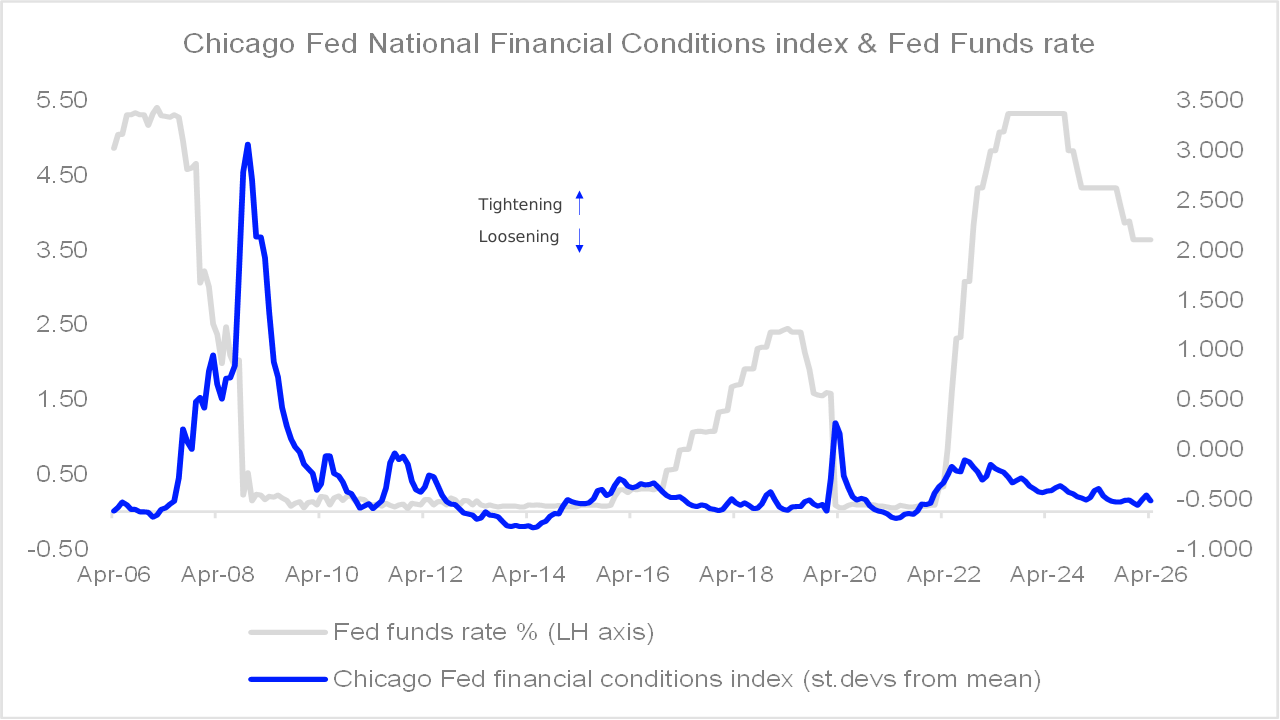
Chart 4: Financial conditions and Fed policy rates.
Source: US Federal Reserve. Data to April, 2026. Past performance is not a guide to future returns. Please see the end for important legal disclosures.
….with a bias towards credit, and strongly correlated variables
Since financial conditions cannot be summarised in one variable, like policy rates, putting the concept to work requires a composite indicator. One of the best known FCIs is the Chicago Fed National Financial Conditions Indicator, launched in 2011, and back-tested to 1971. This has 105 variables in total, with three major sub-indexes, for credit (33 variables), risk (33 variables) and leverage (39 variables). It is built as a dynamic factor model so many of the variables are strongly correlated, but the data requirements are substantial and it is harder to identify an underlying investment narrative in FCIs with large numbers of variables, and may be vulnerable to regime shift. The time series is also dominated by the enormous spike during the GFC, as chart 4 shows.
Our own FTSE Russell FCIs use a more pared-back approach, based on seven subsets of macro variables, which are equally weighted and intuitively connected to financial conditions. Equities are included in the FTSE Russell FCIs, since they are a key component in the cost of capital, but only equity market volatility, and not equity market levels, to avoid circularity. The variables are standardised by Z-scoring and then combined to give an overall composite indicator value, centred at zero. We also avoid so-called “look-ahead bias” by ensuring the Z-scoring at time “t” only captures data released before time “t”. By using a smaller set of variables, we were able to build FCIs for the US, Eurozone, Japan, UK, Canada and China.
Objectives for FCI need to be clearly defined
Clarity is required on the objectives of an FCI. Central banks use FCIs to help assess whether financial systems are stable, and as an aid to setting monetary policy, in contrast to investors who may wish to use them for market assessment and forecasting. Our intention was not to produce a forecasting tool for financial markets, since FTSE Russell is an index provider and not a forecasting house. Instead, the objective was to capture financial conditions at a given point in time, and to see how these mapped to financial market performance. Back-testing the FTSE Russell FCIs, we find they generally capture major financial and economic dislocation well, as shown in Chart 5.
Chart 5: FTSE Russell Financial Conditions Indicators since 2006
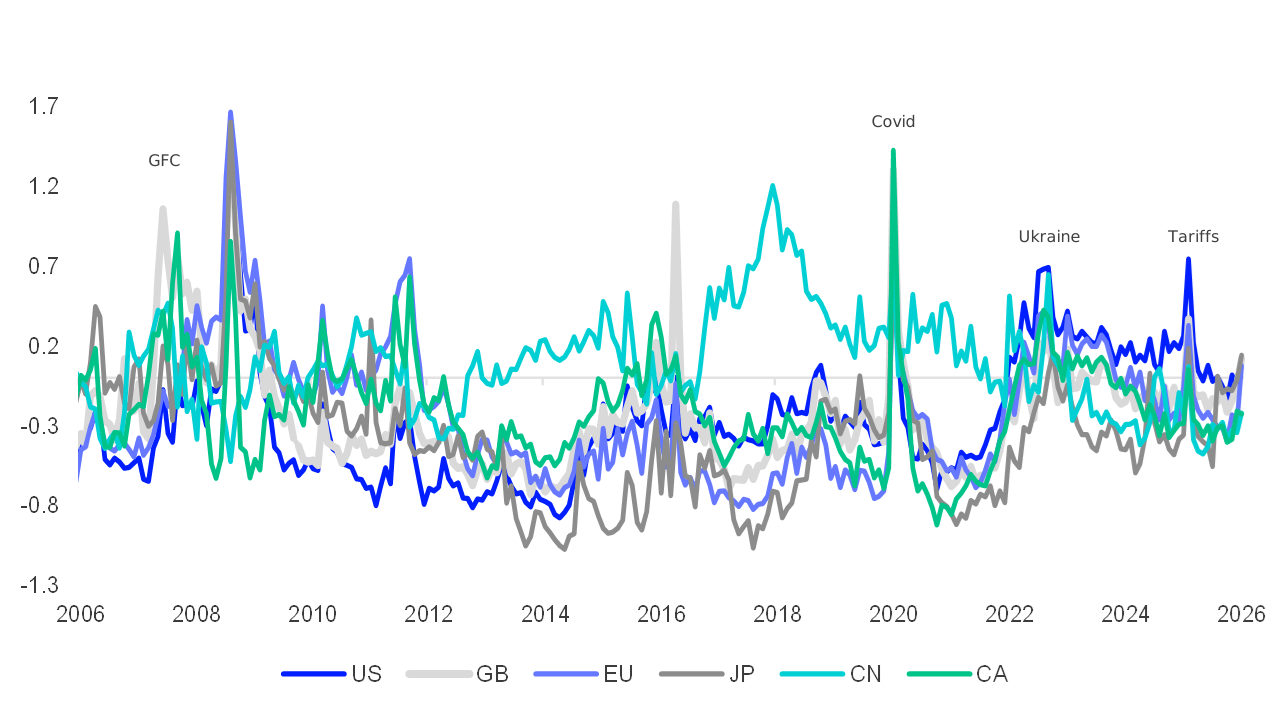
Source: FTSE Russell, data to March 31, 2026. Past performance is not a guide to future returns. Please see the end for important legal disclosures.
FCIs may give insights into equity and other financial market turning points
Extending this to US equity market turning points, Chart 6 shows some evidence of financial conditions tightening in advance of the sell-offs in the Russell 1000 during the GFC, and Covid, Ukraine and tariff tantrum episodes. But the speed of the movement, as well as the scale of the change in financial conditions appears key, with very rapid tightening a key determinant.
The Chart also suggests there may be threshold effects in FCIs, whereby FCIs only become critical for equity markets when the scale of the moves exceed certain ranges. In terms of standard deviations, the period before the GFC, Covid and Ukraine shocks shows a tightening of about 1.25 to 1.5 st.deviations from the mean caused significant corrections in the Russell 1000, whilst the tightening before the US tariff shock was less than 1 st.deviation. Standard deviation moves in FCIs of less than 0.75 have not been followed by major equity market turning points.
It is a similar story when FCIs loosen, as opposed to tightening, in terms of the scale of the moves after shocks, and its speed. The Russell 1000 was slower to recover after the GFC but, as central bank reaction functions became better known, since the GFC, and markets became aware QE asset purchases are likely, recoveries in risk-on assets have also accelerated.
Chart 6: Financial conditions and US Russell 1000 index
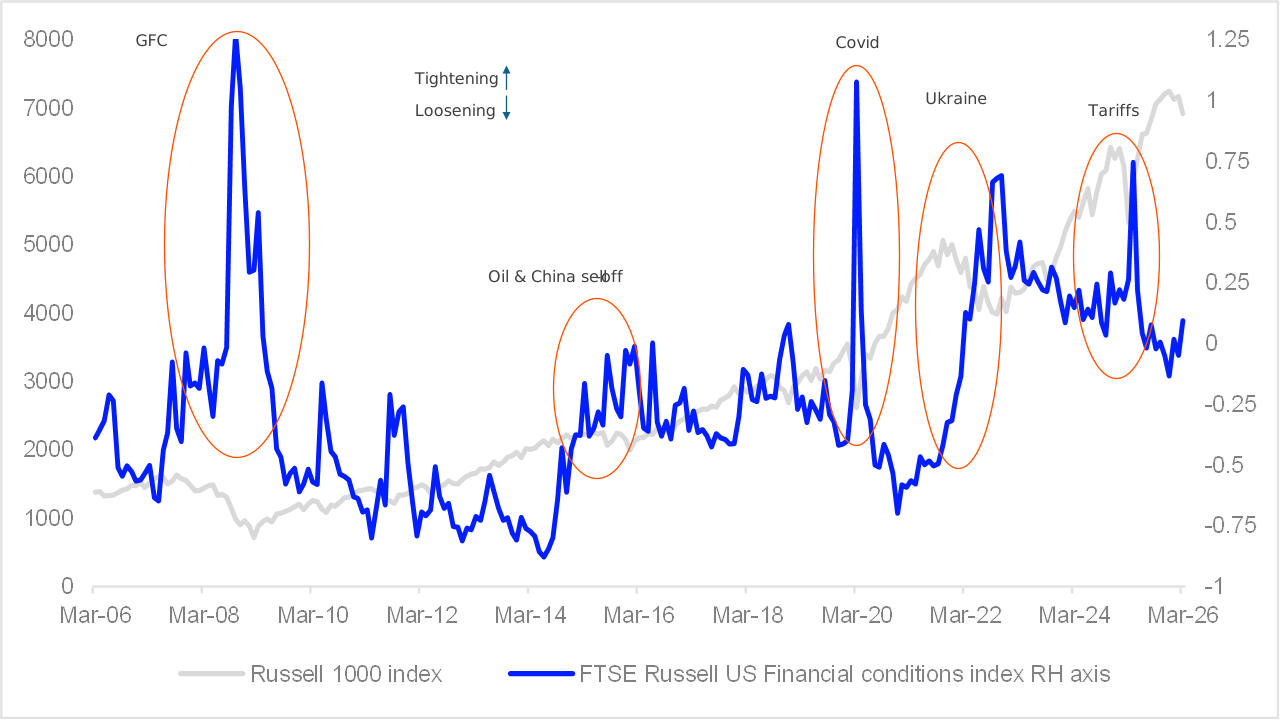
Source: FTSE Russell, data to March 31, 2026. Past performance is not a guide to future returns. Please see the end for important legal disclosures.

Legal Disclaimer
Republication or redistribution of LSEG content is prohibited without our prior written consent.
The content of this publication is for informational purposes only and has no legal effect, does not form part of any contract, does not, and does not seek to constitute advice of any nature and no reliance should be placed upon statements contained herein. Whilst reasonable efforts have been taken to ensure that the contents of this publication are accurate and reliable, LSEG does not guarantee that this document is free from errors or omissions; therefore, you may not rely upon the content of this document under any circumstances and you should seek your own independent legal, investment, tax and other advice. Neither We nor our affiliates shall be liable for any errors, inaccuracies or delays in the publication or any other content, or for any actions taken by you in reliance thereon.
Copyright © 2025 London Stock Exchange Group. All rights reserved.
The content of this publication is provided by London Stock Exchange Group plc, its applicable group undertakings and/or its affiliates or licensors (the “LSE Group” or “We”) exclusively.
Neither We nor our affiliates guarantee the accuracy of or endorse the views or opinions given by any third party content provider, advertiser, sponsor or other user. We may link to, reference, or promote websites, applications and/or services from third parties. You agree that We are not responsible for, and do not control such non-LSE Group websites, applications or services.
The content of this publication is for informational purposes only. All information and data contained in this publication is obtained by LSE Group from sources believed by it to be accurate and reliable. Because of the possibility of human and mechanical error as well as other factors, however, such information and data are provided "as is" without warranty of any kind. You understand and agree that this publication does not, and does not seek to, constitute advice of any nature. You may not rely upon the content of this document under any circumstances and should seek your own independent legal, tax or investment advice or opinion regarding the suitability, value or profitability of any particular security, portfolio or investment strategy. Neither We nor our affiliates shall be liable for any errors, inaccuracies or delays in the publication or any other content, or for any actions taken by you in reliance thereon. You expressly agree that your use of the publication and its content is at your sole risk.
To the fullest extent permitted by applicable law, LSE Group, expressly disclaims any representation or warranties, express or implied, including, without limitation, any representations or warranties of performance, merchantability, fitness for a particular purpose, accuracy, completeness, reliability and non-infringement. LSE Group, its subsidiaries, its affiliates and their respective shareholders, directors, officers employees, agents, advertisers, content providers and licensors (collectively referred to as the “LSE Group Parties”) disclaim all responsibility for any loss, liability or damage of any kind resulting from or related to access, use or the unavailability of the publication (or any part of it); and none of the LSE Group Parties will be liable (jointly or severally) to you for any direct, indirect, consequential, special, incidental, punitive or exemplary damages, howsoever arising, even if any member of the LSE Group Parties are advised in advance of the possibility of such damages or could have foreseen any such damages arising or resulting from the use of, or inability to use, the information contained in the publication. For the avoidance of doubt, the LSE Group Parties shall have no liability for any losses, claims, demands, actions, proceedings, damages, costs or expenses arising out of, or in any way connected with, the information contained in this document.
LSE Group is the owner of various intellectual property rights ("IPR”), including but not limited to, numerous trademarks that are used to identify, advertise, and promote LSE Group products, services and activities. Nothing contained herein should be construed as granting any licence or right to use any of the trademarks or any other LSE Group IPR for any purpose whatsoever without the written permission or applicable licence terms.