

Erwan Jacob
Global markets are shifting as U.S. uncertainty and financial fragmentation reshape investment strategies. Emerging markets and China are proving resilient, offering compelling opportunities for investors seeking growth and diversification. Read the insight to find out more about:
- Emerging market strength: Sovereign debt and local currency bonds are outperforming, supported by attractive valuations and a softer dollar.
- China’s trade resilience: Despite reduced U.S. exposure, exports to ASEAN, Africa, and Latin America are surging, driven by heavy industries and strategic diversification.
- Investor trends: Fed rate cuts and dollar weakness are fueling inflows into emerging market assets, while China maintains accommodative policies amid deflationary pressures.
Over the past decade, despite interest rates generally being higher than in the U.S., the BRICS currencies have depreciated against the U.S. dollar. The technology boom created strong demand for U.S. equities, while U.S. Treasuries remain among the most liquid asset globally. In theory, a weaker dollar should support exports; however, export levels have shown little change recently, with the most notable shift occurring in imports. Gold imports rose significantly over the summer. This may suggest that volatility and inflation could persist in the U.S. economy in the coming months, prompting American consumers to seek hedges against these risks.
Indices tracking emerging market performance are on course for their strongest year since 2017. Sovereign debt from emerging markets has outperformed nearly all other fixed income categories, with local currency government bonds delivering returns of around 15% year-to-date. This is more than double the return of U.S. high-yield corporate bonds and well above the 5.4% gain in the Bloomberg U.S. Treasury Index. Brazil, Mexico, Colombia, Hungary, and South Africa have led the charge, each posting gains of at least 23% this year.
Emerging markets represent a substantial share of the global economy: approximately 86% of the world’s population and labour force, 77% of land, 59% of global GDP and 44% of exports – as well as most key resources (around 87% of proven oil, 83% of copper, 77% of nickel and 69% of lithium). These markets appear attractive compared with the U.S. and Europe, supported by valuation gaps, a softer dollar, and long-term growth prospects.
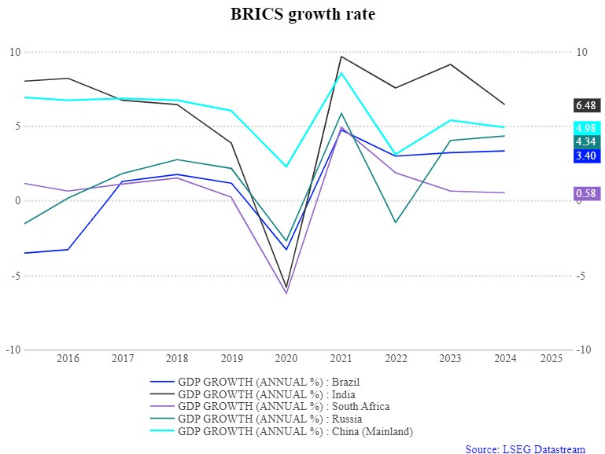
Source: LSEG Datastream. Past performance is not a guide to future returns. Please see the end for important legal disclosures.
Despite the relatively higher risk profile of U.S. equities, investor interest remains strong, driven by optimism around artificial intelligence and productivity gains. The S&P 500 currently trades at about 22.5 times next-12-months (NTM) earnings, levels last seen in the late 1990s and early 2000. By comparison, Europe and emerging markets trade at roughly 15 times NTM earnings – a discount of around 40%.
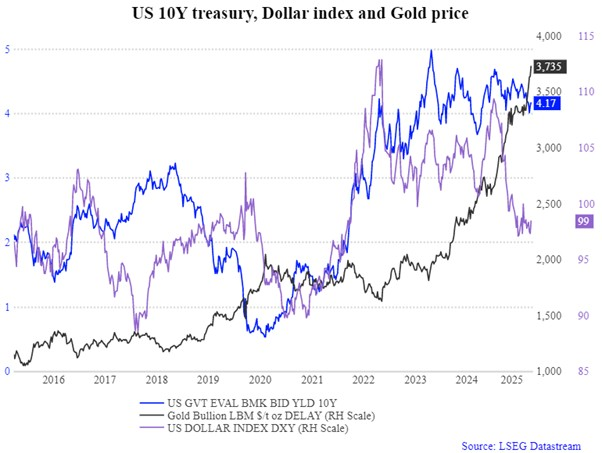
Source: LSEG Datastream. Past performance is not a guide to future returns. Please see the end for important legal disclosures.
With the Fed resuming rate cuts after a nine-month pause, investors are increasingly seeking yields outside the U.S., particularly in local currency bonds, which could benefit further if the dollar continues to weaken. These shifts reflect expectations that monetary easing will maintain downward pressure on the dollar, enhancing returns from bonds linked to appreciating currencies. If the U.S. dollar continues to weaken, returns on bonds denominated in local currencies will be further amplified.
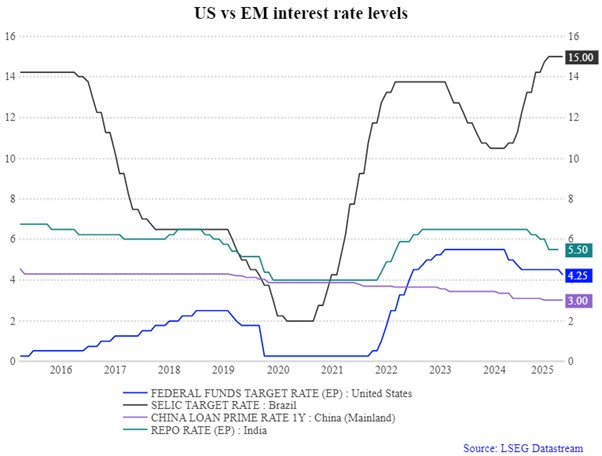
Source: LSEG Datastream. Past performance is not a guide to future returns. Please see the end for important legal disclosures.
Emerging market investments remain volatile and are generally suited to investors with a higher tolerance for fluctuations. Recent sell-offs in Turkey and Argentina highlight the unpredictability of these markets. Nevertheless, historical trends show that emerging market debt has typically returned between 6% and 8% following Fed rate cuts. This momentum has continued, with EM debt funds attracting approximately $300 million in the week ending 17 September – the 22nd consecutive week of inflows, according to EPFR data compiled by Bank of America. Year-to-date, net inflows have reached $45 billion. Interest rates in developing countries remain significantly higher than in the United States, and many emerging market central banks, mindful of inflation, have adopted a cautious approach to easing, making their asset yields comparatively attractive.
China stands apart from other emerging markets, maintaining an accommodating monetary policy in response to deflationary pressures Despite these risks, Chinese trade performance remains resilient. Exports rose by 8.3% year-on-year in September, exceeding expectations of 6% increase from Reuters Polls and marking the fastest growth since March, compared with a 4.4% increase in August. Beijing’s imports also surged by 7.4% last month, well above the 1.5% growth forecast, representing a 17-month high and surprising markets given recent signs of weaker domestic demand.
Chinese exports to India have continued to grow, pushing New Delhi’s trade deficit with Beijing to a record $99.21 billion in the fiscal year ending March 2025. China recorded a $77.7 billion trade surplus with India as of August, up 16% from a year earlier. Bilateral trade between India and Russia also reached a record $68.7 billion in fiscal 2025, driven largely by increased oil imports, contributing to a $59 billion deficit.
The U.S. now accounts for only about 10% of China's direct exports, by destination. Exports to the U.S. fell by 27%, offset by strong growth to other regions: the EU (14.2%), ASEAN (15.6%), Africa (56.6%) and Latin America (15.2%), all posted robust gains in September. Trade volumes have generally outpaced trade value growth, indicating that export prices have generally declined amid intense competition.
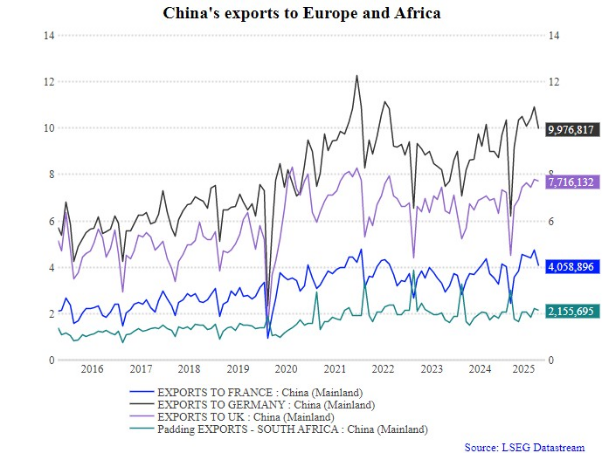
Source: LSEG Datastream. Past performance is not a guide to future returns. Please see the end for important legal disclosures.
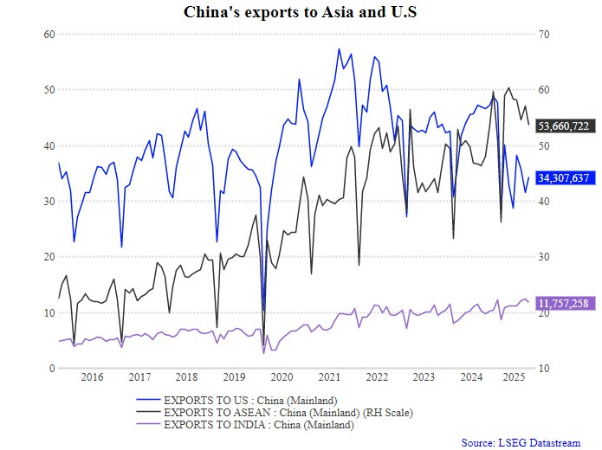
Source: LSEG, Datastream. Past performance is not a guide to future returns. Please see the end for important legal disclosures.
In summary, the fragmentation of financial markets affects not only developed nations, but also emerging markets. As economic dynamics between China and the U.S. evolve, opportunities in emerging markets continue to develop, particularly in regions that are less mature than China. Moreover, the anticipated easing of the Federal Reserve’s policy rate is likely to strengthen the incentives for investors seeking higher yields. China’s diversification strategy also appears to be effective, as reflected in its growing trade surplus.

Read more about

Legal Disclaimer
Republication or redistribution of LSEG content is prohibited without our prior written consent.
The content of this publication is for informational purposes only and has no legal effect, does not form part of any contract, does not, and does not seek to constitute advice of any nature and no reliance should be placed upon statements contained herein. Whilst reasonable efforts have been taken to ensure that the contents of this publication are accurate and reliable, LSEG does not guarantee that this document is free from errors or omissions; therefore, you may not rely upon the content of this document under any circumstances and you should seek your own independent legal, investment, tax and other advice. Neither We nor our affiliates shall be liable for any errors, inaccuracies or delays in the publication or any other content, or for any actions taken by you in reliance thereon.
Copyright © 2025 London Stock Exchange Group. All rights reserved.
The content of this publication is provided by London Stock Exchange Group plc, its applicable group undertakings and/or its affiliates or licensors (the “LSE Group” or “We”) exclusively.
Neither We nor our affiliates guarantee the accuracy of or endorse the views or opinions given by any third party content provider, advertiser, sponsor or other user. We may link to, reference, or promote websites, applications and/or services from third parties. You agree that We are not responsible for, and do not control such non-LSE Group websites, applications or services.
The content of this publication is for informational purposes only. All information and data contained in this publication is obtained by LSE Group from sources believed by it to be accurate and reliable. Because of the possibility of human and mechanical error as well as other factors, however, such information and data are provided "as is" without warranty of any kind. You understand and agree that this publication does not, and does not seek to, constitute advice of any nature. You may not rely upon the content of this document under any circumstances and should seek your own independent legal, tax or investment advice or opinion regarding the suitability, value or profitability of any particular security, portfolio or investment strategy. Neither We nor our affiliates shall be liable for any errors, inaccuracies or delays in the publication or any other content, or for any actions taken by you in reliance thereon. You expressly agree that your use of the publication and its content is at your sole risk.
To the fullest extent permitted by applicable law, LSE Group, expressly disclaims any representation or warranties, express or implied, including, without limitation, any representations or warranties of performance, merchantability, fitness for a particular purpose, accuracy, completeness, reliability and non-infringement. LSE Group, its subsidiaries, its affiliates and their respective shareholders, directors, officers employees, agents, advertisers, content providers and licensors (collectively referred to as the “LSE Group Parties”) disclaim all responsibility for any loss, liability or damage of any kind resulting from or related to access, use or the unavailability of the publication (or any part of it); and none of the LSE Group Parties will be liable (jointly or severally) to you for any direct, indirect, consequential, special, incidental, punitive or exemplary damages, howsoever arising, even if any member of the LSE Group Parties are advised in advance of the possibility of such damages or could have foreseen any such damages arising or resulting from the use of, or inability to use, the information contained in the publication. For the avoidance of doubt, the LSE Group Parties shall have no liability for any losses, claims, demands, actions, proceedings, damages, costs or expenses arising out of, or in any way connected with, the information contained in this document.
LSE Group is the owner of various intellectual property rights ("IPR”), including but not limited to, numerous trademarks that are used to identify, advertise, and promote LSE Group products, services and activities. Nothing contained herein should be construed as granting any licence or right to use any of the trademarks or any other LSE Group IPR for any purpose whatsoever without the written permission or applicable licence terms.