

Grace Ong
Corporate treasury is evolving into a strategic nerve center, driven by a new transparency mandate. This blog examines how FX cost transparency, commodity risk management and market intelligence enable treasurers to reposition banking relationships, embed resilience and support better capital allocation. The result is sharper decision‑making and stronger stakeholder confidence in volatile markets.
- Transparency is becoming a strategic mandate in 2026, requiring corporate treasurers to move beyond operational efficiency toward deeper risk visibility and intelligence‑led decision‑making.
- Data‑driven insight across FX, commodities and banking relationships enables corporates to benchmark costs, optimise partnerships and manage volatility with greater confidence.
- Embedding market intelligence into core treasury workflows strengthens resilience, improves capital allocation and turns transparency into a competitive advantage.
Many corporate functions are undergoing a fundamental transformation. Treasury, finance, tax, and procurement teams are no longer measured solely on short term efficiency but on their ability to illuminate risk, optimise relationships, and embed strategic intelligence into every financial or operational decision. The new transparency mandate demands that these functions evolve into strategic nerve centres equipping their organisations with the data and insights necessary to navigate an increasingly complex global landscape.
Redefining banking relationships through intelligent partnerships
For decades, corporate treasurers accepted the cost of accessing financial markets as an unavoidable expense. Volatile FX and interest rate environments were navigated through trusted banking relationships, with little visibility into the true cost of those relationships. That era is ending. Today's transparency imperative requires treasurers to understand not just what they pay, but why they pay it, and what risk premium their financial partners are embedding into every transaction as well as the broader offering of facilities.
The shift is profound - from "best execution" to "best relationship." Best execution focuses on a single transaction at a single moment. Best relationship considers the entire lifecycle of financial partnership, quantifying both explicit costs and implicit operational risks. Tools enabling pre- and post-trade FX transaction cost analysis empower treasurers to benchmark their liquidity providers, assess execution quality across market conditions, and negotiate from a position of informed strength.
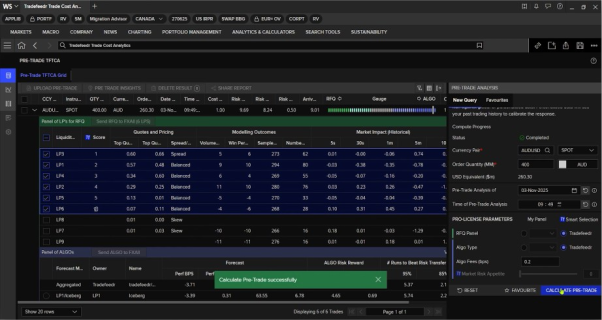
This transparency creates leverage. When treasurers can demonstrate that they understand market pricing, spread dynamics, and the competitive landscape of liquidity provision, they transform banking relationships from one-sided arrangements into genuine partnerships. Trust is built not on opacity but on mutual understanding of value delivered and received. For example, a corporate can now use their power of negotiation to have their banks adhere to the FX Global Code, to lean on key principles when economic markets are not calm.
The commodities challenge: From supply chain to balance sheet
The convergence of geopolitical tensions, climate transition, and supply chain fragmentation has thrust commodity risk onto the corporate treasurer's desk. Rare earth elements, critical minerals, energy inputs, and agricultural commodities now represent material exposures that directly impact financial stability and competitive positioning.
Companies are diversifying their supply sources to reduce concentration risk, but diversification creates new financial complexities. New suppliers require time to ramp production, creating timing mismatches between contractual commitments and physical delivery. Price volatility in commodities markets can turn operational necessities into speculative exposures. The answer lies in integrating commodity hedging into core treasury operations rather than treating it as a procurement afterthought.
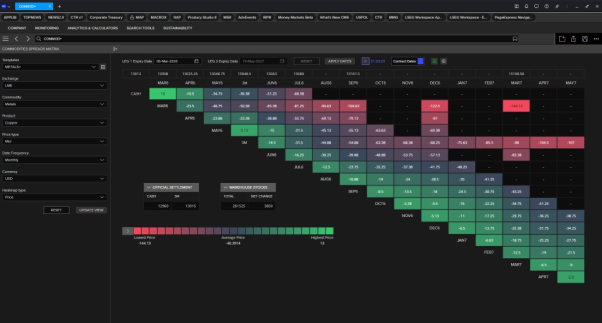
Access to comprehensive commodities research and market data intelligence enables treasurers to hedge large capex programmes and working capital exposures more effectively. This isn't about speculation; it's about stability. When commodity costs are hedged appropriately, financial reporting becomes more predictable, capital allocation decisions more rational, and stakeholder confidence more durable. The treasurer who masters commodity risk management delivers strategic value that resonates across the entire organisation.
Market intelligence as strategic infrastructure
Beyond transactional excellence, treasury and finance teams must serve as intelligence hubs for strategic decision-making. Corporate development initiatives, investor relations narratives, and capital structure optimisation all depend on high-quality market intelligence. League tables reveal which financial institutions have expertise in specific sectors or transaction types. Private company analytics provide competitive context that public filings cannot capture. A deep external research base coverage offers forward-looking perspectives that complement internal analysis.
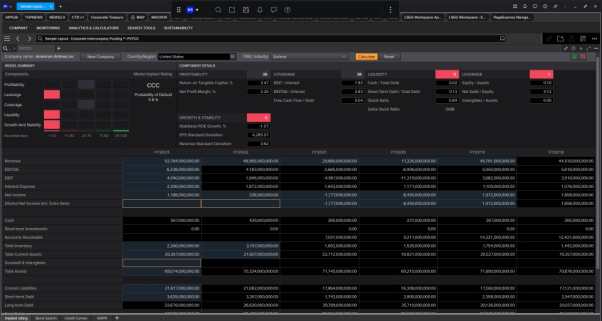
For corporate teams evaluating acquisition targets, partnership opportunities or simply tracking the company’s balance sheet, access to detailed financial information including EBITDA metrics, weighted average cost of capital calculations, and cash flow projections transforms due diligence from guesswork into science. Understanding internal and external company's financial architecture in context of industry benchmarks enables more accurate and efficient integration planning.
For investor relations teams, demonstrating sophisticated financial governance creates confidence. When management can articulate how they model risk, how they benchmark performance, and how they optimise their financial relationships, they validate their commitment to protecting shareholder capital. In volatile markets, this transparency premium can materially impact valuation multiples and cost of capital.
Building operational resilience through financial intelligence
The common thread connecting FX optimisation, commodity hedging, and market intelligence is resilience. Companies that embed transparency into their financial operations build muscle memory for crisis response. They understand their exposure profiles. They maintain diversified relationships. They can model scenarios and adjust strategies dynamically.
This resilience isn't defensive; it's offensive. Companies with market leading financial intelligence make faster decisions, allocate capital more efficiently, and identify opportunities that competitors miss. They negotiate better terms because they understand market dynamics and avoid costly mistakes because they see risks before they materialise.
The mandate for 2026
Every financial relationship and operation should be benchmarked, optimised, and aligned with strategic goals. It’s a survival requirement in an environment where information asymmetry represents competitive vulnerability. The transparency mandate challenges corporate teams to demand more from their data, more from their banking partners, and more from themselves.
The CFOs, treasurers, procurement and other corporate leaders who embrace this mandate will discover that armed with comprehensive market intelligence, transaction cost analysis, and other data and analytics tools, they transform their function from back-office necessity to forward looking advantage.


Legal Disclaimer
Republication or redistribution of LSEG content is prohibited without our prior written consent.
The content of this publication is for informational purposes only and has no legal effect, does not form part of any contract, does not, and does not seek to constitute advice of any nature and no reliance should be placed upon statements contained herein. Whilst reasonable efforts have been taken to ensure that the contents of this publication are accurate and reliable, LSEG does not guarantee that this document is free from errors or omissions; therefore, you may not rely upon the content of this document under any circumstances and you should seek your own independent legal, investment, tax and other advice. Neither We nor our affiliates shall be liable for any errors, inaccuracies or delays in the publication or any other content, or for any actions taken by you in reliance thereon.
Copyright © 2025 London Stock Exchange Group. All rights reserved.
The content of this publication is provided by London Stock Exchange Group plc, its applicable group undertakings and/or its affiliates or licensors (the “LSE Group” or “We”) exclusively.
Neither We nor our affiliates guarantee the accuracy of or endorse the views or opinions given by any third party content provider, advertiser, sponsor or other user. We may link to, reference, or promote websites, applications and/or services from third parties. You agree that We are not responsible for, and do not control such non-LSE Group websites, applications or services.
The content of this publication is for informational purposes only. All information and data contained in this publication is obtained by LSE Group from sources believed by it to be accurate and reliable. Because of the possibility of human and mechanical error as well as other factors, however, such information and data are provided "as is" without warranty of any kind. You understand and agree that this publication does not, and does not seek to, constitute advice of any nature. You may not rely upon the content of this document under any circumstances and should seek your own independent legal, tax or investment advice or opinion regarding the suitability, value or profitability of any particular security, portfolio or investment strategy. Neither We nor our affiliates shall be liable for any errors, inaccuracies or delays in the publication or any other content, or for any actions taken by you in reliance thereon. You expressly agree that your use of the publication and its content is at your sole risk.
To the fullest extent permitted by applicable law, LSE Group, expressly disclaims any representation or warranties, express or implied, including, without limitation, any representations or warranties of performance, merchantability, fitness for a particular purpose, accuracy, completeness, reliability and non-infringement. LSE Group, its subsidiaries, its affiliates and their respective shareholders, directors, officers employees, agents, advertisers, content providers and licensors (collectively referred to as the “LSE Group Parties”) disclaim all responsibility for any loss, liability or damage of any kind resulting from or related to access, use or the unavailability of the publication (or any part of it); and none of the LSE Group Parties will be liable (jointly or severally) to you for any direct, indirect, consequential, special, incidental, punitive or exemplary damages, howsoever arising, even if any member of the LSE Group Parties are advised in advance of the possibility of such damages or could have foreseen any such damages arising or resulting from the use of, or inability to use, the information contained in the publication. For the avoidance of doubt, the LSE Group Parties shall have no liability for any losses, claims, demands, actions, proceedings, damages, costs or expenses arising out of, or in any way connected with, the information contained in this document.
LSE Group is the owner of various intellectual property rights ("IPR”), including but not limited to, numerous trademarks that are used to identify, advertise, and promote LSE Group products, services and activities. Nothing contained herein should be construed as granting any licence or right to use any of the trademarks or any other LSE Group IPR for any purpose whatsoever without the written permission or applicable licence terms.