Paula Van Laningham
Hosted by LSEG in partnership with S&P Global Energy and the UN Sustainable Stock Exchanges (UN SSE) Initiative.
Summary
LSEG hosted a closed door round table discussion during London Climate Action Week to discuss the role of voluntary carbon markets and compliance in a world increasingly focused on energy security. This was the latest in a series of international roundtables under the SSE–S&P Global Energy Carbon Currents collaboration, bringing together exchanges from around the world, alongside leading market experts, to discuss carbon market developments, opportunities, and challenges across their respective regions.
Participants discussed the relative success of market initiatives like the Core Carbon Principles (CCPs) as a means of driving market confidence going forward, as well as how the European Union’s apparent thawing towards crediting mechanisms could shape the conversation.
The discussion was focused on the following four questions:
Questions
The discussion was focused on the following four questions:
1) What is carbon “missing” relative to other successful global benchmarks?
- What makes a successful benchmark?
- Can a carbon benchmark exist in a voluntary environment? In a fragmented one?
2) What might emerge as the global carbon benchmark?
- Is CORSIA an adequate benchmark? Can it adapt to capture the variability of carbon crediting?
- What role if any can CBAM play in the development of a global carbon benchmark?
3) How can carbon markets scale in time to meet expected demand while also maintaining credibility?
- Are there enough of the “right” credits to meet variable sources of demand?
4) Are carbon markets still relevant in today’s environment?
- What role do carbon markets have in a world focused less on collective action over unilateral action?
- Energy transition vs. decarbonisation: does this change the conversation around carbon market?
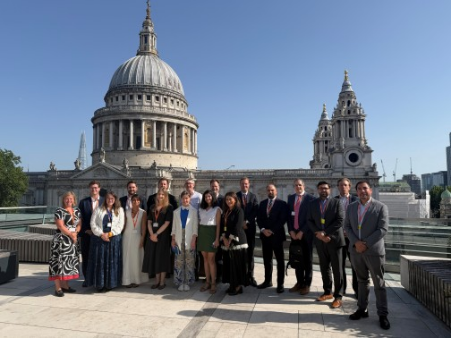
Attendees of the LCAW ‘Carbon Currents’ event in partnership with LSEG, UN SSE and S&P Global Energy
Discussion & conclusions
While the voluntary carbon markets have struggled to coalesce around a single pricing benchmark, they have managed to build more niche positions around smaller ones, and the expansion of the ICVCM’s Core Carbon Principles (CCPs) may help to address credit credibility concerns from possible buyers. However, participants agreed that the absence of benchmarking across a wider swathe of carbon projects greatly impacts market scalability and will continue to weigh on demand, absent a sufficiently robust framework ecosystem. While there has been progress in building this ecosystem through the overlapping guidelines of the ICVCM, VCMI, Article 6 and CORSIA — with an additional oversight mechanism provided by ratings infrastructure — the system remains immature and disjointed. Further, there is still significant variability across CCP inclusion and ratings which, separate to an additional mechanism, have done little to further the process of standardisation.
The attendees agreed that there is nothing about carbon markets that make them different from other commodities markets, but they fundamentally lack the consistent demand that stabilises the market and manages significant forward risk. This is, in some ways, a policy question — should there be some greater regulatory oversight to require use? — but it is also about building a compelling business case for carbon offsetting. Many businesses are still interested in engaging with offsetting but have shied away from the significant risk that it presents to reputation, particularly in the absence of a larger enforcement mechanism. Additionally, absent stronger enforcement mechanisms, many buyers have become increasingly self-limiting about the credits they are willing to consider, which often penalises otherwise effective, but much smaller project. This has meant that many buyers have flocked to CORSIA as a mechanism to support credibility, even if they are not part of the airline industry or have begun to demand Correspondingly Adjusted-credits. In addition to creating another pricing variable within the already highly-variable credit pricing environment, this creates additional supply challenges for Correspondingly Adjusted-credits, potentially undermining a key component of what makes Article 6 work within the Paris Climate Agreement. Additionally, corporate reluctance to engage more openly with carbon markets means that the necessary financing to drive decarbonisation in local communities will fail to materialise.
Participants discussed that recent steps by the European Commission towards introducing crediting mechanisms into the EU ETS has potentially created a crucial policy signal that could allow for the development of a pricing signal needed to help support the development of demand. While the EU Commission may be unlikely to integrate voluntary or Article 6 carbon credits in the EU ETS directly the European Union is integrating removal credits within the 2040 90% target and has even discussed them potentially playing a role in its Carbon Border Adjustment Mechanism (CBAM), which creates a trade-driven enforcement mechanism to standardize certain aspects of carbon accounting. However, it is too soon to tell if introducing carbon crediting to CBAM, for example, would create a global carbon market linked to the EU price. CBAM, while useful in creating standardization in some things is inherently designed around European markets, which will limit its broad applicability for decarbonization across other markets and may even create counter-productive incentives that increase industrial emissions in specific jurisdictions. However, the attendees agreed that the discussion of carbon credits within this context means that now is probably the right time to try and address these questions around standardization.
Carbon markets remain relevant — but power prices may be doing heavy lifting. A provocative "EU ETS on trial" segment showed structurally high power prices (EVs, data centres, electrification, curtailment) may be driving more industrial decarbonisation than the carbon price itself. Still, the room agreed a long-term carbon price signal remains a potential regulatory "fail-safe," especially for the harder, higher-priced industrial transition ahead. Further, the global conversation around decarbonisation has already become more prescient in the wake of the global energy crisis following the closure of the Strait of Hormuz during the recent conflict in the region. Because carbon is also an accounting instrument, both financially and as a quantification tool for emissions overall, the “market” element provides the crucial pricing signal for particularly hard-to-abate industries to invest in often costly upgrades to lower overall emissions. However, this is not always a prefect signal and has meant that carbon leakage remains the prescient challenge. As prices must rise to bite on industrial emissions, leakage and competitiveness concerns have pushed governments toward either cost containment linking to the voluntary market or CBAMs, which could risk further trade distortion.

Legal Disclaimer
Republication or redistribution of LSE Group content is prohibited without our prior written consent.
The content of this publication is for informational purposes only and has no legal effect, does not form part of any contract, does not, and does not seek to constitute advice of any nature and no reliance should be placed upon statements contained herein. Whilst reasonable efforts have been taken to ensure that the contents of this publication are accurate and reliable, LSE Group does not guarantee that this document is free from errors or omissions; therefore, you may not rely upon the content of this document under any circumstances and you should seek your own independent legal, investment, tax and other advice. Neither We nor our affiliates shall be liable for any errors, inaccuracies or delays in the publication or any other content, or for any actions taken by you in reliance thereon.
Copyright © 2026 London Stock Exchange Group. All rights reserved.
The content of this publication is provided by London Stock Exchange Group plc, its applicable group undertakings and/or its affiliates or licensors (the “LSE Group” or “We”) exclusively.
Neither We nor our affiliates guarantee the accuracy of or endorse the views or opinions given by any third party content provider, advertiser, sponsor or other user. We may link to, reference, or promote websites, applications and/or services from third parties. You agree that We are not responsible for, and do not control such non-LSE Group websites, applications or services.
The content of this publication is for informational purposes only. All information and data contained in this publication is obtained by LSE Group from sources believed by it to be accurate and reliable. Because of the possibility of human and mechanical error as well as other factors, however, such information and data are provided "as is" without warranty of any kind. You understand and agree that this publication does not, and does not seek to, constitute advice of any nature. You may not rely upon the content of this document under any circumstances and should seek your own independent legal, tax or investment advice or opinion regarding the suitability, value or profitability of any particular security, portfolio or investment strategy. Neither We nor our affiliates shall be liable for any errors, inaccuracies or delays in the publication or any other content, or for any actions taken by you in reliance thereon. You expressly agree that your use of the publication and its content is at your sole risk.
To the fullest extent permitted by applicable law, LSE Group, expressly disclaims any representation or warranties, express or implied, including, without limitation, any representations or warranties of performance, merchantability, fitness for a particular purpose, accuracy, completeness, reliability and non-infringement. LSE Group, its subsidiaries, its affiliates and their respective shareholders, directors, officers employees, agents, advertisers, content providers and licensors (collectively referred to as the “LSE Group Parties”) disclaim all responsibility for any loss, liability or damage of any kind resulting from or related to access, use or the unavailability of the publication (or any part of it); and none of the LSE Group Parties will be liable (jointly or severally) to you for any direct, indirect, consequential, special, incidental, punitive or exemplary damages, howsoever arising, even if any member of the LSE Group Parties are advised in advance of the possibility of such damages or could have foreseen any such damages arising or resulting from the use of, or inability to use, the information contained in the publication. For the avoidance of doubt, the LSE Group Parties shall have no liability for any losses, claims, demands, actions, proceedings, damages, costs or expenses arising out of, or in any way connected with, the information contained in this document.
LSE Group is the owner of various intellectual property rights ("IPR”), including but not limited to, numerous trademarks that are used to identify, advertise, and promote LSE Group products, services and activities. Nothing contained herein should be construed as granting any licence or right to use any of the trademarks or any other LSE Group IPR for any purpose whatsoever without the written permission or applicable licence terms.