
Lily Dai

Lee Clements
The green economy has always been about more than climate change. But, while the green economy includes waste, water, natural resources and pollution control, as well as more obviously climate-related sectors such as energy and transport, its performance has tended to be tied closely to ebbs and flows of the decarbonisation agenda.
However, the latest energy shock, triggered by conflict in the Middle East, has elevated a previously secondary driver for the green economy. The return of high and volatile fossil fuel prices has increased the focus on energy security and resilience, which is contributing to renewed interest in parts of the green economy.
Energy shock – rewarding the early movers
The conflict which began in February, and the subsequent closure of the Strait of Hormuz, has created what the International Energy Agency’s Executive Director, Fatih Birol, has called “the greatest threat to global energy security in history.”
The immediate response to the subsequent spike in energy prices included an unprecedented release of strategic oil reserves, demand destruction, including through reduced refinery runs and rationing, as well as some increased use of other fossil fuels, such as coal. These measures have been applied particularly urgently in Asia, whose economies tend to be highly dependent on energy imports.
But the beneficiaries of this latest energy shock are not only undisrupted exporters of oil and gas, such as the United States and Norway. Those countries which have already begun moving away from a dependence on fossil fuels – such as China, Spain and even Pakistan – have also found themselves insulated from its worst impacts.
Meeting the transition as it happens
These countries have begun to recognise energy security considerations associated with parts of the green economy. China is the world’s largest installer of renewable energy capacity, and its burgeoning electric vehicle (EVs) sector is reducing its demand for imported oil. Spain’s rapid roll-out of solar power has reduced its dependence on gas for power generation, while Pakistan has installed 51GW of solar in recent years – primarily in response to an unreliable grid. One forecast suggests that this build-out will save it more than US$18 billion in fossil fuel import costs this year. [note1]
A different context
This is not the first energy shock to roil the global economy. But the difference between this one and those in 1973, 1979 or even 2022 is that alternatives to imported fossil fuels are significantly more commercially viable and can increasingly be deployed at scale.
Clean energy costs have tumbled in recent years, wind and solar additions were sufficient to meet all the growth in power demand last year – eating into the share of power produced by fossil fuels for the first time. [note2]
Meanwhile, EVs accounted for more than 25% of new cars sold globally last year.[note3] Even by the end of 2025, EVs were displacing more than 1.7 million barrels of oil per day – equivalent to 70% of Iran’s pre-war exports (see figure).[note4] Since the latest hike in gasoline prices, sales have accelerated – reaching more than two-thirds of all cars sold in China in one week in June.[note5]
Growth in EV usage and oil demand avoided
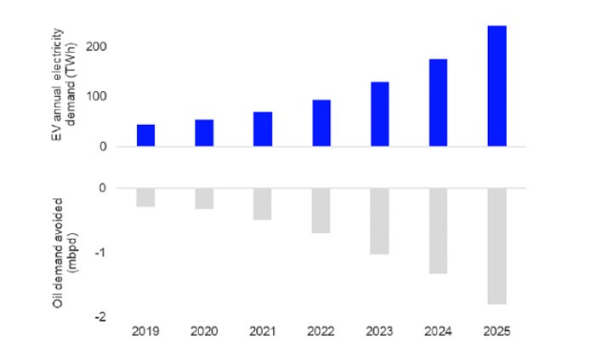
Source: Ember. Please see the end for important legal disclosures.
Why 2026 isn’t 2022
As governments and companies respond to the latest energy shock, they are both benefitting from recent growth in the green economy as well as contributing to its continued growth.
The performance of the green economy – as tracked by the FTSE Environmental Opportunities All-Share (EOAS) equity index – stuttered in the wake of Russia’s full-scale invasion of Ukraine in 2022, and the subsequent rise in energy prices. Then, many of its growth-orientated constituents were hit by interest rate rises, general ‘risk-off’ sentiment and by poor relative performance compared with the fossil fuel sector, as well as a reversion to more typical valuations after a strong rally after 2019.
However, between the start of 2023 and end June 2026, the FTSE EOAS rose by 123%, compared with 95% for its benchmark, the FTSE Global All Cap. This outperformance is despite flattening investment flows and geopolitical tensions affecting green technology supply chains. And, while the index sold off during the short-lived tariff war in the first quarter of 2025 and in response to the beginning of hostilities in the Middle East, it strongly rallied following both events.
The index is positioned differently in 2026 than in 2022 to weather a similar period of turbulence. It is broader, with 1,208 constituents in February 2026, compared with 612 in February 2022, and less concentrated. It is also more conservatively valued, with a price/equity premium in the first quarter of 2026 of 13%, compared with 26% in 2022.
Notably, the resilience of the index has been underpinned by the positive performance of the renewable energy sub-sector – part of the green economy that has been particularly volatile and vulnerable to climate policy reversals in the past. This strength has come from both renewable energy-generating power utilities and renewable energy equipment manufacturers. Renewables are benefitting both from demand from data centres needed for the AI boom, but also from demand from transportation, industrial process and building heating and cooling.
A regionally differentiated green economy
Speaking at the recent LSEG Green Economy Forum, Paolo Macrì, head of thematic research Impax Asset Management, noted that the primary single engine of the green economy – concern over climate change, and related policies – has turned into three: energy security, industrial competitiveness and plain power demand. None of these depend on climate policy to drive performance, he added.
These drivers are contributing to the evolution of the energy transition and the green economy. But that transition will move at different speeds, and with different characteristics, in different parts of the world. It will be shaped by existing energy mixes, fiscal space, domestic industrial policy and the nature and state of local power systems.
Asia is already at the forefront of the energy transition, supported by strong government policy, clean energy adoption and investment. Asian companies accounted for 47% of the global green economy by revenues in 2025, led by China, Japan, Hong Kong and South Korea – and including 60% of the global Electrified Road Vehicles and Devices sub-sector.
Energy security will be a particular focus of the green economy in the region, given Asia’s heavy dependence on imported fossil fuels, but policy measures – such as Japan’s US$1 trillion Green Transformation programme, to reach net zero by 2050 – form part of the regional context.
In the United States, the green economy is growing against a changing policy environment. Recent federal policy has sought to increase domestic oil and gas production, prioritising energy affordability and inflation control.
Nonetheless, the US remains the largest green economy by market capitalisation, at US$6 trillion, accounting for 57% of the global total. Here, it is about technology transition – it accounts for 75% of revenues from the Cloud Computing sub-sector – and the scramble to generate sufficient power for its AI boom. Here, solar and, to a lesser extent wind generating capacity, is proving attractive, as they are quicker and easier to install than fossil fuel-fired generation.
Concern about climate change remains a key motivator for the green economy, in Europe, although its structural shift towards diversified, and predominantly renewable, energy sources was given greater momentum by the full-scale invasion of Ukraine in 2022. The resulting REPowerEU Plan, which became law in early 2026, sets a target of 42.5% renewables in overall energy consumption by 2030, up from 18.9% in 2022.
Europe’s green economy has a market capitalisation of US$1.25 trillion and green revenues of US$1.20 trillion. It is more geographically diverse than Asia, with 91% of those revenues spread across 10 countries, led by Germany, France and the UK. European companies play a key role globally in green sectors such as bioenergy, cogeneration and food and agriculture.
Beyond decarbonisation – new drivers of the green economy
Also speaking at the Green Economy Forum, Jon Wallace, investment manager at Jupiter Asset Management, noted that the next phase of the growth of the green economy is likely to be led not by decarbonisation policy, but by a combination of technology adoption and resilience, including energy security.
What has become clear is that, in a world where roughly three-quarters of the population lives in countries that are net-fossil fuel importers, [note6] energy transition and energy security have become aligned rather than competing priorities. This increased focus on resilience and security is contributing to the additional impetus to a green economy that is becoming increasingly multifaceted and diversified.

footnotes
[1] https://energyandcleanair.org/the-hedge-that-paid-off-how-pakistans-solar-boom-is-shielding-it-from-the-hormuz-crisis/ | Back to Note 1
[2] https://ember-energy.org/latest-insights/global-electricity-review-2026/ | Back to Note 2
[3] https://uk.finance.yahoo.com/news/electric-vehicles-hit-25-global-142900686.html | Back to Note 3
[4] https://ember-energy.org/latest-updates/electric-vehicles-avoided-oil-consumption-equivalent-to-70-of-irans-exports-in-2025/ | Back to Note 4
[5] https://www.scmp.com/business/china-evs/article/3356789/evs-capture-two-thirds-chinas-car-market-record-breaking-week | Back to Note 5
[6] https://ember-energy.org/latest-insights/energy-security-in-an-insecure-world | Back to Note 6
Read more about

Legal Disclaimer
Republication or redistribution of LSE Group content is prohibited without our prior written consent.
The content of this publication is for informational purposes only and has no legal effect, does not form part of any contract, does not, and does not seek to constitute advice of any nature and no reliance should be placed upon statements contained herein. Whilst reasonable efforts have been taken to ensure that the contents of this publication are accurate and reliable, LSE Group does not guarantee that this document is free from errors or omissions; therefore, you may not rely upon the content of this document under any circumstances and you should seek your own independent legal, investment, tax and other advice. Neither We nor our affiliates shall be liable for any errors, inaccuracies or delays in the publication or any other content, or for any actions taken by you in reliance thereon.
Copyright © 2026 London Stock Exchange Group. All rights reserved.
The content of this publication is provided by London Stock Exchange Group plc, its applicable group undertakings and/or its affiliates or licensors (the “LSE Group” or “We”) exclusively.
Neither We nor our affiliates guarantee the accuracy of or endorse the views or opinions given by any third party content provider, advertiser, sponsor or other user. We may link to, reference, or promote websites, applications and/or services from third parties. You agree that We are not responsible for, and do not control such non-LSE Group websites, applications or services.
The content of this publication is for informational purposes only. All information and data contained in this publication is obtained by LSE Group from sources believed by it to be accurate and reliable. Because of the possibility of human and mechanical error as well as other factors, however, such information and data are provided "as is" without warranty of any kind. You understand and agree that this publication does not, and does not seek to, constitute advice of any nature. You may not rely upon the content of this document under any circumstances and should seek your own independent legal, tax or investment advice or opinion regarding the suitability, value or profitability of any particular security, portfolio or investment strategy. Neither We nor our affiliates shall be liable for any errors, inaccuracies or delays in the publication or any other content, or for any actions taken by you in reliance thereon. You expressly agree that your use of the publication and its content is at your sole risk.
To the fullest extent permitted by applicable law, LSE Group, expressly disclaims any representation or warranties, express or implied, including, without limitation, any representations or warranties of performance, merchantability, fitness for a particular purpose, accuracy, completeness, reliability and non-infringement. LSE Group, its subsidiaries, its affiliates and their respective shareholders, directors, officers employees, agents, advertisers, content providers and licensors (collectively referred to as the “LSE Group Parties”) disclaim all responsibility for any loss, liability or damage of any kind resulting from or related to access, use or the unavailability of the publication (or any part of it); and none of the LSE Group Parties will be liable (jointly or severally) to you for any direct, indirect, consequential, special, incidental, punitive or exemplary damages, howsoever arising, even if any member of the LSE Group Parties are advised in advance of the possibility of such damages or could have foreseen any such damages arising or resulting from the use of, or inability to use, the information contained in the publication. For the avoidance of doubt, the LSE Group Parties shall have no liability for any losses, claims, demands, actions, proceedings, damages, costs or expenses arising out of, or in any way connected with, the information contained in this document.
LSE Group is the owner of various intellectual property rights ("IPR”), including but not limited to, numerous trademarks that are used to identify, advertise, and promote LSE Group products, services and activities. Nothing contained herein should be construed as granting any licence or right to use any of the trademarks or any other LSE Group IPR for any purpose whatsoever without the written permission or applicable licence terms.