
Alessandro Sanos, CAIA, SCR
The Strait of Hormuz, a maritime chokepoint of strategic importance, is once again at the center of global commodity risk.
What was initially priced as a low‑probability conflict, has evolved into a material disruption affecting the physical flows of energy, commodities, and gold.
At its narrowest, the strait is only about 21 nautical miles wide. At that point, Iran’s waters to the north and Oman’s to the south meet, leaving no international water. Ships sail through two narrow lanes, just 2 miles wide each - one for inbound traffic, and one for vessels leaving the Gulf, with a small buffer zone of 2 miles in between.
Traders report intense stress driven by the effective closure of the strait. Many oil traders are in wait and see mode, trying to assess how long the disruption will last. At the same time, many buyers and refiners are scrambling for alternative crude supplies. While global oil availability exists, short notice volumes are hard to secure because much of the supply either already committed or sanctioned. Whilst there is not outright panic yet, the market shows urgency and deep concern, with traders and refiners increasingly worried about prolonged outages.
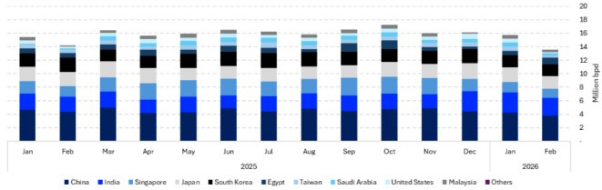
In 2025, around 16 million barrels per day of crude and roughly 3.8 million barrels per day of refined products transited the strait. That represents just over 30% of global seaborne crude trade and about 20% of seaborne refined product flows, making any disruption highly significant.
Source: LNG transits. Past performance is not a guide to future returns. Please see the end for important legal disclosures.
Main destinations of Middle East crude
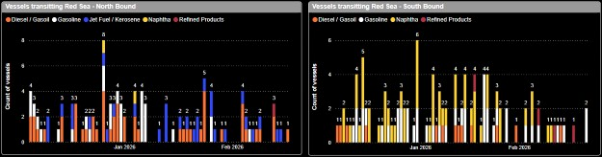
Most of the crude moving through the strait is destined for Asia, meaning Asian markets are likely to bear the brunt of supply disruptions. Since the conflict escalated, many vessels have been warned away from the strait. Tankers are largely stuck at anchorage inside the Gulf or waiting outside it, with only limited transit still occurring.
As a result, cargoes that would normally move from the Middle East are not reaching the market, forcing buyers to scramble for alternative supplies. The disruption is less about changed destinations and more about the sudden loss of access to Middle Eastern barrels, creating acute stress across crude markets.
Markets initially priced a low probability of conflict and assumed any war would be brief and limited, leading to only modest early increases in energy prices. As tensions escalate and the conflict is proving being broader and more severe than expected, oil prices have significantly risen campared to a few weeks ago. The sharper reaction has been in natural gas, which saw little movement initially but has since surged nearly 70% versus early January levels.
Gulf oil exporters have tried to maintain supply continuity by diverting exports away from the Strait of Hormuz where possible. Countries with some flexibility - Saudi Arabia, the UAE, and Oman - have reduced the share of exports routed through the strait this year, using alternative ports and pipelines instead.
But this flexibility is inherently constrained.
In Saudi, for example, there is a single main east‑west pipeline to Yanbu with a capacity of about 5 million barrels per day, compared with roughly 7 million barrels per day that Saudi Arabia has historically exported through its Gulf ports. The UAE faces a similar limitation: its main export pipeline can carry around 1.5 million barrels per day, versus about 2.8 million barrels per day typically shipped through the Gulf. As a result, any volume via pipeline will only be incremental, not transformational.
Shipping data also shows shorter transit times, down from about 23 days to 16 days in February, suggesting producers accelerated loadings and shipments ahead of the recent escalation. Overall, exporters have taken mitigating steps, but structural capacity constraints mean these measures only partially offset the disruption.
Beyond crude, the LNG market has turned extremely volatile after QatarEnergy suspended production at the Ras Laffan LNG plant following security incidents near the site. Ras Laffan is a major global facility, supplying roughly 20% of global LNG, so the shutdown has had an immediate and severe price impact. Gas benchmark prices have jumped by around 40% in a single day, far outpacing oil’s roughly 8% rise.
Source: LNG transits. Past performance is not a guide to future returns. Please see the end for important legal disclosures.
Most Middle Eastern LNG flows go to Asia, but the loss of such a large volume is creating global knock on effects, tightening supply everywhere. The episode highlights how the conflict is now causing real, physical disruption, with logistical problems rapidly escalating and significantly amplifying market stress.
Recent shifts in oil and LNG flows to Asia are reshaping global dynamics. China, the largest crude importer, is relatively well positioned to handle short term disruption thanks to large commercial and strategic stockpiles and sanctioned Iranian barrels held offshore that can be released if needed. India, another major importer, has been buying more Saudi crude under U.S. pressure to reduce Russian imports, but this is likely to reverse in the short term, with India turning back to Russian barrels while the Strait of Hormuz remains disrupted.
Japan and South Korea have some strategic buffers, including joint Aramco–Japan stocks in Okinawa, which could be released if disruptions persist. Even so, refiners in both countries are actively seeking replacement barrels, adding upward pressure on prices. Overall, Asia will absorb most of the impact, with second order effects showing up in trade re routing and firmer global prices.
Product markets are seeing uneven but intensifying stress
Source: LNG transits. Past performance is not a guide to future returns. Please see the end for important legal disclosures.
clean products
Source: LNG transits. Past performance is not a guide to future returns. Please see the end for important legal disclosures.
dirty products
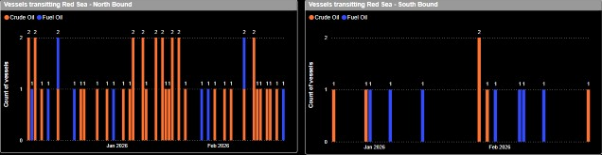
Source: LNG transits. Past performance is not a guide to future returns. Please see the end for important legal disclosures.
Diesel and gasoil markets are experiencing sharper price increases than other refined products, reflecting Europe’s growing exposure to Middle Eastern supply. Since the ban on Russian diesel, Europe has increasingly relied on imports from the Middle East. This dependency intensified further at the start of this year, when restrictions were extended to include refined products made from Russian crude regardless of where they were processed. India had previously acted as a key swing supplier to Europe, but this role has diminished because Indian refiners rely heavily on Russian feedstock and are now constrained by the expanded ban. As a result, the Middle East had been filling much of Europe’s diesel and gasoil gap. The current disruption in the Strait of Hormuz therefore directly threatens one of Europe’s most critical replacement supply sources. With Middle Eastern flows at risk and Indian barrels unavailable, Europe faces acute uncertainty over where incremental diesel and gasoil supply will come from, pushing prices higher and tightening the market.
The LPG market is under severe pressure, with price increases more pronounced than for naphtha. Tightness was already evident before the conflict, after Saudi Arabia cancelled all March cargoes from its Jumah NGL facility, removing about 300,000 tons per month of supply. The disruption to additional Middle Eastern flows has compounded this shortage. Asia is highly exposed: roughly 50% of LPG imports come from the Middle East, and India relies on the region for nearly 90% of its supply, while holding only around two weeks of inventories. India is now urgently seeking alternative sources, underscoring how vulnerable the LPG market is to prolonged disruption.
Naphtha prices have risen alongside other products, driven primarily by the broader rally in crude, but the increase has been less extreme than in LPG. As a key petrochemical feedstock, naphtha remains closely tied to crude price movements and Middle Eastern export flows into Asia. Unlike LPG, naphtha has not faced major product‑specific outages, leaving it less acutely affected so far. However, Asian petrochemical producers remain exposed if Gulf supply disruptions persist, meaning second‑order tightening risks could emerge over time.
Methanol markets are coming under pressure as the Middle East, and Iran in particular, is a key global supplier. Iranian methanol production is highly seasonal: output typically falls during winter because natural gas feedstock is diverted to domestic heating, then rises as temperatures increase. The market has therefore been emerging from a period when Iranian methanol supply was already limited. Despite this seasonal low point, prices are now moving higher because the closure of the Strait of Hormuz is expected to create further supply shortfalls. The disruption threatens exports not only from Iran but from other Middle Eastern producers as well, tightening availability into Asia. As a result, the market is pricing in reduced near‑term supply and higher risk, pushing methanol prices upward, particularly in Asian import markets. Overall, methanol is experiencing a compound shock: seasonal constraints layered on top of geopolitical disruption to a critical export route.
What happens at sea, is reflected in the skies where most air traffic into and out of Dubai has stopped. This is causing a disruption for gold as Dubai is accounts for approximately 20% of global gold flows, with India being the largest destination of its exports.
Taken together, the developments underscore how quickly localized geopolitical shocks can cascade across global energy and commodities markets. While producers and consumers have taken mitigating steps, from drawing on inventories, rerouting flows, to activating limited spare infrastructure, these measures only partially offset the loss of Middle Eastern supply.
With Asia bearing the greatest exposure and downstream markets increasingly strained, the situation is no longer defined by price volatility alone, but by physical availability, logistics, and duration risk.
The longer the disruption persists, the more pronounced the second‑order effects across commodities, trade flows, and end‑users are likely to become.

Legal Disclaimer
Republication or redistribution of LSEG content is prohibited without our prior written consent.
The content of this publication is for informational purposes only and has no legal effect, does not form part of any contract, does not, and does not seek to constitute advice of any nature and no reliance should be placed upon statements contained herein. Whilst reasonable efforts have been taken to ensure that the contents of this publication are accurate and reliable, LSEG does not guarantee that this document is free from errors or omissions; therefore, you may not rely upon the content of this document under any circumstances and you should seek your own independent legal, investment, tax and other advice. Neither We nor our affiliates shall be liable for any errors, inaccuracies or delays in the publication or any other content, or for any actions taken by you in reliance thereon.
Copyright © 2025 London Stock Exchange Group. All rights reserved.
The content of this publication is provided by London Stock Exchange Group plc, its applicable group undertakings and/or its affiliates or licensors (the “LSE Group” or “We”) exclusively.
Neither We nor our affiliates guarantee the accuracy of or endorse the views or opinions given by any third party content provider, advertiser, sponsor or other user. We may link to, reference, or promote websites, applications and/or services from third parties. You agree that We are not responsible for, and do not control such non-LSE Group websites, applications or services.
The content of this publication is for informational purposes only. All information and data contained in this publication is obtained by LSE Group from sources believed by it to be accurate and reliable. Because of the possibility of human and mechanical error as well as other factors, however, such information and data are provided "as is" without warranty of any kind. You understand and agree that this publication does not, and does not seek to, constitute advice of any nature. You may not rely upon the content of this document under any circumstances and should seek your own independent legal, tax or investment advice or opinion regarding the suitability, value or profitability of any particular security, portfolio or investment strategy. Neither We nor our affiliates shall be liable for any errors, inaccuracies or delays in the publication or any other content, or for any actions taken by you in reliance thereon. You expressly agree that your use of the publication and its content is at your sole risk.
To the fullest extent permitted by applicable law, LSE Group, expressly disclaims any representation or warranties, express or implied, including, without limitation, any representations or warranties of performance, merchantability, fitness for a particular purpose, accuracy, completeness, reliability and non-infringement. LSE Group, its subsidiaries, its affiliates and their respective shareholders, directors, officers employees, agents, advertisers, content providers and licensors (collectively referred to as the “LSE Group Parties”) disclaim all responsibility for any loss, liability or damage of any kind resulting from or related to access, use or the unavailability of the publication (or any part of it); and none of the LSE Group Parties will be liable (jointly or severally) to you for any direct, indirect, consequential, special, incidental, punitive or exemplary damages, howsoever arising, even if any member of the LSE Group Parties are advised in advance of the possibility of such damages or could have foreseen any such damages arising or resulting from the use of, or inability to use, the information contained in the publication. For the avoidance of doubt, the LSE Group Parties shall have no liability for any losses, claims, demands, actions, proceedings, damages, costs or expenses arising out of, or in any way connected with, the information contained in this document.
LSE Group is the owner of various intellectual property rights ("IPR”), including but not limited to, numerous trademarks that are used to identify, advertise, and promote LSE Group products, services and activities. Nothing contained herein should be construed as granting any licence or right to use any of the trademarks or any other LSE Group IPR for any purpose whatsoever without the written permission or applicable licence terms.