


Chantel Breedt
Compliance teams are processing larger customer populations, broader sanctions obligations and rising expectations around risk management. As teams face increasing volumes of alerts across sanctions screening, politically exposed person (PEP) screening and adverse media monitoring, reducing false positives remains one of the most persistent operational challenges.
While screening technology remains central to the effectiveness of screening programmes, it is rarely the only factor behind high alert volumes. False positives are often shaped just as much by data quality, operational processes, workflow design and analyst decision-making practices.
Why is it difficult to reduce false positives in screening?
Many compliance programmes invest significant effort in improving screening effectiveness, yet false positives remain difficult to eliminate entirely.
Incomplete customer records, inconsistent naming conventions, insufficient contextual information and varying risk appetites can all contribute to excessive alert volumes.
Additionally, today's compliance environment involves increasingly complex identity data. Individuals and organisations may be known by multiple names, aliases, transliterations, translations, or alternative spellings. While capturing these variations is essential for effective risk management, it can also increase the number of potential matches requiring investigation.
As a result, compliance teams face a difficult trade-off. Reducing alert volumes may improve operational efficiency, but screening too narrowly could increase the risk of overlooking relevant matches. Conversely, broader screening criteria may provide greater coverage but generate a larger investigative workload.
There is no single configuration that eliminates false positives entirely. Screening programmes typically evolve over time as organisations review performance, refine processes and align screening practices with their risk appetite.
What is shaping screening practices today?
In response to these challenges, one of the most significant developments in modern screening programmes is the growing use of contextual information to support decision-making. While name matching remains important, many organisations now incorporate additional data points into investigations. Information such as dates of birth, jurisdictions, entity identifiers and other structured attributes can help analysts assess potential matches more accurately and reduce unnecessary investigative effort.
Data quality also shapes screening outcomes. Poorly structured, incomplete, or inconsistent records can increase alert volumes and make investigations harder to resolve efficiently.
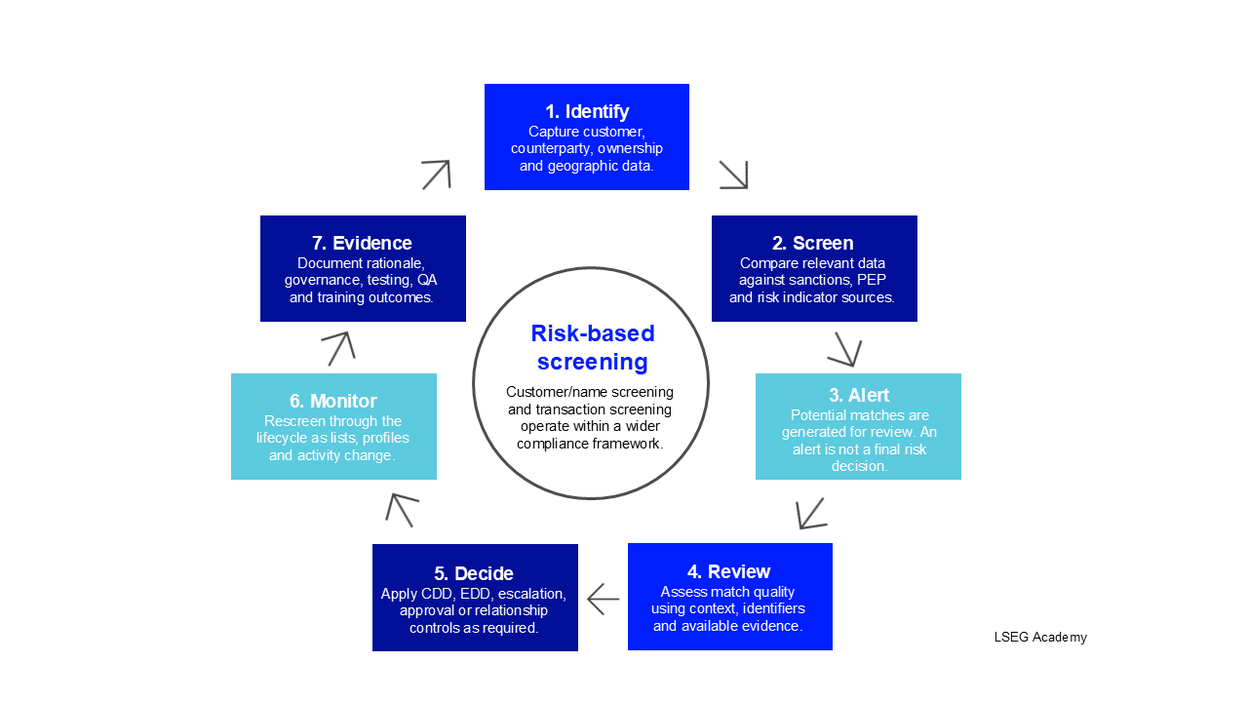
This growing focus on context and data quality is also changing how organisations view screening programmes. Rather than treating screening as a standalone technology solution, many are taking an end-to-end approach that examines the entire screening lifecycle, from policies and escalation procedures to case management and governance. This can help improve consistency and reduce inefficiencies.
How can workflow design improve screening effectiveness?
Beyond data quality and contextual information, screening effectiveness also depends on how alerts are investigated, prioritised and resolved. Even relatively small workflow improvements can have a meaningful impact on analyst productivity when applied across thousands of investigations.
As a result, many compliance organisations are reviewing how investigation workflows support prioritisation, escalation and case management activities.
Even as screening technologies evolve, human judgement remains central to the investigation process. Analysts still assess context, weigh risk indicators and determine whether an alert warrants further action. Clear procedures, consistent guidance and easy access to supporting information can help improve decision quality, reduce duplication of effort and ensure similar alerts are handled in a consistent manner. This can strengthen efficiency, auditability and overall compliance outcomes.
For many organisations, some of the most significant efficiency gains come from improving how investigations are conducted rather than changing what is screened.
Screening programmes will continue to face growing volumes of data, increasingly complex customer identities and evolving risk requirements. The organisations making the greatest progress are often those improving how data, context and investigations work together throughout the screening process.
Key screening takeaways for compliance professionals
- False positives are a business and risk management challenge, not just a technology challenge.
- Better context and better data can help improve screening precision.
- Strong workflows and consistent processes often deliver bigger gains than simply changing screening technology.
Further learning on screening, risk and compliance
Professionals seeking a deeper understanding of sanctions screening, customer due diligence, investigation workflows and risk-based compliance approaches can continue their learning through related courses, webinars and learning pathways. These learning experiences explore how screening programmes operate in practice, how investigations are conducted and how organisations balance operational efficiency with regulatory expectations.
Legal Disclaimer
Republication or redistribution of LSE Group content is prohibited without our prior written consent.
The content of this publication is for informational purposes only and has no legal effect, does not form part of any contract, does not, and does not seek to constitute advice of any nature and no reliance should be placed upon statements contained herein. Whilst reasonable efforts have been taken to ensure that the contents of this publication are accurate and reliable, LSE Group does not guarantee that this document is free from errors or omissions; therefore, you may not rely upon the content of this document under any circumstances and you should seek your own independent legal, investment, tax and other advice. Neither We nor our affiliates shall be liable for any errors, inaccuracies or delays in the publication or any other content, or for any actions taken by you in reliance thereon.
Copyright © 2026 London Stock Exchange Group. All rights reserved.
The content of this publication is provided by London Stock Exchange Group plc, its applicable group undertakings and/or its affiliates or licensors (the “LSE Group” or “We”) exclusively.
Neither We nor our affiliates guarantee the accuracy of or endorse the views or opinions given by any third party content provider, advertiser, sponsor or other user. We may link to, reference, or promote websites, applications and/or services from third parties. You agree that We are not responsible for, and do not control such non-LSE Group websites, applications or services.
The content of this publication is for informational purposes only. All information and data contained in this publication is obtained by LSE Group from sources believed by it to be accurate and reliable. Because of the possibility of human and mechanical error as well as other factors, however, such information and data are provided "as is" without warranty of any kind. You understand and agree that this publication does not, and does not seek to, constitute advice of any nature. You may not rely upon the content of this document under any circumstances and should seek your own independent legal, tax or investment advice or opinion regarding the suitability, value or profitability of any particular security, portfolio or investment strategy. Neither We nor our affiliates shall be liable for any errors, inaccuracies or delays in the publication or any other content, or for any actions taken by you in reliance thereon. You expressly agree that your use of the publication and its content is at your sole risk.
To the fullest extent permitted by applicable law, LSE Group, expressly disclaims any representation or warranties, express or implied, including, without limitation, any representations or warranties of performance, merchantability, fitness for a particular purpose, accuracy, completeness, reliability and non-infringement. LSE Group, its subsidiaries, its affiliates and their respective shareholders, directors, officers employees, agents, advertisers, content providers and licensors (collectively referred to as the “LSE Group Parties”) disclaim all responsibility for any loss, liability or damage of any kind resulting from or related to access, use or the unavailability of the publication (or any part of it); and none of the LSE Group Parties will be liable (jointly or severally) to you for any direct, indirect, consequential, special, incidental, punitive or exemplary damages, howsoever arising, even if any member of the LSE Group Parties are advised in advance of the possibility of such damages or could have foreseen any such damages arising or resulting from the use of, or inability to use, the information contained in the publication. For the avoidance of doubt, the LSE Group Parties shall have no liability for any losses, claims, demands, actions, proceedings, damages, costs or expenses arising out of, or in any way connected with, the information contained in this document.
LSE Group is the owner of various intellectual property rights ("IPR”), including but not limited to, numerous trademarks that are used to identify, advertise, and promote LSE Group products, services and activities. Nothing contained herein should be construed as granting any licence or right to use any of the trademarks or any other LSE Group IPR for any purpose whatsoever without the written permission or applicable licence terms.
