


James Perkins
Despite rapid advances in artificial intelligence (AI), many financial services teams still face challenges when deploying models in real-world workflows. A key limitation is that models may not consistently access governed, real-time data in a consistent or reliable manner across all use cases.
While AI capabilities continue to expand, certain tools may still have constrained access to real-time, structured, and trusted data, factors that can influence performance in practical use cases. In some scenarios, models operate with restricted context and may not connect directly to external systems, which can, in some cases, contribute to a gap between potential and real-world applications.
The Model Context Protocol (MCP) is one approach being explored to support more standardised AI integration. By aiming to enable more consistent connections with external data sources and tools, frameworks like MCP aim to streamline access to data across APIs and systems. Compared with highly customised integrations, a more unified approach may help simplify how data is accessed and used.
What is MCP?
MCP is an emerging open standard designed to support AI systems in connecting with external data, tools, and services, helping them access the context needed to support more context-informed outputs.
MCP provides a common framework that aims to standardise how different systems interact. Instead of relying on complex, one-off integrations, it offers a more consistent way for AI to request and receive information.
At a high level, it works through a simple structure: an AI application (host) connects via a standard interface (connector) to external data sources or tools (servers), supporting a more scalable and consistent approach to integration.
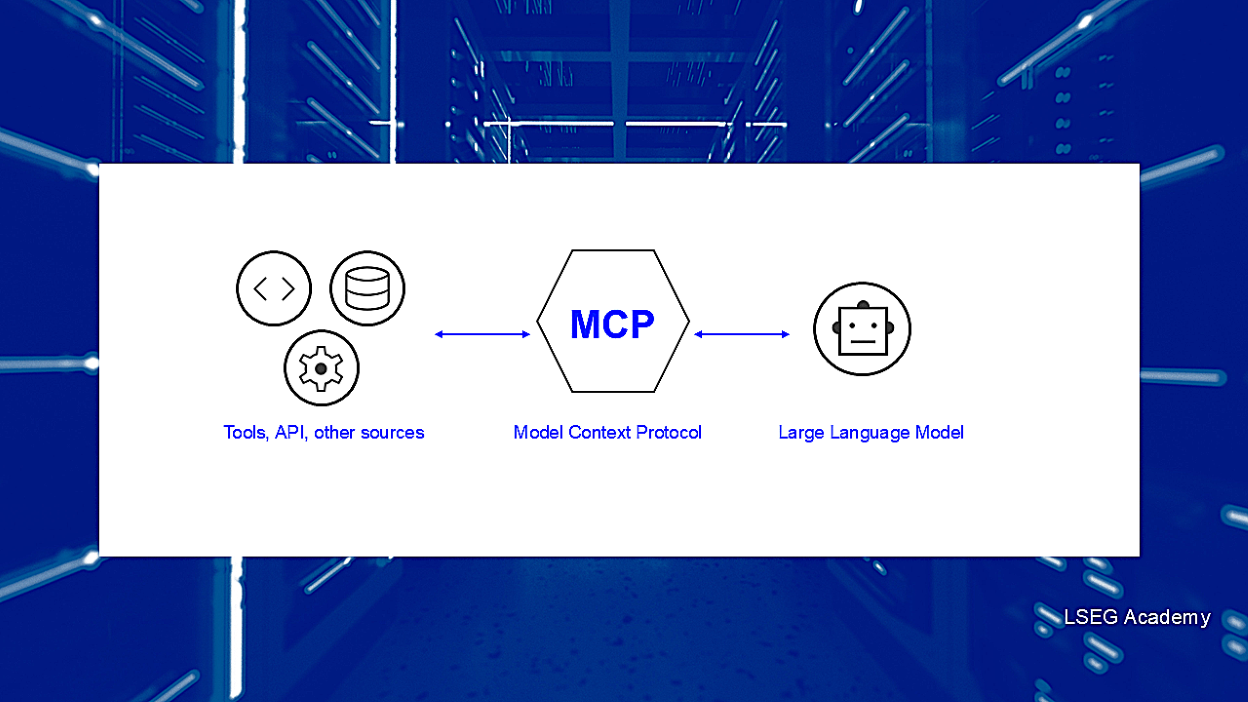
How does MCP work?
In practice, MCP can enable AI systems to go beyond static, pre-trained responses by allowing them to retrieve real-time data, perform calculations, and interact with external tools. This can, in some cases, support a shift from AI simply providing answers to supporting more actionable and dynamic workflows. Through MCP, AI can access three key elements:
- Tools - the actions MCP allows an AI system to take
- Data - the information MCP enables it to retrieve
- Context - how MCP can support the model in interpreting and responding to a request
Together, these capabilities can help support more relevant and context-informed AI outputs.
For example, an AI assistant used by a financial services team could use MCP to query a governed market dataset, retrieve reference data, apply a calculation, and return an answer that can reflect current market conditions. Instead of relying on static training data or manual inputs, the model can access trusted, up-to-date information when available.
Why MCP matters for AI in financial services
In financial services, where decisions depend on accurate, structured, and well-governed data, the ability to connect AI with reliable information sources is increasingly important. This is particularly relevant in environments such as LSEG, where access to trusted, structured financial data is critical.
MCP supports:
- More consistent access to structured and trusted data for regulated decision-making
- Improved context accuracy for AI-driven outputs
- More efficient and streamlined workflows
By providing a standardised way for AI systems to interact with data and tools, protocols like MCP aim to help organisations deliver information in a format that AI can use more consistently. Over time, this can support the development of AI systems that can work more directly with real-world financial data, enabling more informed and context-aware analysis.
Key takeaways
- Many AI systems remain limited by data access and integration complexity
- MCP serves as a standardised approach to connecting AI with data and tools
- MCP supports more context-aware and data-driven AI applications
Further learning on MCP
For readers who want to explore this topic in more depth, the LSEG Academy learning path on Model Context Protocol (MCP) looks more closely at how MCP supports context-aware AI, real-time data access, and data-driven decision-making across industries.
Legal Disclaimer
Republication or redistribution of LSE Group content is prohibited without our prior written consent.
The content of this publication is for informational purposes only and has no legal effect, does not form part of any contract, does not, and does not seek to constitute advice of any nature and no reliance should be placed upon statements contained herein. Whilst reasonable efforts have been taken to ensure that the contents of this publication are accurate and reliable, LSE Group does not guarantee that this document is free from errors or omissions; therefore, you may not rely upon the content of this document under any circumstances and you should seek your own independent legal, investment, tax and other advice. Neither We nor our affiliates shall be liable for any errors, inaccuracies or delays in the publication or any other content, or for any actions taken by you in reliance thereon.
Copyright © 2026 London Stock Exchange Group. All rights reserved.
The content of this publication is provided by London Stock Exchange Group plc, its applicable group undertakings and/or its affiliates or licensors (the “LSE Group” or “We”) exclusively.
Neither We nor our affiliates guarantee the accuracy of or endorse the views or opinions given by any third party content provider, advertiser, sponsor or other user. We may link to, reference, or promote websites, applications and/or services from third parties. You agree that We are not responsible for, and do not control such non-LSE Group websites, applications or services.
The content of this publication is for informational purposes only. All information and data contained in this publication is obtained by LSE Group from sources believed by it to be accurate and reliable. Because of the possibility of human and mechanical error as well as other factors, however, such information and data are provided "as is" without warranty of any kind. You understand and agree that this publication does not, and does not seek to, constitute advice of any nature. You may not rely upon the content of this document under any circumstances and should seek your own independent legal, tax or investment advice or opinion regarding the suitability, value or profitability of any particular security, portfolio or investment strategy. Neither We nor our affiliates shall be liable for any errors, inaccuracies or delays in the publication or any other content, or for any actions taken by you in reliance thereon. You expressly agree that your use of the publication and its content is at your sole risk.
To the fullest extent permitted by applicable law, LSE Group, expressly disclaims any representation or warranties, express or implied, including, without limitation, any representations or warranties of performance, merchantability, fitness for a particular purpose, accuracy, completeness, reliability and non-infringement. LSE Group, its subsidiaries, its affiliates and their respective shareholders, directors, officers employees, agents, advertisers, content providers and licensors (collectively referred to as the “LSE Group Parties”) disclaim all responsibility for any loss, liability or damage of any kind resulting from or related to access, use or the unavailability of the publication (or any part of it); and none of the LSE Group Parties will be liable (jointly or severally) to you for any direct, indirect, consequential, special, incidental, punitive or exemplary damages, howsoever arising, even if any member of the LSE Group Parties are advised in advance of the possibility of such damages or could have foreseen any such damages arising or resulting from the use of, or inability to use, the information contained in the publication. For the avoidance of doubt, the LSE Group Parties shall have no liability for any losses, claims, demands, actions, proceedings, damages, costs or expenses arising out of, or in any way connected with, the information contained in this document.
LSE Group is the owner of various intellectual property rights ("IPR”), including but not limited to, numerous trademarks that are used to identify, advertise, and promote LSE Group products, services and activities. Nothing contained herein should be construed as granting any licence or right to use any of the trademarks or any other LSE Group IPR for any purpose whatsoever without the written permission or applicable licence terms.
