


Sacha Jingree
Style classification plays a central role in asset allocation, performance evaluation and portfolio construction. Investors may select a fund because its stated style serves a particular purpose within their portfolio. A Large Cap Value fund, for example, represents a different set of expected characteristics from a Small Cap Growth fund. Style and size classifications allow funds to be compared with benchmarks or portfolios that share similar size and investment-style characteristics.
However, a fund’s characteristics can change over time, meaning its actual exposure may no longer fully reflect what an investor originally expected. This raises an important question: how can investors understand whether a fund still provides the exposure its classification suggests?
Style drift can be viewed through the decisions of an individual portfolio manager. But peer-group analysis raises another possibility: what if similar shifts are occurring across multiple managers? Looking beyond an individual fund can help distinguish manager-specific decisions from positioning shared across a wider peer group. Research by David Suarez, Director of Portfolio Research at LSEG, found that managers within the same peer group often tilted their portfolios away from their benchmark at the same time. The research also identified stock-selection decisions that were not always aligned with stated style mandates.
What is investment style, and why does fund style drift matter?
There are many ways to invest, and funds can follow different investment styles. No investment style is inherently better than another. These styles describe the characteristics or approach associated with a fund, from Growth, Value and Core to size classifications such as Small, Mid or Large Cap. But a fund does not always stay within those characteristics. Style drift occurs when a fund moves away from its stated mandate or investment style as its holdings and exposures change. Over time, this can change the fund's risk and diversification profile. This presents a significant challenge, as the fund may no longer provide the exposure an investor originally expected.
How can style drift be identified in a fund?
Several analytical approaches can help investors assess whether a portfolio remains aligned with its stated style and size classification. Holdings-based analysis, factor analysis and attribution each provide a different view of how those characteristics may be changing.
Holdings-based analysis shows how a portfolio’s size and style exposures change over time. For example, the Holdings Based Style Analysis in Portfolio Analytics can be used to compare these exposures across different periods.
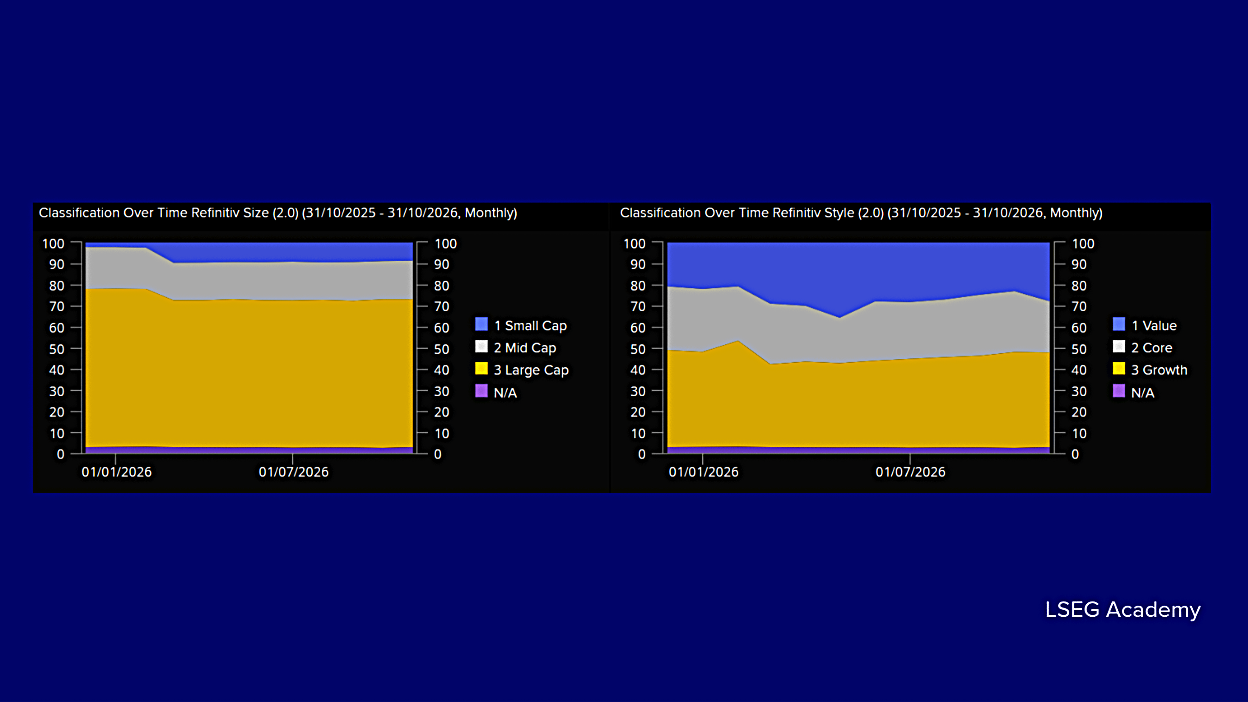
Source: LSEG Workspace Portfolio Analytics
In this example, exposure to small cap stocks increases, while value exposure rises as core exposure declines.
Across the portfolios examined in the research, similar shifts also appeared at peer-group level. In terms of size:
- Small Cap managers allocated away from Small Cap into Mid Cap and Large Cap stocks.
- Mid Cap managers underweighted Mid Cap in favour of Small Cap and Large Cap stocks.
- Large Cap managers shifted away from Large Cap in favour of Small Cap.
For style allocations, the research also found that:
- Core managers allocated away from Growth into Value.
- Value managers also overweighted Value, with the exception of Large Cap managers.
- Growth managers were relatively neutral and did not show the same directional consistency.
Factor analysis provides another way to examine what may be driving a portfolio’s exposures. The LSEG Global Equity Risk Model, for example, can support this type of analysis. The research examined the relationship between industry classifications, size and style, identifying systematic tilts within the sample portfolios. As smaller companies are disproportionately represented in healthcare, this sector was used as a proxy for small cap positioning. However, Small Cap managers consistently demonstrated a tilt away from this sector.
Attribution analysis adds another perspective by separating the effects of asset allocation and stock picking decisions. Brinson Attribution within Portfolio Analytics is one example of this approach. The research suggests that managers often included companies in their portfolios in pursuit of alpha, or returns above the benchmark, even when those holdings did not align closely with the fund’s stated classification.
What causes fund style drift and how can it appear across peer groups?
Fund style drift does not always reflect an isolated manager decision. Market structure, liquidity and available investment opportunities can change over time. Portfolio mandates, capacity and risk constraints can also shape how closely a fund remains aligned with its style definition.
Managers may also make sector or stock-level decisions that cut across traditional Growth, Value and Size categories.
The picture changes when the same analysis is applied across a peer group. When similar positioning appears across a peer group, what looks like style drift at the individual-fund level may also reflect a shared tilt.
Across the portfolios examined, the research found several signs of common positioning:
- When managers were aggregated into peer portfolios, their deviations remained visible rather than cancelling each other out.
- Similar size and style tilts appeared within categories.
- Managers within style categories shared exposure to some of the same industries.
- Similar stock-level positioning appeared across different peer groups.
If managers within the same peer group take similar tilts at the same time, benchmark comparison tells only part of the story. It can become harder to distinguish an individual manager’s decisions from positioning that appears across the wider peer group. The analytical question then becomes “Does this positioning reflect an individual manager’s active decisions, or are managers across the category taking the same systematic bet?”
Shared positioning can also create overlapping portfolio-level exposures. Investors may appear diversified across managers and investment styles while the underlying holdings reveal growing concentrations in the same size, style, industry or individual securities across their fund allocations.
A fund's classification provides a useful starting point, but it may not fully describe its underlying exposures at a particular point in time. Looking at holdings, factor exposures and attribution alongside peer-group behaviour can provide a fuller picture of what a fund contributes to a portfolio, how its characteristics have changed, and whether those changes are unique to one manager or shared more widely.
Further learning on fund style drift
The recorded webinar on equity style drift provides a closer look at the research behind these findings. For readers interested in the analytical methods discussed, the on-demand learning on Portfolio Analytics looks more closely at analysing portfolio holdings and characteristics.
Disclaimer: This content is for informational purposes only and does not constitute investment advice, a recommendation, or an offer to buy or sell any financial instrument. Past performance and historical observations may not be indicative of future results.
Legal Disclaimer
Republication or redistribution of LSE Group content is prohibited without our prior written consent.
The content of this publication is for informational purposes only and has no legal effect, does not form part of any contract, does not, and does not seek to constitute advice of any nature and no reliance should be placed upon statements contained herein. Whilst reasonable efforts have been taken to ensure that the contents of this publication are accurate and reliable, LSE Group does not guarantee that this document is free from errors or omissions; therefore, you may not rely upon the content of this document under any circumstances and you should seek your own independent legal, investment, tax and other advice. Neither We nor our affiliates shall be liable for any errors, inaccuracies or delays in the publication or any other content, or for any actions taken by you in reliance thereon.
Copyright © 2026 London Stock Exchange Group. All rights reserved.
The content of this publication is provided by London Stock Exchange Group plc, its applicable group undertakings and/or its affiliates or licensors (the “LSE Group” or “We”) exclusively.
Neither We nor our affiliates guarantee the accuracy of or endorse the views or opinions given by any third party content provider, advertiser, sponsor or other user. We may link to, reference, or promote websites, applications and/or services from third parties. You agree that We are not responsible for, and do not control such non-LSE Group websites, applications or services.
The content of this publication is for informational purposes only. All information and data contained in this publication is obtained by LSE Group from sources believed by it to be accurate and reliable. Because of the possibility of human and mechanical error as well as other factors, however, such information and data are provided "as is" without warranty of any kind. You understand and agree that this publication does not, and does not seek to, constitute advice of any nature. You may not rely upon the content of this document under any circumstances and should seek your own independent legal, tax or investment advice or opinion regarding the suitability, value or profitability of any particular security, portfolio or investment strategy. Neither We nor our affiliates shall be liable for any errors, inaccuracies or delays in the publication or any other content, or for any actions taken by you in reliance thereon. You expressly agree that your use of the publication and its content is at your sole risk.
To the fullest extent permitted by applicable law, LSE Group, expressly disclaims any representation or warranties, express or implied, including, without limitation, any representations or warranties of performance, merchantability, fitness for a particular purpose, accuracy, completeness, reliability and non-infringement. LSE Group, its subsidiaries, its affiliates and their respective shareholders, directors, officers employees, agents, advertisers, content providers and licensors (collectively referred to as the “LSE Group Parties”) disclaim all responsibility for any loss, liability or damage of any kind resulting from or related to access, use or the unavailability of the publication (or any part of it); and none of the LSE Group Parties will be liable (jointly or severally) to you for any direct, indirect, consequential, special, incidental, punitive or exemplary damages, howsoever arising, even if any member of the LSE Group Parties are advised in advance of the possibility of such damages or could have foreseen any such damages arising or resulting from the use of, or inability to use, the information contained in the publication. For the avoidance of doubt, the LSE Group Parties shall have no liability for any losses, claims, demands, actions, proceedings, damages, costs or expenses arising out of, or in any way connected with, the information contained in this document.
LSE Group is the owner of various intellectual property rights ("IPR”), including but not limited to, numerous trademarks that are used to identify, advertise, and promote LSE Group products, services and activities. Nothing contained herein should be construed as granting any licence or right to use any of the trademarks or any other LSE Group IPR for any purpose whatsoever without the written permission or applicable licence terms.
