

Stephanie Maier
The review of the Sustainable Finance Disclosure Regulation (SFDR) marks an important step in the evolution of the EU sustainable finance framework. Nearly five years after its entry into force, the reform aims to improve transparency, enhance comparability and strengthen confidence in sustainability-labelled investment products.
As policymakers refine the future shape of the SFDR, calibration will be critical to ensuring the framework can both uphold credibility and support capital allocation towards the transition. Our impact analysis across global, developed and emerging listed equity market universes illustrates why this balance matters.
Building a more coherent ESG product framework, with transition at the core
Sustainable investing has evolved rapidly over the last decade, with asset owner adoption increasing from around 50% [note1] in 2019 to 73% today[note2] .As investors are increasingly focused on financing real-world decarbonisation, clearer product categories would help improve transparency and comparability across sustainability-labelled products.
However, the transition to a low-carbon economy will not be delivered by green assets alone[note3]. Sectors such as Energy, Utilities and Basic Materials remain central to industrial decarbonisation, infrastructure development and energy security.
This reflects the reality that transition investing is not limited to green assets but also includes the essential financing of high emitting sectors as they decarbonisate to support the shift toward a low carbon economy across sectors.
The impact of the proposed exclusion criteria in practice: a significant reduction in investable universes
Transition investing requires exposure to sectors central to infrastructure development, industrial transformation and energy system evolution. New exclusions, including the “no new fossil fuel projects” requirement, may limit investment in companies enabling the low-carbon transition.
The calibration of thermal coal exclusions will also remain important in balancing transition objectives with regional and sector-specific realities, where they may lead to reduced investment universes and the ineligibility of companies or entire sectors that are important for the transition to a low-carbon economy.
Under the current SFDR proposals, eligibility for the ESG (Article 8), Transition (Article 7) and Sustainable (Article 9) categories is partly defined through exclusion criteria, including restrictions on thermal coal exposure and on companies involved in new fossil fuel projects. Applying these proposed exclusions across global, developed and emerging listed equity market FTSE universes illustrates this challenge clearly [note4]:
- In the FTSE Emerging universe, the proposed Sustainable and Transition exclusions would remove more than 20% of the index weight.
- In developed markets, approximately 12% of the FTSE Developed Europe index weight would be excluded under the Transition category. Around 14% of the same universe would be excluded under the Sustainable category.
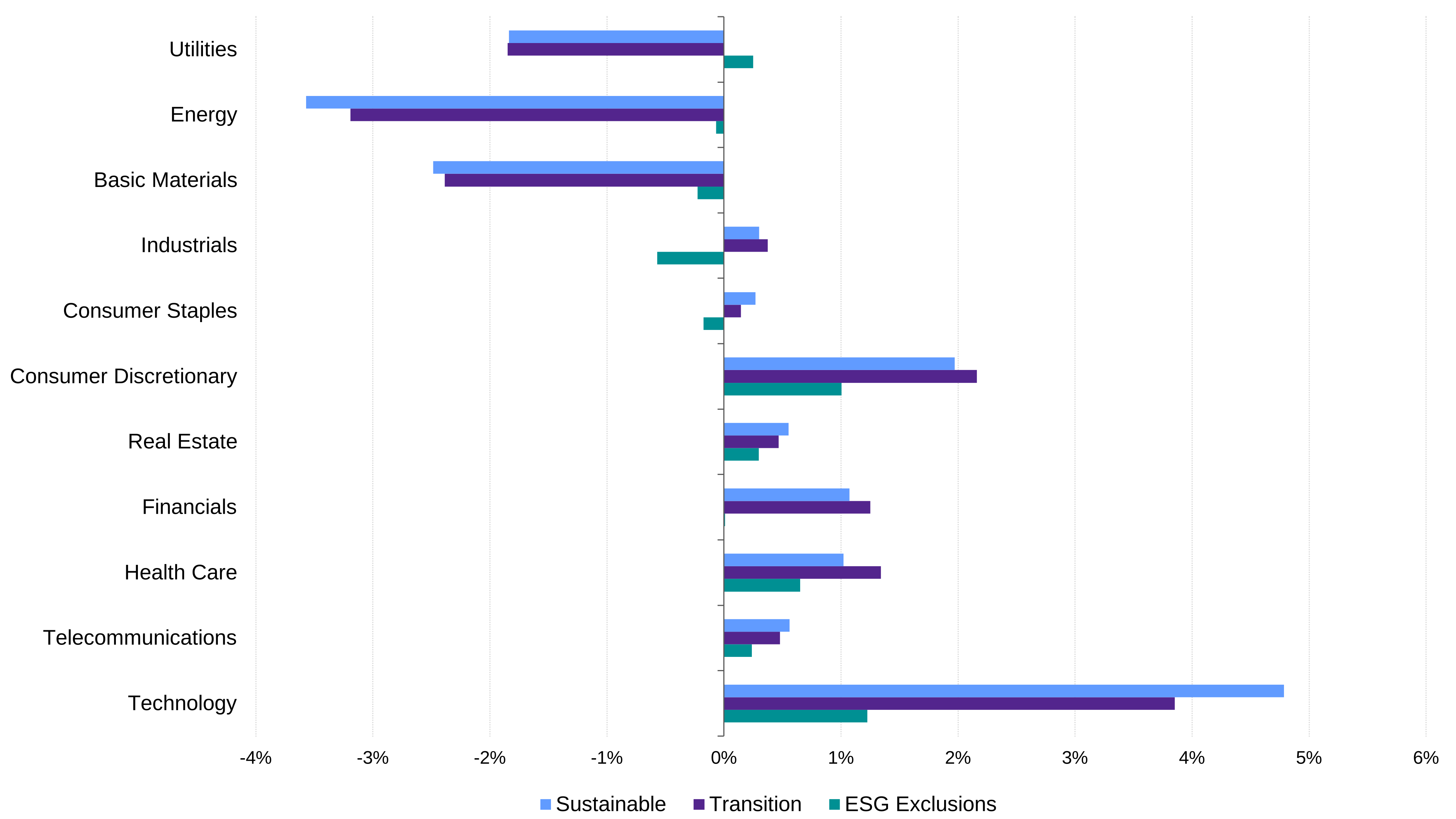
- Exclusions linked to thermal coal and “no new fossil fuel projects” have particularly significant impacts across the Energy, Basic Materials and Utilities exposures.
- The analysis also shows that the “no new fossil fuel projects” requirement may reduce the differentiation between the Transition and Sustainable categories, potentially limiting the practical role of transition-focused investment strategies.
Table – active industry weights in the FTSE All-World as at September 2025, after applying the proposed exclusion criteria for the ESG (Article 8), Transition (Article 7) and Sustainable (Article 9) categories:
Source information
These results highlight the importance of ensuring that transition criteria remain aligned with real-economy decarbonisation pathways. Global transition investing requires sufficient flexibility to reflect differing regional realities and decarbonisation trajectories.
In current proposals mean that some of the sectors most critical to the transition, including Energy, Utilities and Basic Materials, could become under-represented in transition strategies, limiting the ability of investors to finance the infrastructure and industrial transformation required for decarbonisation.
The role of sovereign bonds in sustainable and transition investing
The current proposals for Transition and Sustainable categories focus largely on EU Green Bond-aligned instruments or equivalent labelled issuance. However, this does not fully reflect how sovereign transition financing occurs in practice.
Government budgets, which are primarily financed through general-purpose sovereign issuance, remain the main channel for large-scale transition investment. By comparison, the green bond market, including the EU Green Bond segment, remains relatively small and less liquid.
This is even more the case in some emerging markets, where labelled sovereign issuance remains limited, despite significant transition financing needs.
Introducing a pathway for general purpose sovereign bonds, subject to appropriate safeguards, would allow them to qualify for the Transition and Sustainable categories, rather than being limited to ESG Basics. This would better align SFDR 2.0 with market realities while supporting credible transition objectives.
The importance of workable frameworks
Another important discussion emerging from SFDR reform concerns ESG data.
Transparency, governance and methodological robustness are essential to sustainable finance markets. Investors increasingly use ESG data to support investment decisions, portfolio construction, risk management and disclosure obligations.
At the same time, ESG data ecosystems remain highly dynamic and are continuously evolving. he distinction between raw data, estimates, models, analytics, scores and assessments is not always straightforward and methodologies continue to develop alongside corporate disclosure standards and regulatory expectations.
Extending SFDR to directly regulate ESG data providers could create duplication with existing frameworks, increase compliance costs and introduce legal uncertainty. In practice, these risks slow innovation and reduce the diversity of ESG data solutions available to investors.
Existing initiatives, including the EU ESG Ratings Regulation, are already addressing key transparency and governance challenges in this space. Building on these frameworks, rather than expanding the scope of SFDR, would support a more coherent and effective regulatory approach.
Aiming for interoperability
As policymakers consider the future role of ESG data within the sustainable finance framework, maintaining coherence and interoperability across existing regulations and standards will be critical. Rather than introducing additional layers of requirements, better alignment between disclosure, ratings and sustainable finance frameworks can improve the consistency and usability of ESG information across markets.
At the same time, interoperability ultimately depends on the quality of the underlying data. In practice, the availability and comparability of ESG information is shaped by corporate disclosures, making the continued implementation of frameworks such as the Corporate Sustainability Reporting Directive (CSRD) and the Corporate Sustainability Due Diligence Directive (CS3D) a key foundation for more reliable and seful data.
As such, building on existing frameworks and international initiatives offers a more practical and proportionate way to strengthen transparency. This approach can reduce duplication, limit complexity and support a more coherent and globally workable framework for investors.
Calibrating SFDR 2.0 for real-world transition financing
SFDR reform represents a significant opportunity for Europe’s sustainable finance agenda.
Clearer product categories could help improve transparency, enhance comparability and strengthen investor confidence in sustainability-labelled investment products.
But achieving those goals will require careful calibration to ensure we have an effective framework that supports credible sustainability outcomes, remains globally workable and continues to channel capital toward the sectors and companies driving the real-world transition. This means:
- Ensuring exclusion criteria are calibrated to preserve investable universes, enabling transition strategies to finance the sectors most critical to decarbonisation.
- Avoiding duplicative regulation of ESG data, building instead on existing frameworks to support transparency without limiting innovation.
- Aiming for interoperability across sustainable finance frameworks, to improve consistency, usability and comparability for investors and market participants.

footnotes
[1] FTSE Russell. (2019). Smart sustainability: 2019 global survey findings from asset owners. FTSE Russell. | Back to Note 1
[2] 8th Annual Sustainable Investment Asset Owner Survey 2025 (2025). LSEG- https://www.lseg.com/en/ftse-russell/sustainable-investing-solutions/global-asset-owner-survey| Back to Note 2
[3] United Nations Environment Programme Finance Initiative (UNEP FI). (2025). Transition finance: Emerging practices. https://www.unepfi.org/wordpress/wp-content/uploads/2025/07/29-Transition-finance-emerging-practices.pdf | Back to Note 3
[4]Approach to the analysis: FTSE Russell has looked at the impact of the proposed exclusions on the following universes: FTSE All-World (global universe), FTSE Developed Europe, and FTSE Emerging. The analysis looks at how many constituents/how much index weight would be removed by the proposed criteria, and industry exposures (how would the ICB industry exposures differ in the reweighted indices post exclusions). Please note that this analysis is based on a single point in time (as at September 2025 review) and FTSE Russell’s interpretation of the proposed requirements. A proxy indicator was used for the new fossil fuel projects exclusion as there is no direct datapoint to fulfil it. This data was applied to the following three ICB sectors only: basic materials, energy and utilities. The thermal coal exclusion removed companies with greater than or equal to 0% revenues in thermal coal extraction (includes mining and exploration) and tailor-made products and services that support thermal coal extraction (includes storage and transportation, mining, and coal refining services | Back to Note 4
Read more about

Legal Disclaimer
Republication or redistribution of LSEG content is prohibited without our prior written consent.
The content of this publication is for informational purposes only and has no legal effect, does not form part of any contract, does not, and does not seek to constitute advice of any nature and no reliance should be placed upon statements contained herein. Whilst reasonable efforts have been taken to ensure that the contents of this publication are accurate and reliable, LSEG does not guarantee that this document is free from errors or omissions; therefore, you may not rely upon the content of this document under any circumstances and you should seek your own independent legal, investment, tax and other advice. Neither We nor our affiliates shall be liable for any errors, inaccuracies or delays in the publication or any other content, or for any actions taken by you in reliance thereon.
Copyright © 2025 London Stock Exchange Group. All rights reserved.
The content of this publication is provided by London Stock Exchange Group plc, its applicable group undertakings and/or its affiliates or licensors (the “LSE Group” or “We”) exclusively.
Neither We nor our affiliates guarantee the accuracy of or endorse the views or opinions given by any third party content provider, advertiser, sponsor or other user. We may link to, reference, or promote websites, applications and/or services from third parties. You agree that We are not responsible for, and do not control such non-LSE Group websites, applications or services.
The content of this publication is for informational purposes only. All information and data contained in this publication is obtained by LSE Group from sources believed by it to be accurate and reliable. Because of the possibility of human and mechanical error as well as other factors, however, such information and data are provided "as is" without warranty of any kind. You understand and agree that this publication does not, and does not seek to, constitute advice of any nature. You may not rely upon the content of this document under any circumstances and should seek your own independent legal, tax or investment advice or opinion regarding the suitability, value or profitability of any particular security, portfolio or investment strategy. Neither We nor our affiliates shall be liable for any errors, inaccuracies or delays in the publication or any other content, or for any actions taken by you in reliance thereon. You expressly agree that your use of the publication and its content is at your sole risk.
To the fullest extent permitted by applicable law, LSE Group, expressly disclaims any representation or warranties, express or implied, including, without limitation, any representations or warranties of performance, merchantability, fitness for a particular purpose, accuracy, completeness, reliability and non-infringement. LSE Group, its subsidiaries, its affiliates and their respective shareholders, directors, officers employees, agents, advertisers, content providers and licensors (collectively referred to as the “LSE Group Parties”) disclaim all responsibility for any loss, liability or damage of any kind resulting from or related to access, use or the unavailability of the publication (or any part of it); and none of the LSE Group Parties will be liable (jointly or severally) to you for any direct, indirect, consequential, special, incidental, punitive or exemplary damages, howsoever arising, even if any member of the LSE Group Parties are advised in advance of the possibility of such damages or could have foreseen any such damages arising or resulting from the use of, or inability to use, the information contained in the publication. For the avoidance of doubt, the LSE Group Parties shall have no liability for any losses, claims, demands, actions, proceedings, damages, costs or expenses arising out of, or in any way connected with, the information contained in this document.
LSE Group is the owner of various intellectual property rights ("IPR”), including but not limited to, numerous trademarks that are used to identify, advertise, and promote LSE Group products, services and activities. Nothing contained herein should be construed as granting any licence or right to use any of the trademarks or any other LSE Group IPR for any purpose whatsoever without the written permission or applicable licence terms.